Let’s get one thing straight right out of the gate: I firmly believe that absolutely anyone can cook like a seasoned expert in a standard home kitchen without a pretentious culinary degree. You do not need to spend thousands of dollars on commercial equipment, and you certainly do not need to endure the anxiety of a restaurant line to put a mind-blowing meal on your dining table. But we do need to have a serious, closed-door conversation about the starchy, gelatinous paste you served as a side dish last night.
You might call it rice, but the rest of us recognize it as industrial-grade wallpaper adhesive.
If you have ever stared into the bottom of your expensive rice cooker and frantically wondered why your rice is gummy, clumped together, and completely devoid of that light, fluffy texture you get at your favorite local takeout spot, you are not alone. I learned to cook through grueling trial, error, and setting off my apartment’s smoke detector more times than I care to admit. I have ruined more pots of grains than I can count. But mastering the art of the kitchen is not about being perfect; it is about understanding the fundamental science of your ingredients and utilizing the right tools to make your life infinitely easier.
Today, we are going to completely dismantle the myths surrounding rice preparation. We are going to dive deep into the molecular biology of starch, explain why your current washing method is actually sabotaging your dinner, and introduce you to an inexpensive, brilliantly engineered tool that will change your weeknight cooking routine forever: the Japanese rice wash bowl.
The Molecular Sabotage: Why Your Rice Turns into Glue
To understand how to fix the problem, we have to put on our lab coats and look at the actual food science happening inside your cooking pot. Rice is not just a uniform little white pebble; it is a complex biological structure composed primarily of complex carbohydrates.
When rice is harvested, it is encased in an inedible hull. Once that hull is removed, you are left with brown rice, which still retains its nutrient-dense bran layer and germ. But to get the polished, silky white rice that most of us consume (like Jasmine, Basmati, or short-grain Japonica), the grain has to go through an aggressive mechanical milling process. Industrial milling machines literally scrub the bran and germ off the grain. This violent friction leaves behind a microscopic layer of fine, powdery starch dust coating every single kernel.
This dust is your absolute worst enemy in the kitchen.
Rice starch is made up of two primary polysaccharide molecules: amylose and amylopectin.
Amylose is a long, straight-chain molecule. When it cooks, it remains relatively distinct, which is why long-grain varieties like Basmati (which are naturally higher in amylose) tend to cook up fluffy and separate.
Amylopectin, on the other hand, is a highly branched, chaotic molecule. It acts like a microscopic grappling hook. When heated in water, amylopectin molecules expand, tangle together, and create a highly viscous, sticky matrix. The powdery dust left on the outside of milled white rice is overwhelmingly composed of easily dissolvable amylopectin.
Here is where the thermodynamics of your kitchen ruin your dinner. Gelatinization is the process by which starch granules absorb water and swell irreversibly when exposed to heat. For most rice varieties, this critical gelatinization temperature range hits right around 60°C to 70°C (140°F to 158°F).
If you do not properly wash that surface dust off your grains before you hit the heat, that loose amylopectin instantly dissolves into your cooking water. The moment the water temperature crosses that 60°C threshold, that starchy water undergoes rapid gelatinization. It literally transforms into a thick, cohesive gel that coats every single grain in the pot, locking them together. Instead of individual grains steaming beautifully in their own space, they fuse into a solid, impenetrable block of carbohydrates.
In fact, controlled laboratory trials using a TA.XTplus Texture Analyzer have proven this exact phenomenon. Unwashed long-grain white rice exhibits a cooked grain adhesion force (the scientific measurement of stickiness) of a staggering 12.4 Newtons. Properly rinsed rice? It measures just 3.8 Newtons. That is a massive 69% reduction in stickiness just by removing that surface starch.
You might think that the easiest way to stop making gummy rice is to just buy those pre-cooked microwave pouches and give up entirely, but I promise you, the solution is much simpler and drastically cheaper.
The Wire Strainer Massacre: Stop Grating Your Grains
At this point, you are probably rolling your eyes and saying, “I already wash my rice, and it still turns out like a brick!”
If your side dish always turns out mushy despite your best efforts at the sink, I can almost guarantee I know exactly what you are doing wrong. You are taking a cup of dry rice, dumping it into a standard stainless steel wire mesh strainer, running it under the faucet, and aggressively rubbing the grains against the metal mesh with your hands.
You need to stop doing this immediately. You are committing a culinary massacre.
Let’s look at the physical mechanics of a woven wire mesh strainer. The overlapping metal wires create thousands of tiny, sharp, raised intersections. It is essentially a flexible, microscopic cheese grater. Now consider the raw rice grain. Because of the intense mechanical stress it endured during the factory milling process, raw white rice is highly brittle and riddled with invisible micro-fissures.
When you press, swirl, and grind those brittle kernels against the sharp, unyielding metal matrix of a wire strainer, you are causing catastrophic structural damage to the grains. You are scratching them, micro-abrading them, and in many cases, snapping them completely in half.
Why is this a disaster? Because when you break a grain of rice, you compromise its structural integrity and expose the inner endosperm. You are no longer just dealing with surface dust; you are now actively bleeding the internal starches of the grain directly into your cooking water. The more grains you snap against your wire strainer, the more starch you release, and the more glue you create in your pot. You are actively engineering the exact problem you are trying to avoid.
Enter the Japanese Rice Washing Bowl: A Masterclass in Design
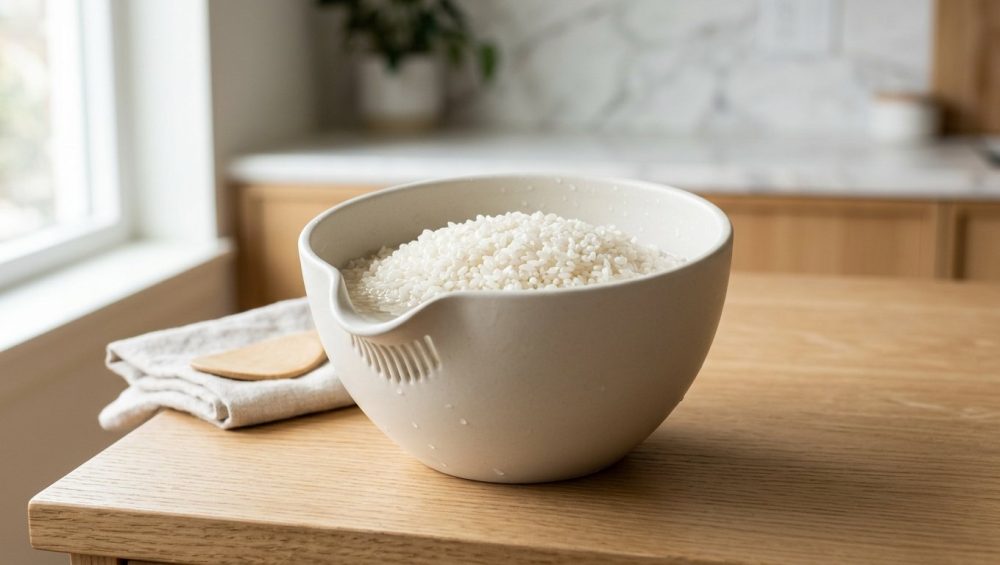
This is where we introduce the hero of our story. The Japanese rice washing bowl (often referred to simply as a wash bowl or speed bowl) is a masterclass in functional, hyper-specific kitchen engineering. It is a tool specifically designed to solve the exact fluid dynamic problems of washing grains.
At first glance, it looks like a simple plastic or steel bowl with a few slits cut into the side. But the true magic of rinsing your grains properly lies in the subtle brilliance of this design.
The Solid, Cushioned Bottom
Unlike a colander or a wire strainer that immediately drains water away from the bottom, a true Japanese wash bowl has a completely solid base. This is crucial. When you add water to the bowl, it pools at the bottom, creating a liquid cushion for the rice. When you agitate the grains, they are suspended in this water. Instead of grinding against a sharp metal grate, the grains gently rub against each other and against the smooth, slightly textured plastic or steel bottom of the bowl. This grain-on-grain friction is exactly what you want. It is firm enough to polish the stubborn starch dust off the exterior of the kernel, but gentle enough to ensure that the brittle grains remain completely intact.
The Precision Side Drainers
The most iconic feature of the wash bowl is the series of micro-perforated vertical slits or holes located along the upper side and spout of the bowl. When the water becomes cloudy with starch, you simply tilt the bowl forward. The starchy water easily flows out of the side drains, while the slits act as a perfect barrier, preventing a single grain of rice from escaping into your sink.
If you have ever tried to wash rice in a standard mixing bowl and ended up performing a high-stakes balancing act with your hand to hold the rice back while pouring off the water—inevitably losing a quarter cup of good rice down the drain—you will immediately understand why this side-drain design is a revelation.
The “No-Go” Rule: Banishing Toxic Kitchenware
As your sassy sous-chef, I have a strict, non-negotiable policy on banishing toxic kitchen gear from my house, and I expect you to do the same. I absolutely despise cheap, peeling non-stick coatings, mystery metals that warp the second they touch a hot stove, and dollar-store plastics that leach endocrine disruptors into your family’s food.
When you go to purchase your Japanese wash bowl, you must pay attention to the materials. Do not buy unbranded, ultra-cheap polycarbonate bowls from shady online third-party sellers.
Safe Plastic Options
If you are buying a plastic wash bowl (which is the traditional and most common style, famously manufactured by reputable Japanese brands like Inomata), ensure that it is made from food-grade, BPA-free Polypropylene (PP). Polypropylene is highly durable, resistant to cracking, and safe for food contact. It is lightweight, which makes the repeated tilting and draining process effortless on your wrists.
Stainless Steel Options
If you are actively trying to eliminate all plastics from your kitchen, you can absolutely find high-quality stainless steel rice washing bowls. Look for 18/8 or 18/10 food-grade stainless steel. The key with the metal versions is to ensure that the drainage holes on the side are punched into the solid steel sheet, rather than woven like a wire mesh. A punched steel bowl will still provide that smooth, solid bottom necessary for gentle washing without the cheese-grater effect of a wire strainer.
Remember, time is money, and buying a high-quality, safe tool once is always cheaper than replacing a toxic, broken piece of garbage three times a year.
The “Kome Togi” Technique: How to Wash Rice Like a Pro
Now that you have the proper equipment, you need the proper technique. In Japan, the process of washing rice is known as kome togi (sharpening or polishing the rice). It is treated with respect because knowing the actual chemistry behind your food is the key to surviving kitchen disasters without crying over the stove.
Here is the exact, step-by-step masterclass on how to execute the perfect wash.
Step 1: The Critical First Rinse
This is the step that almost everyone messes up. The absolute second that dry rice comes into contact with water, it begins to rapidly absorb it. If you pour water into your bowl and casually let it sit there while you go check your phone, the rice is going to absorb that first round of water. The problem? That first round of water is instantly saturated with all the dirty surface starch, dust, and impurities on the grain. If you let it sit, your rice is literally soaking up dirty starch water, locking that gluey texture deep inside the kernel.
The first rinse must be lightning fast. Pour cold water into your wash bowl, swish the rice aggressively with your hand for exactly three to five seconds, and immediately tilt the bowl to drain the milky water out of the side spout. Speed is your best friend here.
Step 2: The “Claw” Hand
Once the initial dirty water is drained, your rice will be wet but not submerged. This is when the actual polishing happens. Shape your fingers into a stiff claw—imagine you are holding a tennis ball or a grapefruit. Press your clawed hand into the damp rice and swirl it in a rapid, circular motion around the bottom of the bowl.
You are not crushing the rice into the plastic; you are simply forcing the wet grains to tumble over and rub against one another. Do this for about 10 to 15 seconds. You will hear a satisfying, rhythmic swishing sound. This grain-on-grain friction is safely scouring the remaining amylopectin dust off the kernels.
Step 3: Rinse and Repeat
Fill the bowl with cold water again. You will see the water turn opaque and cloudy as the loosened starch lifts away. Give it a quick stir, and tilt the bowl to drain it through the side slits.
Repeat this process—add water, swirl, drain—about three to four times.
Step 4: Knowing When to Stop
A massive rookie mistake is washing the rice until the water runs completely, perfectly crystal clear. Do not do this. If you wash the grain until the water looks like pure glass, you have gone too far. You are washing away water-soluble nutrients, essential amino acids, and the delicate, sweet flavor compounds that make rice taste like rice.
You want to stop washing when the water looks slightly hazy, like heavily diluted skim milk. That is the sweet spot. The excess glue-forming starch is gone, but the soul of the grain remains intact.
The Arsenic Elephant in the Room: A Health Imperative
We cannot have a definitive masterclass on washing rice without addressing a very serious public health reality: inorganic arsenic.
All rice naturally absorbs inorganic arsenic (iAs) from the soil and irrigation water it grows in. Because rice is traditionally grown in flooded paddies, the anaerobic conditions of the submerged soil make arsenic highly mobile and easily absorbed by the plant’s root system. The U.S. FDA’s Total Diet Study consistently finds measurable levels of inorganic arsenic in uncooked white and brown rice.
Here is why your wash bowl is a literal lifesaver: Research published in environmental science journals has demonstrated that 30% to 50% of this inorganic arsenic resides in the outer 5 to 10 micrometers of the milled grain. It is sitting right there in that surface dust layer.
By executing a proper three-rinse cycle in your wash bowl, you are not just improving the texture of your dinner; you are physically washing away heavy metals. Studies show that three 30-second rinses with cool tap water can reduce total inorganic arsenic by up to 48% in polished white rice. A fourth rinse yields diminishing returns, proving that the three-to-four rinse method is scientifically optimal.
You cannot achieve this level of thorough, uniform washing in a wire strainer because the water runs straight through before it has a chance to properly suspend and lift the heavy impurities away from the grain. The pooling action of the wash bowl is critical for public health, not just culinary aesthetics.
Weeknight Efficiency vs. Weekend Perfection
I am a busy professional, and I know you are too. When we discuss everyday cooking, my philosophy is simple: time is money. You need systems that work fast. But you also need the flexibility to slow down and chase absolute perfection on a lazy Sunday afternoon. Your wash bowl adapts to both.
The 6:00 PM Weekday Hack
It is Tuesday night. You are exhausted. You do not have time for a meditative, multi-step kome togi ceremony. You just need dinner on the table before you collapse.
The wash bowl makes this lightning fast. Dump your measured rice into the bowl. Blast it with cold water from the faucet while aggressively swishing it with your hand. The second the bowl fills, tilt it and dump the water through the side drain. Do this three times in rapid succession. Because you aren’t fighting to scrape wet grains out of a wire mesh, and you aren’t picking runaway grains out of the sink drain, the entire washing process takes exactly 45 seconds.
Drain it, dump it into your rice cooker, add your measured water, and hit start. It is effortless efficiency.
The Sunday Dinner Perfection Protocol
When the weekend hits and you are cooking to impress, you can elevate your rice to Michelin-star levels with one extra step: The Soak.
After you have properly washed and polished your rice in the bowl, transfer it to your cooking pot. Add your precisely measured cooking water. And then… do absolutely nothing. Walk away. Let the washed rice sit in its cold cooking water for 30 to 45 minutes before you turn on the heat.
Why? Because dry rice hydrates from the outside in. If you immediately blast it with boiling heat, the exterior of the grain cooks and gelatinizes before the water has a chance to penetrate the hard, dry core. This can lead to rice that is mushy on the outside but chalky and hard in the center. By allowing the grain to soak and fully hydrate at room temperature, you ensure that the entire kernel cooks at the exact same rate. The result is a pot of rice where every single grain stands up perfectly straight, distinct, glossy, and impossibly fluffy.
Beyond the Grain: Unexpected Uses for Your Wash Bowl
One of my core kitchen rules is avoiding “unitaskers”—tools that only do one highly specific job and take up valuable cabinet space. While it is called a rice washing bowl, this incredibly designed vessel is a multi-tasking powerhouse.
Conquering Quinoa
Quinoa is a fantastic, protein-packed seed, but it grows with a natural exterior coating of saponins. Saponins are chemical defense compounds that taste incredibly bitter and soapy. If you do not wash quinoa, your dinner will taste like dish detergent.
Because quinoa seeds are so tiny, washing them in a standard colander is a nightmare; they slip right through the holes and vanish down the drain. This simple bowl is also the answer to why your quinoa gets mushy and bitter. The micro-slits on the side of the wash bowl are small enough to hold back the tiny seeds while allowing the soapy saponin water to easily drain away. You can aggressively agitate the quinoa in the pooled water, guaranteeing a sweet, earthy flavor without losing half your expensive groceries to the sink gods.
Legumes and Lentils
When you buy dried beans or lentils, they are notorious for hiding small stones, dirt clods, and agricultural dust. Dumping them into the wash bowl allows you to pool the water and easily spot and pick out the heavy debris that sinks to the bottom, while the dust floats away. Please, do not try to fish your legumes out of a pot with a stainless steel spider skimmer when you can just wash them properly and efficiently in a designated bowl first.
Delicate Berries
Have you ever blasted a pint of ripe raspberries under a high-pressure faucet, only to watch them instantly disintegrate into a sad, pulpy mess? The wash bowl solves this. Fill the bowl with cold water first, then gently drop your delicate berries (raspberries, blackberries, strawberries) into the pool. The water cushions them. You can gently swish them around to remove dirt and mold spores without bruising the fragile fruit, then easily drain the water away.
Just like you should stop eating bland tofu by utilizing the freezer trick to save time and boost flavor, you need a streamlined, multi-purpose system for all of your grains and produce prep.
The Final Verdict on Fluffy Rice
Cooking incredible food at home does not require magic, and it certainly does not require enduring the sticky, gluey disasters of the past. It simply requires respecting the chemistry of your ingredients and refusing to settle for inferior, improperly designed tools.
The surface starch on milled rice is a structural reality. If you ignore it, it will punish you by turning your beautiful dinner into a solid block of carbohydrate paste. If you attack it with a harsh wire strainer, you will break the grains, release internal starches, and make the problem exponentially worse.
By investing a few dollars in a high-quality, BPA-free or stainless steel Japanese wash bowl, you are leveraging decades of brilliant, functional engineering. You are creating a safe, cushioned environment to gently polish away the amylopectin dust, drastically reducing the adhesion force of the cooked grains, and washing away harmful environmental heavy metals—all while saving yourself the headache of scrubbing glued-on rice off the bottom of your cookware.
Stop settling for mediocre, mushy side dishes. Stop grating your expensive grains against sharp metal mesh. Buy the bowl, master the claw technique, and reclaim your right to perfectly distinct, impossibly fluffy rice every single time you step up to the stove. You’ve got this.