If you enjoy aggressively scraping a glass measuring cup with a miniature silicone spatula while your stand mixer impatiently whirs in the background, then you can go ahead and close this tab. If you find some sort of masochistic joy in watching expensive, artisanal honey stubbornly cling to the sides of a plastic scoop while your baking ratios are thrown entirely out of whack, I cannot help you. But if you are a sane, busy home cook who wants professional-level results without the unnecessary mess, pull up a stool and pour yourself a glass of wine. We need to talk about the absolute nightmare that is measuring sticky, viscous ingredients, and the brilliant, mechanics-driven tool that will change your weekday cooking and weekend baking forever.
I am talking, of course, about the plunger measuring cup. Sometimes called an adjustable measuring cup, this unassuming cylindrical gadget is the unsung hero of the modern kitchen. I learned to cook through trial, error, and setting off the smoke detector more times than I care to admit. Over the years, I have ruthlessly optimized my kitchen setup. I have absolutely zero patience for pretentious chef-speak, and I have even less patience for tools that do not pull their weight. Standard measuring cups are perfectly fine for water, milk, and granulated sugar. But the second you introduce peanut butter, molasses, or corn syrup into the equation, traditional measuring cups become an absolute liability. One of the most common rookie kitchen mistakes I see weekend hobbyists make is trusting a standard cup to accurately dispense a sticky liquid. It simply does not work, and the physics of fluid dynamics prove it.
The Sticky Situation: Why Traditional Kitchen Tools Are Sabotaging Your Bakes
The Viscosity Problem: When Physics Hates Your Measuring Cup
Let’s get a quick science lesson out of the way, without the boring textbook jargon. The reason you are constantly fighting with your ingredients comes down to two concepts: viscosity and adhesion. Viscosity is essentially a fluid’s resistance to flow. Water has low viscosity; it pours effortlessly. Honey, molasses, and tahini have high viscosity; they take their sweet time. But the real enemy here is adhesion. Adhesion is the tendency of dissimilar particles or surfaces to cling to one another.
When you pour a supersaturated sugar solution—like honey or maple syrup—into a standard borosilicate glass or rigid plastic measuring cup, the hydrogen bonds in the sugars aggressively adhere to the microscopic imperfections on the surface of the cup. When you turn that cup upside down over your mixing bowl, gravity is simply not strong enough to break those adhesive bonds. The cohesive forces (the honey sticking to itself) lose the battle against the adhesive forces (the honey sticking to the glass). Furthermore, a vacuum is created at the base of the cup as the thick liquid attempts to slide out, pulling the ingredient back in. You are left with a thick, stubborn film of ingredient coating the entire interior of the cup.
What follows is the familiar, infuriating dance of the home baker: grabbing a spatula, desperately scraping the sides, and inevitably leaving a significant portion of the ingredient behind. Not only is this incredibly frustrating, but it also creates a massive mess on your countertops and your hands. You end up with sticky fingerprints on your recipe book, your cabinets, and somehow, your forehead. You are fighting against the fundamental laws of physics with a rubber spatula, and it is a battle you will lose every single time.
The Chemistry Crisis: How Leftover Residue Ruins Your Ratios
Cooking a weekday stir-fry is a highly subjective art form where you can play fast and loose with measurements. A splash of soy sauce here, a glug of sesame oil there—it all works out in the pan. Baking, however, is unforgiving, quantitative chemistry. Every single ingredient in a baking recipe serves a highly specific structural or chemical purpose. Flour provides the gluten network. Leavening agents provide the carbon dioxide for lift. And your sticky liquids—like honey, corn syrup, and melted fats—provide crucial moisture, sugar content, and tenderness.
When a recipe calls for exactly one-half cup of honey, the recipe developer has calculated the exact ratio of hydration and sugar required to interact with the dry ingredients. If 15% of that honey remains glued to the inside of your measuring cup, you have just fundamentally altered the chemical makeup of your dough or batter. You have reduced the humectant properties (which keep the bake moist) and lowered the sugar content (which affects the Maillard reaction and browning). Just as scooping flour instead of weighing it ruins your baked goods, eyeballing your wet ingredients by leaving a thick layer of residue in the cup will lead to disastrous, inconsistent results.
If you have ever wondered why your cakes are dense, dry, or crumbly despite following the recipe instructions to the absolute letter, it might just be because your standard measuring cups are holding your sticky ingredients hostage. You cannot achieve professional-level culinary results if you are essentially guessing how much of your liquid actually made it into the mixing bowl. Baking requires absolute precision, and a tool that actively fights against that precision has no place in your kitchen.
Enter the Plunger Measuring Cup: A Masterclass in Mechanical Extrusion
How the Plunger Mechanism Actually Works
The solution to this sticky nightmare is not a better spatula, nor is it spraying your cups with toxic aerosol cooking spray beforehand. It is a fundamentally better tool. The plunger measuring cup (famously championed by culinary science advocates like Alton Brown on classic cooking shows) bypasses the physics of adhesion entirely through mechanical extrusion.
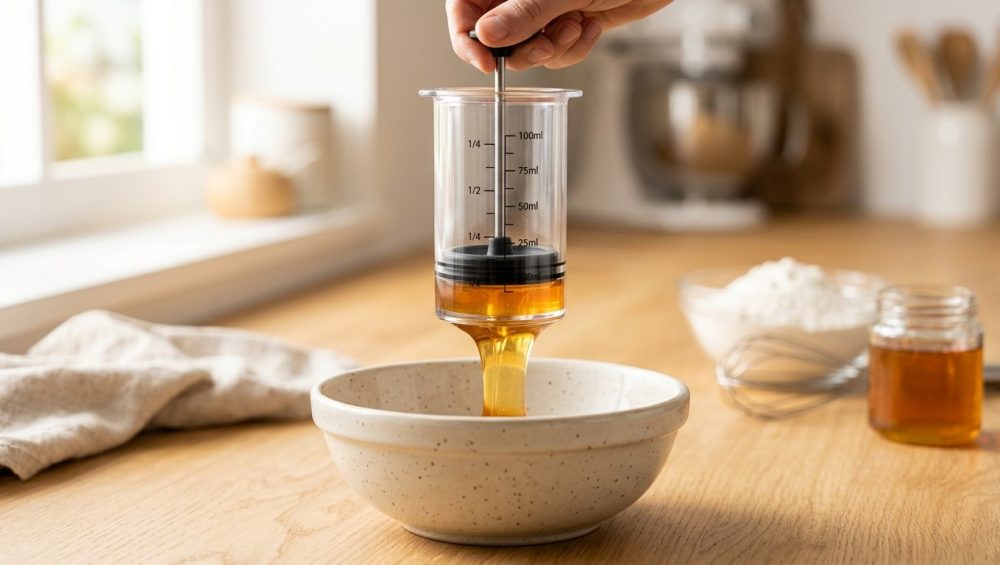
Here is exactly how this brilliant gadget operates: It consists of a clear, cylindrical outer sleeve and a tightly fitted inner plunger tube. The top edge of the inner plunger is outfitted with a flexible, food-grade silicone ring that creates an airtight, vacuum seal against the walls of the outer sleeve. To use it, you twist or pull the inner plunger down along an internal track until the top of the plunger aligns with your desired volumetric marking—say, one-third of a cup or four ounces.
You then fill the resulting empty cavity with your sticky ingredient, leveling it off perfectly flush at the top. Because the cavity is a perfect cylinder, you can easily see if there are any air pockets trapped in your peanut butter or shortening. When it is time to dispense, you hold the outer sleeve over your bowl and push the plunger upward. The silicone ring acts as a 360-degree squeegee, mechanically scraping the walls of the cylinder completely clean as it forces the ingredient out. There is no vacuum holding the liquid back, and the mechanical force easily overcomes the adhesive bonds. The ingredient is extruded in a perfect, satisfyingly solid puck. Zero scraping. Zero mess. Zero guesswork.
The True Cost of Wasted Ingredients (And Why This Tool Pays for Itself)
Let’s talk economics, because time is money, and actual money is also money. Food waste is a massive global issue with staggering economic repercussions. Recent environmental statistics reveal that over 1.05 billion tons of food were wasted globally in 2022, a crisis that accounts for 8 to 10 percent of annual global greenhouse gas emissions and costs the global economy roughly $1 trillion annually. On a micro level, the average American household throws away approximately $1,300 a year on wasted food. While a tablespoon of honey left in a measuring cup might seem like a drop in the bucket, the cumulative financial drain is very real.
High-quality baking ingredients are not cheap. Authentic, locally sourced raw honey, pure grade-A maple syrup, artisanal roasted tahini, and premium organic nut butters command a premium price at the grocery store. If you are losing 10% to 15% of these ingredients to the bottom of your measuring cups every single time you bake, you are literally washing your hard-earned cash down the kitchen sink. When you finally stop wasting sticky ingredients, you will realize that a high-quality plunger measuring cup pays for itself within the first few months of use. It is not a novelty gadget; it is a serious investment in efficiency and financial sanity.
The “No-Go” Rule: Avoiding Toxic and Flimsy Plunger Cups
Material Safety: Ditching Cheap Plastics for BPA-Free and Food-Grade Silicone
If you know anything about my cooking philosophy, you know my strict “No-Go” rule regarding cheap, toxic kitchenware. I am completely uncompromising when it comes to banishing toxic kitchen gear from my countertops. The market is absolutely flooded with knockoff, dollar-store kitchen gadgets made from mystery metals, peeling non-stick coatings, and deeply questionable plastics. You must actively avoid these when shopping for a plunger measuring cup.
Because the ingredient sits directly inside the plastic cylinder and is subjected to the intense friction of the squeegee ring, material safety is paramount. You absolutely cannot use a cup made from cheap polycarbonate that leaches Bisphenol A (BPA) or other endocrine-disrupting chemicals into your food, especially if you are measuring warm liquids like melted coconut oil or hot syrup. Look exclusively for cups made from high-grade, BPA-free plastics like SAN (styrene acrylonitrile) or Tritan. Furthermore, the squeegee gasket must be made from 100% food-grade silicone, not synthetic rubber that will dry rot, crack, and shed microscopic plastic particles into your carefully crafted sourdough bread.
Durability vs. Cheap Knockoffs: What to Look For
A well-made plunger cup will feel distinctly sturdy in your hands. The twisting or pushing mechanism should offer smooth, consistent resistance. If the inner track feels gritty, skips, or requires excessive force to move, leave it on the shelf. The outer plastic sleeve must be thick enough to withstand accidental drops on a tile floor without shattering into a million pieces.
Brands like OXO Good Grips and KitchenArt have set the gold standard for this specific tool over the last decade. They utilize durable, shatter-resistant plastics and high-quality silicone rings that maintain their vacuum seal over years of heavy use. Cheap knockoffs often fail at the seal; the second that silicone ring warps or loses its tension, liquid ingredients will seep down the sides of the inner tube, completely defeating the purpose of the tool and creating a horrifying, impossible-to-clean mess inside the mechanism itself. Spend the extra five to ten dollars for a reputable brand. Your sanity is worth the premium.
Beyond Honey: The Stubborn Ingredients That Demand a Plunger Cup
Peanut Butter, Almond Butter, and Tahini
Nut and seed butters are notoriously difficult to measure accurately. Whether you are baking classic peanut butter cookies, whipping up a spicy Thai peanut sauce for a quick weeknight dinner, or measuring tahini for homemade hummus, standard cups fail miserably. Nut butters trap massive air pockets when scooped into a traditional cup, meaning your “one cup” might actually be three-quarters of a cup once the air is displaced. The plunger cup allows you to aggressively pack the nut butter down into the cylinder. Because the outer sleeve is perfectly clear, you can visually inspect the sides to ensure there are absolutely no air voids before you extrude it, guaranteeing a flawless measurement.
Molasses, Corn Syrup, and Malt Extracts
If you are tackling elaborate weekend baking projects like chewy gingerbread cookies, traditional pecan pie, or homemade bagels (which require malt syrup in the boiling water for that authentic, shiny crust), you will be dealing with the stickiest substances known to humanity. Molasses and corn syrup laugh in the face of silicone spatulas. The plunger cup handles them with effortless grace. Because you can set the exact measurement beforehand, you simply pour the dark, viscous syrup directly into the top until it is flush with the rim. One swift push of the plunger, and the syrup is deposited cleanly into your stand mixer bowl. No sticky trails across your countertops, and no frantic scraping.
Mayonnaise, Sour Cream, and Solid Fats
This tool is not just for sweets and baking. If you constantly battle with why your salad dressing separates, precise emulsifier measurement is often the hidden culprit. Mayonnaise and sour cream are thick, gloopy, and incredibly annoying to measure for homemade ranch dressings, spinach dips, and ultra-moist chocolate cakes. The plunger cup makes quick, hygienic work of them.
Additionally, this tool is an absolute lifesaver for measuring solid fats like vegetable shortening, lard, or bulk blocks of butter. While standard sticks of butter usually have convenient tablespoon markings printed on the wrapper, massive tubs of shortening do not. Trying to pack shortening into a standard measuring cup and then dig it out is a greasy, miserable chore that leaves a film on everything you touch. The plunger cup allows you to pack the shortening tightly and extrude it in a perfect, ready-to-cream cylinder, keeping your hands entirely grease-free.
Step-by-Step: How to Use and Maintain Your Plunger Measuring Cup
The Perfect Extrusion Technique
Using this tool correctly requires a slight adjustment to your prep routine, but once you master the mechanics, you will never go back to standard cups. Here is the foolproof technique for absolute precision:
First, always set your measurement before you add the ingredient. Twist or pull the inner plunger down so the top of the silicone ring aligns perfectly with the desired marking on the outer sleeve.
Second, if you are measuring a thick paste like peanut butter or shortening, use a spoon to add the ingredient in small increments, pressing down firmly after each addition to eliminate air pockets. If you are measuring a liquid like honey, simply pour it in until it is perfectly level with the top rim of the outer sleeve. Do not overfill it to the point of crowning, as this will throw off your ratio.
Third, position the cup directly over your mixing bowl. Place your thumb on the bottom of the plunger and push steadily upward. Do not rush it. Allow the silicone ring to do its mechanical job, squeegeeing the sides clean as the ingredient is forced out.
Finally, use a butter knife or a straight-edged spatula to cleanly slice the extruded puck off the top of the plunger. You will be left with an empty cup and a perfectly measured ingredient.
Cleaning and Maintenance for Long-Lasting Gear
Even the highest quality kitchen gear requires proper maintenance to survive. While many manufacturers slap a “dishwasher safe” label on their plunger cups for marketing purposes, I strongly advise against utilizing it. The intense, prolonged heat of a dishwasher’s drying cycle, combined with highly abrasive enzymatic detergents, can degrade the silicone seal over time and cause the clear plastic sleeve to become cloudy, brittle, or cracked.
Understanding why your plastic containers stay greasy will help you properly clean this tool. Fats and oils bind stubbornly to plastic surfaces at a molecular level. To clean your plunger cup, immediately disassemble it by pulling the inner tube completely out of the outer sleeve. Wash both pieces by hand in the sink using very hot water and a high-quality, grease-cutting dish soap. Use a soft sponge to wipe down the silicone ring and the inside of the cylinder. Never use abrasive scouring pads or steel wool, as scratching the inside of the plastic sleeve will compromise the airtight seal and cause future ingredients to leak. Dry the components thoroughly before reassembling them to prevent mold or mildew from forming in the track.
Time is Money: Weekday Efficiency for the Home Cook
Cutting Down Prep Time and Frustration
As much as I love spending a leisurely Sunday afternoon perfecting a complex laminated pastry or a slow-simmered ragu, my weekday reality is entirely different. When it is 6:30 PM on a Tuesday and I am trying to get a nutritious dinner on the table for my family, time is money. Efficiency is everything. The first step in breaking your takeout habit is eliminating the friction and frustration that make cooking feel like an exhausting chore.
Fumbling with multiple sticky measuring cups, frantically searching for a spatula small enough to scrape them out, and dealing with a messy countertop are exactly the kinds of friction that drive people to give up and open a delivery app. The plunger cup streamlines your prep work (the crucial mise en place) by turning a messy, five-minute chore into a clean, ten-second action. You measure, you plunge, you move on. It keeps your momentum going and your stress levels low.
Less Dishwashing, More Eating
One of the most underrated benefits of the plunger measuring cup is its incredible versatility. Because it effectively scrapes itself completely clean with every single plunge, you can easily reuse the same cup for multiple ingredients in the same recipe without washing it in between. If you are making a complex Asian-inspired marinade, you can measure your peanut butter, extrude it, wipe the top lip with a damp cloth, and immediately use the same cup to measure your honey, and then your mayonnaise.
You are effectively replacing an entire drawer full of clunky, nesting measuring cups with one highly engineered tool. Less clutter in your cabinets means less time digging for the right size cup, and less time standing over the sink doing dishes after dinner. That buys you more precious time to actually sit down, enjoy the meal you just cooked, and relax.
The Final Verdict: Upgrading Your Culinary Arsenal
The difference between an amateur cook and a confident home chef rarely comes down to innate talent or expensive culinary degrees. It usually comes down to understanding the science of your ingredients and utilizing the right tools to manipulate them. The plunger measuring cup is not a late-night infomercial gimmick; it is a highly practical, mechanics-driven solution to a universal culinary problem.
It guarantees hyper-accurate ratios, ensuring your baking chemistry is flawless every single time. It is the missing link that explains why your cookies spread unevenly when your fat ratios are off, or why your breads turn out dense and dry when your humectants are left behind in the cup. It eliminates the economic waste of throwing away expensive artisanal ingredients, and it dramatically reduces the frustration and cleanup of daily cooking.
Mastering the art of the home kitchen doesn’t require a culinary degree or a massive budget. It requires a willingness to banish inefficient, toxic, and frustrating gear from your life, and replace it with smart, durable tools that actually work. Stop fighting with your honey, ditch the tiny spatulas, and let mechanical extrusion do the heavy lifting. Your cakes, your sanity, and your dishwasher will thank you.