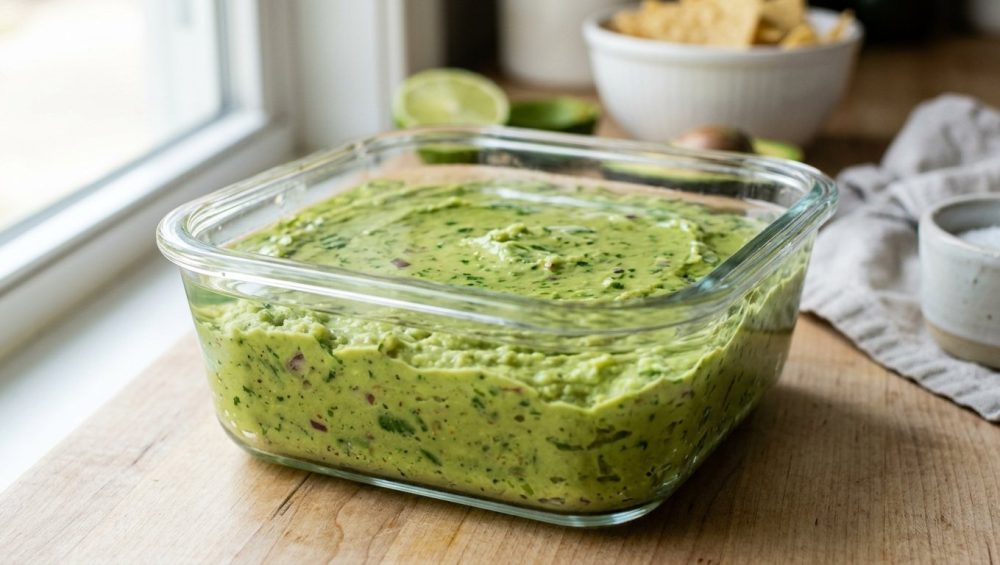
Let’s have a brutally honest conversation about the most heartbreaking tragedy in the modern home kitchen. You have just spent your precious weekend meticulously crafting the perfect batch of guacamole. You selected the avocados with the precision of a diamond appraiser, mashed them to that flawless textural balance of creamy and chunky, and seasoned the bowl like a true culinary artist. You serve it, your friends devour half of it, and you proudly store the leftovers in the fridge. But the next day, when you reach for that container to elevate your sad Tuesday taco night, you are greeted by a grotesque, swampy layer of brown sludge.
It is enough to make you want to throw your spatula across the room.
We are currently living in an era of unprecedented avocado obsession. In the United States alone, avocado consumption is projected to smash the three-billion-pound record between 2025 and 2026. That is a staggering mountain of green gold. Yet, despite this massive cultural reliance on the mighty Hass avocado, millions of home cooks are still throwing away perfectly good, albeit terrifyingly brown, leftovers. We are literally throwing our grocery budgets into the compost bin because of a simple chemical reaction that is entirely preventable.
I am here to tell you that you do not need a culinary degree to solve this problem. You just need a basic understanding of food science and a willingness to unlearn decades of terrible internet advice. As your resident sassy sous-chef, I have zero patience for pretentious chef-speak, and even less patience for kitchen hacks that simply do not work. If you actually want to stop guacamole from turning brown, you have to stop listening to old wives’ tales and start looking at the physics of your food. Today, we are going to dive deep into the absolute masterclass of avocado preservation: the water barrier method.
The Science of the Sad, Brown Avocado: Enzymatic Browning Explained
Let’s get one thing straight: cooking is just edible chemistry. When you understand the fundamental science behind your ingredients, you can easily avoid the common rookie kitchen mistakes that leave your meals looking like a science experiment gone wrong. The brown layer on your guacamole isn’t mold, and it doesn’t mean your dip has gone rancid. It is the result of a highly specific, entirely natural chemical reaction known as enzymatic browning.
Meet the Culprit: Polyphenol Oxidase (PPO)
Avocados, much like apples, pears, and potatoes, are packed with an enzyme called polyphenol oxidase, affectionately known in the food science world as PPO. In a healthy, intact avocado, PPO lives happily and harmlessly inside the cytoplasm of the plant’s cells, completely separated from the phenolic compounds that are stored inside the cell’s vacuoles. Think of them as two dramatic reality show contestants kept in separate rooms. As long as they do not interact, there is peace.
But the moment you slice into that avocado, you rupture those cell walls. You unleash chaos. The PPO and the phenolic compounds are suddenly thrown together into the same space. However, they need a third participant to actually cause the browning reaction: oxygen.
The Oxygen Catalyst: Why Air is the Enemy
When PPO, phenolic compounds, and atmospheric oxygen meet, a rapid biochemical cascade begins. The PPO catalyzes the oxidation of the phenolic compounds, transforming them into entirely new molecules called quinones. These quinones then link together in long, complex chains—a process called polymerization—resulting in a dark brown pigment known as melanin. Yes, this is the exact same family of pigments responsible for human skin color.
Because avocados contain an exceptionally high concentration of polyphenol oxidase compared to other fruits, this enzymatic browning happens aggressively fast. At room temperature, the reaction kicks off within ten to fifteen minutes. This means your beautiful, vibrant green dip is already starting to chemically degrade before you even have a chance to serve it.
The Cellular Breakdown: What Happens When You Mash
When you simply slice an avocado for a salad, you are only damaging the cells directly along the knife’s path. The browning is relatively contained. But when you make guacamole, you are aggressively mashing, crushing, and obliterating the cellular structure of the entire fruit. You are maximizing the release of PPO and exposing a massive amount of surface area to the air. You are essentially throwing a giant, oxygen-fueled rave for the enzymes.
This is where weekend perfectionism meets weekday reality. You want to prep a large batch of dip on Sunday to save time during your chaotic workweek, but the enzymatic browning clock is ticking loudly. To beat it, we have to completely block the oxygen.
The Great Guacamole Lie: Why Traditional Hacks Fail
If you search the internet for ways to keep your guacamole green, you will be bombarded with a tidal wave of absolute nonsense. It infuriates me how much bad advice is peddled to everyday home cooks by people who clearly do not understand basic food chemistry. Let’s systematically destroy these myths so you can stop ruining your leftovers.
The Lime Juice Fallacy
The most pervasive myth is that you must drown your guacamole in lime or lemon juice to keep it green. The logic seems sound on the surface: PPO activity is slowed down in highly acidic environments (typically below a pH of 5.0). By adding citrus, you are lowering the surface pH of the dip, which theoretically creates a hostile environment for the enzyme.
But here is the brutal reality: acid only slows the browning; it does not stop it. In rigorous laboratory testing, guacamole treated with a heavy dose of lime juice still exhibited significant surface browning after twelve hours in the fridge because the oxygen was still making contact with the food. More importantly, from a culinary perspective, this is a disaster. Acid should be used to balance and elevate the rich, fatty flavor of the avocado, not to embalm it. If you add enough lime juice to actually halt enzymatic browning, you are no longer eating guacamole; you are eating an aggressive, sour avocado soup. We want to taste the delicate alliums, the fresh cilantro, and the creamy avocado, not pucker our lips in agony.
The Avocado Pit Myth
Then there is the adorable, utterly useless trick of burying the avocado pit in the center of the guacamole bowl. I do not know who started this old wives’ tale, but they clearly failed high school geometry.
The pit does absolutely nothing to chemically inhibit PPO. It possesses no magical aura that repels oxygen. The only thing the pit does is act as a physical barrier for the exact millimeter of guacamole it is physically touching. When you lift the pit away the next day, you will find a perfectly green little circle surrounded by a massive sea of brown sludge. Unless you plan on paving the entire surface of your dip with a cobblestone layer of avocado pits, this hack is a colossal waste of your time.
Plastic Wrap and Toxic Storage
Finally, we have the plastic wrap method. The instruction is to press a sheet of cling film directly against the surface of the guacamole to block the air. While this is scientifically more sound than the pit trick, it fails miserably in execution. It is nearly impossible to press plastic wrap into every single microscopic crevice of the mashed avocado. Air pockets will inevitably form, and wherever there is a bubble of trapped oxygen, there will be browning. Furthermore, as the dip chills in the fridge, the plastic often lifts and curls at the edges, allowing air to seep in.
But beyond its inefficiency, this brings me to my absolute strictest rule in the kitchen: the banishment of toxic, cheap materials. I am fiercely passionate about banishing toxic kitchen gear from my home, and I despise cheap plastic wrap just as much as I despise peeling Teflon pans. Pressing flimsy, single-use plastics directly into the acidic, fatty surface of your food is not something I will ever recommend. You deserve better, your family deserves better, and your food deserves better.
The Magic of the Water Barrier: Your New Secret Weapon
So, if acid ruins the flavor, the pit is a geometric failure, and plastic wrap is a toxic, leaky mess, how do we save our guacamole? The answer is sitting right in your kitchen faucet. We are going to use a water barrier.
How and Why Water Works
Water is a physical barrier that is practically impermeable to atmospheric oxygen under normal refrigerator conditions. By pouring a continuous layer of water over the surface of your guacamole, you are completely sealing it off from the air. Without oxygen, the polyphenol oxidase cannot convert the phenolic compounds into melanin. The enzymatic browning reaction is entirely starved of its necessary catalyst.
This isn’t just an anecdotal kitchen trick; it is backed by rigorous food physics. When the surface is fully submerged under a thin, unbroken layer of cool water, the oxidation process halts immediately. You can leave it in the fridge for two to three days, and when you pour that water off, the guacamole underneath will be as vibrantly green as the moment you mashed it. This is exactly the kind of stress-free prep you need so you can actually host a relaxed dinner party without panicking over your appetizers turning brown before the guests arrive.
The Hydrophobic Miracle: Why Water Doesn’t Make It Soggy
I know exactly what you are thinking. You are staring at your screen, horrified, screaming, “But won’t pouring water on my guacamole turn it into a soggy, diluted mess?!”
No. It absolutely will not. And this is where the magic of lipid chemistry comes into play.
Avocados are incredibly dense in monounsaturated fats. Fats are naturally hydrophobic, meaning they actively repel water at a molecular level. Just like oil and vinegar naturally separate in a vinaigrette dressing, the high fat content of the avocado creates a natural resistance to the water layer. The guacamole is also significantly denser than the water, meaning the water will simply sit gently on top of the surface rather than seeping down into the dip.
When you are ready to eat, you simply pour the water down the drain. The surface of the guacamole might have a tiny microscopic film of moisture left, but a quick stir incorporates it flawlessly without altering the texture or the flavor profile one bit. It is the ultimate time-saving, flavor-preserving hack for the busy weekday cook who refuses to compromise on quality.
The Masterclass: Ingredient Prep and Knife Skills
Before we can even talk about storing the guacamole, we need to ensure you are actually making it correctly. A perfect water barrier cannot save a dip that was poorly prepped to begin with. Your weekend culinary projects require precision, and that starts with your knife work.
Mastering the Alliums
Great guacamole requires the sharp bite of white or red onions to cut through the rich fat of the avocado. However, the way you prep your onions will drastically alter the final flavor of the dish. The same cellular damage that makes you cry while chopping onions also releases harsh sulfur compounds that can overpower your dip.
If you are hacking away at your onions, you are crushing the cells rather than slicing them cleanly. I cannot overstate this: working with dull kitchen knives is the fastest way to ruin your prep and your palate. Use a razor-sharp chef’s knife to finely and cleanly dice your onions. If they still smell overly pungent, rinse the diced onions under cold water for thirty seconds before adding them to your avocado mash. This washes away the volatile sulfur compounds, leaving you with a sweet, crisp onion flavor that won’t ruin your breath for the next forty-eight hours.
Handling Delicate Herbs
Cilantro is the soul of authentic guacamole, but it is incredibly fragile. If you buy a bunch of cilantro on Sunday and just toss it into the bottom of your fridge, you are making a massive mistake. There is nothing sadder than watching your fresh herbs turn to slime in the crisper drawer before you even have a chance to chop them.
Treat your cilantro like a bouquet of fresh flowers. Snip the ends of the stems and place them upright in a small glass jar filled with an inch of water. Loosely drape a plastic bag over the top and store it in the fridge. When it is time to make your guacamole, use your newly sharpened knife to execute clean, deliberate cuts. Do not run your knife back and forth over the herbs repeatedly; this bruises the delicate leaves and turns them black. One clean pass is all you need.
The Step-by-Step Masterclass: Executing the Water Shield Perfectly
Understanding the science is only half the battle. Executing it with precision is what separates the frustrated novice from the confident home cook. Here is exactly how to execute the water barrier method to keep your guacamole flawless for days.
Step 1: The Perfect Mash and Level
To create a successful water seal, you must eliminate any hidden air pockets within the dip itself. Transfer your freshly made guacamole into your storage container. Using the back of a spoon, aggressively pack the guacamole down into the corners of the dish. You want to compress it slightly to force out any trapped air bubbles that might be lurking beneath the surface.
Once it is packed tightly, use the spoon to smooth and level the surface as much as humanly possible. You are aiming for a flat, even plane. If the surface is jagged with peaks and valleys, the water layer might not cover the highest peaks, leaving them exposed to oxygen and prone to browning. Take the extra ten seconds to make it completely smooth. This is where your weekend perfectionism pays off.
Step 2: The Gentle Pour
Next, you need to add the water. Do not blast it directly from the faucet under high pressure, or you will drill a physical hole right through your beautifully leveled dip. Instead, fill a small cup with cool, filtered water.
Hold the cup close to the edge of the container and pour the water incredibly gently down the inside wall of the dish, allowing it to pool and spread slowly across the surface of the guacamole. You only need about a quarter-inch to a half-inch of water. The goal is simply to ensure that the entire green surface is completely submerged. If you see any little green islands poking through the water, add a splash more until they are fully drowned.
Step 3: The Safe Storage Vessel
I cannot stress this enough: the container you use matters. Since we are storing highly acidic ingredients (thanks to the lime juice and tomatoes in your recipe), you must use a non-reactive, non-toxic vessel.
Please, for the love of all things culinary, throw away those stained, greasy plastic storage containers that have been lurking in your cabinets since 2012. They harbor bacteria, leach chemicals, and hold onto phantom odors that will ruin the taste of your fresh food. I strongly advocate for high-quality tempered glass containers with airtight silicone-sealed lids, or food-grade stainless steel. Just ensure you buy quality tempered glass; you don’t want a repeat of the time your cheap glass baking dish shattered due to thermal shock in the fridge. Once your water layer is in place, snap the airtight lid onto your sturdy glass container and place it in the refrigerator.
Step 4: The Drain and Stir
Fast forward to Tuesday night. You are exhausted from work, and you need a quick, comforting meal. You pull your container out of the fridge.
Take off the lid and carefully tilt the container over the sink. Pour off the water layer. Because of the avocado’s hydrophobic fats, the water will slide right off the surface. If there is a tiny bit of residual moisture clinging to the top, do not panic. Simply take a clean spoon and give the guacamole a vigorous stir. The minimal moisture will blend seamlessly into the dip, and you will be left with vibrant, fresh, perfectly seasoned guacamole that tastes exactly like it did on Sunday. No sour lime overload, no brown sludge, no wasted money.
Optimizing the Avocado Lifecycle: From Store to Storage
Of course, preserving your guacamole is only possible if you start with good avocados. The journey to a perfect dip begins the moment you step foot in the produce aisle. Let’s talk about how to manage the lifecycle of this incredibly finicky fruit, because wasting a three-dollar avocado is a crime against your grocery budget. Part of curating a beautifully organized dream kitchen means having a reliable system for managing your fresh produce so it doesn’t rot on the counter.
Selecting the Right Avocado
When you are at the store, you need to buy avocados based on exactly when you plan to eat them. If you are making guacamole tonight, you need fruit that yields to gentle, even pressure in the palm of your hand. Do not poke it aggressively with your thumb; you will bruise the delicate flesh and accelerate internal enzymatic browning before you even cut it open.
If you are shopping for the weekend on a Tuesday, buy them rock hard and bright green. Let them ripen naturally at room temperature on your counter.
The Refrigerator Trick for Whole Avocados
Here is a massive time-saving trick for the busy home cook. When your avocados reach that fleeting, magical window of perfect ripeness on the counter, but you are not ready to make your guacamole yet, put them in the refrigerator immediately.
The cold temperature of the fridge dramatically slows down the ripening process. A perfectly ripe avocado can hold its ideal texture and pristine green interior for up to three to five days in the crisper drawer. This allows you to control your cooking schedule, rather than letting the fruit dictate your life.
However, a strict word of caution: never store cut or halved avocados submerged in water, a trend that recently went viral on social media. The FDA has explicitly warned against this practice, as the water can become a dangerous breeding ground for surface bacteria like Salmonella and Listeria. The water barrier method we use for mashed guacamole in a sanitized, sealed container is safe due to the acidic nature of the dip and the short storage duration, but dropping whole or halved avocados into a jar of water for weeks is a biological hazard. Stick to dry, cold storage for whole fruit.
Frequently Asked Questions About the Water Hack
Even with the science laid out, I know my fellow home cooks will have questions. You are a curious bunch, and I love that about you. Let’s address the most common concerns regarding the water barrier method so you can execute it flawlessly.
Can I use olive oil instead of water?
Technically, yes. A layer of olive oil will also create an oxygen barrier and prevent the polyphenol oxidase from triggering the browning reaction. However, I strongly advise against it for two very practical reasons.
First, olive oil is expensive. Pouring a half-inch of high-quality extra virgin olive oil over your dip just to pour it down the drain the next day is a massive waste of money. Second, olive oil solidifies and turns cloudy when chilled in the refrigerator. When you try to pour it off, it will cling to the guacamole in unappetizing, greasy clumps. You will end up having to stir a significant amount of raw, cold oil into your dip, which will drastically alter the texture and make it overly heavy. Water is free, it doesn’t solidify in the fridge, and it pours off cleanly. Stick to water.
How long will this water barrier actually last?
The water barrier is highly effective, but it is not a magical time machine. It will keep your guacamole vibrant and green for two to three days in the refrigerator. After the 72-hour mark, the structural integrity of the mashed avocado will begin to break down naturally, and the flavors of the raw onions and garlic will become overpowering and stale.
Remember my philosophy: time is money, and efficiency is key for weekday meals. Make a batch on Sunday, protect it with the water barrier, and consume it by Wednesday. If you haven’t eaten it by then, you made too much.
Does this work for store-bought guacamole?
Absolutely. If you bought a massive tub of pre-made guacamole for a party and have leftovers, you can use the exact same method. Do not leave it in the flimsy plastic tub it came in, though. Transfer it to a proper glass storage container, level the surface, add the water layer, and seal it. It works just as flawlessly on store-bought dips as it does on homemade.
Conclusion: Reclaiming Your Guacamole Glory
There is a profound satisfaction in outsmarting your ingredients. By understanding the simple chemistry of enzymatic browning and the hydrophobic nature of avocado fats, you have unlocked a professional-level preservation technique that requires zero culinary training and absolutely no expensive gadgets.
You no longer have to suffer through the heartbreak of brown, oxidized dip. You no longer have to ruin your perfectly balanced recipe with an excessive, mouth-puckering deluge of lime juice. And most importantly, you never have to waste your hard-earned money on throwing away ruined leftovers again.
Cooking should be an empowering, joyful experience, not a source of stress. Whether you are throwing an elaborate weekend dinner party or just trying to survive a frantic Wednesday evening, knowing how to properly store your food is half the battle. So go forth, buy those avocados with confidence, mash them to perfection, and embrace the absolute magic of the water barrier. Your future self—and your Tuesday night tacos—will thank you.