Listen, we need to have a brutally honest conversation about the state of your side dishes. You know exactly the scenario I am talking about. It is 6:30 PM on a random Tuesday. You are exhausted from back-to-back meetings, your patience is thinner than cheap parchment paper, and you just want to get dinner on the table without ordering takeout for the third time this week. You chop up some broccoli, toss it in whatever oil is within arm’s reach, dump it onto a cold baking sheet, and shove it into a 400-degree oven. Twenty-five minutes later, you pull out a tray of sad, limp, gray-green mush that looks less like a vibrant vegetable and more like something you would find at the bottom of a swamp.
You eat it because you are an adult and you need fiber, but let’s be real: it is a culinary tragedy. It is depressing. It makes you hate cooking.
But here is the fantastic news: you do not need a degree from Le Cordon Bleu to fix this. You do not need a ten-thousand-dollar commercial convection oven, and you certainly do not need to spend hours babysitting a pan. I firmly believe that anyone can cook like an expert in a standard home kitchen. You just need to understand a tiny bit of basic kitchen physics. The secret to restaurant-quality, blistered, deeply caramelized, perfectly crisp vegetables costs absolutely zero dollars. It is a technique so incredibly simple that it almost feels like cheating: you just have to preheat your pan.
The Epidemic of Sad, Limp Vegetables
We have all been conditioned by lazy recipe writers to believe that roasting is a completely passive cooking method. The standard instructions always read something like, “Toss vegetables with olive oil, spread on a baking sheet, and bake for 30 minutes.” That is not a recipe; that is a set of instructions for ruining your dinner.
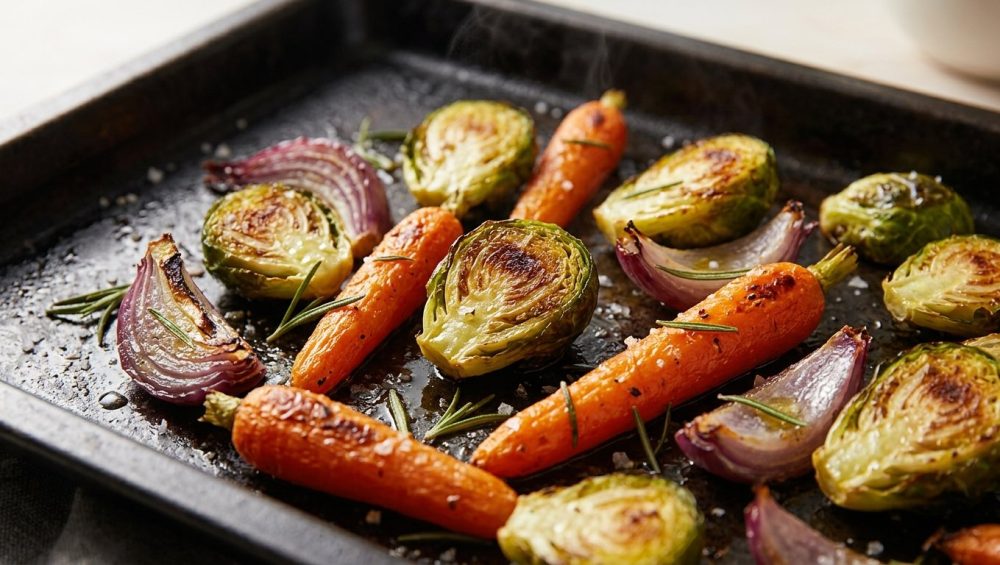
When you order roasted Brussels sprouts at an upscale bistro, they arrive shatteringly crisp on the outside, tender on the inside, and glazed with a deeply savory, sweet char. When you make them at home using the standard dump-and-bake method, they taste like boiled cabbage. The main reason your roasted veggies turn mushy is simply a catastrophic lack of initial heat transfer. You are not roasting them; you are slowly suffocating them in a lukewarm box.
Cooking is about managing energy. When you place a room-temperature (or worse, fridge-cold) pan loaded with cold, wet vegetables into a hot oven, the oven’s ambient heat has to work overtime just to bring the metal of the pan up to a baseline cooking temperature. By the time the pan is actually hot enough to sear the food, the damage is already done. Your vegetables have spent the last fifteen minutes slowly sweating out their internal moisture, turning the bottom of your pan into a shallow, lukewarm vegetable bath.
The Science of the Sizzle: What Actually Happens in Your Oven
To understand why this technique is mandatory, we have to strip away the pretentious chef-speak and look at the basic chemistry of what makes food taste good.
The Magic of the Maillard Reaction
At the heart of roasting’s universal appeal is the Maillard reaction. This is a complex chemical reaction between amino acids and reducing sugars that occurs when food is exposed to high heat. It is the exact same process that gives a seared steak its crust, baked bread its golden crust, and roasted coffee its depth. It is responsible for the browning and the intense, savory depth of flavor in roasted vegetables.
Here is the catch: the Maillard reaction does not even begin to kick off until the surface temperature of the food reaches approximately 285°F. Furthermore, if you want true caramelization—which is the breakdown of sugars that yields that sweet, rich, candy-like flavor—you need to hit at least 320°F.
The Water Balloon Problem
Vegetables are, biologically speaking, delicious little water balloons. The crunch in a fresh vegetable comes from turgor pressure—the water pressure inside each plant cell that keeps its walls rigid. Zucchini is roughly 94% water by weight. Bell peppers and mushrooms sit at around 92%.
When you put them in the oven, that massive volume of water has to go somewhere. Heat evaporates water, concentrating the natural sugars and breaking down the fibrous cell walls to make the vegetable tender. However, if your roasted veggies are soggy, it is because that moisture is trapped on the surface of the food rather than flashing off into vapor. Water cannot exceed 212°F (its boiling point) until it turns into steam. If your vegetables are sitting in a puddle of their own water, their surface temperature is physically capped at 212°F. Zero Maillard reaction. Zero caramelization. Just hot, sad, boiled mush.
The Cold Pan Catastrophe: Why You’re Boiling Your Dinner
Let’s break down the exact timeline of what happens when you put cold vegetables on a cold pan and stick it into a 425°F oven.
During the first 7 to 10 minutes, the pan absorbs heat incredibly slowly. Its surface remains stubbornly below 212°F. Meanwhile, the vegetables begin to warm up and naturally release their internal water. Because the pan is not hot enough to instantly vaporize this moisture upon contact, the water pools around the food.
This creates a highly humid microclimate right at the surface of the pan. The vegetables are now effectively steaming. To stop steaming your veggies in their own juices, you must fundamentally change the interface temperature—the precise thermal state where the food meets the metal.
The consequences of the cold pan method go beyond just terrible texture. It actually destroys the nutritional profile of your meal. Scientific trials using thermocouple validation have shown that when a cold pan is used, the surface temperature of the food lags behind the oven air temperature by 112°F to 145°F for the first five minutes. This prolonged, low-temperature sweating directly correlates with an increased leaching of water-soluble vitamins. In fact, vitamin C loss increases by a staggering 29% when roasting starts below a 300°F surface temperature. You are literally boiling the nutrients out of your dinner.
Thermal Mass: Your Kitchen’s Secret Weapon
To fix this, we need to utilize a concept called thermal mass. In physics, thermal mass refers to the ability of a material to absorb, store, and release heat energy.
Think of a heavy cast iron skillet or a thick baking steel as a “heat battery”. When you preheat a dense, heavy object in your oven, you are charging that battery with an enormous amount of stored thermal energy. A properly preheated 12-inch cast iron skillet holds 2.8 times more heat energy per degree than a standard, flimsy aluminum sheet pan.
When you drop cold, wet food onto a pan with high thermal mass, the pan has enough stored energy to maintain its temperature. It delivers immediate conductive heat—raising the vegetable’s surface temperature to 250°F within a mere 8 seconds. This instant blast of heat causes the surface water to flash-vaporize immediately. Laboratory moisture-loss tracking shows that vegetables roasted on preheated pans lose 37% more surface water in the first 90 seconds than those placed on cold pans.
This rapid initial dehydration is the holy grail of roasting. It rapidly lowers the surface water activity of the vegetable, permitting the Maillard reaction and caramelization to proceed instantly without competition from evaporative cooling.
On the flip side, thin, cheap bakeware has virtually zero thermal mass. When you hear that terrifying sound and your cheap baking sheet pops violently in the oven, it is because the thin metal is warping under the stress of thermal shock. It cannot hold heat, and it drops in temperature the second cold food touches it.
The Magic of the Preheated Pan: An Instant Upgrade
So, how do we weaponize this science for our Tuesday night dinners? It is remarkably easy. You will finally stop eating mushy veggies once you master the simple protocol of the preheated pan.
The Preheat Protocol
- Empty Pan First: Before you even touch a cutting board, place your empty, heavy-duty roasting pan or cast iron skillet into the cold oven.
- Crank the Heat: Turn the oven on to your target temperature (usually between 400°F and 450°F).
- Wait for the Charge: Let the pan heat up with the oven. Depending on your oven’s efficiency, this takes about 10 to 15 minutes. Do not rush this. Let it sit at the target temperature for at least 3 to 5 extra minutes so the metal is fully saturated with heat.
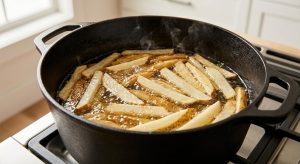
- The Sizzle Test: Carefully remove the screaming hot pan from the oven (use high-quality oven mitts, please, I do not want you burning yourself). When you drop your oiled, seasoned vegetables onto the metal, you should immediately hear a loud, aggressive sizzle. If it doesn’t sizzle, your pan wasn’t hot enough.
- Back in the Box: Quickly spread the vegetables into a single layer and get the pan right back into the oven.
That immediate sizzle is the sound of success. It is the sound of water vaporizing on contact, sealing the exterior of the vegetable, and kickstarting the Maillard reaction before the inside has a chance to turn to mush.
The “No-Go” Zone: Why Your Gear Might Be Sabotaging You
Now, as your sassy sous-chef, I have to lay down a very strict, non-negotiable rule. I am absolutely relentless about banishing toxic kitchen gear from my home, and you should be too.
You cannot use this high-heat preheating technique on cheap, coated non-stick pans. Period.
The Poison in the Pan
Traditional non-stick coatings are made from PTFE, which belongs to a massive family of over 10,000 synthetic chemicals known as PFAS (per- and polyfluoroalkyl substances). These are universally referred to as “forever chemicals” because they simply do not break down in the environment or in the human body. Scientific research has linked exposure to certain PFAS compounds with increased risks of kidney and testicular cancers, liver damage, thyroid disease, and immune system suppression.
When you heat a cheap non-stick pan empty in a 425°F oven, the coating degrades, releasing toxic fumes. You are actively ruining your nonstick pans if you expose them to this kind of aggressive, dry thermal shock.
The regulatory landscape is shifting massively, and for good reason. As of January 1, 2026, France has implemented bans on PFAS in cosmetics and textiles, with Denmark following suit. The European Union has enacted the Packaging and Packaging Waste Regulation (PPWR), which completely bans PFAS in food-contact packaging placed on the EU market starting August 12, 2026. At the EU level, a universal PFAS restriction covering over 10,000 chemical compounds—including those used in nonstick cookware coatings—is on track for a European Commission decision in 2027. Even the US FDA, which usually drags its feet, finally announced that all grease-proofing agents containing PFAS are no longer being sold for food packaging in the U.S. as of 2025.
What to Use Instead
Throw away your scratched, peeling Teflon. If your baking sheets keep warping under high heat, they belong in the recycling bin. For high-heat roasting, you need materials that are safe, durable, and possess high thermal mass.
- Cast Iron: The undisputed king of roasting. A 12-inch seasoned cast iron skillet emits infrared radiation at an incredible 0.92–0.94 emissivity, transferring massive amounts of radiant energy to the vegetables and accelerating browning without over-drying the interiors.
- Carbon Steel / Baking Steels: Acts as a literal heat battery, stabilizing oven temperatures and delivering fierce, immediate heat to the food.
- Heavy-Gauge Bare Aluminum: A thick, commercial-grade half-sheet pan will not warp and conducts heat beautifully.
- High-Quality Stainless Steel: Excellent for durability, though it has lower emissivity than cast iron.
Preparing the Veggies: It’s Not Just About the Heat
A good heavy pan is one of those tools every beginner needs to succeed, but you also have to prep your ingredients correctly. Even the hottest pan in the world cannot save you if you sabotage the vegetables on the cutting board.
Surface Area is Everything
When you chop your vegetables, think about maximizing the surface area that will make direct contact with the hot metal. Do not just roughly chop a potato into jagged boulders. Cut it so it has flat, flush sides. The more flat surface area touching the pan, the more conduction takes place, and the more glorious caramelized crust you will get.
The Oil Factor: Fat as a Conductor
Oil is not just there to keep food from sticking; it is a thermal conductor. Air is a terrible conductor of heat. If a dry piece of broccoli is sitting on a hot pan, only the microscopic points of physical contact are transferring heat. When you coat the vegetable in a high-smoke-point oil (like avocado oil, ghee, or refined olive oil), the oil fills in the microscopic gaps between the food and the metal, creating a continuous bridge for the heat to travel across. Toss your vegetables in a bowl with oil before they hit the pan to ensure an even, thorough coating.
The Cardinal Sin: Overcrowding
This is where most home cooks fail. If you pile three pounds of wet Brussels sprouts onto a single sheet pan, they will steam, regardless of how hot the pan was initially. Moisture needs an escape route. When vegetables are shoulder-to-shoulder, the evaporating water gets trapped between them, creating that dreaded humid microclimate.
Give your vegetables personal space. You should be able to see the metal of the pan between the pieces. If you have too many vegetables, use two pans or roast them in batches.
The Ultimate Weeknight Roasting Cheat Sheet
Time is money, and on a weeknight, efficiency is everything. Different vegetables have different cellular structures, densities, and water contents, which means they react differently to heat. Here is your fail-proof guide to roasting temperatures and times once your pan is screaming hot.
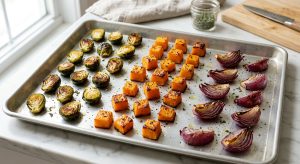
Dense Root Vegetables (Potatoes, Carrots, Beets, Parsnips)
- Temperature: 425°F to 450°F.
- Time: 30 to 45 minutes.
- The Science: These are dense and low in free water. They benefit heavily from direct conduction. The high heat drives the Maillard reaction fast, caramelizing the complex sugars before the interior dries out.
Cruciferous Powerhouses (Broccoli, Cauliflower, Brussels Sprouts)
- Temperature: 400°F to 425°F.
- Time: 20 to 30 minutes.
- The Science: These have tightly packed florets that can burn if the heat is too aggressive. The 400°F sweet spot allows the stalks to tenderize while the frilly edges get crispy and charred.
High-Water Vulnerables (Zucchini, Bell Peppers, Mushrooms, Eggplant)
- Temperature: 400°F to 425°F.
- Time: 15 to 25 minutes.
- The Science: These are the most prone to turning to mush because of their massive water content. The preheated pan is absolutely critical here to flash-evaporate the surface moisture immediately.
Pro Tip: If you live in a highly humid climate, your vegetables will naturally hold more moisture and may take slightly longer to roast. Conversely, at higher altitudes, food cooks faster, so keep a close eye on the oven.
Troubleshooting: When Good Veggies Go Bad
Even with a preheated pan, you might run into a few hiccups as you perfect your technique. Let’s troubleshoot the most common issues so you never have to eat a bad side dish again.
“My Vegetables Are Burnt on the Outside but Raw in the Middle!”
This means your heat transfer was entirely unbalanced. Either your oven temperature was set too high (pushing 475°F+), or you cut your vegetables too thick. If you are roasting massive chunks of sweet potato, the outside will carbonize before the heat has time to penetrate to the center. Solution: Cut denser vegetables into smaller, uniform pieces, or drop the oven temperature by 25 degrees.
“Everything is Sticking to the Pan!”
Understanding why your food always sticks is the first step to fixing it. Food sticks to metal when the proteins and sugars form chemical bonds with the microscopic pores in the pan’s surface. When you preheat the pan properly, you trigger the Leidenfrost effect (or a micro-version of it), where the immediate evaporation of water creates a tiny barrier of steam that prevents the food from fusing to the metal.
If your food is sticking, one of three things went wrong:
- You didn’t let the pan preheat long enough.
- You skimped on the oil (remember, fat is a thermal conductor and a barrier).
- You tried to flip the vegetables too early. When the Maillard reaction forms a proper crust, the food will naturally release itself from the pan. Have patience.
“My Leafy Greens Turned to Dust!”
If you are roasting delicate greens like kale or spinach, they require a completely different approach. They have almost zero density and will incinerate at 450°F. Drop the oven to 375°F and only roast them for 10 to 15 minutes.
Conclusion: Take Back Your Tuesday Nights
Cooking should not be a source of stress, and it certainly shouldn’t result in food that you have to force yourself to swallow. By understanding the basic physics of thermal mass, the chemistry of the Maillard reaction, and the absolute necessity of a preheated pan, you are taking control of your kitchen.
You don’t need fancy equipment, and you don’t need a culinary degree. You just need to respect the science of heat. So tonight, ditch the toxic non-stick pans, pull out your heaviest metal baking sheet or cast iron skillet, let it get screaming hot in the oven, and listen for that glorious sizzle. Your Tuesday night dinners will never be the same. Now get cooking.