Let’s get one thing straight right out of the gate: you have been lied to. For decades, glossy food magazines, celebrity chefs, and well-meaning grandmothers have perpetuated one of the most pervasive and time-wasting myths in the culinary world. We have all participated in the weekend ritual. You buy a beautiful, expensive cut of flank steak or a pack of chicken breasts, dump them into a gallon-sized plastic bag, drown them in a bottle of store-bought Italian dressing or a homemade concoction of olive oil, garlic, and herbs, and leave them in the fridge overnight. You go to sleep feeling like a culinary genius, fully expecting that tomorrow’s dinner will be infused to the bone with vibrant, herbaceous flavor.
Then, you cook it. The outside burns because of the sugar in the marinade, the exterior texture is strangely mushy, and when you finally slice into the dead center of that chicken breast, it tastes exactly like… plain, unseasoned chicken.
Welcome to the great marinade lie.
As a home cook, your time is your most valuable asset. Spending twenty minutes chopping aromatics and whisking together a complex liquid soak only to end up with a disappointing, flavorless dinner is a culinary tragedy. The truth is that traditional liquid marinades simply do not work the way we want them to. They are a surface treatment, plain and simple. Understanding why they fail requires tossing out the old wives’ tales and looking at the cold, hard science of meat. Once you understand the physical structure of muscle fibers and the chemical properties of flavor molecules, you will never waste your time on an overnight liquid soak again.
Instead, we are going to break down exactly why marinades fail, how acidic ingredients are secretly ruining the texture of your food, and how you can leverage the brilliant chemistry of salt, dry brining, and finishing techniques to achieve deeply seasoned, restaurant-quality results in a fraction of the time. Grab a glass of wine, roll up your sleeves, and let’s get into the science of fixing your dinner.
The Great Marinade Lie: Why You Have Been Wasting Your Time
To understand why your garlic-herb-oil soak is failing, we first have to understand the canvas we are working with. Meat is not a dry, porous sponge waiting to soak up whatever liquid you throw at it. It is a highly complex, tightly woven matrix of proteins, water, and fat.
The Anatomy of a Muscle Fiber
At a microscopic level, meat is composed of bundles of muscle fibers. These fibers are made up of myofibrils, which are tightly packed proteins—primarily myosin and actin—designed by nature to contract and release to facilitate movement. These bundles are wrapped in sheaths of connective tissue. They are incredibly dense. They are built to be strong, resilient, and structurally sound. They are absolutely not built to act as a funnel for your balsamic vinaigrette.
Furthermore, raw meat is already composed of roughly 75 percent water. Think about that fully saturated sponge sitting next to your kitchen sink. If you run that sponge under the faucet until it can’t hold another drop, and then you pour a cup of flavored broth over it, what happens? The broth doesn’t penetrate the center of the sponge; it just cascades uselessly down the sides. Your steak and your chicken breasts are already completely saturated with their own natural juices. There is simply no physical room for a liquid marinade to enter the tightly packed, water-logged muscle fibers.
The Oil and Water Problem
To make matters worse, the vast majority of traditional marinades are oil-based. Whether it is olive oil, sesame oil, or a neutral vegetable oil, fat is usually the primary carrying agent for the spices and herbs.
Here is a basic rule of chemistry that you learned in the third grade: oil and water do not mix. Because the interior of the meat is packed with water, it actively repels the oil in your marinade. You are essentially creating a waterproof barrier on the outside of your chicken. The oil clings to the surface, bringing the herbs and spices with it, but it is chemically incapable of penetrating the water-dense interior of the muscle. You can leave that meat in the fridge for three days, and the oil will still be sitting right there on the surface, mocking you.
The Bouncer at the Club: Understanding Molecular Weight
If the water content wasn’t enough to keep your flavors locked out, we also have to talk about the physical size of the molecules you are trying to force into the meat. In chemistry, the size of a molecule is measured by its molecular weight, often expressed in Daltons or grams per mole (g/mol).
The Size of Flavor
Imagine the surface of your steak as the door to an exclusive, tightly packed nightclub. The muscle fibers are the bouncers, and they have a very strict VIP list. Only the smallest, most nimble molecules are allowed inside.
Water is a tiny molecule, weighing in at just 18 g/mol. Sodium chloride (table salt) is also incredibly small. When salt dissolves in water, it breaks down into sodium ions (about 23 g/mol) and chloride ions (about 35.5 g/mol). These tiny ions are on the VIP list. They can slip right past the bouncers and navigate the microscopic gaps between the muscle fibers with ease.
Now, let’s look at the flavor molecules in your marinade. Sucrose (table sugar) has a massive molecular weight of 342 g/mol. Allicin, the primary organic compound that gives garlic its glorious, pungent flavor, weighs roughly 162 g/mol. The complex aromatic hydrocarbons found in black pepper, rosemary, thyme, and cumin are similarly massive.
When you rub crushed garlic and sugar onto a piece of meat, those molecules act like a group of massive linebackers trying to squeeze through a dog door. They are physically too large to penetrate the dense protein matrix of the muscle fibers. They get stopped at the surface, leaving the interior of the meat completely untouched.
The One-Millimeter Myth
Extensive culinary science and laboratory testing have repeatedly proven this point. Food scientists have used water-soluble dyes and precise slicing techniques to measure exactly how far marinades penetrate meat over time. The results are always the same. Even after 24 to 48 hours of continuous soaking, the large flavor molecules from garlic, herbs, and spices penetrate a maximum of one to three millimeters into the meat.
If you are cooking a paper-thin slice of bulgogi beef, a surface marinade works beautifully because the entire piece of meat is only two millimeters thick. But if you are cooking a thick-cut pork chop, a massive ribeye, or a plump chicken breast, that one millimeter of surface flavor is going to be completely lost against the massive volume of unseasoned meat in the center. You are wasting your expensive olive oil and fresh herbs on a chemical impossibility.
The Acid Trap: How Vinegar and Citrus Destroy Your Dinner
At this point, you might be thinking, “But what about acid? Doesn’t acid break down the meat and tenderize it?” This is perhaps the most destructive myth in the home kitchen. While acid does alter the structure of meat, it does not do it in a way that you actually want.
The Ceviche Effect and Protein Denaturation
Most marinades rely heavily on an acidic component—lemon juice, lime juice, vinegar, or wine. The theory is that the high acidity will eat away at the tough connective tissues, resulting in a melt-in-your-mouth texture.
Here is what is actually happening: acid denatures proteins. In their raw state, the protein molecules in meat are tightly folded, complex coils. When they are exposed to a highly acidic environment (a low pH), those coils rapidly unwind, lose their structure, and then haphazardly snap back together in new, highly disorganized web-like formations.
This is the exact same chemical process that occurs when you apply heat to meat. It is why raw, translucent fish turns opaque, white, and firm when you soak it in lime juice to make ceviche. The acid is literally “cooking” the exterior of the meat without any heat.
When you leave a chicken breast sitting in a highly acidic vinaigrette overnight, the acid attacks that outer millimeter of meat. It denatures the proteins so aggressively that the surface becomes tightly bound and physically damages the tissue. When you finally take the chicken out of the bag, the outside will look slightly grey and opaque. When you cook it, that acid-damaged exterior will turn chalky, mealy, and unpleasantly mushy. You haven’t tenderized the meat; you have pre-digested the surface, ruining the texture and making it nearly impossible to achieve a beautiful, crispy, golden-brown sear.
The Lactic Acid Exception
There is exactly one exception to the “no acid” rule, and that is dairy. If you must marinate, harness the secret power of yogurt since its lactic acid is much gentler. Unlike the harsh citric acid in lemons or the acetic acid in vinegar, lactic acid operates at a slightly higher, milder pH.
Dairy also contains calcium, which activates enzymes in the meat that slowly and gently break down proteins without aggressively denaturing them into a chalky mess. This is why traditional Indian tandoori chicken or Middle Eastern shish tawook—both of which rely on yogurt-based marinades—result in incredibly tender, juicy meat. But even then, the flavor molecules in the yogurt are only flavoring the surface. The tenderizing effect is real, but the deep flavor penetration is still a myth.
The Magic Molecule: Why Salt is the Only Thing You Need
If oil can’t get in, garlic is too big, and acid turns meat to mush, how on earth are we supposed to season our food? The answer lies in the single most important ingredient in your kitchen: Salt.
Salt is not just a flavor enhancer; it is a highly active chemical tool that fundamentally alters the physical structure of meat for the better. It is the only ingredient small enough, and chemically reactive enough, to penetrate deep into the muscle fibers and transform a bland, dry piece of protein into a juicy, restaurant-quality masterpiece.
Osmosis vs. Diffusion
When you apply a heavy layer of salt to the surface of raw meat, two distinct chemical processes occur: osmosis and diffusion.
First, osmosis kicks in. Osmosis is the movement of water across a semipermeable membrane to equalize the concentration of solutes. Because there is a massive concentration of salt on the outside of the meat and very little on the inside, the salt acts like a magnet, drawing the meat’s natural moisture out to the surface. If you watch a salted steak for ten minutes, you will see beads of water pooling on the exterior.
Many amateur cooks panic at this stage, assuming they are drying out their expensive steak. But patience is a virtue. After about 30 to 45 minutes, the second process begins: diffusion.
The water that was drawn to the surface has now dissolved the salt, creating a highly concentrated liquid brine. Through diffusion—the movement of particles from an area of high concentration to an area of low concentration—that salty liquid is slowly reabsorbed deep into the muscle fibers. Because the sodium and chloride ions are so small, they easily slip past the “bouncers” and travel all the way to the center of the meat.
Denaturing Myosin for Maximum Juiciness
Once the salt gets inside the meat, it performs a culinary miracle. The chloride ions bind to the myosin filaments (the primary proteins in the muscle fibers). These ions carry a negative electrical charge. Because negative charges repel each other, the tightly packed protein filaments are forced to push away from one another, widening the gaps between the fibers.
This structural change does two incredible things. First, it seasons the meat all the way through, ensuring that the dead center of your pork chop is just as savory and flavorful as the outside. Second, and more importantly, it turns the meat into a moisture-trapping sponge. By opening up the protein structure, the meat is able to hold onto significantly more of its own natural water during the cooking process.
When meat cooks, heat causes the muscle fibers to contract and squeeze out moisture (this is why well-done steaks are dry and tough). But because the salt has chemically altered and relaxed those proteins, they don’t contract nearly as violently. A properly salted piece of meat will retain up to 15 percent more moisture after cooking than an unsalted piece. You aren’t just flavoring the meat; you are chemically engineering it to be juicier.
The Masterclass on Dry Brining
Now that we know salt is the only ingredient that actually penetrates meat, it is time to abandon the messy, wasteful liquid marinades and embrace the technique that professional chefs use every single day. Once you understand the magic of dry brining, you will never go back to those messy liquid soaks.
Dry brining is exactly what it sounds like: treating the meat with salt (and nothing but salt) well in advance of cooking, and letting it rest uncovered in the refrigerator. It requires zero prep time, zero chopping, and zero wasted ingredients. Here is exactly how to execute a flawless dry brine.
Step 1: The Pat Down
Moisture on the exterior of your meat is the ultimate enemy of a good sear. If you throw a wet piece of chicken into a hot pan, the heat energy has to boil off that water before the temperature can rise high enough to trigger the Maillard reaction (the chemical process that causes browning and creates complex, savory flavors). This results in sad, grey, steamed meat.
Remove your meat from its packaging and use heavy-duty paper towels to pat it completely, bone-dry on all sides. Do not rinse your meat under the sink—this is a massive food safety hazard that splashes bacteria all over your kitchen, and it only adds unwanted moisture.
Step 2: The Salt Application
You must use the right salt. Throw away your iodized table salt; it is too fine, too dense, and tastes metallic. You need a high-quality Kosher salt. Diamond Crystal Kosher Salt is the industry standard because its hollow, pyramid-shaped crystals dissolve rapidly and adhere beautifully to the meat.
Sprinkle the salt generously from high above the meat to ensure an even coating. You want to apply slightly more salt than you think you need, as this salt has to season the entire interior volume of the cut, not just the surface.
Step 3: Elevation and Airflow
Place the salted meat on a wire cooling rack set inside a rimmed baking sheet. This is a non-negotiable step. If you put the meat flat on a plate, the bottom will sit in a pool of its own juices and get soggy. The wire rack allows air to circulate a full 360 degrees around the meat.
Place the baking sheet into the refrigerator, completely uncovered. The modern frost-free refrigerator is essentially a giant, highly efficient dehumidifier. As the meat rests, the cold, circulating air will aggressively dry out the surface, creating a tacky, moisture-free layer called a pellicle. When this ultra-dry surface hits a hot pan, it will sear instantly, creating a thick, crunchy, mahogany-brown crust that a wet marinade could never achieve.
Step 4: The Waiting Game
Time is the secret ingredient here. The salt needs time to undergo the processes of osmosis and diffusion.
- For thin cuts (chicken breasts, thin pork chops, skirt steak): A minimum of 45 minutes to 1 hour.
- For thick cuts (thick ribeyes, bone-in pork chops, whole chicken legs): 2 to 4 hours is good, but overnight (12 to 24 hours) is absolute perfection.
- For massive cuts (whole turkeys, prime rib roasts, pork shoulders): 48 to 72 hours.
When you pull the meat out of the fridge, the surface will look deep red, dry, and slightly tight. Do not rinse the salt off. It has already done its job. The meat is now fully seasoned to the core, chemically altered to retain its juices, and perfectly prepped for a hard, violent sear.
If Not Marinades, Then What? How to Actually Build Flavor
So, we’ve established that soaking meat in garlic and herbs is a waste of time, and that dry brining with salt is the only way to season the interior. But we still want those complex, aromatic flavors! How do we get the taste of rosemary, garlic, chili, and citrus onto our plate without a marinade?
The answer is simple: you apply the flavor where it actually belongs—on the surface, during the cook, and in the finishing sauce.
Fat-Soluble Flavor and Surface Rubs
Most of the aromatic compounds in spices and herbs are fat-soluble, meaning their flavors are unlocked and amplified when exposed to hot oil or fat, not cold water or vinegar. If you want a deeply spiced crust on your chicken, apply a dry spice rub right before cooking.
Even better, if you are making a curry or a heavily spiced dish, do not just dump raw spices into the pot. You get infinitely more flavor by blooming them in oil before rubbing them on the meat or adding them to your sauce. Gently frying spices in a bit of oil for thirty seconds awakens their essential oils, transforming them from dusty and dull to vibrant and deeply aromatic.
The Art of the Pan Sauce
If you want restaurant-quality flavor, you need to master the pan sauce. When you sear a dry-brined piece of meat in a hot pan, the Maillard reaction creates caramelized, browned bits of protein that stick to the bottom of the skillet. This is called the fond, and it is culinary gold. It is the concentrated essence of the meat.
When your meat is done cooking, remove it from the pan and let it rest. Now, you have a hot pan coated in deeply flavorful fond. Throw in your minced garlic, shallots, and fresh herbs right now. Let them sizzle in the residual meat fat for a minute. Then, deglaze the pan by pouring in a splash of wine, chicken stock, or even water. The liquid will aggressively boil, allowing you to scrape up all that beautiful fond with a wooden spoon.
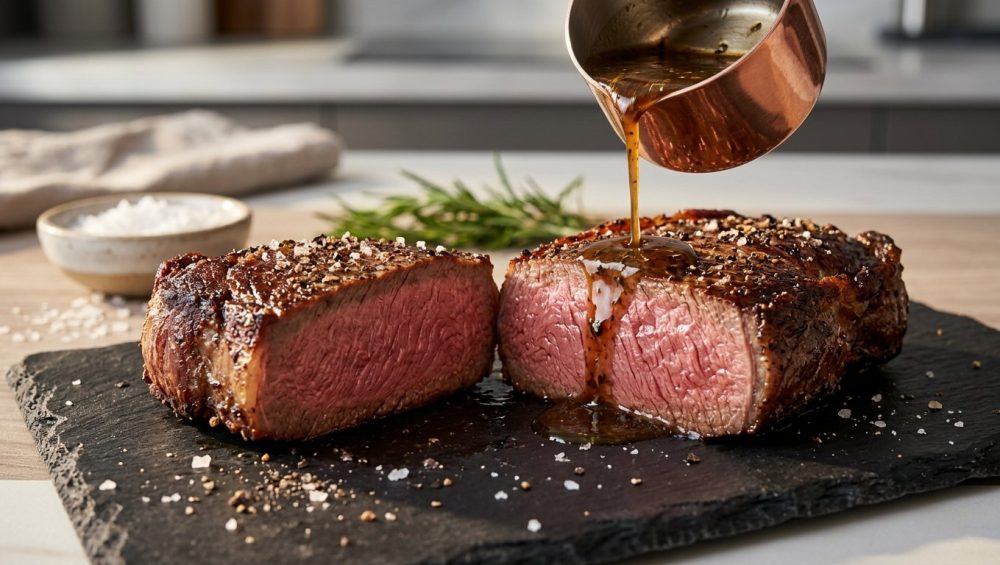
Let the liquid reduce by half to concentrate the flavors. Turn off the heat, and vigorously whisk in a few cubes of ice-cold butter. The cold butter will emulsify with the liquid, creating a rich, glossy, velvet-smooth sauce that coats the back of a spoon. If your homemade sauces always end up thin and watery, you can even add some unflavored gelatin to give it that glossy, restaurant-quality body. Pour this incredible sauce over your perfectly cooked, deeply seasoned meat, and you will have more flavor in one bite than a three-day marinade could ever provide.
The Board Sauce Technique
For larger cuts like flank steak or tri-tip, professional chefs often use a “board sauce.” Instead of marinating the meat beforehand, you build the flavor on the cutting board.
Finely chop your fresh herbs (parsley, cilantro, rosemary), mince a clove of garlic, add a pinch of chili flakes, and mix it with a generous glug of high-quality extra virgin olive oil directly on your wooden cutting board. When your steak comes out of the pan, place it directly on top of this herb-oil mixture to rest. As the hot meat rests, its juices will mingle with the aromatics and the oil, creating a rich, raw sauce. When you finally slice the meat, every single piece will be dragged through that vibrant, fresh flavor profile. It is a stunningly effective technique that takes two minutes of prep.
The Finishing Touch
Finally, we need to address the acid. We know that soaking meat in acid destroys its texture. But acid is still a crucial component of a balanced dish; it cuts through rich fats and brightens heavy flavors.
Instead of soaking meat in acid, rely on the magic of a lemon squeeze right before serving. A hit of fresh citrus juice or a drizzle of high-quality balsamic vinegar applied to the meat after it has been cooked provides a massive, bright pop of flavor without ever having the chance to degrade the proteins. You get all of the vibrant zing and none of the mushy texture.
The Gear Check: Stop Sabotaging Your Searing
You can understand all the science in the world, dry brine your meat for 24 hours, and build a beautiful pan sauce, but if you are cooking on cheap, toxic, poorly made equipment, you are shooting yourself in the foot. As a home cook, your tools dictate your ceiling.
Banishing Toxic Cookware
I have zero patience for cheap, lightweight, non-stick pans. If your skillet has a peeling, scratched black coating, throw it in the garbage immediately. Those cheap non-stick coatings (often made with PFAS or PFOA “forever chemicals”) are not only an environmental and health nightmare, but they are also culinary dead weight.
Non-stick pans cannot safely handle the high heat required to properly sear a piece of meat. If you get them hot enough to trigger the Maillard reaction, the chemical coating begins to break down and off-gas toxic fumes. Furthermore, because they are designed to be “non-stick,” they completely prevent the formation of fond. No fond means no pan sauce. No pan sauce means boring food.
Mastering the Stainless Steel Sear
It is time to learn how to properly use stainless steel pans for a hard sear. A heavy-bottomed, tri-ply stainless steel skillet (or a well-seasoned carbon steel or cast iron pan) can handle ripping high heat, creates magnificent fond, and will last for generations.
People avoid stainless steel because they are terrified of their food sticking and tearing. But sticking is purely a result of poor temperature control. If you put cold meat into a cold pan, the proteins will chemically bond to the metal. To prevent this, you must utilize the Leidenfrost effect. Heat your dry stainless steel pan over medium-high heat. Do not add oil yet. Just use the water drop test to know when your pan is perfectly preheated. Flick a tiny drop of water into the skillet. If it fizzles and evaporates immediately, the pan is too cold. If it instantly forms a perfect bead of water that glides and dances across the surface like a mercury marble, the pan is perfectly heated. Add your oil, wait ten seconds for it to shimmer, and lay your dry-brined meat down. It will sear beautifully and release naturally when the crust is fully formed.
Precision and Prep
Cooking meat requires precision. You cannot guess when a thick chicken breast is cooked through by poking it with your finger and comparing it to the fleshy part of your palm. That is nonsense. Chances are, your cheap meat thermometer is lying to you anyway. Invest in a high-quality, instant-read digital thermometer. Cook your chicken to exactly 160°F (it will carry over to 165°F as it rests), and pull your steaks at exactly 130°F for a perfect medium-rare.
When searing, you also want maximum contact between the meat and the hot metal. Cuts of meat tend to buckle and curl when they hit a hot pan, lifting the center off the heat and resulting in a pale, unseared ring. Grab a vented chef’s press to ensure maximum contact with the hot metal. The weight keeps the meat flat, while the vents allow steam to escape so you are searing, not boiling, your dinner.
Finally, respect the crust you just worked so hard to build. Trying to slice through a beautiful crust with a dull knife is a culinary tragedy. It will tear the meat fibers, squeeze out the juices, and ruin the presentation. Keep your knives honed and sharply ground.
The Final Verdict: Cook Smarter, Not Harder
The modern home kitchen should be a place of efficiency, creativity, and joy—not a place where you blindly follow outdated advice that actively sabotages your dinner. The myth of the overnight liquid marinade has persisted for generations simply because it feels like cooking. It feels like you are doing something complex and beneficial. But culinary science doesn’t care about our feelings; it cares about molecular weight, protein denaturation, and thermodynamics.
By ditching the messy Ziploc bags of acidic, oily vinaigrettes, you are saving yourself time, money, and frustration. You are respecting the physical structure of the meat.
The formula for perfect, restaurant-quality protein is remarkably simple, and it is entirely within your grasp as a home cook. Pat the meat dry. Apply a generous layer of high-quality Kosher salt. Let it rest on a wire rack in the fridge so the salt can work its chemical magic on the myosin proteins. Sear it hard in a properly heated, non-toxic skillet. Build a deeply flavorful pan sauce from the fond, or rest the meat on a vibrant board sauce. Finish with a hit of fresh acid just before the fork hits your mouth.
That is how you build profound, layered, edge-to-edge flavor. That is how you guarantee a juicy, tender, perfectly crusted piece of meat every single time. Leave the marinades in the past, trust the science of salt, and go make something spectacular for dinner tonight. You’ve got this.