Picture this: It is a beautiful Sunday morning. You have your favorite coffee brewing, the good bacon is sizzling, and you are about to whip up a batch of soft, custardy scrambled eggs. You have done everything right. You preheated the pan, you used the good butter, and you folded those eggs with the gentle, meticulous care of a mother swaddling a newborn. You sit down, take that first highly anticipated bite, and suddenly—bam. Your eggs taste like a fresh breeze of “Mountain Spring” dish detergent with a lingering, aggressive aftertaste of last Tuesday’s garlic-heavy stir-fry.
It is a culinary tragedy. You want to throw the plate across the room. I have been there. We have all been there. And let me tell you a little secret: it is entirely the fault of your silicone spatula.
Welcome to one of the most maddening, universally experienced, yet rarely explained phenomena in the modern home kitchen. You are not going crazy, your tastebuds are not broken, and you did not accidentally squirt dish soap directly into your breakfast. Your silicone cooking utensils are actively betraying you by hoarding the ghosts of meals past and the chemical perfumes of your dishwasher pods. It is honestly one of the seven rookie kitchen mistakes that people make without even realizing it, and it has nothing to do with your actual culinary skills.
If you are tired of your baked goods tasting faintly of pot roast, and your delicate pan sauces carrying notes of artificial lemon and chemical rinse aid, you are in the exact right place. Today, we are taking a brutally honest, science-backed deep dive into why this happens, how to permanently fix it, and how to prevent it from ever ruining your food again. Because if there is one thing I cannot stand, it is wasting good ingredients and precious time on a meal that ends up tasting like a laundromat. Let us get into it.
The Soapy Science: Why Your Spatula is a Fragrance Sponge
Silicone is a modern kitchen miracle. It is heat-resistant, flexible, non-stick, and will not melt into a puddle of toxic goo when you accidentally leave it resting on the edge of a hot carbon steel skillet. But this miracle material has a dark side. To understand why your spatula is currently masquerading as a Yankee Candle, we have to look at the chemistry. Do not worry, I have zero patience for pretentious chef-speak or boring academic lectures, so we are going to keep this highly practical.
The Molecular Structure of Silicone
Without getting bogged down in a college-level textbook, you need to know what silicone actually is. Unlike natural rubber or rigid, brittle plastics, silicone (technically known as polysiloxane) is a synthetic polymer made up of a flexible silicon-oxygen backbone. This unique molecular structure is exactly what gives it that incredible flexibility and extreme heat resistance. It is an elastomer, meaning it can stretch, bend, scrape the sides of a mixing bowl, and snap back into its original shape without breaking down or degrading.
But here is the kicker: silicone is inherently porous at a microscopic level. It is not a perfectly sealed, impenetrable fortress like a sheet of high-quality stainless steel or a piece of tempered glass. The polymer chains have microscopic spaces between them. Under normal, room-temperature conditions, these spaces are relatively tight and closed off. But the moment you introduce heat, the physics of the material completely change.
Heat Expansion and the “Pore” Effect
Think of your silicone spatula like a microscopic sponge, or even like human skin in a hot sauna. When you subject silicone to high temperatures—say, the boiling, steamy environment of your dishwasher’s bottom rack or a bubbling pot of acidic marinara sauce—the material undergoes thermal expansion. As the silicone heats up, those polymer chains relax and stretch, causing the microscopic pores on the surface of the spatula to open wide.
While those pores are gaping open, your spatula is swimming in a hot, turbulent soup of dissolved food oils, pungent garlic compounds, and heavily fragranced dishwasher detergent. Because silicone is heavily lipophilic (a fancy scientific term that just means it absolutely loves oil and fat), it acts like a powerful magnet for the greasy, fragrant molecules floating around in the wash water. The food oils and synthetic perfumes slip right into the expanded pores of the silicone. This is the exact same scientific principle behind why your plastic containers stay greasy even after you have scrubbed them with a soapy sponge.
Then, the dishwasher cycle ends. The drying and cooling phase begins. As the spatula drops back down to room temperature, the silicone naturally contracts. The pores snap shut, tightly trapping the garlic oils and soap fragrances deep inside the matrix of the material. You put the spatula away in your drawer, thinking it is perfectly clean. The next time you use that spatula in a hot pan to make breakfast, the heat of the stove opens the pores back up, and—surprise!—it releases that trapped soapy, garlicky cocktail directly into your delicate food. It is a vicious, flavor-ruining cycle.
The Dishwasher Detergent Disaster
Now that we know how the silicone traps the smells, we need to talk about what it is actually trapping. We have all spent too much time surviving kitchen disasters that were completely out of our control, but putting your silicone in the dishwasher with heavy-duty pods is an act of self-sabotage.
Aggressive Surfactants and Synthetic Fragrances
Modern dishwasher pods are incredibly concentrated chemical powerhouses. They are designed to strip baked-on lasagna off a glass casserole dish without you having to pre-rinse it. To achieve this, these pods are packed with abrasive enzymes, aggressive surfactants, and overwhelmingly strong synthetic fragrances.
Manufacturers pump these detergents full of artificial lemon, “ocean breeze,” and “mountain fresh” perfumes so that when you open the dishwasher door, you are hit with a blast of perceived cleanliness. But those fragrances are made of volatile organic compounds and synthetic oils. When your silicone spatula’s pores open up in the hot water, it drinks in those artificial perfume oils like a sponge. Because those fragrances are specifically engineered to linger and withstand high heat, they embed themselves permanently into the silicone.
The Rinse Aid Trap
If the detergent pods were not bad enough, we also need to talk about rinse aid. Rinse aid is a chemical surfactant designed to lower the surface tension of water, allowing it to sheet off your glassware so you don’t get hard water spots. It is brilliant for your wine glasses, but it is an absolute nightmare for your silicone.
During the final, hottest rinse cycle, the rinse aid coats everything in the machine. It coats your open-pored silicone spatula right before the extreme heat of the drying cycle bakes it in. You are essentially curing a layer of chemical surfactant directly into your cooking utensils. When you are rushing to throw together simple weeknight dinners, the last thing you want is to realize your food tastes like a chemical drying agent.
The “No-Go” Rule: Toxic Gear vs. Genuine Food-Grade Silicone
If you have read any of my previous masterclasses, you know I have a strict, uncompromising “No-Go” rule in my kitchen. I absolutely despise cheap, toxic, poorly manufactured kitchenware. I believe that anyone can cook like a professional at home, but you cannot do it if your equipment is actively poisoning your food or falling apart in your hands. If you are serious about banishing toxic kitchen gear from your home, you need to start paying attention to what your utensils are actually made of.
The Dangers of Mystery Kitchenware
The global market for food-grade silicone is massive, valued at nearly a billion dollars in recent years. Because it is such a lucrative industry, the market is currently flooded with cheap, budget imports that do not disclose their manufacturing processes or their curing methods. Many of these products are not even genuine silicone; they are cheap plastics coated in a thin layer of silicone, or they are pumped full of chemical fillers to cut manufacturing costs.
Just like you need to stop ruining your nonstick pans with cheap aerosol cooking sprays that degrade the coating, you need to stop buying mystery-metal and mystery-plastic utensils that degrade into your food. High-quality, 100% food-grade silicone is incredibly stable and safe. It will not leach chemicals into your food, provided you use it within its safe temperature range (which is generally up to 428°F to 450°F). Cheap silicone, however, is a completely different story.
How to Spot Fake Silicone (The Famous Pinch Test)
So, how do you know if the spatula you bought at the discount store is actually pure silicone? You perform the Pinch Test.
Take the flexible edge of your silicone spatula and aggressively pinch, twist, or pull it. Observe the color of the stressed area. If the silicone remains a solid, uniform color, you are likely holding a high-quality, pure silicone product. If the pinched area turns stark white, you have a problem. That white color indicates that the manufacturer has used cheap plastic or chemical fillers to bulk up the product.
The science behind this is actually fascinating. Because of its unique molecular structure, pure silicone absorbs light and appears transparent (before safe pigments are added). Fillers added to cheap silicone do not have the same band structure, so they cannot absorb light in the same way. When you stretch the material, these impurities scatter the light, which is exactly why you see that white discoloration. If your spatula turns white when you twist it, throw it in the garbage. It is not worth the risk.
FDA vs. LFGB Standards
When you are building your collection of essential tools every beginner needs, do not cheap out on the silicone. You will often see products proudly claiming to be “FDA Approved” or “Food Safe.” Here is the brutal truth: the FDA standards for silicone are actually quite lenient. Under FDA regulations, silicone products are legally allowed to contain certain levels of chemical impurities and fillers as long as they stay beneath a designated “safe” threshold.
If you want absolute peace of mind, look for silicone that is certified by the LFGB (the European standard). LFGB testing is significantly stricter than the FDA and does not allow for any fillers whatsoever. LFGB-certified silicone is more expensive to produce, but it will never turn white when pinched, it will last a lifetime, and it is far less likely to absorb aggressive odors compared to its cheap, filler-stuffed counterparts.
The Ultimate Fix: The Silicone Baking Method
Alright, enough theory. Your spatula currently smells like a lavender-scented garlic clove, and you want to know how to fix it. Because silicone traps odors via thermal expansion, we are going to use thermodynamics to our advantage. If heat opened the pores to trap the smell, controlled heat will open the pores to release it. We are going to bake the smell right out of the silicone.
The Thermodynamics of Deodorization
When you place your smelly silicone in the oven at a controlled, moderate temperature, the polymer chains will once again expand. However, because you are using dry heat rather than a wet, soapy dishwasher environment, the trapped volatile organic compounds (the soap fragrances and garlic oils) will vaporize. They will literally evaporate out of the open pores of the silicone and dissipate into the air, leaving you with a perfectly neutral, odor-free utensil. Research confirms that pure silicone is highly stable at baking temperatures, so as long as you keep the heat reasonable, you will not damage the tool.
Step-by-Step Instructions for the Oven Trick
Follow these instructions exactly. Do not skip steps, and for the love of all things culinary, pay attention to the handle of your spatula.
Step 1: The Handle Check
Before you even think about turning on your oven, examine your spatula. Is it a solid, one-piece silicone design? If yes, proceed. If your spatula has a wooden handle or a hard plastic handle, do not put the entire thing in the oven. You will start a fire or melt a puddle of plastic onto your oven rack. If you are wondering why your wooden spoons keep cracking after a few months, it is because extreme heat and moisture destroy wood. Pull the flexible silicone head completely off the wooden or plastic handle. You are only baking the silicone part.
Step 2: The Pre-Wash
Wash the silicone thoroughly in the sink using hot water and a mild, unscented dish soap. You want to strip away any surface-level grease before you bake it. Dry it completely with a clean towel.
Step 3: Preheat the Oven
Preheat your oven to 250°F (120°C). This is the sweet spot. It is hot enough to force the silicone pores open and vaporize the trapped oils, but well below the 428°F threshold where silicone begins to risk degradation.
Step 4: The Bake
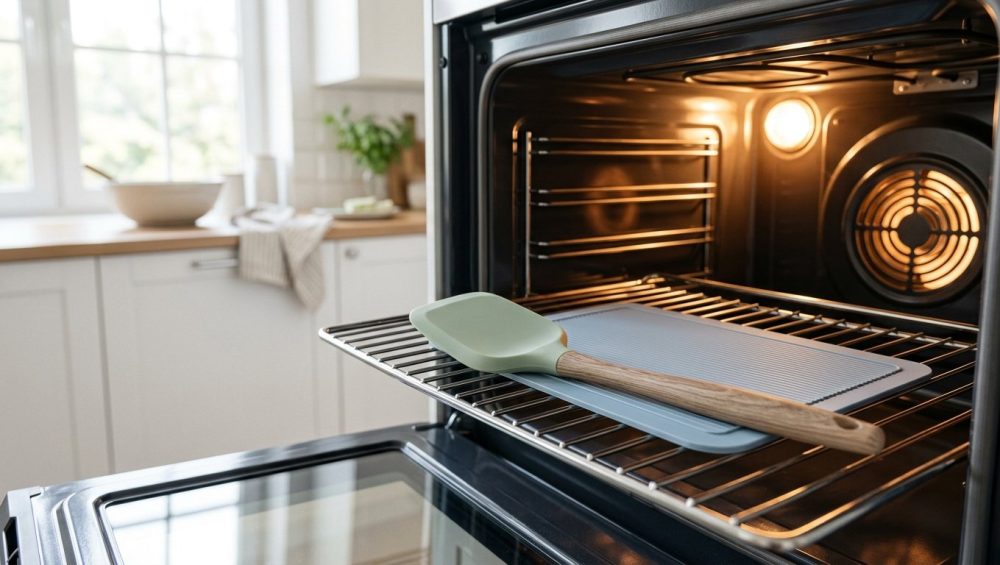
Place the silicone spatula (or just the silicone head) directly on a clean, ungreased baking sheet. Do not line the sheet with parchment paper or aluminum foil; just put it right on the metal. Place the baking sheet in the oven and let it bake for 20 to 30 minutes.
Step 5: The Sniff Test
After 20 minutes, open the oven. You will likely be hit with a strong waft of hot dish soap and old garlic. This is a good thing! It means the volatile compounds are leaving the spatula. Carefully remove the baking sheet and use an oven mitt to pick up the silicone. Give it a cautious sniff. If it still smells heavily of soap, put it back in for another 10 to 20 minutes. Some heavily saturated spatulas may take up to an hour to fully deodorize.
Step 6: The Cool Down
Once the silicone smells like absolutely nothing, take it out of the oven and let it cool completely on the counter. As it cools, the pores will snap tightly shut, leaving you with a fresh, pristine tool.
Alternative Deodorizing Methods (For the Cautious Cook)
I understand that putting your cooking utensils into a hot oven feels incredibly unnatural. If you are too nervous to try the baking method, or if your oven is currently occupied by a slow-roasting pork shoulder, there are a few alternative, science-backed methods to strip those nasty odors from your silicone. They require a bit more elbow grease, but they get the job done.
The Boiling Water and Baking Soda Hack
Baking soda (sodium bicarbonate) is a powerful alkaline compound that is incredibly effective at neutralizing acidic odors and drawing out trapped oils.
Find a wide saucepan or a deep skillet. Fill it with enough water to completely submerge the silicone portion of your spatula. Bring the water to a rolling boil on the stove. Once boiling, carefully add two heaping tablespoons of baking soda. The water will violently bubble and foam up—this is normal. Drop your smelly silicone into the boiling alkaline bath and let it simmer for 10 to 15 minutes.
The boiling water provides the heat necessary to open the silicone’s pores, while the baking soda acts as an abrasive, odor-neutralizing magnet that pulls the trapped oils out of the material. After 15 minutes, carefully remove the spatula with a pair of tongs, rinse it under cold water, and give it a sniff.
The White Vinegar Soak
If your spatula is suffering more from hard water mineral buildup and old garlic smells rather than synthetic soap perfumes, an acid soak is your best friend. White vinegar contains acetic acid, which excels at breaking down stubborn, pungent food odors.
In a large glass bowl or a baking dish, create a mixture of 50% hot water and 50% plain white distilled vinegar. Submerge the silicone head of your spatula into the bath and let it soak for at least two hours (or overnight for extreme cases). The heat of the water will slightly expand the pores, allowing the acetic acid to penetrate the silicone and neutralize the trapped garlic and onion compounds. Afterward, wash it thoroughly with unscented soap to remove the vinegar smell.
Preventative Measures: Keeping Your Spatulas Tasting Like Nothing
Congratulations! You have successfully exorcised the demons of Mountain Spring detergent and last week’s fajitas from your favorite kitchen tool. But if you do not change your habits, you are going to be right back here baking your spatulas next month. Let us talk about how to protect your gear moving forward. By treating your gear with respect, you can transform your cooking into a peaceful daily habit rather than a frustrating chore.
The Handwashing vs. Dishwasher Debate
I am going to give it to you straight: stop putting your high-quality silicone in the dishwasher. I know I said earlier that time is money, and I am the biggest advocate for efficiency in the kitchen. But handwashing a single silicone spatula takes exactly ten seconds. Ruining an expensive batch of homemade lemon curd because you were too lazy to handwash your spatula costs you an hour of your life and ten dollars in wasted ingredients.
Keep your silicone out of the dishwasher. The extreme, prolonged heat, combined with the aggressive chemical surfactants and rinse aids, is the sole reason your tools are absorbing odors. Wash your silicone in the sink with warm water and a mild dish soap immediately after you finish cooking.
Separation of Church and State (Sweet vs. Savory Tools)
If your favorite baking spatula smells like garlic from last night’s dinner, you are going to transfer that flavor directly into your vanilla buttercream. You need to establish a strict separation of church and state in your utensil drawer.
Buy two different colors of high-quality, LFGB-certified silicone spatulas. Designate the red or black spatulas exclusively for savory, pungent cooking—stir-fries, curries, tomato sauces, and searing meats. Designate the light blue or white spatulas strictly for baking—folding egg whites, scraping cake batter, and making custards. Never let the two cross paths. Your baked goods will thank you.
Switching to Unscented Detergents
If you absolutely insist on using the dishwasher for your silicone, you must change your detergent. Ditch the brightly colored, heavily perfumed chemical pods. Switch to a free-and-clear, unscented powder or gel detergent. These eco-friendly alternatives lack the aggressive synthetic fragrances that get trapped in silicone pores. Furthermore, turn off the heated dry cycle on your dishwasher, as the extreme baking heat is what locks the remaining odors into the material.
The Bottom Line
You do not need a culinary degree to make mind-blowing food at home, but you do need to understand how your equipment actually works. Silicone is an incredibly durable, heat-resistant, and versatile material, but its microscopic porosity means it requires a specific kind of care.
Stop settling for scrambled eggs that taste like a laundry aisle. Stop buying cheap, filler-stuffed plastic masquerading as pure silicone. Invest in genuine, high-quality gear, keep it out of the chemical warzone of your dishwasher, and do not be afraid to throw your spatula in the oven for a quick detox when things get a little too fragrant. Now go pull that spatula out of the oven, give it a sniff, and get back to cooking something spectacular. You’ve got this.