Look, we have all been there. You drop twenty hard-earned dollars on a beautiful block of aged Gruyère and a wedge of sharp artisanal cheddar. You grate it lovingly, toss it into a hot pan with some milk, and suddenly, you are staring into the abyss. Instead of a luscious, velvety pool of liquid gold, your cheese instantly seizes into a horrifying, oily puddle of gritty despair. You didn’t make a cheese sauce; you made a dairy-based grease slick.
Grab a glass of wine and take a deep breath, because it is not your fault. Cheese is a temperamental diva, and melting it seamlessly requires a bit of chemical trickery. If you are tired of fixing your grainy cheese sauce with frantic whisking and whispered prayers, you have come to the right place. You do not need a culinary degree to cook like an expert, and you certainly do not need to order specialty chemical powders off the internet. You just need science, a dash of common sense, and a humble, ninety-cent can of evaporated milk.
Welcome to the definitive, no-nonsense masterclass on emulsion, protein structures, and the culinary magic of evaporated milk.
Anatomy of a Dairy Diva: Why Cheese Hates You
To understand why your cheese sauce breaks, you first need to understand what cheese actually is. I promise to keep the pretentious chef-speak to an absolute minimum, but we do need to put on our lab coats for a second.
Cheese is essentially a microscopic sponge. It is an emulsion—a delicate, solid suspension of fat, water, and protein. The structural framework of this sponge is made up of casein proteins. These proteins are bundled together into tiny clusters called micelles, and they are held tightly in place by calcium phosphate bridges. Think of calcium as the molecular superglue that keeps the protein cage intact, trapping the fat and water inside.
The Heat Squeeze: When Good Emulsions Go Bad
When you subject cheese to heat, that delicate protein matrix begins to vibrate and break down. The cheese softens and melts. However, as the temperature continues to rise, those casein proteins start to panic. They begin to actively contract and bond with one another even tighter than before.
Imagine wringing out a soaking wet sponge. As the protein network tightens and shrinks, it violently squeezes out all the fat and water that was previously trapped inside. The result? The proteins clump together into stringy, rubbery wads, while the expelled fat pools into a slick, unappetizing layer of grease. This separation is one of the most common beginner cooking mistakes that drives home cooks to tears. Once those proteins have clumped and the fat has separated, no amount of aggressive whisking is going to force that genie back into the bottle. The emulsion is broken.
The Traditional Roux: A Flawed (and Exhausting) Classic
For centuries, the classical French solution to this problem has been the béchamel sauce. You melt butter, whisk in flour to create a paste (a roux), and then slowly whisk in milk until it thickens. Finally, you remove it from the heat and gently fold in your cheese.
Why Béchamel Mutes Your Masterpiece
How does it work? The starch molecules from the flour swell up in the liquid, creating a thick, physical barrier that prevents the cheese proteins from finding each other and clumping together. It is a physical blockade against separation.
But let’s be brutally honest: making a roux on a busy Tuesday night is an exhausting chore. Time is money, and standing over a stove constantly whisking flour to cook out the raw taste is a luxury most of us do not have. Furthermore, a flour-based roux actively works against your flavor profile. The swollen starch molecules coat your tongue, severely muting the sharp, tangy notes of your expensive cheddar. You end up with a sauce that tastes more like floury milk than actual cheese. And the worst part? If you accidentally let a béchamel-based cheese sauce come to a boil, the proteins will still tighten, the fat will still separate, and your sauce will still break.
We need a better way. We need a method that is faster, packs a stronger flavor punch, and is practically bulletproof.
The Evaporated Milk Miracle: Better Living Through Chemistry
Enter the unsung hero of the baking aisle: evaporated milk. This is the secret weapon that will allow you to ditch the flour entirely and create a sauce that tastes like pure, unadulterated cheese.
What Actually is Evaporated Milk?
First, a crucial disclaimer: evaporated milk is not sweetened condensed milk. If you accidentally buy sweetened condensed milk for your macaroni and cheese, you will end up with a sugary, dessert-like catastrophe. Evaporated milk is simply fresh milk that has been gently heated in a vacuum until roughly 60 percent of its water content has evaporated.
What you are left with is a highly concentrated liquid. Because the water is gone, the milk proteins (casein) and fats are incredibly dense. When you use evaporated milk as the base for your sauce, you are introducing a massive dose of flowy, structural milk proteins that help support the emulsion. But the real magic lies in what happens to the natural salts during the evaporation process.
The Magic of Natural Emulsifying Salts
Milk naturally contains small amounts of citrate and phosphate salts. When the water is vacuumed out to create evaporated milk, the concentration of these natural salts skyrockets.
Why does this matter? Because sodium citrate is the holy grail of cheese melting. It is the exact same emulsifying salt used by the food industry to make American cheese so incredibly meltable. By using evaporated milk, you are harnessing the power of these naturally occurring emulsifying salts without having to order a tub of synthetic sodium citrate powder online.
The Molecular Hostage Negotiation: Citrate vs. Calcium
Here is how the magic trick works. Remember how calcium acts as the superglue holding the cheese protein cage together? Citrate ions have an incredibly high chemical affinity for calcium. When you heat your cheese in a bath of evaporated milk, the concentrated citrate acts like a molecular hostage negotiator. It actively binds to the calcium, stripping it away from the casein proteins.
Without the calcium holding them tightly together, the casein proteins relax. They uncoil and stretch out, becoming completely water-soluble. Instead of clumping together and squeezing out the fat, these relaxed proteins form a flexible, continuous matrix that wraps around the fat droplets, locking them seamlessly into the water. The result is a permanently stable, glossy, luxurious emulsion that will absolutely refuse to break, even if you reheat it the next day.
The Gear Check: Stop Poisoning Your Cheese Sauce
Before we get to the recipe, we need to have a serious talk about your cookware. As your biggest culinary cheerleader, I refuse to let you ruin a scientifically perfect cheese sauce by cooking it in garbage equipment.
The Non-Stick Nightmare
I have zero patience for cheap, peeling Teflon pans. If your non-stick skillet has scratches on it, you are actively flaking toxic forever-chemicals directly into your family’s dinner. Stop treating cookware as a disposable commodity. If you are serious about banishing your toxic kitchen gear, the first thing you need to do is throw that scratched pan straight into the trash.
The Stainless Steel and Saucier Solution
For a flawless cheese sauce, you need cookware with excellent thermal mass and heat distribution. A heavy-bottomed, multi-clad stainless steel skillet or an enameled cast iron pot is mandatory. Yes, cooking with stainless steel pans requires a slight learning curve regarding temperature control, but it will never leach mystery metals or toxic flakes into your food.
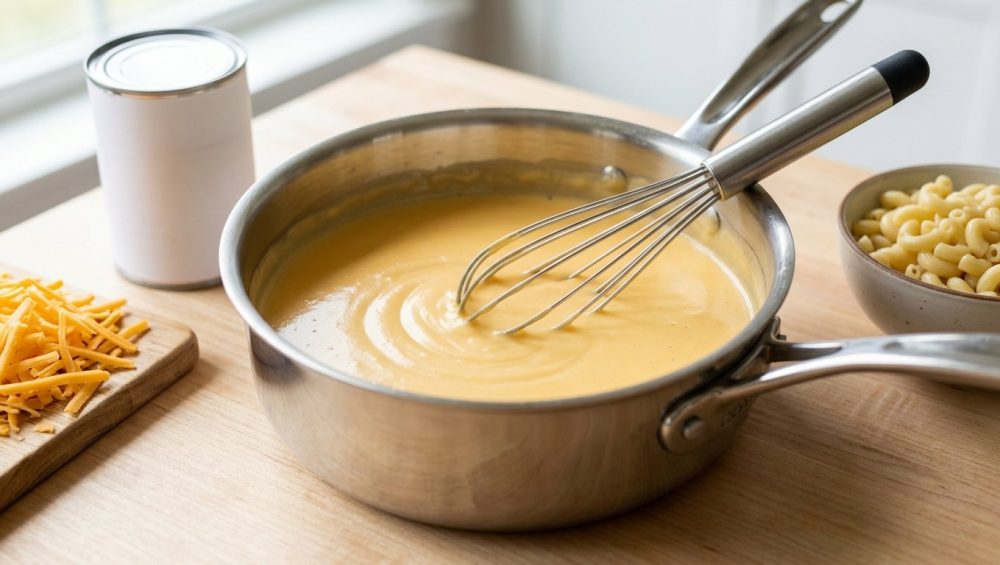
If you want to cook like an absolute pro, you should invest in a curved saucier. Unlike standard pots with sharp 90-degree corners where sauces can hide, stick, and scorch, a saucier has a gently sloped interior. This allows your whisk to reach every single millimeter of the pan, ensuring that your evaporated milk never scorches on the bottom.
The Masterclass Method: The Foolproof 3-Ingredient Stovetop Revolution
This technique, heavily popularized by culinary scientist J. Kenji López-Alt, is the ultimate weeknight dinner hack. It completely eliminates the need for a flour roux, takes less than 15 minutes from start to finish, and yields professional-level results in a standard home kitchen.
The Golden Ratio
The beauty of this method is its mathematical simplicity. You only need to remember a 1:1:1 ratio by weight.
- 6 ounces of dry elbow macaroni (or any short pasta)
- 6 ounces of evaporated milk
- 6 ounces of freshly grated cheese
The Skillet Pasta Hack
Do not waste time boiling a massive, heavy pot of water. We are going to use the skillet pasta cooking method. Place your dry macaroni directly into a wide stainless steel skillet. Add just enough cold water to barely cover the pasta, along with a generous pinch of salt.
Turn the heat to high. Because you are using a fraction of the water you normally would, it will come to a boil in minutes, completely preventing messy stovetop boil-overs. As the pasta cooks, it releases starch into the shallow pool of water. Instead of dumping that liquid down the drain, we are going to let it reduce.
Step-by-Step Execution
- Boil and Reduce: Stir the pasta frequently. As the water evaporates, it leaves behind a highly concentrated, syrupy starch slurry. This leverages the magic of starchy pasta water, acting as a powerful secondary binder for your sauce.
- Add the Milk: When the pasta is just shy of al dente and the water has almost completely absorbed (about 6 to 8 minutes), immediately pour in your 6 ounces of evaporated milk.
- Simmer: Bring the evaporated milk to a gentle simmer. Do not let it reach a violent boil.
- Melt the Cheese: Turn the heat down to the absolute lowest setting (or turn it off entirely if you are using an electric stove that holds residual heat). Dump in your 6 ounces of grated cheese.
- Stir to Perfection: Stir continuously. Watch in amazement as the citrate in the evaporated milk breaks down the calcium bonds, allowing the cheese to melt into a glossy, velvety, emulsified masterpiece in under two minutes.
The Pre-Shredded Evil: Rethink Your Cheese Drawer
Your evaporated milk can only do so much heavy lifting. If you sabotage the chemistry with bad ingredients, you will still fail.
The Anti-Caking Conspiracy
If you want to ditch the pre-shredded cheese, you need to understand why it is the enemy of a smooth sauce. Those convenient bags of shredded cheddar at the grocery store are coated in anti-caking agents—usually cellulose (literally wood pulp) or potato starch. These powders are added to absorb ambient moisture and prevent the cheese shreds from clumping together in the bag during transit.
However, when you throw that coated cheese into a hot pan, those anti-caking agents aggressively resist hydration. They prevent the casein proteins from melting smoothly, resulting in a gritty, sandy texture that will instantly ruin a perfectly smooth melt. Always buy a block of cheese and grate it yourself. It takes exactly sixty seconds and will fundamentally transform your cooking.
Selecting the Ultimate Melting Cheeses
Not all cheeses are created equal. For a flawlessly smooth sauce, you need to balance flavor with meltability.
- Young Cheeses (The Melters): Cheeses that are young have a high moisture content and a loosely knit protein structure. Monterey Jack, Fontina, mild cheddar, and young Gouda melt like an absolute dream. They provide the gooey texture you crave, but they can sometimes lack a deep flavor punch.
- Aged Cheeses (The Flavor Bombs): As cheese ages (like a sharp 2-year cheddar, Parmigiano-Reggiano, or aged Gruyère), it loses moisture. The protein bonds become incredibly tight, and the fat becomes more prone to separating. While they taste incredible, they are notoriously difficult to melt smoothly on their own.
The Pro-Move: Blend them. Use a young, high-moisture cheese (like Jack) for the structural melt, and an aged, sharp cheddar for the flavor. The evaporated milk will easily handle the emulsion of the blended cheeses.
Advanced Troubleshooting and Flavor Hacks
Even with foolproof science, the kitchen is a dynamic environment. Here is how to tweak your masterclass sauce on the fly.
Rescuing a Sauce That is Too Thick
Because this method relies on a highly concentrated starch slurry and reduced moisture, your sauce might thicken up very quickly as it begins to cool. If it turns from a flowy liquid into a dense paste, do not panic. Simply put the skillet back over low heat and whisk in a splash of regular milk, a tablespoon of water, or a bit more evaporated milk. The emulsion is incredibly stable, so it will easily accept the new liquid and loosen right back up into a silky glaze.
Adding Acid Without Curdling
A great cheese sauce often needs a hit of acidity to cut through the heavy, rich butterfat. A dash of hot sauce, a spoonful of Dijon mustard, or a tiny squeeze of lemon juice can elevate the dish from good to mind-blowing.
Normally, adding acid to hot dairy is a recipe for disaster. Acid lowers the pH, which causes casein proteins to instantly curdle and precipitate out of the liquid (this is exactly how ricotta cheese is made). However, because you are using evaporated milk, the high concentration of citrate acts as a powerful pH buffer. It stabilizes the chemical environment, allowing you to stir in a dash of hot sauce right at the end without breaking the emulsion. Just be sure to add your acidic ingredients off the heat, whisking vigorously.
Final Thoughts from the Sassy Sous-Chef
Cooking is not magic; it is just applied physics and chemistry that you get to eat when you are finished. You do not have to settle for the powdery, neon-orange packets from a cardboard box, and you do not have to spend an hour painstakingly whisking a flour roux only to have it taste like library paste.
By understanding the microscopic structure of your ingredients and utilizing the naturally occurring emulsifying salts in a simple can of evaporated milk, you have successfully outsmarted the kitchen. You have taken a notoriously finicky, frustrating culinary process and turned it into an effortless weeknight victory.
So go grate a block of the good stuff, fire up your stainless steel skillet, and show that cheese who is boss. You’ve got this.