Picture this: You just dropped fifty bucks on a brand-new, mid-range nonstick skillet. It’s gorgeous. The surface is pristine, dark, and smooth as glass. For the first three months, you are living the dream. Your morning eggs are literally gliding across the pan like Olympic figure skaters. You feel like a culinary genius. And then, around month six, the betrayal happens. You crack an egg, and it cements itself to the center of the pan. You nudge it with your spatula, and the yolk breaks. You curse the cookware gods. You assume you bought a dud, toss it in the trash, and head back to the store.
Stop right there. Put down your wallet and listen to me.
Your pan didn’t fail you. You failed your pan. If your skillets are suddenly losing their slip after just a few months of use, I can almost guarantee I know exactly what happened. You reached into your pantry, pulled out a convenient little aerosol can of cooking spray, and blasted that beautiful nonstick surface.
I get it. You are a busy professional. It is a Tuesday night, you are exhausted, and you just want to get dinner on the table without measuring out oils or dealing with a greasy bottle. I am the biggest advocate for weeknight efficiency, and my “time is money” philosophy dictates that we should always look for clever kitchen shortcuts. But an aerosol cooking spray is a false shortcut. It is a silent killer of cookware, and it is costing you a small fortune in replacement pans.
Today, we are skipping the pretentious chef-speak and diving deep into the actual science of why aerosol sprays are destroying your kitchenware. I am going to break down the chemistry of emulsifiers, the hidden dangers of chemical propellants, and how you can break this toxic cycle for good.
The Anatomy of a Nonstick Pan (And Why We Love Them)
Before we can understand how we are ruining our pans, we need to understand what makes them so magical in the first place. I firmly believe that anyone can cook like an expert at home, but having the right gear is half the battle. When you are stocking up on beginner kitchen tools, it is tempting to grab the cheapest, most “convenient” options available, but understanding your equipment elevates your cooking from a stressful chore to a joyful hobby.
What Actually Makes It Nonstick?
Modern nonstick cookware generally falls into two categories: traditional PTFE (polytetrafluoroethylene) and ceramic sol-gel coatings. PTFE, famously known by the brand name Teflon, is an absolute marvel of material science. It is a polymer made up of a carbon backbone completely encased by fluorine atoms.
Here is the only chemistry lesson you need to know about it: the carbon-fluorine bond is one of the strongest bonds in organic chemistry, and fluorine is highly electronegative. This means the fluorine atoms hold onto their electrons so tightly that they refuse to interact with other molecules. They do not want to bond with your eggs, your pancakes, or your delicate fish fillets. This creates an incredibly low surface energy—typically around 15 to 22 dynes per centimeter. In layman’s terms, liquids and proteins bead up and slide off rather than spreading and adhering.
Ceramic nonstick pans work on a similar principle of low surface energy, using a silica-based sol-gel (solution-gel) derived from sand, which is cured in an oven to create a slick, glass-like finish. Both surfaces are engineered for one specific purpose: to prevent chemical bonding between the pan and your food.
The False Narrative of Early Failure
There is a pervasive myth in the home cooking community that nonstick pans are essentially disposable, doomed to fail after six to eight months. You will see this pattern repeated endlessly on culinary forums and Reddit threads. A home cook buys a highly-rated pan, treats it relatively well, but within a year, everything sticks. Because there are no visible scratches or peeling, the logical conclusion is that the coating simply “wore out.”
This is statistically false. According to cookware manufacturers and accelerated wear trials, a quality PTFE or ceramic pan should last anywhere from three to five years with proper care. If your pan is failing in under a year, the coating hasn’t degraded. It has been covered up. The nonstick surface is still there, trapped beneath an invisible, impenetrable layer of polymerized gunk. And that gunk came directly from your aerosol can.
The Aerosol Cooking Spray Illusion
We buy cooking spray because it promises portion control and an impossibly even coating of oil. It feels like a smart, healthy choice. But understanding exactly why cooking spray ruins nonstick coatings requires a brief dive into the fascinating world of food chemistry and manufacturing.
It Is Not Just Oil in That Can
Take a look at the back of a standard can of commercial cooking spray. You might expect the ingredient list to say “Canola Oil” and nothing else. Instead, you are going to find a cocktail of additives. A typical aerosol can contains roughly 20% to 30% actual oil by volume. The rest of the can is filled with propellants, anti-foaming agents like dimethyl silicone, and emulsifiers.
Dimethyl silicone is added to prevent the oil from foaming when it hits a hot surface. While the FDA considers it safe for consumption, it is the same chemical used in cosmetics and textile finishing. But the real villain in this story, the ingredient single-handedly responsible for sending millions of perfectly good frying pans to the landfill every year, is the emulsifier.
The Role of Emulsifiers: The Soy Lecithin Sabotage
In most conventional cooking sprays, the primary emulsifier is soy lecithin. Lecithin is a fatty substance naturally found in eggs, soybeans, and sunflower seeds. In baking and food manufacturing, it is a miracle ingredient that binds water and oil together. In your cooking spray, lecithin acts as a surfactant. It lowers the surface tension of the oil, allowing it to spray out of the nozzle in an ultra-fine mist and coat the pan evenly without pooling.
From an engineering standpoint, it is brilliant. From a cookware longevity standpoint, it is a disaster. Lecithin is highly susceptible to heat. When exposed to the medium-high temperatures of a standard stovetop, lecithin breaks down and undergoes a massive chemical transformation.
The Chemistry of Pan Destruction: Polymerization
Polymerization is a word that gets thrown around a lot in culinary circles, usually in a positive context. When you season a raw cast iron skillet or a carbon steel wok, you apply a thin layer of oil and heat it past its smoke point. The fatty acid chains in the oil break down and cross-link, forming a hard, durable, plastic-like polymer that bonds to the metal. This is what gives cast iron its natural nonstick properties.
How Polymerization Sabotages PTFE
On a nonstick pan, polymerization is your worst nightmare. The soy lecithin in cooking spray polymerizes much faster and at lower temperatures than regular cooking oils. When you spray your pan and turn on the burner, that ultra-fine mist of lecithin cross-links and hardens.
Much like the frustrating reason your plastic containers stay greasy after holding leftover spaghetti sauce, polymerized oil bonds stubbornly to the surface at a molecular level. Even though PTFE is incredibly slick, it is not perfectly smooth under a microscope. It has microscopic pores and textures. The polymerized lecithin anchors itself into these microscopic variations, creating a permanent, sticky film over the Teflon.
The Invisible Enemy
The most insidious part of this process is that you cannot see it happening. Most nonstick pans are black or dark gray. When soy lecithin polymerizes, it forms a thin, yellowish-brown residue. Against a dark background, this residue is completely invisible.
You finish cooking your eggs, you take the pan to the sink, and you wash it with warm water and standard dish soap. The pan looks clean. But dish soap is designed to cut through loose, liquid fats. It is completely powerless against a hardened, cross-linked polymer.
Every single time you use that cooking spray, you are depositing another microscopic layer of lecithin on top of the last one. Over weeks and months, this invisible film builds up. Eventually, the film becomes thick enough to completely mask the PTFE underneath. When you crack an egg into the pan, the egg isn’t touching the nonstick coating; it is touching a sticky, carbonized layer of polymerized soy lecithin. The food sticks, the pan becomes impossible to clean, and you throw it away, completely unaware that the actual nonstick coating underneath is still in perfect condition.
I will scream it from the rooftops until every home cook hears me: cooking spray is the enemy of a well-maintained kitchen. It is a false economy that sacrifices long-term durability for three seconds of perceived convenience.
The Hidden Danger of Propellants
If the soy lecithin wasn’t bad enough, we need to talk about the propellants. I have absolutely zero patience for cheap, peeling equipment, which is why banishing toxic kitchen gear from your life is a non-negotiable first step. But even a high-end, expensive pan can be destroyed by the pressurized gases inside an aerosol can.
Propellants and the Physics of Thermal Shock
To force the oil and lecithin out of the nozzle at high speed, manufacturers use liquefied petroleum gases. Yes, you read that correctly. The most common propellants in commercial cooking sprays are butane, isobutane, propane, and dimethyl ether. While the FDA classifies these as safe for use in food processing because they evaporate instantly and leave negligible residue in the food itself, their physical effect on your cookware is brutal.
When a pressurized liquid propellant is released from the can, it rapidly expands into a gas. According to the laws of thermodynamics, this phase change is highly endothermic—it absorbs a massive amount of heat from its surroundings. If you spray this mixture onto your pan, the surface of the pan experiences an instantaneous, localized temperature drop.
This rapid cooling induces severe thermal shock. The materials in your pan—the aluminum core and the PTFE or ceramic coating—have different coefficients of thermal expansion. When subjected to a sudden, extreme temperature change, they contract at different rates. In thin-film ceramic coatings (which are often less than 12 microns thick), this repeated thermal cycling causes micro-stress in the coating matrix. Over time, this leads to subsurface delamination. The coating literally detaches from the metal base at a microscopic level, leading to premature flaking and chipping.
The “No-Go” Rule on Toxic Degradation
I am militant about my “No-Go” rule regarding toxic kitchenware. When a nonstick coating begins to micro-fracture and flake due to thermal shock from propellants, it exposes the bare aluminum underneath and releases microplastics into your food. A single scratch or flaking edge on a degraded PTFE pan can release thousands of plastic particles into your meal. This is entirely avoidable. We do not need to subject our cookware to butane-induced thermal shock just to grease a pan.
How to Tell if Your Pan is Ruined (Or Just Dirty)
So, how do you know if your pan is truly dead, or if it is just suffering from a severe case of lecithin buildup?
The Tactile Test
Since you often cannot see the polymerized residue, you have to feel for it. Wash your pan thoroughly and dry it completely. Run your bare fingertips very lightly across the cooking surface, paying special attention to the sides and the outer edges where oil tends to pool. A clean, healthy PTFE or ceramic pan will feel impossibly smooth, almost frictionless. If your fingers drag, catch, or feel a slight tacky, sticky resistance, your pan is coated in polymerized spray residue.
Can It Be Saved? The Baking Soda Rescue Mission
If you want to avoid scrubbing stainless steel pans until your arms ache, you need to understand heat control, but with nonstick, heat control alone won’t save you from aerosol damage. However, if you catch the lecithin buildup early enough, you can actually reverse the damage and rescue your pan from the trash can.
Standard dish soap won’t work, but a mild alkali will. Enter baking soda. Baking soda (sodium bicarbonate) has a high enough pH to gently saponify and break down polymerized fats without being abrasive enough to scratch the delicate PTFE coating.
Here is the exact rescue protocol:
- Mix a generous amount of baking soda with just enough warm water to form a thick, toothpaste-like paste.
- Smear this paste aggressively over the entire interior of the dry pan, focusing on the sticky areas.
- Walk away. Let it sit for at least 15 to 20 minutes to give the alkaline mixture time to break down the polymer chains.
- Using a non-abrasive sponge (like a silicone scrubber or a Dobie pad—absolutely no steel wool or heavy-duty scouring pads), gently scrub the surface in circular motions.
- Rinse thoroughly with warm water and wash normally with dish soap.
If the nonstick coating underneath is still intact, your pan will be restored to its original, frictionless glory. If the pan still sticks after this treatment, or if you see visible flaking and deep scratches, the coating itself has failed. At that point, it is time to throw it away and start fresh.
The Sassy Sous-Chef’s Guide to Safe Alternatives
We have established that aerosol sprays are a menace to society and your cookware. But we still need to lubricate our pans to cook properly. How do we achieve the efficiency of a spray without the chemical warfare?
Refillable Oil Misters: The Ultimate Upgrade
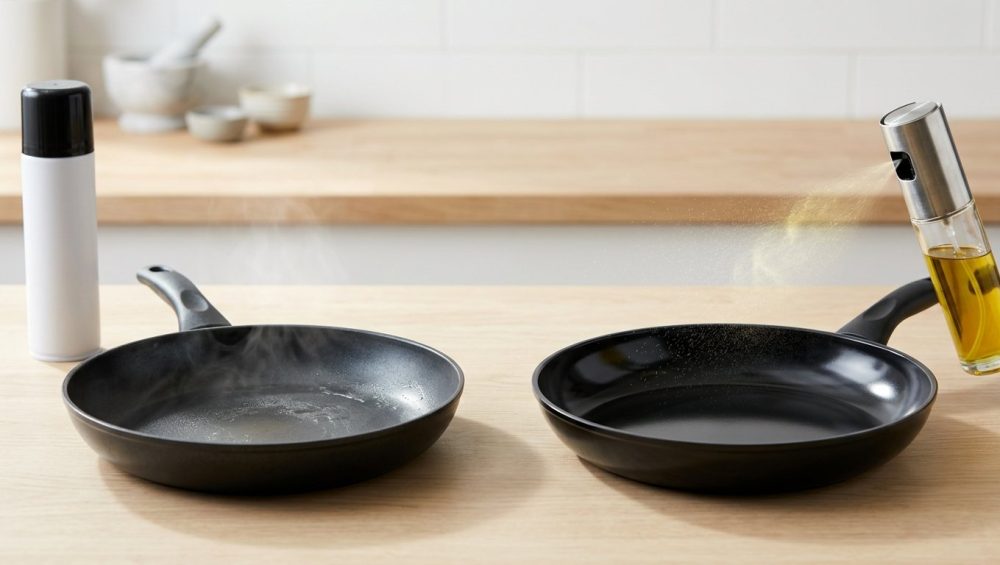
Instead of wasting your hard-earned money on superficial aesthetic kitchen upgrades, invest a mere twenty bucks into a high-quality glass oil mister. This is the single greatest swap a home cook can make for the longevity of their cookware.
A refillable oil sprayer uses a mechanical pump mechanism to pressurize the bottle with ambient room air. You fill it with your own high-quality, pure cooking oil. When you press the nozzle, you get a beautiful, even mist of pure oil. There is no soy lecithin. There is no dimethyl silicone. There is no butane or propane inducing thermal shock. It is just pure, unadulterated fat.
Let’s look at the basic math here, because time is money, and money is money. A can of name-brand cooking spray costs around $5. If you cook daily, you might go through a can every two months. That is $30 a year. If that spray ruins a $60 skillet twice a year, your true annual cost is $150. A premium glass oil mister costs about $15 to $20 as a one-time purchase. You buy a large bottle of high-quality avocado oil for $15 that lasts you all year. You save over a hundred dollars annually, and your pans survive to see their fifth birthday.
The Paper Towel Method
If you refuse to buy a mister, you can go old-school. Pour a dime-sized drop of your preferred cooking oil into the center of the cold pan. Take a folded paper towel and aggressively wipe the oil across the entire surface, buffing it in until the pan looks almost dry.
Learning these simple, foundational techniques will help you survive the kitchen without setting off the smoke alarm or ruining your dinner. This method leaves a microscopic layer of pure fat that acts as a perfect thermal barrier and release agent, with absolutely no pooling or excess grease.
Choosing the Right Oil
Not all fats are created equal when it comes to preserving nonstick coatings. You must match the smoke point of your oil to your cooking temperature. If you use extra virgin olive oil or whole butter and crank the heat to medium-high, the milk solids and low-temperature fats will burn, carbonize, and stick to the pan just like polymerized lecithin.
For everyday searing, sautéing, and egg-frying, stick to refined oils with high smoke points. Avocado oil, grapeseed oil, and refined canola oil are your best friends. They can withstand the heat without breaking down into a sticky mess.
Rethinking Your Kitchen Habits
A truly beautifully organized dream kitchen isn’t about hoarding single-use gadgets; it is about curating durable, reliable tools that work as hard as you do, and treating them with the respect they deserve.
Proper Heat Management
Even without cooking spray, heat is the enemy of PTFE. Teflon begins to degrade and release toxic fumes at temperatures above 500°F (260°C). But even at 400°F, the lifespan of the coating is significantly reduced. Nonstick pans are not designed for hard searing. You should never use them to put a crust on a ribeye steak—that is what your cast iron or carbon steel skillet is for.
Nonstick pans excel at gentle, low-to-medium heat applications. Eggs, delicate fish, pancakes, and grilled cheese. Never preheat a nonstick pan empty; always add your fat first so it can act as a temperature buffer. And never, under any circumstances, turn your burner dial past medium when using a coated pan.
The True Lifespan of Cookware
We need to normalize realistic expectations for our kitchen gear. A nonstick pan is a consumable item. Unlike a heavy-gauge stainless steel clad skillet that you can pass down to your grandchildren, a PTFE or ceramic pan has a finite lifespan. The coating will eventually wear thin through sheer mechanical friction from spatulas and washing.
However, that lifespan should be measured in years, not months. By eliminating aerosol cooking sprays, managing your heat, and using proper silicone or wooden utensils, a quality mid-range pan will easily give you three to five years of flawless performance.
Final Thoughts from the Sassy Sous-Chef
Cooking at home should be a joy, not an exercise in frustration. You don’t need a degree from Le Cordon Bleu to make an incredible meal, but you do need to stop sabotaging yourself with cheap, chemically-laden shortcuts.
Aerosol cooking sprays are a relic of a bygone era of convenience cooking. They offer a temporary illusion of efficiency while quietly destroying the very tools you rely on to feed yourself and your family. The polymerized soy lecithin buildup and the brutal thermal shock from butane propellants are the hidden culprits behind the premature death of millions of skillets.
So do yourself, your wallet, and your perfectly cooked over-easy eggs a massive favor. Throw the aerosol can in the garbage today. Invest in a simple, elegant glass oil mister. Treat your nonstick pans with the gentle, low-heat respect they deserve. Your cookware will last for years, your food will taste better without the lingering hint of dimethyl silicone, and you will finally break the toxic cycle of replacing your pans every six months. Now go pour yourself a glass of wine, mist your pan with some pure avocado oil, and cook something spectacular. You’ve got this.