Look, I know your history with tofu. It usually ends with a sad, crumbly mess that tastes vaguely like wet drywall and disappointment. You bought a block of extra-firm with the best of intentions, chopped it up, threw it in a pan, and watched it disintegrate into a watery scramble while you questioned all of your life choices.
But stick with me, pour yourself a glass of whatever gets you through a Tuesday evening, and let’s get one thing straight: the problem isn’t you, and the problem isn’t the tofu. The problem is that nobody ever told you about the secret, transformative power of your freezer.
We are currently living in a golden age of plant-based eating. The global plant-based protein market hit a staggering $18 billion in 2025 and is projected to reach over $31 billion by 2034. Yet, despite all the high-tech, lab-engineered faux meats flooding the supermarket aisles, the humble, ancient block of coagulated soy milk remains one of the cheapest, most versatile proteins you can buy. You just need to know how to hack its biology.
The Wet Drywall Dilemma: Why Store-Bought Tofu Fails You
To understand why we need to freeze tofu, we first need to understand what tofu actually is. At its core, tofu is essentially a highly fragile sponge that is already completely saturated with water.
During the manufacturing process, soy milk is curdled using coagulants like calcium sulfate or magnesium chloride (often referred to as bittern). These resulting curds are then pressed into blocks. The firmness of the tofu you buy at the store is entirely dependent on how much water the manufacturer mechanically pressed out of it during this stage.
Here is the brutal truth about the water content in your average block of tofu:
- Silken tofu is hovering around an astonishing 90% water.
- Soft tofu sits at roughly 85% water.
- Firm tofu is about 80% water.
- Extra-firm tofu still contains roughly 75% water.
Read that again. Even when you buy the absolute firmest block available at your local grocery store, you are essentially buying a brick of water held together by a delicate network of soy proteins.
When you try to cook unpressed, unfrozen tofu, that internal moisture immediately starts to steam. You cannot achieve a crispy, golden-brown sear—the legendary Maillard reaction—when your food is aggressively steaming itself from the inside out. Furthermore, because the protein network is already at maximum capacity with its own flavorless water, it physically cannot absorb your expensive marinades. It’s like trying to wipe up a spill with a sponge that is already soaking wet.
Most recipes tell you to just press the tofu. And yes, you absolutely should invest in a tofu press if you want to make your weeknight dinners infinitely easier. Pressing a block of firm tofu for 20 minutes under a 500-gram weight can successfully drop its water content down to about 70%. But pressing alone only removes the surface-level and loosely bound water. It doesn’t fundamentally alter the dense, smooth internal structure of the soy protein.
If you want to turn that dense block into a highly porous, flavor-absorbing, meaty marvel, you have to get molecular. You have to freeze it.
The Science of the Freeze: What Actually Happens Inside the Block
This is where the magic happens. We are going to use basic thermodynamics to do the heavy lifting for us.
The “Soy Balloon” Analogy
Imagine the internal structure of a block of tofu as millions of microscopic water balloons tightly packed together. The “balloon” is the soy protein matrix, and the liquid inside is water. This is how the water stays suspended inside the block in the first place.
As anyone who has ever accidentally left a glass bottle of soda in the freezer knows, water expands when it turns into ice. When you place a block of tofu into your freezer, the water trapped inside those millions of microscopic protein balloons begins to freeze and expand.
Because the water expands, it violently stretches and eventually ruptures the delicate soy protein walls. The ice crystals act like microscopic daggers, permanently tearing through the smooth protein matrix.
The Sponge Effect: Creating a Porous Matrix
When you eventually take that block of tofu out of the freezer and let it thaw, the ice crystals melt back into water. But the structural damage to the protein matrix is already done—and that damage is exactly what we want.
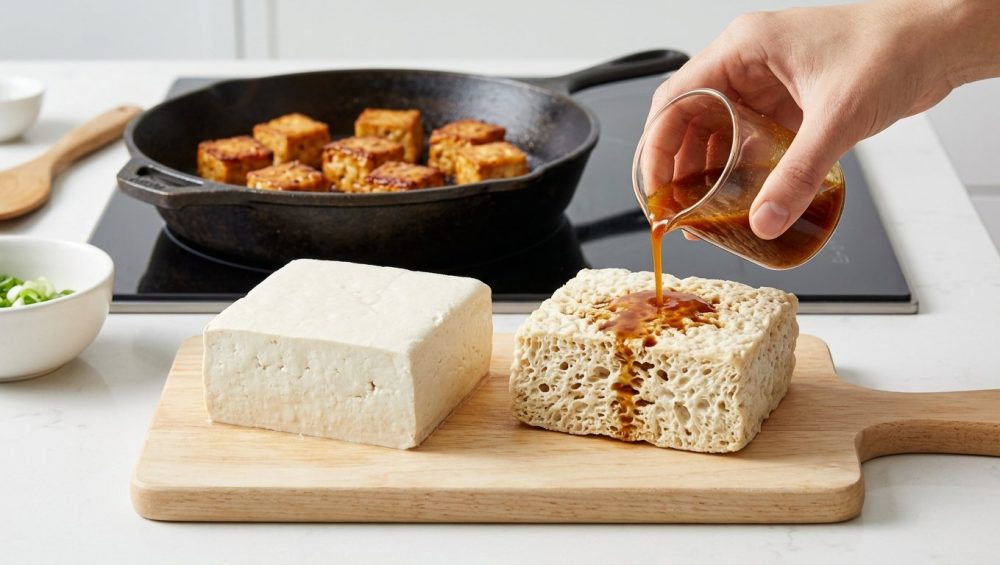
The soy protein does not snap back into its original smooth, dense shape. Instead, it leaves behind a network of large, gaping holes and cavernous capillary channels where the ice crystals used to be.
Once you press the thawed water out of these newly formed pockets, you are left with a highly porous, structurally robust sponge. The texture transforms from soft and crumbly to chewy, layered, and incredibly meaty. Even better, those empty capillary channels act as a vacuum, ready to aggressively suck up whatever marinade you throw at it. Gravimetric testing has actually shown that while unpressed, raw tofu absorbs a pathetic 12% of an applied marinade, properly prepped and pressed tofu can absorb up to an incredible 63%.
Slow Freezing vs. Fast Freezing
If you are a culinary nerd prioritizing efficiency, you might be wondering if you should chop the tofu into small cubes before freezing it to save time. For a rushed weeknight, sure, you can do that. But if you want the absolute best, meatiest texture possible, you need to freeze the block whole, in its original packaging.
Why? Because of how ice crystals form. When things freeze rapidly (like small, exposed cubes of tofu), they form very small ice crystals. Smaller ice crystals cause less structural damage to the protein network, resulting in smaller, less effective capillary holes.
When you freeze a large, solid mass slowly—like a whole, unopened block of tofu—it takes much longer for the core temperature to drop. This slow freezing process allows massive, jagged ice crystals to form. The larger the ice crystals, the larger the holes left behind when it thaws, and the spongier and meatier your final product will be.
Choosing Your Fighter: The Tofu Hierarchy
Before we get into the step-by-step methodology, we need to talk about ingredient selection. Not all tofu is created equal, and throwing the wrong type into the freezer will result in an absolute culinary disaster.
Silken Tofu: The Do-Not-Freeze Zone
Silken tofu is unpressed. It has an incredibly high water content (around 90%) and a delicate, custard-like texture. If you freeze silken tofu, the massive amount of expanding water will completely obliterate the fragile protein structure. When it thaws, it will collapse into a grainy, unappetizing puddle of mush. Save your silken tofu for smoothies, vegan mayonnaises, and delicate soups. Keep it far away from your freezer.
Medium-Firm: The Middle Ground
Medium-firm tofu can be frozen, and it will develop a slightly chewier texture, but it still contains too much water for optimal pan-searing. It tends to fall apart when you try to aggressively press it post-thaw. It is acceptable in a pinch, but it is not the ideal candidate for this technique.
Firm and Extra-Firm: The Gold Standard
This is where you want to live. Firm and extra-firm tofu have already had a significant portion of their moisture mechanically pressed out during manufacturing. They have a robust enough protein structure to withstand the violent expansion of ice crystals without completely disintegrating.
When frozen and thawed, extra-firm tofu develops a texture that is remarkably similar to the layered, fibrous chew of chicken or pork. It is the absolute best candidate for this method.
The Definitive Masterclass: How to Freeze Tofu Like a Pro
Alright, let’s get down to business. This is the foolproof, step-by-step method for transforming your sad, waterlogged soy blocks into culinary gold. This process requires zero active effort, just a little bit of forethought.
Phase 1: The Prep
There is no prep. Seriously. Do not open the package. Do not drain the water. Do not chop it into cubes.
As we established in the science section, we want maximum water content and a slow freezing process to generate the largest possible ice crystals. The water surrounding the tofu inside the sealed plastic package actually helps insulate the block, slowing down the freezing process even further.
Just take the unopened plastic tub of firm or extra-firm tofu directly from your grocery bag and toss it straight into the freezer. That’s it. You’ve just completed phase one.
Phase 2: The Deep Freeze
Leave the block in the freezer for a minimum of 14 to 24 hours. You want it to freeze completely solid, all the way to the core. If you pull it out too early, the center will remain soft and dense, and you will end up with wildly uneven textures.
Pro-Tip for the Organized Cook: Don’t just freeze one block. Whenever you go to the grocery store, buy four or five blocks of extra-firm tofu and immediately transfer them to the freezer. They will keep in there for months. You are essentially building an arsenal of pre-prepped, high-quality plant protein that you can deploy whenever you need it. Just like mastering the beginner kitchen tools you need to succeed, having a stash of frozen tofu is a foundational habit for stress-free dinners.
Phase 3: The Thaw
This is the only part of the process that requires patience. You must thaw the tofu completely before you can cook it. If you try to press or slice partially frozen tofu, it will shatter into a million crumbly pieces.
The Slow Thaw (Recommended): Move the frozen package from the freezer to the refrigerator 24 to 48 hours before you plan to cook it. This is the gentlest method and preserves the integrity of the newly formed sponge structure.
The Quick Thaw (For the Forgetful): If it’s 5:00 PM on a Tuesday and you forgot to take the tofu out of the freezer, don’t panic. Remove the frozen block from its plastic packaging (you may need to run the plastic under warm water for a few seconds to loosen it). Place the frozen ice-block of tofu in a large bowl and cover it completely with boiling water. Let it sit for 15 minutes. Carefully pour out the cooled water, and cover it with a fresh batch of boiling water for another 15 minutes. It should be fully thawed and ready to press.
Phase 4: The Press
Once the tofu is completely thawed, you will notice it looks entirely different. It will have a slightly yellowish tint, and it will feel significantly firmer and spongier to the touch.
Now, you need to evacuate the water from those newly formed capillary channels.
- Slice the thawed block into your desired shapes (slabs, cubes, or torn chunks).
- Place the pieces between two clean, lint-free kitchen towels (or heavy-duty paper towels).
- Place a heavy object on top—a cast-iron skillet, a stack of cookbooks, or your dedicated tofu press.
- Let it press for 15 to 30 minutes.
Because the protein structure has been permanently altered, the water will flow out of the tofu incredibly fast. You will be shocked by how much liquid ends up on your kitchen towels. What you are left with is a dry, highly porous, incredibly durable protein sponge.
The Weekend Perfectionist’s Secret: The Double-Freeze Method
If you thought a single freeze was transformative, buckle up. For the weekend culinary hobbyists who demand absolute perfection, let me introduce you to the Double-Freeze Method.
This technique is legendary in plant-based circles for creating a texture that is shockingly close to the fibrous, stringy pull of actual poultry. It takes time, but the active effort is still virtually zero.
Here is how you execute the Double-Freeze:
- Place an unopened package of extra-firm tofu in the freezer until completely solid (24 hours).
- Move the unopened package to the refrigerator and let it thaw completely (24 to 48 hours).
- Do not open the package. Place the fully thawed, still-sealed package back into the freezer for a second round. Let it freeze solid again (24 hours).
- Thaw it completely one final time in the refrigerator.
- Open, drain, and press.
Why does this work? The first freeze creates the initial network of large ice crystals and tears the protein matrix. When it thaws, the water settles into those new, larger pockets. The second freeze causes that pooled water to expand again, tearing the matrix even further and creating distinct, fibrous layers within the block.
When you tear (don’t chop!) double-frozen tofu into irregular chunks, it physically pulls apart in stringy layers, mimicking the muscle fibers of chicken. It is the ultimate flex for a weekend dinner party.
The Sponge Effect: Engineering the Perfect Marinade
Now that you have successfully evacuated the water from your porous tofu sponge, it is time to introduce flavor. But you cannot just dump a bottle of cheap, store-bought teriyaki sauce on it and call it a day. You need to understand the science of flavor absorption.
The Enemy of Absorption: Oil
The biggest rookie mistake I see home cooks make is adding oil to their tofu marinades. Oil and water do not mix. Even after pressing, your tofu still retains a small amount of internal moisture. If you coat the outside of the tofu with a heavy, oil-based marinade, the oil creates an impermeable hydrophobic barrier around the protein. The flavor will stubbornly sit on the outside of the block and absolutely refuse to penetrate the interior.
Keep your marinades water, soy, or vinegar-based. Save the oil for the frying pan.
The Holy Trinity: Umami, Salt, and Acid
Your frozen-and-pressed tofu is a blank canvas, which means it desperately needs aggressive seasoning. A scientifically optimized marinade requires three components:
- Salt/Umami: Soy sauce, tamari, liquid aminos, or miso paste. Salt is crucial because sodium ions actually help to partially unfold the protein chains, allowing the moisture to bind properly. Without adequate salt, your tofu will rapidly lose moisture during the cooking process and shrink into a tough little puck.
- Acid: Rice vinegar, apple cider vinegar, or citrus juice. Acidic ingredients lower the surface pH of the tofu, which helps neutralize the slightly alkaline, “beany” flavor of the soy. If you’ve ever wondered why you need acid in your cooking, this is a prime example—it brightens the entire flavor profile and masks any residual wet-cardboard notes.
- Aromatics: Garlic powder, ginger, smoked paprika, or nutritional yeast. (Note: Use powdered aromatics rather than fresh minced garlic/ginger in the marinade, as fresh bits will burn instantly when they hit the hot pan).
Toss your pressed tofu chunks in the oil-free marinade. Because of the capillary channels created by the ice crystals, the tofu will suck up the liquid in a matter of seconds. You don’t need to marinate it overnight; 10 to 15 minutes is more than enough time for the flavor to reach the very center of the block.
The Starch Wars: Choosing Your Crispy Coating
If you want an otherworldly crunch, you need to introduce a starch. After your tofu has absorbed all of its marinade, toss the pieces in a few tablespoons of a pure starch powder. But do not reach for your all-purpose baking flour. Flour contains gluten, which will turn gummy, heavy, and pale when it hits the oil. You need pure carbohydrates that crisp up instantly upon contact with hot oil.
- Cornstarch: The most accessible option. It creates a sturdy, glass-like crust that shatters beautifully and holds up decently well when tossed in a finishing sauce.
- Potato Starch: The absolute king of crispy coatings. Potato starch granules are larger than cornstarch granules, which means they absorb less oil and create a lighter, shatteringly crisp exterior that stays crunchy for much longer. This is the secret ingredient behind elite Japanese Karaage.
- Arrowroot or Tapioca: Excellent gluten-free alternatives that provide a slightly chewier, glossier crust, though they tend to get soggy faster than potato starch.
The Searing Process: Achieving the Ultimate Crunch (And Ditching Toxic Pans)
You’ve frozen it. You’ve thawed it. You’ve pressed it. You’ve marinated it. You’ve coated it in starch. Now, it is time to cook it. The goal here is a violently crispy, golden-brown exterior that gives way to a chewy, meaty interior.
The Rant: Banishing Toxic Cookware
Before we talk technique, we need to have a serious conversation about your equipment. I have zero patience for cheap, peeling, scratched-up Teflon pans. If your “non-stick” skillet has mysterious flakes of black coating peeling off into your food, throw it in the garbage immediately. You are quite literally eating forever chemicals.
Furthermore, cheap non-stick pans cannot safely handle the high heat required to achieve a proper sear on your tofu. If you heat Teflon past 500°F (which happens faster than you think on a gas stove), the coating begins to break down and release toxic fumes. It’s a culinary and environmental disaster. This is exactly why your non-stick pans lose their slip after six months of use.
If you want professional-level results, you need to use professional-level gear. A heavy-bottomed carbon steel wok, a well-seasoned cast-iron skillet, or a high-quality multi-clad stainless steel pan are your best friends here.
“But my tofu always sticks to stainless steel!” I hear you crying. No, it doesn’t. You just aren’t heating the pan correctly. You need to utilize the Leidenfrost effect. Heat your dry stainless steel pan over medium-high heat until a drop of water flicked into the pan instantly beads up and dances across the surface like a little mercury marble. Once the pan is properly heated, add your high-smoke-point oil, and then add your tofu. The intense heat instantly sears the exterior, creating a microscopic layer of steam that prevents the food sticking to stainless steel.
The Oil Primer: Smoke Points and Searing Science
Do not use extra virgin olive oil to sear your tofu. Olive oil has a low smoke point and contains unrefined particles that will burn, turn bitter, and fill your kitchen with acrid smoke before your tofu ever gets crispy.
You need a neutral, refined oil with a high smoke point. Avocado oil, grapeseed oil, or canola oil are your best options. They can withstand the aggressive heat required to polymerize the starch coating without degrading into a smoky mess.
Mastering the Maillard Reaction
The Maillard reaction is the chemical reaction between amino acids and reducing sugars that gives browned food its distinctive, complex flavor. To achieve this with your tofu:
- Get the Pan Hot: As discussed, preheat your carbon steel or cast-iron pan.
- Use Enough Fat: Tofu is incredibly lean. You need a generous slick of oil in the pan to conduct the heat evenly into the uneven crevices of your starch coating.
- Do Not Crowd the Pan: If you cram two entire blocks of tofu into a tiny 10-inch skillet, the temperature of the pan will plummet. The tofu will release its residual moisture, and instead of frying, it will sadistically steam itself in its own juices. Leave at least a quarter-inch of space between each piece. Work in batches if you have to.
- Leave It Alone: Once the tofu hits the hot oil, do not touch it. Do not nudge it. Do not aggressively shake the pan. Let it sit undisturbed for at least 3 to 4 minutes so the starch coating can solidify and the Maillard reaction can work its magic. When the bottom is a deep, golden brown, it will naturally release from the pan. Flip and repeat.
Advanced Tofu Freezing Techniques for the Weekend Perfectionist
Once you have mastered the basic freeze-and-press method, you can start experimenting with advanced applications. The frozen sponge texture opens up a world of culinary possibilities that raw tofu simply cannot match.
The “Ground Meat” Hack
If you are trying to make a plant-based Bolognese sauce, a spicy mapo tofu, or a vegan chili, frozen tofu is your secret weapon.
Take a block of frozen, thawed, and pressed extra-firm tofu. Instead of slicing it, take a standard box grater and grate the entire block on the largest holes. Because the freezing process has toughened the protein matrix, the tofu will shred beautifully into small, jagged crumbles that perfectly mimic the texture of cooked ground beef or pork.
Sauté these crumbles in a hot pan with a generous amount of oil, soy sauce, and a touch of liquid smoke. The crumbles will crisp up on the edges and absorb the savory flavors, creating a rich, meaty base for any sauce.
Pre-Marinating Before the Freeze
This is a controversial technique, but one that yields fascinating results. Instead of freezing the tofu in its original water, you drain it, press it, slice it, and submerge it in a heavily flavored broth or marinade before putting it in the freezer.
As the seasoned liquid freezes and expands inside the tofu, it forces the flavor compounds deep into the tearing protein matrix. When it thaws, the flavor is literally baked into the molecular structure of the block. This method requires a lot of extra work, but for a weekend project, it is a fun experiment in food science.
The “Chicken Nugget” Tear
Stop cutting your tofu into perfectly symmetrical cubes. Perfect cubes look like diet food. If you want your frozen tofu to feel rustic and meaty, you need to tear it.
After the freeze-and-thaw process, use your hands to rip the block into uneven, jagged chunks. These rough, torn edges create exponentially more surface area than a clean knife cut. More surface area means more jagged edges for the starch to cling to, which results in a significantly crispier, crunchier exterior when pan-fried. Plus, it saves you from ruining your good kitchen knives by hacking away at a dense block on a hard cutting board.
Troubleshooting Your Tofu Disasters
Even with the best techniques, things can go wrong. If your frozen tofu isn’t turning out like the crispy, meaty masterpiece I promised, you are likely committing one of these cardinal sins.
Problem: It’s Still Crumbly and Falling Apart
The Diagnosis: You either used the wrong type of tofu, or you didn’t let it freeze long enough.
The Fix: Ensure you are exclusively using Firm or Extra-Firm tofu. If you pull the block out of the freezer after only 6 hours, the core will still be soft. It must be frozen rock-solid, which takes a minimum of 14 to 24 hours. Additionally, make sure it is 100% thawed before you try to press it. Pressing a semi-frozen block will cause it to fracture and crumble.
Problem: It’s Spongy, But It Tastes Like Nothing
The Diagnosis: You skipped the marinade, or you used an oil-based marinade.
The Fix: Remember the sponge effect. The frozen tofu has massive, empty pockets just waiting to be filled. If you don’t aggressively season it with a water-based, high-umami marinade (like soy sauce, broth, or vinegar), you are just eating a dry, flavorless sponge. And remember, blooming your spices in oil is a great technique for building a finishing sauce, but the actual marinade that soaks into the tofu needs to be oil-free to penetrate the capillary channels.
Problem: The Coating Is Gummy, Not Crispy
The Diagnosis: You didn’t press out enough water, or your pan wasn’t hot enough.
The Fix: If the tofu is still waterlogged when you toss it in cornstarch, the starch will immediately turn into a thick, gummy paste. You must press the thawed tofu aggressively. Secondly, if your oil isn’t shimmering hot when the tofu hits the pan, the starch will absorb the oil instead of frying in it, leaving you with a greasy, soggy mess. If you want to stop eating greasy eggplant or soggy tofu, strict temperature control is your best friend.
Problem: It Burns Before It Crisps
The Diagnosis: You used a marinade with too much sugar, or you used fresh minced garlic.
The Fix: Sugars (like maple syrup, honey, or agave) and fresh aromatics (like minced garlic) burn incredibly fast in a hot skillet. If your marinade is sweet, wipe the excess off the surface of the tofu before coating it in cornstarch. Alternatively, skip the sugar in the marinade entirely, fry the tofu until it’s perfectly crispy, and then toss it in a sweet, sticky glaze off the heat.
The Bottom Line: Reclaiming Your Plant-Based Dinners
Cooking shouldn’t be a source of stress, and eating plant-based proteins shouldn’t feel like a punishment. You don’t need a culinary degree, a massive grocery budget, or a kitchen full of pretentious, single-use gadgets to make incredible food. You just need to understand the basic science of your ingredients and how to manipulate them to your advantage.
Freezing your tofu is the ultimate testament to the power of working smarter, not harder. It is a completely hands-off technique that fundamentally alters the molecular structure of the cheapest protein in the supermarket, transforming it from a watery, crumbly disappointment into a chewy, flavor-absorbing powerhouse.
It requires zero active prep time. It requires zero fancy equipment. It just requires you to take a plastic tub out of your grocery bag and toss it into the freezer instead of the fridge.
So, the next time you find yourself staring blankly into your refrigerator at 6:00 PM, wondering how you are going to turn a pale block of soy into a dinner worth eating, remember the secret power of the freezer. Embrace the ice crystals. Respect the Maillard reaction. Ditch your toxic non-stick pans. And for the love of all things holy, please stop trying to fry silken tofu.
Now, go revive your stale bread for some homemade croutons, whip up a quick side salad, and enjoy the crispiest, meatiest tofu you have ever made in your life. You’ve earned it. And remember, much like letting your batter rest before making Sunday morning pancakes, patience in the kitchen is the secret ingredient that separates the amateurs from the artists.