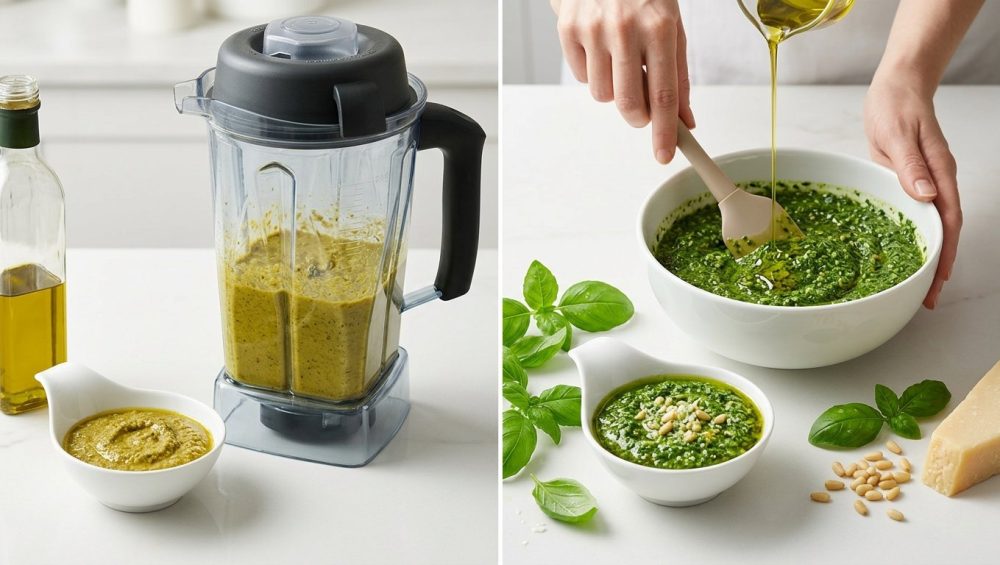
Welcome to the weekend. You have just returned from the specialty grocer, having spent a small fortune on the holy grail of Italian ingredients. You have a massive, fragrant bouquet of sweet basil, a wedge of authentic Parmigiano-Reggiano that costs more than your monthly streaming subscriptions, buttery pine nuts, and a bottle of cold-pressed, single-estate extra virgin olive oil so beautiful it belongs in a museum. You are ready to create culinary magic. You toss everything into your high-speed blender, hit the power button, and watch it whir into a vibrant, emerald-green paste. You dip a spoon in, close your eyes, and prepare to be transported to the sun-drenched cliffs of the Italian Riviera.
Instead, your face violently scrunches up. Your mouth feels like you just chewed on a bitter aspirin wrapped in aluminum foil. The sauce is harsh, metallic, and aggressively acrid. You stare at the blender in betrayal, wondering if your basil was spoiled or if your pine nuts were rancid. Nope. Your ingredients were absolutely flawless. The culprit behind this culinary crime? Your trusty kitchen appliance.
As a home cook who learned the hard way by ruining more dinners than I care to admit, I am here to tell you that you do not need a culinary degree to cook like a master—you just need to understand a little bit of food science. We are going to dive deep into the fascinating, slightly infuriating chemistry of why your high-powered appliances are destroying your delicate ingredients. By the end of this definitive masterclass, you will know exactly how to fix your bitter homemade pesto and guarantee a perfectly sweet, vibrant, and balanced sauce every single time.
The Anatomy of a Kitchen Heartbreak
When you are trying to survive the weekday grind, time is money. I am the first person to advocate for taking clever shortcuts to get dinner on the table before you lose your mind. But on the weekend, when you have the luxury of time, we strive for perfection. Pesto is a raw sauce. It is not cooked, simmered, or reduced, which means there is absolutely nowhere for flaws to hide. Every single ingredient must pull its weight, and the technique must be flawless.
When a fresh batch of basil sauce turns out inedible, most people immediately blame the ingredients. They assume the pine nuts have gone bad (which, to be fair, they do quite quickly due to their high fat content). They blame the garlic, assuming the cloves were old and sprouting green, bitter germs. They might even blame the cheese, especially if they committed the cardinal sin of using pre-shredded cheese coated in cellulose and anti-caking agents.
But what happens when you control for all of those variables? What happens when your nuts are freshly toasted, your garlic is farm-fresh, and your cheese was grated off a pristine block? The bitterness still strikes. That is because the problem is mechanical, not biological. When you are building your kitchen arsenal, it is crucial to understand that knowing the beginner tools you actually need also means understanding exactly how those tools manipulate your food at a microscopic level. Your blender does not care about your culinary dreams; it only cares about kinetic energy and shear force.
The Science of Extra Virgin Olive Oil and Polyphenols
To understand why your sauce tastes like battery acid, we have to get a little nerdy and look at the chemical makeup of your most expensive ingredient: the olive oil.
What Are Polyphenols?
Extra virgin olive oil (EVOO) is unique among culinary fats because it is essentially a fresh, unrefined fruit juice. Because it is not subjected to chemical refining or high heat, it retains all of its natural organic compounds. The most notable of these are polyphenols, specifically compounds known as oleuropein and oleocanthal.
These polyphenols are incredibly powerful antioxidants. They are the exact compounds responsible for the renowned anti-inflammatory and heart-healthy benefits of the Mediterranean diet. However, they are also the exact same compounds that make raw, uncured olives taste like absolute poison straight off the tree. In a high-quality bottle of oil, there can be over thirty different types of phenols, but oleuropein is the primary driver of that distinct, sharp bitterness.
The Protective Lipid Bubble
In a pristine bottle of EVOO, these bitter polyphenol molecules are safely suspended within fatty acids. You can think of the fat as a protective, microscopic bubble. Because polyphenols are highly hydrophilic (water-soluble), this lipid coating acts as a crucial buffer.
When you pour a glug of beautiful olive oil onto a plate and dip a piece of crusty sourdough bread into it, the oil droplets remain relatively intact. The lipid bubble prevents the bitter compounds from instantly dissolving into the watery environment of your saliva. Instead of a harsh chemical burn, you taste a pleasant, grassy, and slightly peppery finish at the back of your throat. That peppery kick is the hallmark of a world-class oil. As long as the oil’s structure remains whole, the bitterness is controlled and enjoyable. Naturally, to protect this delicate balance before you even start cooking, you must store olive oil properly in a cool, dark place to prevent premature oxidation.
The Hidden Trap of the High-Speed Blender
Enter the modern food processor and the high-speed blender. These appliances are engineering marvels, capable of pulverizing ice and turning raw nuts into creamy butter in seconds. But that sheer power is exactly what ruins your delicate raw sauces.
The Physics of Shear Force
Blender blades operate at thousands of revolutions per minute (RPM). They do not gently mix your ingredients; they violently shear them. When you pour your beautiful, polyphenol-rich extra virgin olive oil into a blender and hit the highest speed, you are subjecting the oil to extreme physical trauma. The blades tear the oil droplets into microscopic fragments, drastically reducing their size and exponentially increasing their surface area.
Emulsification Gone Wrong
This violent mechanical action literally strips the protective lipid coating right off the polyphenols. Suddenly, those bitter, water-soluble compounds are naked and exposed.
Because your sauce contains water—from the fresh basil leaves, the ambient moisture of the garlic and cheese, and perhaps a squeeze of lemon juice—these newly liberated polyphenols immediately leach out of the fat and dissolve directly into the liquid phase of the emulsion. Once they are dissolved in the water, they completely bypass any remaining lipid barriers. When you take a bite, those dissolved compounds bind instantaneously and directly to the bitter taste receptors on your tongue. The result is a total sensory hijacking. The sweet, herbal notes of the basil and the rich umami of the parmesan are completely obliterated by an overwhelming, metallic bitterness.
The Heat Factor
If the mechanical shearing wasn’t bad enough, we also have to talk about thermodynamics. Blenders and food processors generate a massive amount of friction, which translates directly into heat. Running a blender for even sixty seconds creates a localized heat vortex around the blade assembly. Heat is the mortal enemy of extra virgin olive oil, accelerating oxidative degradation and bringing out stale, rancid notes that further compound the bitter flavor.
Furthermore, this heat wreaks havoc on your storage containers. When hot, oxidized oils emulsify into plastics, it becomes a nightmare to clean greasy plastic containers later, leaving a permanent film of rancid oil that taints your future leftovers.
The Great Basil Debate: Oxidation and Bruising
It is not just the olive oil that suffers under the wrath of the blender blade. Basil is notoriously one of the most dramatic, fragile herbs in the culinary world.
Polyphenol Oxidase and Browning
Basil leaves contain a highly reactive enzyme called polyphenol oxidase. When the fragile cell walls of the basil leaf are ruptured and exposed to oxygen, this enzyme triggers a rapid chemical reaction that turns the bright green leaves brown or even black. When a high-speed blender pulverizes the basil, it aerates the mixture, whipping oxygen directly into the crushed cellular structure of the herb. This guarantees a swampy, unappetizing, military-green sludge instead of the vibrant emerald sauce you were hoping for.
The Dull Blade Dilemma
This problem is magnified tenfold if the blades of your appliance are dull. A sharp blade makes a clean, microscopic slice through the plant tissue, minimizing the amount of cellular trauma. A dull blade, however, does not cut; it bludgeons and crushes. This massive cellular destruction releases a flood of bitter enzymes and rapidly accelerates oxidation. This is the exact same mechanical reason why kitchen knives get dull and end up bruising your delicate herbs on the cutting board rather than slicing them cleanly.
The Sassy Sous-Chef’s Foolproof Pesto Method
Alright, enough doom and gloom. You now understand the chemistry of why your sauce tastes awful. Now, I am going to teach you how to fix it. I am a fierce advocate for efficiency, and I promise you that this foolproof method takes exactly one extra minute of your time, but it will save your thirty-dollar batch of premium ingredients from the trash can.
Step 1: Prep and Toast
First, always toast your nuts. Pine nuts are traditional, but walnuts, pistachios, or even almonds work beautifully. Toasting them in a dry skillet over medium heat releases their natural essential oils and deepens their savory flavor. However, you must let them cool completely before they go anywhere near the basil. Throwing hot nuts into a food processor with delicate herbs will instantly cook the leaves and turn them black.
Step 2: The Dry Pulse
Add your garlic cloves, your cooled toasted nuts, and a generous pinch of coarse sea salt to the bowl of your food processor. Pulse this mixture until it is coarsely ground. Next, add your fresh basil leaves and your freshly grated cheese. Pulse again.
Do not add the olive oil yet! If the mixture is too dry and struggling to catch the blades, you can add a tiny splash of ice-cold water or a neutral oil (like grapeseed, avocado, or canola oil, which do not contain those bitter polyphenols). Pulse just until the mixture forms a rough, vibrant green paste. Do not over-process it into a puree; you want texture.
Step 3: The Gentle Fold
This is the magic trick that changes everything. Remove the blade from the food processor, and scrape that beautiful, chunky, aromatic paste into a separate mixing bowl. Now, take your expensive, gorgeous extra virgin olive oil and gently fold it into the paste by hand using a silicone spatula or a wooden spoon.
By gently stirring the oil into the solids by hand, you maintain the structural integrity of those lipid bubbles. The oil is incorporated perfectly, but the polyphenols stay safely tucked away inside their fatty armor. Your sauce will remain sweet, nutty, and perfectly balanced. Furthermore, if you want to keep your pesto bright green for days in the fridge, this gentle hand-folding prevents the rapid, heat-induced oxidation caused by aerating the sauce in a blender.
The Mortar and Pestle: Pretension or Perfection?
If you truly want to embrace the art of weekend cooking and be an absolute perfectionist, you should ditch the electrical appliances entirely.
Traditional Ligurian Techniques
The word “pesto” originates from Genoa in the Liguria region of Italy. It is derived from the Italian verb “pestare,” which literally translates to “to pound” or “to crush.” Traditionally, this sauce never saw a spinning metal blade.
Crushing vs. Shearing
A mortar and pestle does not shear the ingredients; it gently crushes them. Crushing basil leaves against stone releases their essential oils without creating the violent aeration and heat of a machine. Crushing garlic with coarse salt breaks it down into a sweet, mellow paste. Emulsifying the olive oil with a slow, grinding, circular pestle motion gently incorporates the fat without shattering the polyphenol molecules.
Yes, it takes ten minutes of elbow grease, but it is a deeply therapeutic, aromatic process. If you ever want to host a mindful pesto night with friends, making the sauce by hand at the kitchen island with a glass of wine is an incredible, interactive centerpiece activity. The texture achieved by a mortar and pestle—creamy, yet distinctively rustic—cannot be replicated by a machine.
Choosing the Right Mortar
If you are going to go the traditional route, do not buy a tiny, lightweight ceramic mortar meant for grinding a few peppercorns. You need a heavy, unpolished marble mortar and a sturdy wooden pestle (traditionally made of olive wood). The friction of the wood against the rough stone provides the perfect abrasive texture for grinding tough leaves into a luxurious, creamy sauce.
Ingredient Quality: You Can’t Fake Good Pesto
Because this sauce is entirely raw, the quality of your ingredients is paramount. You cannot hide cheap ingredients behind complex cooking techniques.
The Olive Oil Selection
Not all olive oils are created equal, and not all of them belong in your raw sauces. For pesto, you should actively avoid early-harvest, robust, ultra-peppery oils, as their polyphenol count is naturally much higher. Instead, seek out mild, buttery, late-harvest oils. Oils from the Liguria region of Italy (often made from Taggiasca olives) are historically famous for their smooth, sweet, and delicate flavor profiles, making them the gold standard for this specific application.
The Cheese and The Nuts
I will say it again: never, under any circumstances, use cheese from a plastic shaker can. Those products are loaded with dehydrated dairy powders and wood pulp (cellulose) to prevent clumping. Buy a wedge of real Parmigiano-Reggiano and, if you want to be truly authentic, a piece of Pecorino Fiore Sardo. Grate them fresh. The natural fats and salts in real cheese are essential for binding the sauce together.
The Garlic Equation
Garlic is another ingredient that turns aggressively bitter when abused by improper tools. The more you destroy garlic cells, the more the enzyme alliinase reacts to create allicin, the highly pungent, spicy, and bitter compound in garlic. This severe cellular destruction is exactly garlic presses create bitterness in your food. Instead of pressing it, mince your garlic finely with a sharp knife, or pound it into a paste in your mortar.
And please, if you are adapting your fresh sauce into a warm pasta dish, stop adding garlic first to a hot, dry pan. It will scorch in seconds, compounding the bitterness and ruining the entire meal before you even boil the water.
Troubleshooting Your Pesto Disasters
We have all been there. You are reading this article, but it is too late. Your food processor is already full of bitter green sludge. Can it be saved?
Can You Save Bitter Pesto?
Sort of. You cannot reverse the chemical reaction that released the polyphenols, but you can attempt to mask them. Your best bet is to add fat and dairy to coat the palate. Stirring in a tablespoon of fresh, whole-milk ricotta cheese or a splash of heavy cream can significantly mellow out the harshness. Alternatively, a squeeze of fresh lemon juice can help balance the bitterness with bright acidity, while adding a bit more grated parmesan can act as a salty distraction. It won’t be traditional, but it will be edible.
Storing and Freezing
If you manage to make a perfect batch, storing it correctly is vital. Transfer the sauce to a glass jar, tap it on the counter to remove air bubbles, and pour a thin layer of olive oil over the top surface. This oil layer acts as a seal, blocking out oxygen and preventing the basil from turning brown in the fridge. If you want to freeze it, spoon the sauce into silicone ice cube trays, freeze until solid, and pop the cubes into a freezer bag for a burst of summer flavor in the middle of winter.
The “No-Go” Rule: Toxic Blenders and Cheap Gear
As your Sassy Sous-Chef, I cannot write a masterclass on kitchen equipment without taking a moment to rant about the absolute state of modern consumer kitchenware. I firmly believe that anyone can cook like an expert without a culinary degree, but you cannot cook safely with garbage tools. I absolutely despise cheap, toxic kitchenware.
If your blender jar is made of cheap, cloudy plastic that scratches easily, you need to throw it away. Those microscopic scratches harbor bacteria and leach microplastics directly into your acidic foods. If the blade assembly at the bottom of your processor looks rusted, or if the bearings smell like burning metal when you turn the machine on, that metallic tang is transferring directly into your delicate sauces.
Do not even get me started on cheap, peeling non-stick cookware. If the black coating on your pans is flaking off into your scrambled eggs, you are actively ingesting toxic chemicals. I am a fierce, unrelenting advocate for banishing toxic kitchen gear from your home immediately.
Invest in a food processor with a heavy-duty, BPA-free or glass bowl, and solid stainless steel blades that actually hold an edge. Buy a heavy marble mortar and pestle. Transition to carbon steel, cast iron, or high-quality stainless steel pans. Quality tools are not a pretentious luxury; they are a strict prerequisite for safe, durable, and delicious home cooking. Stop treating your food like a science experiment gone wrong and buy gear that respects your ingredients.
Conclusion: Reclaiming Your Kitchen Confidence
Culinary perfection is not locked behind the doors of a Michelin-starred restaurant. It is entirely achievable in your standard, everyday home kitchen. You do not need a fancy chef’s coat or a degree from a culinary institute; you just need to understand how your ingredients behave and how your tools interact with them.
By respecting the complex chemistry of extra virgin olive oil, understanding the violent physics of your blender blades, and taking the extra sixty seconds to gently fold your sauce by hand, you have unlocked the secret to world-class, vibrant, and sweet pesto. You have conquered the hidden trap of the blender. Now, go pour yourself a large glass of wine, boil a pot of perfectly salted pasta, and enjoy the magnificent fruits of your labor. You’ve earned it.