Grab a glass of wine, take a deep breath, and put down the roll of aluminum foil. We need to have a serious conversation about what you are doing to your side dishes.
Listen, I get it. It is a random Wednesday night, you are exhausted from staring at spreadsheets all day, and you just want to get a meal on the table without setting off the smoke detector. You grab a couple of sad-looking Russet potatoes from the pantry, wrap them tightly in little silver spacesuits, and toss them into the oven. You probably learned this trick from your mother, who learned it from her mother, or maybe you saw a local steakhouse doing it. It feels right. It feels traditional.
It is also completely, fundamentally, and scientifically wrong.
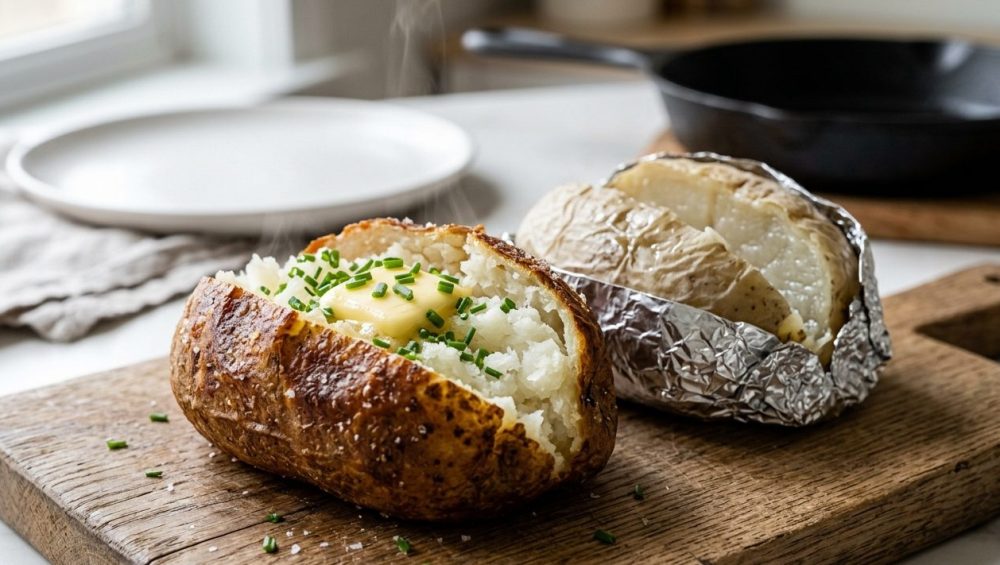
I am entirely committed to banishing toxic kitchen gear and useless cooking myths from my home, and the foil-wrapped baked potato is public enemy number one. You do not need a culinary degree to cook like an absolute expert, but you do need to understand the basic physics of the food you are preparing. When you wrap a potato in foil, you are not baking it. You are boiling it in its own sweat. You are robbing yourself of the textural contrast that makes a true baked potato one of the greatest culinary delights on the planet: a shatteringly crisp, heavily seasoned skin giving way to a light, fluffy, crystalline interior that practically melts when it meets a pat of butter.
Today, we are going to debunk this widespread culinary myth, dive deep into the food science of starch and steam, and teach you how to achieve absolute restaurant-quality perfection in your standard home kitchen. No pretentious chef-speak, no expensive gadgets—just pure, unadulterated potato mastery.
The Aluminum Foil Myth: How We Started Mummifying Our Spuds
If wrapping potatoes in foil is such a culinary disaster, why does everyone do it? Why do diners, steakhouses, and caterers serve them this way? The answer has absolutely nothing to do with flavor or texture, and everything to do with the harsh realities of the commercial food industry.
The Restaurant Industry’s Dirty Little Secret
In a bustling restaurant kitchen, timing is everything. A massive Russet potato can take upwards of an hour to bake properly. When a customer orders a steak and a baked potato, the kitchen cannot wait an hour for the side dish to cook. To solve this logistical nightmare, restaurants bake hundreds of potatoes ahead of time.
However, once a potato is fully baked, it loses its heat rapidly. To keep the potatoes piping hot throughout a busy dinner service, restaurants wrap them in aluminum foil and throw them into a warming drawer. The foil acts as an insulator, trapping the residual heat and moisture so the potato does not dry out while it sits under a heat lamp for three hours.
They do not wrap the potato in foil to make it taste better. They do it for inventory management. Just as you should stop ruining your nonstick pans with cheap aerosol cooking sprays, you need to stop ruining your weeknight dinners by adopting commercial kitchen shortcuts that were never meant for the home cook.
The “Faster Cooking” Delusion
The second part of the foil myth is the persistent belief that wrapping a potato in metal makes it cook faster. The logic seems sound on the surface: metal conducts heat, so wrapping the potato in metal should drive heat into the center more quickly, right?
Wrong. Aluminum foil is incredibly thin and has a very low thermal mass. While it does conduct heat, its primary function in the oven is actually reflecting thermal radiation. When you wrap a potato in shiny foil, the foil reflects a portion of the oven’s radiant heat away from the potato. Furthermore, the foil acts as a barrier to convection—the circulation of hot air that is crucial for baking. Instead of speeding up the cooking process, the foil often increases the total baking time. You are effectively shielding the potato from the very heat it needs to cook efficiently.
The Food Science of a Ruined Potato: Steaming vs. Baking
To truly understand the tragedy of the foil-wrapped potato, we have to look under the microscope. We need to talk about what a potato actually is, and what happens to it when exposed to high heat.
Anatomy of a Russet: Starch, Water, and Culinary Potential
Not all potatoes are created equal. If you want a perfect baked potato, you must use a high-starch, low-moisture potato, and the undisputed king of this category is the Russet (often called an Idaho potato).
A raw Russet potato is composed of roughly 79% water and 21% solids, the vast majority of which is starch. These starch granules are tightly packed inside the potato’s cells. When you expose the potato to heat, the water inside the potato begins to heat up. As the internal temperature climbs, the tightly coiled starch molecules begin to absorb this internal moisture. They swell, expand, and eventually burst in a process called starch gelatinization.
This process is what creates that beautiful, mealy, fluffy texture. However, for the texture to remain light and fluffy, the excess water must be allowed to evaporate and escape as steam. You already know that soggy roasted veggies are a culinary tragedy, so why would you intentionally trap moisture inside your potato?
The Thermodynamics of Trapped Moisture
Here is where the physics of the foil wrapper ruins your dinner. When you tightly seal a potato in aluminum foil, you create an impermeable micro-environment. As the potato heats up and the 79% water content begins to turn into steam, that steam has nowhere to go.
Instead of venting out into the dry heat of the oven, the steam is trapped against the skin of the potato. The foil forces the steam back into the flesh. You are no longer baking the potato in dry, ambient heat; you are steaming it in a tiny, pressurized metallic sauna. Because water cannot exceed 212°F (100°C) without turning into a gas, the trapped moisture clamps the maximum surface temperature of the potato at the boiling point.
The result? The starch absorbs too much water and becomes heavy, dense, and gummy. The interior turns into a wet, heavy paste instead of light, crystalline flakes.
The Maillard Reaction (And Why Foil Kills It)
The interior texture is only half the battle. A truly spectacular baked potato is defined by the contrast between its fluffy interior and its crispy, savory, crackling skin.
Browning in the kitchen is governed by the Maillard reaction—a complex chemical reaction between amino acids and reducing sugars that creates hundreds of new flavor compounds and a deeply browned, crispy exterior. However, the Maillard reaction only occurs rapidly at temperatures above 285°F (140°C).
Remember how the trapped steam in a foil wrapper limits the surface temperature of the potato to 212°F? Because the skin of a foil-wrapped potato is constantly bathed in steam, it can never reach the temperature required for the Maillard reaction to take place. You might have wondered why your baking sheets warp under intense, dry heat, but that same intense, dry heat is exactly what your potato needs to crisp up. The foil guarantees a pale, wet, leathery skin that most people end up throwing in the trash.
The Dark Side of the Foil: The Very Real Risk of Botulism
If the promise of a gummy interior and a soggy skin is not enough to deter you from the foil habit, perhaps the threat of a deadly neurotoxin will do the trick. I am not being hyperbolic. Wrapping potatoes in foil poses a legitimate, documented food safety hazard.
The Anaerobic Danger Zone
Potatoes grow in the dirt, and the soil is the natural home of Clostridium botulinum, the bacterium responsible for botulism. These bacteria produce highly heat-resistant spores that can easily survive the high temperatures of your oven.
Under normal circumstances, these spores are harmless. However, Clostridium botulinum is an anaerobic bacterium, meaning it only thrives and produces its deadly toxin in environments where oxygen is completely absent.
When you wrap a hot potato tightly in aluminum foil, you cut off the oxygen supply. If you then leave that foil-wrapped potato sitting out on the counter to cool, or if you keep it warm in an unheated oven, the temperature of the potato will eventually drop into the food safety “danger zone” (between 40°F and 140°F). You have now created the perfect storm: a warm, moist, oxygen-free environment. The surviving spores will germinate and begin producing botulinum toxin, one of the most lethal poisons known to humanity.
The 1994 El Paso Outbreak: A Cautionary Tale
This is not just a theoretical scientific warning. In April 1994, the city of El Paso, Texas, experienced the largest outbreak of botulism in the United States in over a decade. Thirty people were severely sickened, and four required mechanical ventilators to breathe.
The CDC traced the outbreak back to a local Greek restaurant. The culprit? A potato-based dip called skordalia. The restaurant had baked a massive batch of potatoes wrapped tightly in aluminum foil. Instead of refrigerating them immediately or unwrapping them, they left the foil-wrapped potatoes sitting at room temperature for several days before using them to make the dip. The anaerobic environment inside the foil allowed the botulism toxin to flourish.
If you absolutely must bake a potato in foil (which, after reading this, you shouldn’t), you must unwrap it the absolute second it comes out of the oven to reintroduce oxygen and halt any potential bacterial growth. It is the same logical principle as why potatoes cook unevenly when you drop them into boiling water—ignoring the science of the ingredient leads to disastrous results.
The Masterclass: How to Actually Bake a Potato
Now that we have thoroughly dismantled the foil myth, it is time to build you back up. As the Sassy Sous-Chef, I promise you that achieving potato perfection requires zero expensive gadgets and very little active effort. It just requires proper technique. Here is the definitive, foolproof method for the ultimate baked potato.
Step 1: The Selection and the Scrub
Start with the right ingredient. Buy large, firm Russet potatoes. Avoid anything with a green tint (which indicates the presence of solanine, a bitter toxin) or sprouting eyes.
Because we are going to make the skin so incredibly crispy and delicious that you will want to eat it like a potato chip, you need to clean it thoroughly. Scrub the potatoes under cold running water with a vegetable brush to remove all the dirt.
Once washed, you must dry them completely. And I mean bone dry. Use a clean kitchen towel or paper towels to remove every drop of surface moisture. If the potato goes into the oven wet, that water will steam, delaying the crisping process. You do not want to be scrubbing stainless steel pans unnecessarily, and you certainly do not want to be wiping up a steamy mess in your oven. Dry the spud.
Step 2: The Crucial Prick (Do Not Skip This)
If you have ever had a potato explode in your oven, it is because you skipped this step. As the water inside the potato turns to steam, the internal pressure builds dramatically. If that pressure has no escape route, the potato will detonate, leaving you with a horrific, starchy mess to clean off your oven walls.
Take a standard dinner fork and pierce the potato 6 to 8 times all over. You do not need to stab it all the way to the core; just pierce the skin about a quarter-inch deep. These tiny holes act as exhaust vents, allowing the steam to gently escape during the baking process, ensuring the interior becomes fluffy rather than waterlogged.
Step 3: The Brining and Oiling Debate
Here is where culinary experts slightly disagree, so I will give you the brutally honest breakdown.
Some recipes tell you to rub the raw potato with olive oil and salt before putting it in the oven. The problem with this method is that oil can soak into the raw skin, and over the course of an hour in a 400°F oven, that oil can actually make the skin tough and leathery rather than light and crispy. It is the same reason your garlic always burns if you treat it with the wrong heat at the wrong time.
The superior method—championed by test kitchens and food scientists alike—is the delayed-oil technique.
First, prepare a simple saltwater brine (about 2 tablespoons of kosher salt dissolved in half a cup of warm water). Toss your dry, pricked potatoes in this brine to coat them, and then place them on your baking rack. The water will evaporate in the first few minutes of baking, leaving behind a fine, even crust of salt that draws out moisture from the skin, aiding in the crisping process.
You will wait to apply the oil until the very end of the bake.
Step 4: The Wire Rack Elevation Strategy
Do not place your potatoes directly on a baking sheet. A flat baking sheet cuts off airflow to the bottom half of the potato, resulting in an uneven bake and a soggy bottom.
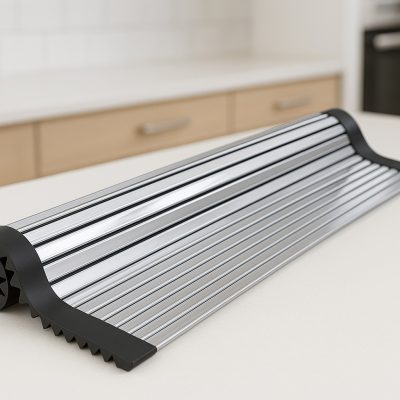
Instead, place a wire cooling rack inside a rimmed baking sheet, and place your potatoes on the wire rack. This setup allows the hot convection air of the oven to circulate 360 degrees around the potato, ensuring perfectly even cooking and a uniformly crispy skin.
Bake the potatoes in a preheated 400°F (200°C) oven. This high heat is non-negotiable. Lower temperatures will not drive off the steam fast enough, and higher temperatures run the risk of burning the exterior before the interior is cooked through.
The Magic Number: Temperature Control and the 205-Degree Rule
How do you know when a baked potato is actually done? Most home cooks just give it a gentle squeeze with an oven mitt. If it yields, they pull it out. This is a terrible way to cook.
Why Guesswork Ruins Dinners
Squeezing a potato tells you that the outer layers have softened, but it tells you absolutely nothing about the core. If your meat thermometer is lying in a drawer unused while you bake potatoes, you are making a massive mistake. A digital instant-read thermometer is not just for steaks and Thanksgiving turkeys; it is the ultimate secret weapon for perfect vegetables and baked goods.
The Chemistry of Starch Gelatinization at 205°F
Through exhaustive testing, food scientists at America’s Test Kitchen determined that the absolute perfect internal temperature for a baked Russet potato is between 205°F and 212°F (96°C to 100°C).
At exactly 205°F, the starch granules have fully absorbed the available moisture, swelled to their maximum capacity, and burst, creating the ultimate fluffy texture. If you pull the potato at 190°F, the starches haven’t fully gelatinized, and the center will be hard and waxy. If you let it push past 212°F for too long, all the moisture will evaporate, and you will be left with a dry, dusty interior that no amount of sour cream can rescue.
Start checking the internal temperature of your potatoes after about 45 to 50 minutes of baking. Push the thermometer probe directly into the thickest part of the center.
The Oiling Step: When the potato reaches an internal temperature of about 195°F (about 10 minutes before it is fully done), pull the tray out. Now, brush the potatoes lightly with vegetable oil, bacon fat, or beef tallow. Return them to the oven for the final 10 minutes. This late application of fat hits the dehydrated skin and essentially oven-fries it, creating a shatteringly crisp, potato-chip-like exterior.
The Critical Post-Bake Window: Venting the Steam
You have hit 205°F. You pull the gorgeous, salt-crusted, crispy-skinned potatoes out of the oven. You are not done yet. The next ten seconds are critical.
The Immediate Slice and Squeeze
Even though the potato is out of the oven, the interior is still trapped at 205°F, and steam is still actively generating. If you let the potato sit on the counter intact, that residual steam will condense as the potato cools, falling back into the starches. If your mashed potatoes are gluey, it is because of mishandled starch, and the same rule applies here. You must vent the potato immediately.
Grab a sharp paring knife and immediately cut a deep slit down the length of the potato. Using a clean kitchen towel to protect your hands, grab the potato by the ends and push them inward and upward. This forces the slit to blossom open, exposing the interior.
You will see a massive plume of steam rise into the air. That is the enemy escaping. By blossoming the potato immediately, you allow the final excess moisture to vent into the atmosphere. The starches left behind will dry out just enough to become incredibly light, fluffy, and snow-like.
Why Resting is for Meat, Not Potatoes
We are so conditioned to “rest” our food. We rest steaks to redistribute juices. We rest casseroles to let them set. Do not ever rest a baked potato. A baked potato is at its absolute peak of perfection the exact minute it comes out of the oven and is vented. Every minute it sits, it loses its fluffy texture and the skin begins to soften. Serve them immediately.
Elevating the Humble Spud: Toppings and Weeknight Efficiency
Now that you have a perfectly baked, fluffy, crispy-skinned Russet, how you dress it is up to you. But as a busy professional who values both time and flavor, I have a few strong opinions on how to integrate this masterpiece into your weekly rotation.
Time-Saving Weeknight Hacks
I know what you are thinking: “Sassy Sous-Chef, I do not have an hour to bake a potato on a Tuesday night.” I hear you. Time is money. But please, do not resort to the microwave. A microwave heats unevenly, boiling the water inside the potato so violently that the starches turn into a sticky, dense glue.
If you are short on time, use the hybrid method. Prick the potatoes and microwave them for exactly 5 to 6 minutes just to get the internal temperature moving. Then, transfer them immediately to a preheated 425°F oven on a wire rack to finish cooking and crisp the skin (about 20 to 25 minutes). You get the speed of the microwave with the crispy skin and fluffy texture of the oven. It is the same reason your kitchen knives get dull when you use the wrong cutting board—using the wrong tool for the whole job ruins the result, but combining tools smartly saves the day.
When it comes to toppings, compound butters are your best friend. Take five minutes on a Sunday to mash softened high-quality butter with roasted garlic, fresh chives, a pinch of smoked paprika, and flaky sea salt. Roll it in parchment paper and keep it in the fridge. Drop a slice of this flavor bomb into your steaming hot, perfectly baked potato, and you have a side dish that outshines the main course.
Ditching Toxic Cookware for Better Bakes
Part of mastering the home kitchen is respecting your ingredients enough to use safe, high-quality gear. Aluminum foil is incredibly useful for covering a resting turkey or lining a drip pan, but it has no business being tightly wrapped around your acidic or high-heat foods. Heavy-duty stainless steel wire racks, uncoated aluminum baking sheets (that you line with unbleached parchment for cookies, not foil), and a reliable digital thermometer are the only tools you need. Stop wasting money on cheap, peeling non-stick foil wraps or gimmicky potato-baking bags.
Conclusion: Reclaiming the American Baked Potato
The baked potato is a cornerstone of American comfort food, but for decades, we have treated it with profound disrespect. We have suffocated it in foil, steamed it into a gummy paste, and subjected it to the indignity of the microwave, all in the name of false convenience.
You now possess the scientific knowledge and the culinary technique to do better. You understand the thermodynamics of steam, the chemistry of starch gelatinization, and the life-saving importance of avoiding the anaerobic botulism danger zone.
The next time you are preparing a steak dinner or hosting a backyard BBQ, leave the aluminum foil in the drawer. Wash your Russets, dry them thoroughly, prick them with purpose, and let the dry, circulating heat of your oven work its magic. Hit that perfect 205°F internal temperature, blossom them immediately, and watch as your family marvels at the impossibly fluffy interior and the shatteringly crisp skin.
Cooking is not about magic; it is about understanding the rules of heat and moisture. Respect the spud, trust the science, and reclaim the perfect baked potato.