We have all been there, standing over the stove on a chilly Tuesday evening, staring down a pot of soup that has been simmering away for hours. You did everything right. You diligently chopped your mirepoix, you seared the meat until it was deeply caramelized, and you used that expensive, organic, free-range bone broth you bought on a whim. You dip a wooden spoon into the bubbling cauldron, blow on it gently, take a hopeful sip, and… it tastes like hot, muddy dishwater.
It is completely flat. It is heavy, it is boring, and it lacks that vibrant, mouth-watering “punch” you get when you order a bowl of soup at your favorite restaurant. Panic sets in. You grab the kosher salt and aggressively toss in a heavy pinch. You stir, you taste again, and now? Now it just tastes like salty dishwater.
Welcome to the most common, frustrating, and universal kitchen tragedy known to the weekend culinary hobbyist. But before you dramatically throw the entire pot down the garbage disposal, aggressively scrub the pot, and order expensive Thai takeout in a fit of rage, take a deep breath. You do not need a culinary degree to fix this. You do not need twenty obscure spices. You just need to understand a fundamental, foundational rule of culinary science that professional chefs use every single day.
You need a finishing acid.
I firmly believe that absolutely anyone can cook like an expert in a standard home kitchen, provided they understand the why behind the food, rather than just blindly following a recipe card. Today, we are going to dive deep into the culinary science of flavor balance. We are going to explore why slow-cooked meals lose their luster, how your taste buds actually process sodium, and how a simple, zero-cost splash of vinegar or citrus can instantly elevate your comforting dinners from dull to mind-blowing.
The Culinary Science of Flavor Balance (Or Why Your Soup Went to Sleep)
To understand how to fix a broken, flat-tasting soup, we first have to understand what happens inside that Dutch oven during a long, slow cook. Making a great soup or stew is fundamentally an exercise in extraction and transformation. But that transformation comes with a biological cost to the ingredients.
The Evaporation of Volatile Compounds
When you simmer vegetables, herbs, and aromatics in a liquid, you are breaking down their rigid cellular walls and releasing their internal flavor molecules into the broth. However, the most vibrant, herbaceous, and fresh-tasting molecules in your ingredients are what food scientists call “volatile flavor compounds”.
The word “volatile” in chemistry simply means that these compounds have a very low boiling point. They vaporize and turn into a gas at temperatures much lower than the boiling point of water (212°F or 100°C). When you see that wonderful, fragrant steam rising from your soup pot and filling your kitchen with the smell of dinner, what you are actually smelling are the flavor compounds physically leaving your food and evaporating into thin air.
This is exactly why your homemade chicken broth turns cloudy and loses its delicate flavor if you aggressively boil it to death instead of treating it with respect. A vigorous, rolling boil violently agitates the ingredients and drastically accelerates the vaporization of these delicate aromatic molecules. Understanding how to control your stove’s temperature is the key to maintaining a gentle simmer (around 185°F to 205°F), which extracts flavor without instantly destroying it.
But here is the catch: even with a perfect, gentle simmer, hours on the stove will inevitably mute the bright, fresh notes of your ingredients. Time is the enemy of volatility. By the time your beef is fork-tender and your root vegetables are soft, the sharp, zippy flavors of your onions, carrots, and herbs have literally floated away, leaving behind a flavor profile that is deep, earthy, but entirely one-dimensional.
Fat Rendering, Collagen, and the “Heavy” Mouthfeel
While the bright flavors are evaporating, something else is happening in the pot. If you are cooking a meat-based soup or stew, the low and slow heat is melting the connective tissues (collagen) in the meat and turning them into rich, silky gelatin. Simultaneously, the intramuscular fats are rendering out and emulsifying into the cooking liquid.
This process is essential for creating a broth with “body”—that luxurious, lip-smacking texture that separates a great soup from a watery bowl of sadness. Furthermore, the Maillard reaction (the chemical browning of proteins and sugars that occurred when you seared your meat and vegetables) combined with lipid oxidation during the long simmer creates a massive amount of savory, umami-rich flavor molecules.
However, fat and gelatin coat the tongue. They create a physical, microscopic film over your taste buds. When your palate is coated in rich, heavy lipids, it physically struggles to perceive nuanced flavors. The soup tastes “muddy” or “flat” not because it lacks flavor, but because the flavor is trapped behind a wall of rendered fat, and the bright, volatile compounds that usually cut through that fat evaporated three hours ago.
The Salt Trap: Why More Sodium Won’t Save You
When a home cook tastes a heavy, flat, muddy soup, their immediate, panicked reflex is to reach for the salt. It makes sense on paper; salt is a universal flavor enhancer. But this is where we need to draw a hard line between a dish that is under-seasoned and a dish that is unbalanced.
Under-Seasoned vs. Unbalanced
If you taste your soup and it literally tastes like hot water, it is under-seasoned. It needs salt. But if you taste your soup and you can detect the savory depth of the beef, the earthiness of the mushrooms, and the umami of the tomato paste, yet the dish still feels like it is missing a heartbeat, it is unbalanced.
If you have already added a heavy pinch of kosher salt and the bowl still lacks a vibrant oomph, you need to stop reaching for the salt immediately. Adding more sodium at this stage will not magically resurrect the evaporated volatile compounds, nor will it strip the heavy fat from your tongue. It will simply push the dish into the dreaded, unpalatable territory of being aggressively over-salted.
The Biology of Taste: How Acid Hijacks Your Taste Buds
To truly understand why we need to step away from the salt shaker, we have to look at the fascinating biology of the human tongue. Our taste buds are comprised of neuroepithelial cells that act as receptors for the five basic tastes: sweet, salty, sour, bitter, and umami.
For decades, culinary instructors have taught that acid “enhances” salt, but recently, molecular biologists have actually proven exactly how this works on a cellular level. Your tongue detects dietary sodium through specific pathways called Epithelial Sodium Channels (ENaC). When you add an acidic ingredient (which is scientifically defined by a high concentration of positively charged hydrogen ions, or H+), those hydrogen ions physically interact with the taste receptor cells in your mouth.
This interaction increases the membrane potential inside the receptor cells, which triggers an influx of calcium ions, effectively depolarizing the cell and making it hyper-sensitive to the sodium that is already present in the food.
I have zero patience for pretentious chef-speak, so let’s translate that biology into plain, weeknight-dinner English: Acid literally hacks your taste buds. It modifies your cellular receptors to make salt taste saltier, more robust, and more complex, without you having to add a single extra grain of actual sodium to your bowl.
The Salivary Gland Response
Beyond the cellular hacking of your sodium receptors, acid triggers an immediate, involuntary physiological response: it makes your mouth water. When sour (acidic) compounds hit your palate, your brain sends a rapid signal to your salivary glands to produce saliva in order to dilute the acid and protect your teeth.
This rush of saliva acts as a natural palate cleanser. It physically washes away the heavy, tongue-coating layer of rendered fat and gelatin we talked about earlier, exposing your taste buds to the full spectrum of flavors hiding in the broth. This is why a squeeze of lemon makes a heavy dish feel “light” and “bright.” It is not just a flavor pairing; it is a biological palate reset.
Enter the “Finishing Acid”: A Professional Kitchen Secret
Now that we understand the science of why your soup is flat (evaporated volatile compounds and a fat-coated palate) and why salt won’t fix it (it’s an imbalance, not an under-seasoning), we can finally introduce the hero of this masterclass: the finishing acid.
What Exactly is a Finishing Acid?
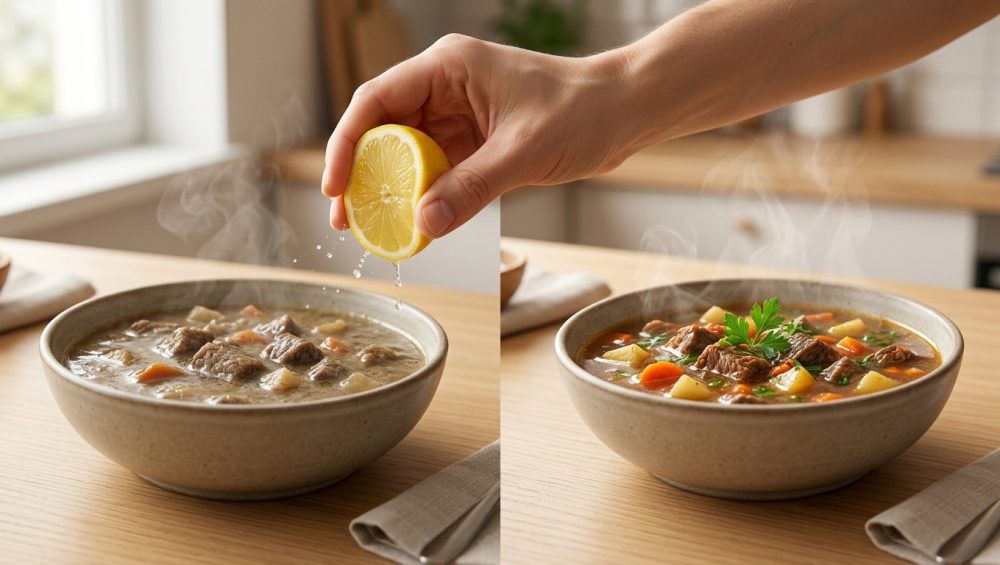
A finishing acid is a small, carefully measured dose of an acidic liquid—typically vinegar or fresh citrus juice—stirred into a hot dish at the very end of the cooking process, entirely off the heat.
In professional kitchens, the “finishing station” is where a dish goes right before it is handed to the waiter. The chef working this station will taste the sauce or the soup, grab a squeeze bottle of vinegar or a wedge of lemon, and hit the pan with a few drops of acid to “wake it up.”
This zero-cost pantry trick is exactly how you master simple weeknight dinners and make them taste like a million bucks. You are artificially replacing the bright, zippy, volatile notes that evaporated during the long simmer. You are lowering the pH of the broth just enough to slice through the lipid layer, and you are hacking your own taste buds to maximize the perception of the savory umami notes.
The Acid Arsenal: Choosing Your Liquid Gold
When I tell home cooks to put vinegar in their soup, they usually look at me like I have lost my mind. They imagine their comforting bowl of chicken noodle suddenly tasting like pungent salad dressing. But when used correctly, you should not actually be able to identify the specific acid in the final dish. It should act invisibly, lifting the other ingredients up without stealing the spotlight.
You do not need to spend twenty dollars on a tiny bottle of imported, artisanal, barrel-aged vinegar. You just need to know how to deploy the basic staples in your pantry. Here is your arsenal.
Apple Cider Vinegar: The Rustic Workhorse
If I could only have one vinegar in my kitchen for the rest of my life, it would be a raw, unfiltered apple cider vinegar (ACV). It has a mellow, slightly fruity sweetness that perfectly counterbalances deep, savory, earthy notes. ACV is the undisputed champion of heavy, rustic soups. It is the perfect pairing for split pea soup, brown lentil stew, beef and barley, or a hearty root vegetable puree. It cuts the mud without adding any aggressive sharpness.
Lemon and Lime Juice: The Brighteners
When your dinner tastes boring, a quick hit of fresh citrus is often the fastest, most effective cure. Lemon juice is arguably the most versatile finishing acid in existence. It brings a floral, sunny brightness that mimics the flavor profile of fresh herbs. It is mandatory for chicken noodle soup, creamy potato leek soup, and anything Mediterranean or Middle Eastern.
Lime juice, on the other hand, has a sharper, slightly more bitter and tropical profile. It is non-negotiable for finishing a chicken tortilla soup, a rich bowl of pho, a spicy black bean soup, or a coconut-milk-based Thai curry. (Note: Always use fresh citrus. That plastic squeeze-bottle shaped like a lemon contains oxidized, heavily preserved juice that tastes like floor cleaner. Throw it away.)
White Wine and Red Wine Vinegar: The Sophisticates
Wine vinegars bring a sharp, clean, and highly structured acidity to the table. White wine vinegar is subtle and piercing; it is brilliant in delicate vegetable soups, minestrone, or a light seafood chowder where you don’t want to alter the color of the broth.
Red wine vinegar is robust, aggressive, and can stand up to the heaviest, fattiest meats you can throw at it. If you are making a rich, tomato-based beef stew, a classic chili con carne, or a heavy Italian sausage soup, a splash of red wine vinegar will slice through the rendered animal fat like a scalpel.
Balsamic Vinegar: The Sweet Finisher
Balsamic is the outlier here because it is significantly sweeter and more syrupy than other vinegars. You must use it sparingly, or your soup will taste like a dessert glaze. However, a few drops of a decent quality balsamic stirred into a French onion soup, a roasted tomato bisque, or a slow-cooked short rib stew will add an incredible, dark, molasses-like complexity that makes the dish taste like it took three days to make.
Sherry Vinegar: The Secret Weapon
If you want to feel like an absolute culinary genius, keep a bottle of sherry vinegar in your pantry. It has a nutty, oxidized, incredibly complex flavor profile that bridges the gap between the brightness of white wine vinegar and the depth of balsamic. Sherry vinegar is the ultimate secret weapon for any soup involving mushrooms. A creamy wild mushroom soup finished with a teaspoon of sherry vinegar is a religious experience.
Step-by-Step Masterclass: How and When to Add Acid to Soup
Having the right acid is only half the battle; the execution is where most weeknight warriors fail. If you dump a quarter cup of vinegar into a boiling pot of soup at the beginning of the cooking process, you are going to ruin your dinner. Timing and dosing are everything.
The “Off the Heat” Rule
Remember our deep dive into culinary science and volatile flavor compounds? The bright, zippy, aromatic molecules in vinegar and fresh citrus juice are incredibly volatile. If you squeeze a beautiful, fresh lemon into a pot of soup that is actively boiling on the stove, the heat will instantly vaporize the delicate floral notes, leaving behind only the harsh, bitter citric acid.
You must follow the “Off the Heat” rule. When your soup is completely finished cooking, turn off the burner. Remove the heavy pot from the heat source entirely. Let the boiling subside into a calm stillness. Then, and only then, do you add your finishing acid. This preserves the delicate aromatic compounds and ensures the acid remains bright and effective.
Dosing: The Teaspoon Method
You are not making a vinaigrette; you are balancing a soup. The goal is not to make the broth taste sour. The goal is to lower the pH just enough to trigger the salivary response and enhance the sodium receptors.
Start small. For a large, standard 5-to-7-quart Dutch oven full of soup, start with exactly one teaspoon of your chosen acid.
The Tasting Loop
Stir that single teaspoon of acid gently into the hot broth. Now, take a clean spoon and taste it. Close your eyes and evaluate what is happening on your palate. Does the broth feel lighter? Do the savory notes of the chicken or beef suddenly taste more pronounced? Does it make your mouth water and compel you to take a second sip?
If the soup still feels a little heavy or muddy, add one more teaspoon, stir, and taste again. You will know you have hit the absolute perfect balance when the flavors suddenly “pop” and taste incredibly vibrant, but you cannot specifically identify that there is vinegar in the bowl. If you taste the soup and think, “Wow, this tastes like apple cider vinegar,” you have gone too far.
Troubleshooting Common Soup Disasters with Acid
Because we are focused on efficiency and saving your weekday meals, let’s do some rapid-fire problem-solving. Knowing how to pivot and fix a mistake is a massive part of conquering weeknight cooking anxiety for good. Acid is not just a flavor enhancer; it is a culinary eraser for a multitude of sins.
The Soup is Too Sweet
Did you get a little too enthusiastic with the carrots, sweet potatoes, or butternut squash? Or perhaps you caramelized your onions a bit too deeply, and now your savory dinner tastes like a dessert puree. Sweetness needs a sharp, aggressive counter-punch. A splash of white wine vinegar or a squeeze of lemon juice will instantly neutralize the cloying sugars, pushing the sweetness into the background and bringing the savory, earthy herbs back to the forefront.
The Soup is Too Fatty or Rich
Let’s say you bought a cheap, heavily marbled cut of chuck roast for a beef stew, and it rendered out a massive, intimidating slick of grease that is now floating on top of your broth. First, do your best to skim off the excess oil with a ladle. Then, hit the pot with a heavy dose of red wine vinegar. The sharp acetic acid will literally slice through the remaining lipid layer, cleansing your palate with every bite and preventing that awful, heavy feeling in your stomach.
The Soup is Too Salty
Okay, you ignored my earlier advice, you panicked, and you dumped way too much salt into the pot. While acid cannot physically remove sodium molecules from the liquid, it can act as a powerful sensory distraction. A heavy squeeze of lemon juice or a splash of white vinegar will introduce a new, sharp flavor profile that competes for your taste buds’ attention. It balances the flavor matrix so that the salt isn’t the only thing screaming at your tongue. (If it is violently salty, you will still need to dilute it with water or unsalted broth, but acid will help bridge the gap).
The Soup is Too Spicy
Did you heavy-hand the red pepper flakes or accidentally leave the seeds in your jalapeños for your chili? Capsaicin (the chemical that makes peppers hot) is an alkaline molecule. Adding an acid like lime juice or apple cider vinegar helps neutralize the alkalinity of the capsaicin, taming the aggressive heat and making the soup much more palatable.
A Brutally Honest Rant on Cookware and Acid (The “No-Go” Rule)
As your sassy, fiercely protective culinary advocate, we need to have a very serious, brutally honest conversation about your pots and pans. I have absolutely zero patience for cheap, peeling, toxic kitchenware. If you are simmering acidic ingredients in garbage cookware, you are actively ruining your food and potentially harming your long-term health.
Mystery Metals and Toxic Leaching
Acid is, by its very chemical nature, highly reactive. When you introduce an acidic ingredient (like tomatoes, wine, citrus, or vinegar) to a cheap, unlined aluminum pot, or a scratched-up, damaged Teflon pan, a chemical reaction occurs. The acid literally eats away at the exposed metal and the synthetic chemical coatings.
Scientific studies have repeatedly shown that cooking acidic foods in reactive cookware causes heavy metals (like aluminum, nickel, and cadmium) and toxic “forever chemicals” (PFAS and PFOA from non-stick coatings) to leach directly into your meal. This is exactly why your tomato sauce tastes metallic sometimes—it’s not a seasoning issue, you are literally tasting dissolved aluminum that has leached into your dinner.
If you want to get serious about banishing toxic kitchen gear, you need to ruthlessly audit your cabinets. Throw away the scratched non-stick pans. Throw away the flimsy, warped aluminum pots you bought for ten dollars in college.
The Safe Bets: Enameled Cast Iron and Stainless Steel
When you are making slow-simmered soups and stews, you must use non-reactive cookware.
The absolute gold standard is enameled cast iron (think of a classic, heavy Le Creuset or Staub Dutch oven). The core is cast iron, which retains heat beautifully for a gentle simmer, but the cooking surface is coated in a layer of baked glass enamel. This enamel is completely inert, meaning it will never react with your vinegars or tomatoes, and it will never leach chemicals into your food.
Your second best option is high-quality, fully-clad 18/10 stainless steel. It is incredibly durable, non-toxic, and highly resistant to acidic corrosion. Stop ruining your nonstick pans by boiling acidic soups in them for hours on end; save the delicate non-stick skillets for your morning scrambled eggs, and use proper, heavy-bottomed steel or enameled iron for your serious cooking.
Real-World Applications: Pairing Acids with Weeknight Soups
Let’s bring all of this culinary science out of the textbook and onto your stovetop. Here is your practical, real-world cheat sheet for matching the right finishing acid to the most common weeknight soups. This final splash of vinegar is the ultimate guarantee for bright, bitter-free meals that actually taste like the effort you put into them.
Classic Chicken Noodle Soup
You have simmered the bones, you have skimmed the impurities, and your kitchen smells like a warm hug. But the broth is feeling a little heavy.
- The Fix: Turn off the heat and stir in a generous squeeze of fresh lemon juice (about 1 to 2 tablespoons for a large pot). The citrus mimics the bright, herbaceous notes of fresh parsley and elevates the savory richness of the rendered chicken fat. It makes the soup taste incredibly restorative.
Rich Beef and Barley Stew
This is a heavy, earthy, stick-to-your-ribs meal. The rendered beef fat and the starches from the barley have created a thick, tongue-coating gravy.
- The Fix: It demands a robust, aggressive acid. Stir in a tablespoon of red wine vinegar, or a heavy splash of Worcestershire sauce (which is heavily vinegar-based and packed with umami), right before serving. The sharp acidity will slice through the beef fat and make every single bite taste deeply complex instead of just heavy.
Creamy Potato or Butternut Squash Soup
Heavy cream, butter, and starchy vegetables are a recipe for palate fatigue. After three spoonfuls, your tongue is coated in dairy fat, and you can barely taste the vegetables anymore.
- The Fix: A dash of apple cider vinegar or white wine vinegar. The acid will instantly cut through the dairy fat, lifting the earthy sweetness of the squash or the savory notes of the potato, making the soup feel surprisingly light and vibrant.
Lentil and Black Bean Soups
Legumes are notoriously difficult to balance. Because they are so starchy and earthy, they have a terrible habit of tasting muddy, flat, and entirely one-dimensional, no matter how much garlic or cumin you add.
- The Fix: A splash of sherry vinegar or red wine vinegar in a brown lentil soup, or a heavy squeeze of fresh lime juice in a black bean soup, is the literal difference between a sad, punishing bowl of mush and a vibrant, restaurant-quality meal. The acid breaks up the dense starchiness and wakes up the spices.
The Final Ladle
Cooking is not about rigidly, blindly following a list of ingredients on a recipe card; it is about tasting your food, trusting your palate, adjusting on the fly, and understanding the basic, beautiful science of how flavors interact. You absolutely do not need a culinary degree, a massive kitchen, or expensive ingredients to make mind-blowing food. You just need to know the tricks of the trade, value your time, and refuse to settle for boring, one-dimensional dinners.
The next time you are standing over a simmering pot, feeling defeated because your hard work tastes like a whole lot of nothing, do not panic. Step away from the salt shaker. Reach into your pantry, grab a bottle of vinegar, add a splash off the heat, and watch the magic happen. Your taste buds—and your weeknight dinners—will never be the same.