Listen, we need to have a serious talk about your breakfast. You woke up, you had grand ambitions, you whisked your eggs, you poured them into a hot pan, and five minutes later, you were staring at a rubbery, yellow sponge sitting in a puddle of vaguely cloudy, unappetizing dishwater.
You’ve probably asked yourself what went wrong. Did you add too much milk? Did you buy cheap eggs? Is your stove cursed?
As your resident culinary realist, I am here to tell you that your stove isn’t cursed, but your technique absolutely is. That gross puddle on your plate is the result of a fundamental misunderstanding of food science. You don’t need a culinary degree from a pretentious French institute to fix it, and you certainly don’t need to spend your mornings stressed out over a frying pan. If you want to transform your daily meals from sad, weeping protein lumps into restaurant-quality masterpieces, you just need to understand a little bit of chemistry. Consider this your essential kitchen survival guide to the most important meal of the day.
We are going to brutally deconstruct exactly why your scrambled eggs are leaking water, why the celebrity chefs you watch on television might actually be giving you terrible advice for a home kitchen environment, and how you can use a few brilliant, time-saving scientific hacks to guarantee perfectly creamy, velvety eggs every single time. Grab your whisk, put down the aerosol cooking spray, and let’s get into it.
The Anatomy of an Egg and the Science of the Puddle
To stop the puddle, you must first understand the puddle. When you crack an egg into a bowl, you aren’t just looking at a yellow orb floating in clear goo; you are looking at a highly complex matrix of water, fat, and tightly folded proteins.
A raw whole egg is composed of approximately 75 percent water. Let that sink in for a moment. Three-quarters of what you are pouring into your skillet is pure liquid. The rest is a mixture of fats (mostly localized in the yolk) and various proteins like ovalbumin, ovotransferrin, and ovomucoid (mostly localized in the white).
In their raw state, these proteins are folded up into tight, little microscopic balls, floating happily in that abundant water. But the moment you introduce heat, everything changes.
Denaturation and the Sponge Effect
When heat hits the egg, those tightly coiled protein balls begin to unfold. This process is called denaturation. As they unfold, they bump into each other and begin to bond, forming a complex, three-dimensional mesh network. This is called coagulation. As this mesh forms, it traps that 75 percent water content inside its structure, turning the liquid egg into a soft, semi-solid gel.
When done correctly, this protein mesh is delicate, loose, and incredibly tender, holding all the water inside like a perfectly saturated sponge. But here is where you are ruining your breakfast: heat is a relentless force. If you keep applying heat, those proteins don’t just stop bonding. They keep tightening, pulling closer and closer together.
Enter Syneresis: The Enemy of Breakfast
As the protein mesh tightens from excessive heat, it aggressively squeezes the trapped water out of the network. In the scientific and culinary world, this physical expulsion of liquid from a gel is known as syneresis.
Think of your scrambled eggs like a wet kitchen sponge. If you hold the sponge gently in your hand, it retains all its moisture. That is a perfectly cooked, soft-scrambled egg. But if you squeeze your fist as hard as you can, the water violently gushes out. That squeezing action is exactly what high heat does to egg proteins. The yellow, rubbery curds left behind on your plate are the dry, over-squeezed sponge, and the unappetizing puddle of liquid is the water that was forcibly evicted from the protein structure.
Syneresis is the singular reason your eggs are leaking. To stop it, we have to physically and chemically prevent those proteins from tightening.
The Great Salt Debate: Why Timing is Everything
If you have ever watched a certain famously angry British chef make scrambled eggs on YouTube, you have undoubtedly heard the golden rule: Never salt your eggs before cooking them, or they will turn watery.
I have zero patience for this pervasive culinary myth. It is factually, chemically, and demonstrably false. In fact, when it comes to eggs, the secret to salting them is doing it well before they hit the heat.
The 15-Minute Rule
Food scientist and author J. Kenji López-Alt famously debunked the anti-salting myth through rigorous testing. His findings proved that salting your eggs roughly 15 minutes before cooking them actually yields the most tender, moisture-retaining results possible.
Here is what is actually happening in your bowl. When you whisk salt into raw eggs and let them sit, the salt dissolves into positively and negatively charged ions. These dissolved ions seek out the electrically charged portions of the egg proteins and cluster around them.
By attaching to the proteins, the salt ions act as a microscopic buffer. When the eggs hit the hot pan and the proteins begin to unfold and seek out bonding partners, the salt ions literally get in the way. They physically prevent the proteins from bonding too tightly to one another. Because the proteins cannot form a restrictive, hyper-tight mesh, they cannot squeeze the water out.
Pre-salting is your first line of defense against syneresis. It raises the temperature at which the proteins coagulate and ensures that even if you leave the eggs on the stove a few seconds too long, they will remain tender rather than turning into rubber tires. So, crack your eggs, aggressively season them with salt, whisk them thoroughly, and go make your coffee. Let the salt do its chemical magic.
Heat Control and the Illusion of “Done”
The second major reason your eggs are weeping is that you are treating your frying pan like a blast furnace. Weekday mornings are rushed, and the temptation to crank the burner to medium-high to get breakfast over with is incredibly strong. You must resist this urge. Time is money, yes, but ruining your food saves you neither.
The Mathematics of Coagulation
Egg proteins are incredibly sensitive to temperature. The proteins in the egg white begin to coagulate at around 140°F (60°C), and the yolks follow shortly after at about 149°F (65°C). By the time your eggs reach 170°F (77°C), they are fully set.
Now, consider that a skillet placed on medium-high heat can easily reach 350°F to 400°F within minutes. When you pour delicate, temperature-sensitive eggs into a pan that hot, the proteins don’t just coagulate; they experience violent thermal shock. They seize instantly, the water flash-boils, and syneresis occurs before you have even had a chance to reach for your spatula.
The Thermodynamics of Carryover Cooking
To master scrambled eggs, you must master the concept of carryover cooking. Heat does not instantly vanish the moment you turn off the burner. Your pan retains heat, and the eggs themselves retain heat.
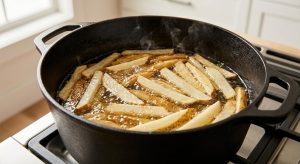
If you are using high-quality cookware, understanding the thermodynamics of carbon steel pans or heavy cast iron is crucial for controlling the heat. These materials hold onto thermal energy aggressively. If you wait to pull your eggs out of the pan until they look perfectly done, they are already ruined. The residual heat in the pan and in the eggs themselves will continue to cook the proteins for another 30 to 60 seconds after they hit your plate.
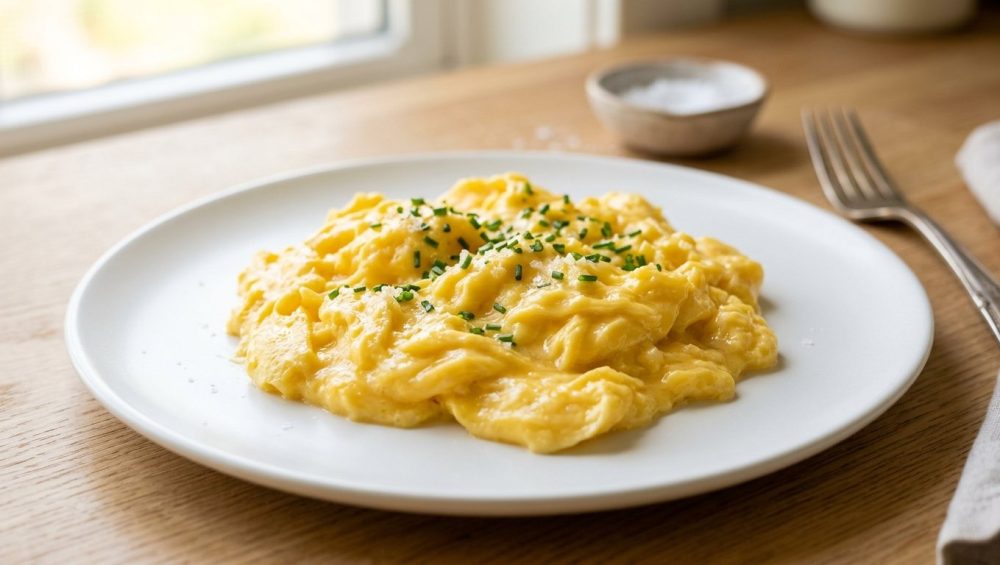
The golden rule of scrambled eggs is this: If they look done in the pan, they are overdone on the plate. You must remove the eggs from the heat while they still look slightly wet, glossy, and undercooked. The carryover heat will gently finish the coagulation process as you walk from the stove to the dining table, leaving you with a perfectly set, puddle-free breakfast.
The Diner Secret: Hydrocolloids and the Starch Slurry
If you want an absolute, foolproof guarantee that your eggs will never leak water again—even if you get distracted by your phone and leave them on the heat too long—you need to steal a brilliant trick from the restaurant industry.
Chefs have long utilized hydrocolloids (substances that form gels when mixed with water) to stabilize emulsions and prevent syneresis. For the home cook, incorporating the magic of a little cornstarch creates a physical barrier that makes overcooking your eggs nearly impossible.
How Gelatinization Halts Syneresis
Cornstarch is composed of starch molecules (amylose and amylopectin). When you mix a tiny amount of cornstarch with a splash of liquid (like water or milk) to create a slurry, and then whisk that slurry into your raw eggs, you are setting up a brilliant chemical defense system.
As the eggs hit the warm pan, the cornstarch granules absorb the surrounding moisture and begin to swell, a process known as gelatinization. These swollen starch molecules physically intersperse themselves throughout the egg protein network. Just like the salt ions, but on a much larger structural scale, the gelatinized starch physically blocks the egg proteins from linking too tightly together.
Because the proteins are obstructed by the swollen starch, they cannot contract. If they cannot contract, they cannot squeeze out the water. The result is a profoundly creamy, custardy texture that holds its moisture flawlessly.
You only need a tiny amount—about half a teaspoon of cornstarch mixed with a tablespoon of cold milk or water for every three eggs. Whisk the slurry until completely smooth before adding it to the raw eggs to prevent lumps. It is completely flavorless, undetectable on the palate, and acts as the ultimate insurance policy against rubbery, weeping curds.
Liquid Additions: Milk, Cream, Water, or Nothing?
The debate over what liquid to add to scrambled eggs is as old as cooking itself. Everyone’s grandmother had a different secret. Some swore by a splash of water, others demanded heavy cream, and purists insist on absolutely nothing. Let’s look at the science of liquid additions so you can make an educated choice.
The Water Trap
Adding plain water to your eggs is a risky game. While it does dilute the proteins slightly (which can theoretically lead to a lighter texture), it adds zero fat. More importantly, you are drastically increasing the overall water content of the mixture. If you overcook eggs that have been thinned out with water, the syneresis will be catastrophic. You will end up with a massive puddle. Skip the water.
The Heavy Cream Mask
Heavy cream is packed with butterfat. Fat is an incredible insulator; it coats the egg proteins and significantly slows down the coagulation process, making it much harder to overcook the eggs. The fat also adds a luxurious, velvety mouthfeel. However, heavy cream is so rich that it effectively masks the actual flavor of the eggs. You end up tasting warm dairy rather than a beautiful, farm-fresh egg.
The Whole Milk Sweet Spot
Whole milk is the ideal compromise. It contains enough water to create steam (which aids in fluffiness) and enough fat to gently coat the proteins and delay coagulation, but it isn’t so rich that it destroys the egg flavor.
The Verdict: If you are utilizing the 15-minute pre-salting rule and the cornstarch slurry trick, your eggs will already be incredibly tender and moist. You technically do not need to add any liquid at all. However, using a tablespoon of whole milk to create your cornstarch slurry is the absolute pinnacle of scrambled egg perfection.
A Brutally Honest Word on Your Toxic Kitchen Gear
We cannot discuss perfect eggs without discussing the surface you are cooking them on. As a home cook who despises pretentious gear but fiercely advocates for quality, I need to address the elephant in your kitchen cabinets: your scratched, peeling, cheap non-stick frying pan.
I have a strict “no-go” rule on toxic gear, which is why I’m always preaching about banishing toxic kitchen gear from your home. If your Teflon pan has visible scratches, flaking black specks, or a dull, sticky surface, throw it in the trash immediately. You are quite literally eating forever chemicals with your breakfast.
Why Your Pan is Failing You
Cheap non-stick coatings degrade rapidly under high heat and improper care. Furthermore, if you are relying on those chemical-laden aerosol cooking sprays, you are accelerating the destruction of your cookware. The propellants and emulsifiers in those sprays burn at low temperatures, polymerizing onto the surface of the pan and creating a sticky, invisible residue. This is precisely why aerosolized cooking spray is the enemy of a truly slick surface, and why you will notice that your pans keep losing their slip over time.
The Safe, Professional Alternatives
You do not need toxic chemicals to cook eggs. You need proper temperature control and a high-quality surface.
- Carbon Steel: A well-seasoned carbon steel skillet is the holy grail of egg cooking. Through the process of polymerization (baking thin layers of oil onto the iron), carbon steel develops a naturally non-stick, chemical-free surface that will outlive you. It requires a little maintenance, but it rewards you with unmatched heat control.
- High-Quality Ceramic: If you absolutely refuse to maintain carbon steel, invest in a high-quality, heavy-gauge ceramic non-stick pan. Ceramic is free of PTFE and PFAS. Just remember that ceramic loses its non-stick properties if subjected to high heat, so keep the burner low.
- The Ultimate Non-Stick Agent: Butter. Stop using flavorless oils for your eggs. Butter contains milk solids and water. When you melt butter in a pan, the water evaporates (causing the butter to foam), and the milk solids lightly toast, providing a brilliant, naturally non-stick barrier between the pan and the egg proteins.
The Sassy Sous-Chef’s Master Protocol for Perfect, Puddle-Free Eggs
We have covered the biology, the chemistry, the thermodynamics, and the metallurgy. Now, it is time to put it all together. This is my definitive, no-nonsense protocol for perfect scrambled eggs. Follow these steps, so you can survive the kitchen without ordering an overpriced brunch ever again.
Step 1: The Slurry
In a small bowl, combine ½ teaspoon of cornstarch with 1 tablespoon of cold whole milk (or water). Whisk vigorously with a fork until the starch is completely dissolved and no lumps remain. Do not skip this step; dumping dry cornstarch directly into eggs will create unappetizing, powdery clumps.
Step 2: The Whisk and the Wait
Crack three large, high-quality eggs into a mixing bowl. Pour in your cornstarch slurry. Add a generous pinch of kosher salt (do not use harsh, iodized table salt). Whisk the eggs aggressively. You want to completely homogenize the yolks and the whites so that no clear streaks remain.
Now, walk away. Let the bowl sit on your counter for at least 10 to 15 minutes. Use this time to brew your coffee, toast your sourdough, or stare blankly out the window. Let the salt ions buffer the proteins.
Step 3: The Pan Prep
Place your well-seasoned carbon steel or ceramic skillet on the stove over medium-low heat. Let the pan warm up gently for about two minutes. Drop in one tablespoon of unsalted butter. Watch the butter closely. It should melt quickly and begin to gently foam as its water content evaporates. If the butter immediately turns brown and smokes, your pan is way too hot. Take it off the heat and let it cool down.
Step 4: The Pour and Fold
Once the butter is foaming but not browning, pour in your egg mixture.
Do absolutely nothing for about 10 to 15 seconds. Let the bottom layer of the eggs gently begin to set.
Now, take a heat-proof silicone spatula and gently push the eggs from the outside edge of the pan toward the center. You will see beautiful, soft curds form. Tilt the pan slightly to let the raw liquid egg run back onto the exposed hot surface.
Do not frantically stir the eggs like you are mixing concrete. Frantic stirring breaks the curds into tiny, dry pebbles. You want slow, deliberate, sweeping folds.
Step 5: The Early Exit
Watch the eggs like a hawk. The entire cooking process should take no more than 60 to 90 seconds.
The moment the eggs form large, soft curds but still look undeniably wet, glossy, and slightly runny in the crevices, turn off the heat. Immediately slide the eggs out of the pan and onto a warm plate.
Do not leave them in the pan “just to be safe.” The carryover heat from the eggs themselves will finish cooking that residual moisture in the 30 seconds it takes you to carry the plate to the table.
Conclusion
Cooking is not magic; it is applied science wrapped in a little bit of intuition. By understanding how proteins react to heat, why salt is your best friend, and how a tiny pinch of starch can act as a structural bodyguard, you have entirely eliminated the guesswork from your morning routine.
You no longer have to settle for rubbery sponges or watery puddles. You have the knowledge to command your ingredients rather than letting them command you, turning breakfast into a peaceful daily habit instead of a stressful chore.
Now, go throw away that peeling non-stick pan, buy yourself a decent spatula, and go make some mind-blowing eggs. You’ve got this.