Let’s have a brutally honest conversation about one of the most universally irritating tasks in the modern home kitchen: prepping fresh ginger.
You know the exact struggle I am talking about. It is a busy Tuesday night. You are exhausted, you are hungry, and you are trying to throw together a quick, healthy weeknight stir-fry so you do not succumb to the siren song of expensive takeout. You have your mise en place mostly ready. Your vegetables are chopped, your protein is sliced, and then you get to the ginger. You grab a beautiful, plump rhizome and your trusty grater. Five minutes later, your knuckles are dangerously close to the sharp metal blades, your grater looks like it is sprouting thick blonde hair, and you have managed to extract exactly a quarter teaspoon of usable ginger pulp. The rest of the root has turned into a mangled, fibrous, stringy knot of utter despair.
I have absolutely zero patience for this kind of kitchen inefficiency. Weekday cooking is about maximizing flavor while ruthlessly minimizing prep time. Time is money, and I am certainly not spending my precious evening picking tough ginger fibers out of a stainless steel grater with a wooden toothpick.
Fortunately, you do not need a culinary degree to cook like a professional; you just need to understand the physical science of your ingredients. There is a scientifically backed, mind-blowingly simple prep hack that completely eliminates the stringy mess, saves you a massive amount of prep time, and maximizes your flavor extraction.
You need to freeze your fresh ginger.
Consider this masterclass your ultimate kitchen survival guide for handling stubborn, fibrous aromatics. We are going to dive deep into the botanical anatomy of ginger, the thermodynamic physics of freezing plant cells, and the exact step-by-step methodology you need to deploy to turn this frustrating chore into a five-second, effortless task.
The Anatomy of Zingiber Officinale: Why Fresh Ginger Fights Back
To understand why room-temperature ginger is such a nightmare to grate, we first need to drop a little bit of botany knowledge. Ginger (Zingiber officinale) is not actually a root, despite what the grocery store labels tell you. It is a rhizome, which is a continuously growing, horizontal underground stem that puts out lateral shoots and adventitious roots at intervals.
Because of its evolutionary role as an underground storage and transport system for the plant, ginger is packed with dense, highly structured parenchyma tissue. These parenchyma cells are the primary storage lockers for starch, water (ginger is approximately 79% water by weight), and the pungent oleoresins that give the plant its signature spicy kick.
Running throughout this starchy matrix are vascular bundles—specifically the xylem and phloem. This is the plant’s internal plumbing system, designed to transport water and nutrients from the soil up to the leafy green shoots above ground. These vascular bundles are constructed from incredibly tough, rigid cellulose fibers.
At room temperature, these cellulose fibers are highly pliable, flexible, and rubbery. They are structurally designed to bend without breaking as the plant grows and shifts in the soil. This flexibility is exactly why fresh ginger fights back when you try to prep it. When you drag a room-temperature rhizome across the sharp teeth of a grater, the flexible cellulose fibers do not shear cleanly. Instead, they bend, fray, and slip directly into the microscopic teeth of your tool.
Just like how a cheap garlic press makes food bitter by violently crushing and mangling the delicate cell walls rather than slicing them, violently shredding warm ginger just leaves you with a bruised, crushed mess. The flexible fibers tangle together, creating a dense hairball that clogs the grater, prevents further grating, and traps all the flavorful juices against the metal instead of letting them fall into your mixing bowl.
The Food Physics of the Freezer: Cryogenic Stiffening
Here is where the magic of physical science completely transforms your prep routine. The solution to the flexible fiber problem is to change the physical state of the water trapped inside the rhizome.
When you place a fresh piece of ginger in your standard home freezer (which should be set to 0°F or -18°C), the ambient thermal energy drops rapidly, and the water trapped within the parenchyma cells and the vascular bundles undergoes a phase change. The liquid water crystallizes into solid ice.
Here is the crucial scientific mechanism: water expands by approximately 9% when it freezes. Because this expanding water is confined within the rigid, microscopic cellulose cell walls of the ginger plant, the forming ice crystals exert immense outward hydrostatic pressure. These microscopic ice crystals act like tiny, sharp daggers, physically piercing and rupturing the tough cellular structure from the inside out.
This internal fracturing induces a state known in food physics as “cryogenic stiffening.” The flexibility of the vascular bundles is entirely destroyed. The ginger transforms from a rubbery, fibrous mass into a crisp, highly brittle solid block.
Just as you use a proper wooden cutting board to stop dulling your knives, you must respect the microscopic teeth of your rasp grater by giving them an ideal surface to bite into. When you apply the shearing force of a sharp grater to this newly brittle, frozen matrix, the fibers can no longer bend or slip. They are forced to snap cleanly.
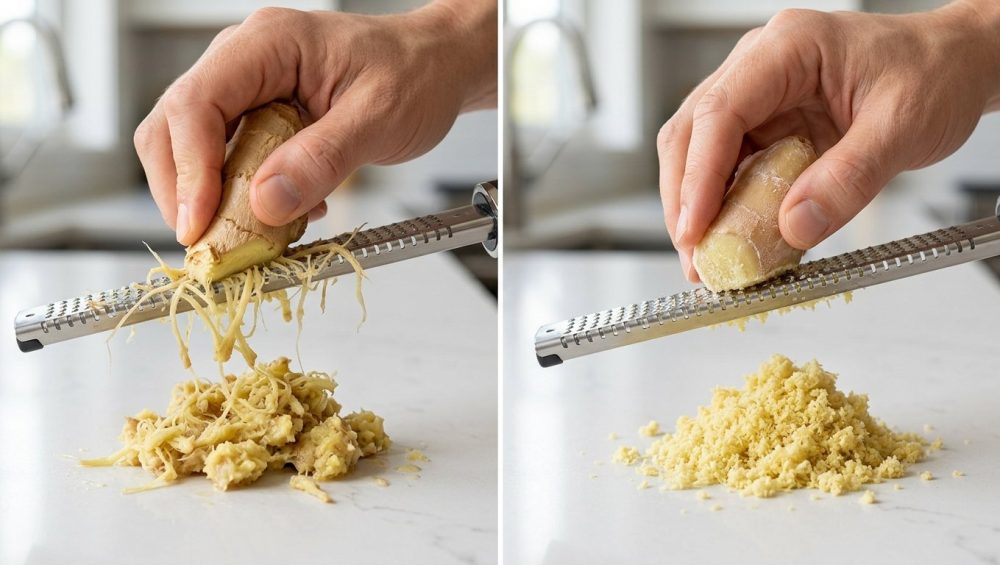
The result is nothing short of culinary magic. Instead of a wet, stringy, tangled mess, the frozen ginger shatters into a microscopic, fluffy, perfectly uniform snow. There are absolutely no strings. There are no clogs. The grater remains perfectly clear, and every single micro-shred of ginger falls effortlessly into your prep bowl.
The Great Peeling Debate: Stop Wasting Your Precious Time
If you spend any time watching internet cooking tutorials, you have undoubtedly seen the famous “spoon trick.” This is the widely circulated advice that you should use the edge of a metal teaspoon to gently scrape the skin off a knobby piece of ginger, navigating the complex bumps and curves without wasting the flesh underneath.
Let’s be brutally honest: while the spoon trick is certainly better than hacking away at the rhizome with a vegetable peeler or a paring knife, it is still incredibly tedious. It takes time, it makes a mess on your cutting board, and it is just one more obstacle standing between you and getting dinner on the table.
When you utilize the freezing method, you unlock another massive time-saving benefit: you no longer need to peel your ginger at all.
While some old-school cooks swear by the magic of a ceramic grater for breaking down fibrous roots, the truth is that the freezer makes the tool’s job infinitely easier, regardless of the skin. The skin of a ginger rhizome is actually paper-thin. When it is frozen solid, it undergoes the exact same cryogenic stiffening as the interior flesh. It becomes highly brittle.
When you run an unpeeled, frozen knob of ginger across a sharp microplane, the skin shatters and grates just as finely as the yellow flesh. It is reduced to microscopic, nearly invisible flecks that completely disappear into the fluffy ginger snow. Unless you are working in a Michelin-starred kitchen attempting to clarify a perfectly transparent, glass-like seafood consommé, you will never visually notice the skin, and you will absolutely never detect it on your palate.
Furthermore, the skin contains its own complex array of earthy aromatic compounds. By leaving it on, you are actually maximizing your yield, reducing your household food waste to zero, and clawing back five precious minutes of your evening. Wash it, freeze it, grate it, and move on with your life.
Flavor Dynamics: Does Freezing Kill the Zing?
There is a persistent, stubborn myth in the culinary world that freezing fresh aromatics destroys their delicate flavor profiles. Skeptics argue that placing ginger in the deep freeze will somehow kill the spicy, pungent “zing” that makes the ingredient so desirable in the first place. This is scientifically false. In fact, freezing is arguably the absolute best way to preserve the flavor of ginger long-term.
To understand why, we need to look at the biochemical makeup of the rhizome. The primary bioactive compound responsible for the sharp, pungent, spicy kick of fresh ginger is a phenol known as 6-gingerol.
You know that moment when you taste a sauce and realize your dinner actually needs acid to balance the heavy fats? Gingerol provides a similar, albeit spicier, function. It cuts through rich, heavy ingredients with a sharp, vibrant brightness that awakens the palate.
When you store fresh ginger in the crisper drawer of your refrigerator, it is subjected to a slow, agonizing death. The dry, circulating air of the fridge leeches the moisture out of the rhizome, causing it to shrivel and wrinkle. More importantly, the ginger undergoes continuous enzymatic degradation and oxidation. The volatile essential oils slowly evaporate, and the 6-gingerol breaks down. Eventually, the root becomes a sad, rubbery, moldy husk devoid of its original vibrancy.
When you place ginger in the freezer, you immediately halt this enzymatic degradation. The volatile oils and aromatic compounds are locked into a state of suspended animation within the ice matrix. Food science studies utilizing gas chromatography-mass spectrometry (GC-MS) have repeatedly demonstrated that frozen ginger retains an astonishing 98.7% of its key bioactive volatiles, even after weeks or months of deep-freeze storage.
Freezing does not dull the flavor; it actively protects it from the ravages of oxidation and moisture loss. You get the exact same fiery, floral punch on day sixty as you would on day one.
The Ultimate Step-by-Step Guide to Processing and Freezing Ginger
If you want to execute this technique flawlessly, you cannot just toss a plastic grocery bag full of ginger into the back of your freezer and hope for the best. Proper methodology is required to prevent freezer burn and ensure maximum grating efficiency. Here is the definitive, step-by-step workflow.
Step 1: Procurement and Selection
Your frozen ginger snow will only ever be as good as the raw ingredient you start with. When shopping, actively look for rhizomes that have tight, shiny, unblemished skin. The ginger should feel dense and heavy for its size, which indicates a high moisture content and a healthy amount of volatile oils. Avoid any pieces that feel surprisingly light, spongy, or have deeply wrinkled skin, as these are already severely dehydrated and oxidized.
Step 2: The Wash and Dry (The Most Critical Step)
Because we are not peeling the ginger, you must wash it thoroughly to remove any residual dirt, sand, or agricultural debris trapped in the knobby crevices. Use a stiff vegetable brush under cold running water.
Once clean, you must dry the ginger completely. Do not skip this step. If you place wet ginger into the freezer, the surface water will freeze into a slick, solid sheet of external ice. When you attempt to grate it later, the tool will hydroplane across the ice, making the process dangerous and highly inefficient. Pat the rhizome completely dry with a clean kitchen towel or paper towels.
Step 3: Strategic Portioning
While you can technically freeze a massive, hand-sized rhizome whole, it is ergonomically awkward to hold a giant block of frozen ice while grating. I highly recommend breaking the ginger down into manageable, one-to-two-inch knobs. This creates perfectly sized pieces that fit safely and comfortably in your hand, keeping your fingers well away from the sharp blades.
Step 4: Airtight Storage Solutions
I am constantly screaming about the importance of banishing toxic kitchen gear from your home, and your storage solutions are no exception. Do not wrap your beautiful, organic ginger in cheap, single-use plastic wrap that leeches endocrine disruptors.
Furthermore, improper storage leads to sublimation—the process where solid ice turns directly into vapor in the dry environment of the freezer, resulting in severe freezer burn. To prevent this, you must use a truly airtight container. High-quality, food-grade silicone bags (with all the excess air squeezed out) or heavy-duty glass mason jars are the superior choices. They protect the ginger from sublimation and prevent the aromatic oleoresins from absorbing the ambient odors of your freezer. Nobody wants ginger that tastes like last month’s frozen chili.
Step 5: The Grating Execution
When it is time to cook, remove a single knob of ginger from your airtight container. Do not let it sit on the counter. Do not let it thaw. You must grate it immediately while it is in its state of cryogenic stiffening. Grate exactly what you need for your recipe, and then instantly return the remaining frozen knob back to the freezer container.
The Gear Check: Stop Buying Toxic, Dull Kitchen Junk
This entire hack relies on the physical interaction between the frozen, brittle ginger cells and the sharp teeth of your grating tool. If your tool is garbage, your results will be garbage.
If you are still ruining your nonstick pans with cheap chemical cooking sprays, we need to have a serious talk about kitchen investments. The same logic applies to your prep tools. You absolutely must ditch the cheap, stamped-metal box graters you bought at a big-box discount store for four dollars.
Stamped metal graters are manufactured by literally punching holes through cheap steel. The resulting edges of those holes are inherently dull, rounded, and imprecise. They do not cut; they tear, mash, and pulverize. Furthermore, many cheap graters are coated in mystery “non-stick” paints that inevitably begin to peel and flake directly into your food. We do not do toxic kitchenware here.
You need a high-quality, photo-etched stainless steel rasp grater, commonly referred to by the premier brand name, Microplane. Photo-etching is a chemical manufacturing process that uses acid to dissolve the metal, leaving behind microscopic, razor-sharp teeth that act like tiny individual knives. Because they are made from pure, high-carbon stainless steel, there are no toxic coatings to worry about.
When you run a frozen block of ginger across photo-etched teeth, the sharp edges shear the brittle cellulose instantly, creating the perfect, fluffy snow we are looking for.
Culinary Deployment: How to Use Your Frozen Ginger Snow
Once you have experienced the joy of creating effortless frozen ginger snow, you will find yourself incorporating it into a massive variety of dishes. The ultra-fine texture and maximized surface area dramatically alter how the ingredient behaves in the pan and on the palate.
The Weeknight Stir-Fry
If you have ever wondered why your garlic always burns the second it hits a hot skillet, it is almost always due to uneven sizing and excessive moisture. The same applies to ginger. When you mince ginger with a knife, the irregular chunks cook at different rates. The small pieces burn and turn bitter, while the large pieces remain raw and aggressive.
Frozen ginger snow solves this completely. Because the particle size is microscopic and perfectly uniform, it melts instantly upon hitting the hot oil. It infuses the cooking fat with gingerol immediately and evenly, creating a deeply aromatic base for your stir-fry without any risk of biting into a harsh, fibrous chunk of raw root.
Emulsified Marinades and Dressings
Creating a stable vinaigrette or a cohesive marinade requires ingredients that can seamlessly blend together. Minced ginger stubbornly sinks to the bottom of the bowl and refuses to integrate. Frozen ginger snow, however, behaves almost like a liquid once it thaws in the dressing. It disperses its fiery flavor evenly throughout the emulsion, ensuring that every single leaf of your salad or every inch of your marinating protein receives a perfectly balanced coating of flavor.
Modern Baking Applications
Powdered, dried ginger is a staple in baking, but it lacks the floral, vibrant high notes of the fresh rhizome. However, adding fresh minced ginger to a cookie dough usually results in unpleasant, wet lumps. By folding frozen ginger snow directly into your gingerbread or ginger snap dough, the microscopic particles hydrate the flour evenly, delivering an explosive, bakery-level flavor profile that dried spices simply cannot match.
Healing Teas and Immune Broths
When you are feeling under the weather and need the anti-inflammatory, digestive-soothing benefits of ginger, extraction efficiency is everything. Boiling thick slices of ginger is highly inefficient; the hot water can only interact with the limited surface area of the slice.
By using frozen ginger snow, you are mathematically maximizing the surface area of the plant tissue. When you pour boiling water over a tablespoon of ginger snow, the extraction of 6-gingerol and other beneficial compounds is nearly instantaneous and incredibly potent.
Much like the essential technique of taking raw spices and blooming them in oil to unlock their full aromatic potential, hitting frozen ginger snow with hot liquids instantly releases its maximum therapeutic and culinary value.
Troubleshooting Common Ginger Disasters
Even with a foolproof, science-backed method, home cooks occasionally run into issues. If you are struggling with the frozen ginger hack, it almost always comes down to a failure to follow the thermodynamic rules of the freezer.
“My ginger turned into a wet, mushy sponge!”
This is the most common complaint, and the diagnosis is incredibly simple: you let it thaw.
Remember the cryogenic stiffening we discussed? The expanding ice crystals ruptured the microscopic cellulose cell walls. As long as the ginger remains frozen, the solid ice provides structural integrity, holding the brittle shape together so it can be grated.
However, if you take the ginger out of the freezer and let it sit on the counter for ten minutes while you prep other ingredients, the ice melts. Because the cell walls have already been shattered, there is nothing left to hold the moisture inside. The water leaks out rapidly, and the once-firm rhizome collapses into a flaccid, weeping, fibrous sponge. It becomes completely un-gratable and must be thrown away.
It is exactly like those moments when you swear your meat thermometer is lying to you, only to realize you accidentally probed the roasting pan instead of the center of the chicken breast. User error is the real enemy. The cardinal rule of this hack is non-negotiable: take it out of the freezer, grate it immediately while it is freezing cold, and put the unused portion right back into the deep freeze.
“My ginger snow tastes like stale freezer air.”
If your ginger has lost its vibrant, spicy kick and instead tastes remarkably like the ghost of last month’s frozen leftovers, you have failed at proper storage. As mentioned earlier, ginger contains volatile oleoresins (fats and oils). Fats are highly susceptible to absorbing ambient odors. If you left your ginger exposed to the open air of the freezer, or loosely wrapped it in a cheap plastic bag, it absorbed the environmental smells and underwent sublimation (freezer burn). Upgrade to an airtight glass jar or a high-quality vacuum-sealed silicone bag, and this problem disappears entirely.
“My grater is slipping and I almost cut myself.”
If your grater is hydroplaning across the surface of the ginger, one of two things has happened. Either you failed to dry the ginger completely after washing it, resulting in a slick sheet of external ice, or your grater is hopelessly dull. Photo-etched teeth will eventually wear down after years of heavy use. If your microplane is older than your current car, it is time to treat yourself to a replacement. A sharp tool requires almost zero downward pressure; it should glide effortlessly through the frozen block.
Take Back Your Kitchen
Cooking should be a joyful, creative process, not an endless slog of frustrating, inefficient chores. By understanding the physical science of how water, ice, and plant cellulose interact, you can completely eliminate one of the most annoying prep tasks in the culinary world.
You do not need to spend twenty minutes picking fibers out of a cheap grater. You do not need to waste money throwing away shriveled, moldy ginger from the bottom of your crisper drawer. And you certainly do not need a professional culinary degree to execute this perfectly.
Buy good ginger. Wash it. Dry it completely. Freeze it in an airtight container. Grate it frozen on a razor-sharp, non-toxic tool.
It really is that simple. Now go pull that ginger out of the fridge before it turns into a science experiment, get it into the freezer, and take back your precious evening time. You have better things to do than fight with a root vegetable.