Welcome to the weekend, my fellow culinary hobbyists. Let’s talk about a very specific, deeply personal kind of heartbreak. Not the “my boss sent a passive-aggressive email on a Friday” kind of heartbreak, but the visceral, soul-crushing disappointment of pulling a highly anticipated tray of chocolate chip cookies out of the oven, only to discover they have morphed into a singular, greasy, quarter-inch-thick mega-puddle. You followed the recipe. You measured your chips. You even bought the expensive vanilla extract. So why does your dough insist on melting into a topographical map of disappointment?
Baking is not magic. It is not a mystical art reserved for people with culinary degrees and pristine white chef coats. It is uncompromising, unfeeling chemistry. During the week, we cut corners to survive the dinner rush, but on a Saturday afternoon? We are scientists, and we respect the process. If you want to stop baking flat cookies, you have to stop treating your ingredients like suggestions and start understanding the thermodynamics of your kitchen.
Today, we are leaving absolutely no stone unturned. We are going to dissect the food science of fat temperatures, flour hydration, leavening agents, and the blatant lies your oven thermostat is telling you. Grab a coffee, put on your apron, and let’s fix your baked goods once and for all.
The Thermodynamics of the Spread: What Happens Inside the Oven
To understand why your cookies are melting into puddles, you first have to understand the chaotic race against time that occurs the second you shut the oven door. Baking a cookie is essentially a high-stakes competition between the fat melting and the proteins setting.
The Anatomy of a Baking Cookie
When a ball of dough enters a 350°F environment, a highly specific sequence of events kicks off. First, the dough begins to warm, and the butter inside it starts to melt. As the butter liquefies, the dough slackens and naturally begins to spread outward across the pan. As it spreads, the edges become thinner, exposing them to the full, intense heat of the oven and the hot surface of the baking sheet. Because they are thin, these edges begin to set and harden long before the thick center of the cookie does.
While the fat is busy melting and spreading, the water in the dough (from the butter and the eggs) begins to heat up and turn into steam. This steam, combined with the carbon dioxide gases produced by your leavening agents, causes the cookie to rise. Finally, as the internal temperature of the cookie climbs, the egg proteins coagulate and the starches in the flour gelatinize, permanently locking the cookie’s structure into place.
If your cookies are turning into flat puddles, it means the fat melted and spread way too fast, long before the starches and proteins had a chance to set and build a structural wall. It is one of the most common simple kitchen fixes to master, provided you understand the variables at play.
The Fat Factor: Why Butter Dictates the Future
Butter is the primary reason your cookies spread. It is an emulsion of butterfat, water, and milk solids. The temperature of your butter before it even enters the oven dictates the entire architectural integrity of your dessert.
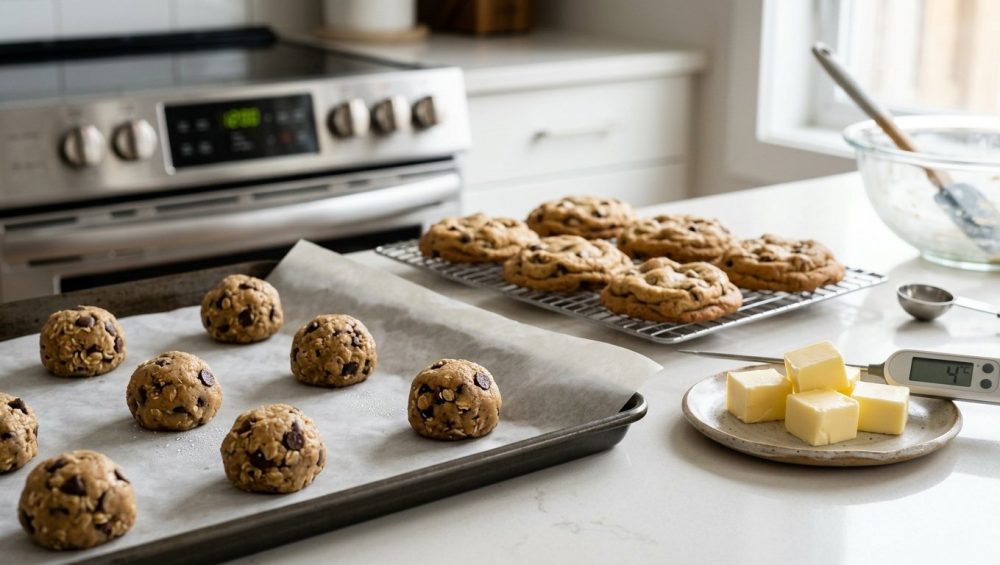
Many amateur bakers make the fatal mistake of using butter that is far too warm. When a recipe calls for “room temperature” butter, it does not mean butter that has been sitting on your sun-drenched kitchen counter until it is the consistency of mayonnaise. Proper room temperature butter should be around 65°F to 68°F. It should yield slightly to the press of a finger, but it should still hold its shape and feel cool to the touch.
If your butter is too warm or entirely melted, the fat is already in a liquid state. When it hits the oven, it doesn’t need time to heat up; it instantly turns into a greasy flood, causing the dough to flatten out before the flour can set. Conversely, cold butter takes much longer to melt in the oven. This delay buys the proteins and starches the precious time they need to firm up. In fact, using cold butter leaves larger air pockets in the dough as it melts, resulting in a thicker, cakier cookie, whereas melted butter produces a denser, flatter, and chewier result.
The Number One Culprit: You Refused to Chill the Dough
I know you lack patience. We all do. When the craving for a chocolate chip cookie hits, waiting 24 hours feels like an absurd, cruel punishment. But skipping the chilling phase is the single biggest rookie mistake you can make. If you want a bakery-style, thick, chewy masterpiece, the refrigerator is your best friend.
Flour Hydration: The Unsung Hero of Structure
When you mix flour into your wet ingredients, it doesn’t instantly absorb the moisture. Hydration takes time. When you immediately scoop and bake freshly mixed dough, the flour is still relatively dry, meaning the dough is loose and prone to spreading.
When you place the dough in the refrigerator, you are giving the liquid from the eggs and the water from the butter a chance to fully hydrate the starches in the flour. This process acts like a sponge, soaking up the free-floating moisture and resulting in a significantly firmer, stiffer dough. A fully hydrated dough holds its shape incredibly well in the oven, drastically reducing horizontal spread. Think of hydration as the ultimate kitchen survival guide technique for structural integrity.
Solidifying the Fat: Buying Time in the Oven
Beyond hydrating the flour, the refrigerator performs the vital task of resolidifying the butter. Remember our thermodynamics lesson? We want the fat to melt as slowly as possible.
The friction of your stand mixer and the ambient temperature of your kitchen have inevitably warmed the butter during the mixing process. By chilling the dough, you return the butterfat to a solid state. When you eventually place these cold, solid balls of dough into a hot oven, the exterior of the cookie begins to bake and set while the interior butter is still struggling to melt. By the time the fat finally liquefies, the outer edges of the cookie have already formed a rigid boundary, trapping the spread and forcing the cookie to bake upward rather than outward.
Flavor Maturation: The 72-Hour Rule
If preventing puddles isn’t enough to convince you to chill your dough, do it for the flavor. Resting the dough allows the enzymes present in the flour and the egg yolks to slowly break down complex carbohydrates into their component simple sugars, like fructose and glucose.
Why does this matter? Because simple sugars caramelize much faster and more beautifully than complex starches. A dough that has rested for 24 to 72 hours will undergo a vastly superior Maillard reaction in the oven, resulting in a deeper, richer, butterscotch-like flavor and a gorgeous, golden-brown color. If you want to cure cooking anxiety, simply realize that time does 90% of the heavy lifting for you.
The Great Sugar Divide: White vs. Brown
Sugars are not merely sweeteners; they are foundational structural components that dictate the texture, chew, and spread of your baked goods. If you alter the ratio of sugars in a recipe, you are fundamentally altering the physics of the dough.
Hygroscopic Properties and Moisture Retention
White granulated sugar is highly crystalline and lacks moisture. Because of its structure, it melts quickly in the oven, encouraging the dough to spread outward and creating a crispier, thinner edge.
Brown sugar, on the other hand, is simply white sugar that has been coated in molasses. Molasses is acidic and highly hygroscopic, meaning it actively attracts and holds onto moisture from its surrounding environment. Because brown sugar retains so much water, it creates a softer, taller, and much chewier cookie.
The Caramelization and Spread Ratio
If your cookies are spreading too much, take a hard look at your sugar ratios. A recipe that relies heavily on white granulated sugar is engineered to spread and crisp. If you prefer a thicker, fudgier center, you can slightly tip the ratio in favor of brown sugar. The molasses will introduce more moisture, hydrate the flour more effectively, and restrict the rapid melting spread caused by white sugar. However, be cautious: adding too much brown sugar without adjusting your leavening agents can make the dough too heavy to rise at all.
Leavening Agents: The Chemistry of Lift vs. Spread
Baking soda and baking powder are not interchangeable. I repeat: they are not the same thing, and swapping them out because you didn’t feel like going to the grocery store is a guaranteed way to ruin your dessert. They serve entirely different chemical purposes.
Baking Soda: The Spreader and Browner
Baking soda (sodium bicarbonate) is a base. In order to create the carbon dioxide gas needed for lift, it must react with an acidic ingredient in your dough. In most cookie recipes, that acid is the molasses found in brown sugar.
When baking soda reacts with the acid, it creates a rapid release of gas, but it also heavily promotes browning and—crucially—spreading. Baking soda weakens the gluten structure of the dough, allowing it to relax and spread outward rather than puffing up. If your cookies are consistently flat, overly dark, and taste slightly metallic or soapy, you are likely using too much baking soda.
Baking Powder: The Puffer
Baking powder is a complete leavening package. It contains both baking soda and its own powdered acid (usually cream of tartar), plus a starch to keep them separated. Most modern baking powders are “double-acting,” meaning they react and create gas twice: once when they get wet in the mixing bowl, and a second time when they hit the intense heat of the oven.
Because baking powder provides its own acid, it doesn’t rely on the brown sugar to work. It primarily provides vertical lift, causing the cookie to puff up rather than spread out. A common baker’s adage is “soda spreads, powder puffs.” If you want thicker cookies, ensuring your recipe utilizes the correct balance of baking powder is essential.
Your Baking Gear is Betraying You (And Might Be Toxic)
We need to have a serious talk about your equipment. I have zero patience for pretentious chef-speak, but I have even less patience for the cheap, toxic garbage lining the shelves of big-box stores. You cannot expect to build a culinary masterpiece on a foundation of flimsy, peeling mystery metal.
The Problem with Flimsy, Dark, Non-Stick Pans
If you are baking on thin, dark-coated, cheap non-stick baking sheets, you are actively sabotaging your cookies. Dark colors absorb and radiate heat much faster than light colors. A dark baking pan will superheat the bottom of your cookies, melting the butter instantaneously and causing rapid, uncontrollable spreading before the rest of the cookie has even begun to bake. This is why your cookies have burnt, black bottoms and raw centers.
Furthermore, cheap, thin pans cannot handle the thermal shock of a hot oven. They warp aggressively, which is exactly why you hear your baking sheets pop violently in the middle of a bake. When a pan warps, the dough pools into the newly formed indentations, creating uneven, misshapen puddles.
Worst of all is the “No-Go” rule on toxic gear: cheap non-stick coatings (like older Teflon and undocumented chemical sprays) degrade under high heat. They scratch, peel, and flake directly into your food. I am incredibly strict about banishing toxic kitchen gear from my home. You must invest in heavy-gauge, light-colored, uncoated aluminum or commercial-grade stainless steel baking sheets. They distribute heat evenly, they don’t scorch the bottoms of your baked goods, and they will outlast you. If your cheap baking sheets keep warping, throw them in the recycling bin immediately.
Silicone Mats vs. Parchment Paper
The surface you bake on heavily influences how much your cookies spread. In recent years, silicone baking mats (like Silpats) have become incredibly popular. They are reusable, non-stick, and eco-friendly. However, they have a massive, hidden flaw when it comes to cookie architecture.
Silicone is exceptionally slick. It offers absolutely zero friction or grip. When the butter in your dough melts, the slick surface of the silicone baking mats allows the dough to slide and spread outward rapidly, resulting in a noticeably thinner, flatter cookie. Additionally, silicone is notorious for absorbing and holding onto grease and odors over time. If you’ve ever wondered why your silicone spatulas taste like soap or old garlic, it’s because the porous nature of the material traps dishwasher detergent and oils. Your baking mats do the exact same thing, which can impart a lovely metallic-soap flavor to your delicate vanilla dough.
Parchment paper is the undisputed champion of the baker’s kitchen. It is naturally non-stick but provides just enough microscopic texture and friction to grip the dough as it bakes, acting as a physical brake against excessive spreading. It also ensures an incredibly easy cleanup without the risk of soapy residue.
Oven Temperature Lies: Why Your Thermostat is Gaslighting You
You preheat your oven to 350°F. It beeps cheerfully. You put your cookies in. You are operating under the assumption that the box of hot air in your kitchen is actually 350°F. I am here to tell you that your oven is a liar.
The Illusion of the Digital Beep
Home ovens are notoriously, hilariously inaccurate. When you set an oven to a specific temperature, it does not hold a perfectly steady line of heat. Instead, it operates on a heating cycle, oscillating up and down. The heating element kicks on, driving the temperature past your target, and then shuts off, allowing the temperature to slowly fall below the target before kicking on again.
If you put your cookies in at the bottom of an oscillation trough, the oven might only be 310°F. At this low temperature, the butter melts slowly, but the heat isn’t intense enough to set the egg proteins or trigger the leavening agents quickly. The result? A flat, greasy puddle. Independent testing has shown that home ovens can vary by as much as 90 degrees from their set temperature.
The Mandatory Fix: Independent Thermometers
You cannot rely on the built-in digital sensor of your oven. It is usually located in a back corner, surrounded by hot metal, and is heavily insulated from the actual ambient air where your food is cooking. It is just as cheaply manufactured and unreliable as the probe you use on Thanksgiving, which is exactly why your meat thermometer is lying to you and ruining your roasts.
You must buy an independent, dial-face stainless steel oven thermometer and hang it directly on the center rack. Let the oven preheat for at least 20 minutes after it beeps to allow the internal walls to absorb the heat and stabilize the oscillations. Check the analog thermometer. If it reads 325°F when you set it to 350°F, you need to manually adjust your dial to 375°F to compensate. Precision temperature control is the absolute baseline for preventing cookie spread.
The Step-by-Step Masterclass to Perfectly Thick Cookies
We have covered the exhaustive science, the thermodynamics, the chemical leaveners, and the equipment. Now, let’s put it all together into an actionable, foolproof methodology. If you follow these strict rules, you will never bake a flat, sad puddle ever again.
Precision is Non-Negotiable (Weigh Your Ingredients)
Volume measurements (using cups) are for people who enjoy gambling with their desserts. Depending on how heavily you scoop your flour, a “cup” can vary in weight by up to 30%. If you accidentally under-measure your flour because you lightly spooned it into a measuring cup, your dough will have an excessively high hydration and fat ratio. Too little flour means there is nothing to absorb the melting butter, resulting in instant spreading.
Buy a digital kitchen scale. Weigh your flour in grams. It takes exactly the same amount of time, dirties fewer dishes, and guarantees mathematical consistency every single time you bake.
Creaming the Butter and Sugar Correctly
The first step of almost every cookie recipe is creaming the butter and sugar together. This is not just a method of combining ingredients; it is a mechanical leavening process. As the sugar crystals grind into the room-temperature butter, they carve out microscopic air pockets. These air pockets are later expanded by the steam and carbon dioxide in the oven, giving your cookie lift.
However, if you over-cream the mixture, or if your butter is too warm, you will destroy the emulsion. The butter will turn into a greasy, soupy mess, and the air pockets will collapse. Cream your butter and sugar on medium speed for exactly two to three minutes, just until it is lightened in color and fluffy. Stop immediately. Do not walk away and let the stand mixer run for ten minutes.
The Panning and Cooling Process
Once your dough is mixed, portioned, and properly chilled for a minimum of 24 hours, it is time to bake.
First, never put raw, chilled dough onto a hot or warm baking sheet. If you are baking in batches, let your aluminum pans cool completely to room temperature before loading them up again. Placing dough on a warm pan jumpstarts the butter-melting process before the cookie even reaches the oven.
Second, consider the geometry of your dough. Instead of rolling perfect, smooth spheres, try shaping your dough into tall cylinders or tearing the dough ball in half and pressing the jagged edges lightly together with the rough side facing up. A taller mound of dough takes longer for the heat to penetrate, meaning the center stays cool and thick while the edges set, aggressively fighting the horizontal spread.
Finally, when you pull the cookies out of the oven, leave them on the hot baking sheet for exactly five minutes. The residual heat will finish setting the bottoms without overbaking the centers. After five minutes, transfer them immediately to a wire cooling rack. Leaving them on the solid pan traps steam underneath, making the bottoms soggy and ruining the crisp texture you just worked so hard to achieve.
Conclusion
Baking the perfect, thick, bakery-style cookie does not require a culinary degree. It simply requires a basic respect for the ingredients and an understanding of the environment you are putting them into. By controlling your butter temperature, allowing your flour to hydrate through proper chilling, ditching the toxic, flimsy pans, and verifying your oven’s actual temperature, you take total control over the science of the spread.
Do not let a flat cookie defeat you. The kitchen is a laboratory, and every failure is just data pointing you toward your next success. Keep your butter cool, throw away your peeling non-stick pans, and enjoy the process. You’ve got this.