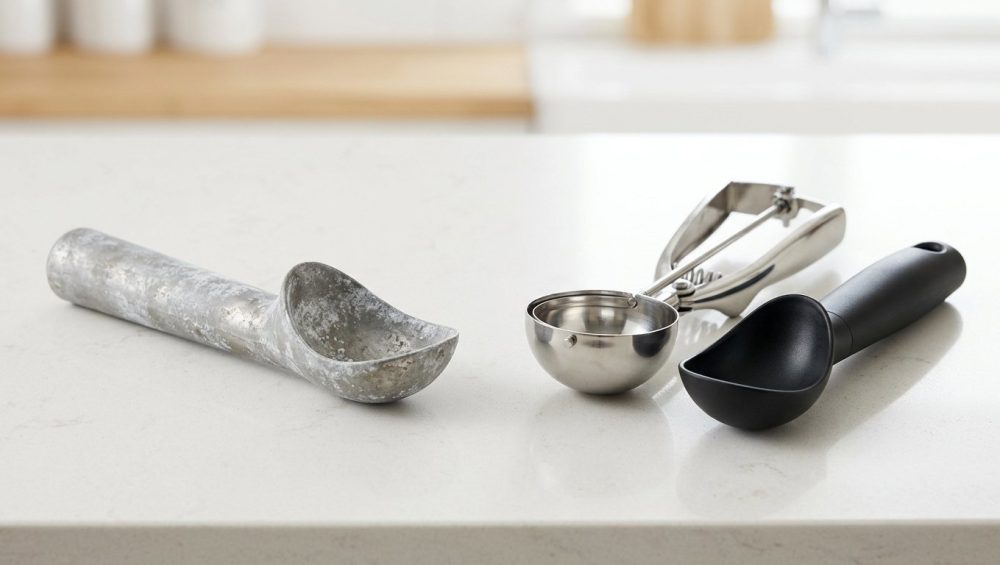
Picture this. It is a random Tuesday night. You have successfully navigated the relentless chaos of the workday, managed to get a semi-respectable dinner on the table without setting off the smoke detector, and now you are staring down a well-deserved pint of premium vanilla bean ice cream. You reach into your utensil drawer, grab your trusty, heavy-duty ice cream scoop, and… your hand is suddenly covered in a bizarre, powdery, dark gray soot. You look at the scoop in horror. It looks like it was recently excavated from a maritime shipwreck. The shiny, smooth metal is completely gone, replaced by a matte, chalky, and frankly terrifying gray crust that immediately smears all over your fingers and the kitchen counter.
What just happened? You ran it through the dishwasher, didn’t you?
Listen up, because as your resident Sassy Sous-Chef, I have absolutely zero patience for kitchenware that self-destructs without a warning label. We are busy people. We rely on our modern appliances to save us from the endless, soul-crushing drudgery of scrubbing dishes by hand. Finding out your favorite dessert tool just committed chemical suicide during a standard rinse cycle is infuriating. Today, we are going to dive deep into the exact metallurgical meltdown that ruined your scoop, debunk the fear-mongering myths about whether that gray dust is going to poison you, and most importantly, talk about upgrading your gear. Because you deserve a beautifully organized dream kitchen filled with resilient tools that actually survive your real, messy life.
The Dishwasher Disaster: What Just Happened to Your Ice Cream Scoop?
To understand the crime scene currently sitting on your kitchen counter, we have to look at the intersection of metallurgy and modern chemical engineering. The truth is, your dishwasher is not a gentle, sudsy spa for your utensils. It is a highly aggressive, extreme-temperature chemical environment designed to blast baked-on lasagna off of ceramic plates.
The Crime Scene: Uncoated Aluminum Meets Alkaline Detergent
Most classic, diner-style ice cream scoops are made of raw, uncoated aluminum alloy. Aluminum is an incredibly popular material in the culinary world because it is lightweight, inexpensive, and boasts phenomenal thermal conductivity. However, from a chemical standpoint, aluminum is what scientists call “amphoteric”. In plain English, this means aluminum is a chemical flip-flopper. It will react violently with highly acidic substances, and it will absolutely disintegrate in highly alkaline (basic) environments.
This is where your dishwasher detergent enters the chat. The detergent pods and powders we use today are nothing like the gentle, pH-neutral Dawn dish soap sitting next to your sink. To effectively dissolve proteins, saponify fats, and leave your wine glasses sparkling, automatic dishwasher detergents are engineered to be highly alkaline, typically clocking in at a staggering pH level between 10 and 14. Just like figuring out why your plastic containers stay greasy, understanding this chemical reaction is the key to preventing future kitchen disasters. When you place a raw aluminum scoop into the dishwasher, you are essentially dropping it into a boiling, caustic chemical bath.
The Chemical Reaction (Explained Without the Pretentious Chef-Speak)
Under normal circumstances, raw aluminum protects itself from the elements. The moment bare aluminum is exposed to oxygen in the air, it forms a microscopic, transparent shield called an aluminum oxide layer. This natural shield is remarkably tough, but it has a fatal flaw: it is only stable within a moderate pH range of roughly 4.5 to 8.5.
When that alkaline detergent pod bursts inside your dishwasher, the pH of the water instantly spikes well past 11. This highly caustic solution immediately attacks and dissolves the protective aluminum oxide shield, leaving the raw, naked aluminum completely exposed.
Once the shield is stripped away, the intense heat of the dishwasher’s water—often reaching 140°F or higher—acts as a massive catalyst, throwing the chemical reaction into absolute overdrive. The bare metal reacts with the alkaline water to form a chaotic, disorganized layer of aluminum hydroxide and severe oxidation. That dark gray, chalky, powdery residue that is currently rubbing off on your hands? That is the physical manifestation of your scoop corroding in real-time. You didn’t just wash your scoop; you fundamentally altered its chemical structure.
The Genius (and Fragility) of the Classic Liquid-Filled Scoop
Before we completely write off aluminum scoops as high-maintenance divas, we need to pay our respects to the granddaddy of them all: the iconic Zeroll scoop. If you have ever been to a professional ice cream parlor and marveled at how effortlessly the teenager behind the counter glides through rock-hard frozen dairy, you have witnessed the magic of this specific tool.
The Legacy of Sherman Kelly and the 1935 Invention
The story goes back to 1935, when a man named Sherman Kelly was vacationing in West Palm Beach, Florida. He watched a young woman struggling to dip hard ice cream, noticing that her hands were covered in painful blisters from the sheer mechanical strain of the repetitive motion. Kelly realized there had to be a better way. He invented a solid, one-piece aluminum scoop with a hollow handle. Inside that handle, he sealed a non-toxic, heat-conductive fluid.
The Thermodynamics of the Magic Fluid
This fluid is the secret sauce of the professional scoop. It is specifically designed to harness the ambient body heat from your hand and rapidly transfer it down the highly conductive aluminum neck, straight into the bowl of the scoop. This continuous transfer of thermal energy warms the metal just enough to melt a microscopic layer of the ice cream it touches. This tiny layer of melted ice cream acts as a natural lubricant, allowing the scoop to glide through a sub-zero block of dairy like a hot knife through butter, completely eliminating the need for excessive mechanical force. It is a brilliant, elegant feat of thermodynamic engineering.
Why the Dishwasher is a Double Homicide for These Scoops
Unfortunately, if you own one of these liquid-filled marvels, putting it in the dishwasher is a catastrophic double homicide. Not only does the highly alkaline detergent completely destroy the exterior aluminum finish, but the heat of the machine destroys the internal mechanics.
The manufacturers of these fluid-filled scoops explicitly warn users never to expose the tool to temperatures above 140°F. Much like the principles behind preventing deformation in your favorite pans, you have to respect the thermal limits of your equipment. The extreme heat of a modern dishwasher’s sanitizing cycle causes the proprietary heat-conductive liquid inside the handle to expand rapidly. This violent expansion can warp the metal, permanently break the vacuum seal, and cause the fluid to leak out entirely, rendering the scoop totally useless. So, if your scoop is now gray and feels weirdly hollow or rattles when you shake it, it is officially time to read it its last rites.
Is That Gray Powdery Residue Actually Dangerous?
Whenever a home cook pulls a powdery, oxidized aluminum pan or scoop out of the dishwasher, the immediate panic sets in. We’ve all read the terrifying internet headlines linking aluminum exposure to a myriad of terrifying neurological diseases. So, is that gray dust going to poison your family? Let’s look at the actual science.
The Aluminum Leaching Debate
The overwhelming consensus from major health organizations, including the FDA, the World Health Organization, and the European Food Safety Authority, is that everyday exposure to aluminum through cookware is minimal and does not pose a significant health risk to the average person. Aluminum is the third most abundant element in the Earth’s crust; it is naturally present in our soil, our water, and the food we eat.
Furthermore, the human digestive system is incredibly efficient at filtering it out. The body only absorbs a microscopic fraction—roughly 0.003%—of the aluminum it ingests, with the vast majority passing through our system completely unabsorbed. The aluminum oxide layer itself is chemically inert and non-toxic. Even if you were to swallow a small amount of that gray dust, it would not react with your stomach acid and would pass through your intestines unmodified. From a strictly toxicological standpoint, ruining your scoop in the dishwasher is a cosmetic tragedy, not a medical emergency.
Why I Refuse to Keep Toxic Gear in My Kitchen
However, just because it won’t land you in the emergency room doesn’t mean you should keep using it. I am a ruthless advocate for banishing toxic kitchen gear from your home, and that includes gear that actively degrades into your food.
The gray aluminum hydroxide powder is loose, messy, and highly transferable. It will rub off onto your hands, your dish towels, and yes, directly into your expensive pint of artisanal pistachio gelato. It looks absolutely disgusting, and worse, it imparts a sharp, unpleasant metallic tang to whatever it touches. You work hard for your money, and you deserve to enjoy your dessert without it tasting like you licked a battery. If your scoop is shedding gray dust, it is actively ruining your culinary experience, and it needs to go.
The “Hand Wash Only” Myth: Why We Need Better Tools
The traditional culinary world is full of gatekeepers who will smugly tell you that you should never put a quality kitchen tool in the dishwasher. They insist that true cooks lovingly hand-wash, dry, and oil their equipment like they are curating a museum exhibit.
Time is Money (And I’m Not Spending It Scrubbing Scoops)
Listen to me very carefully: I love a beautifully crafted kitchen tool, but I am not Laura Ingalls Wilder. I am not churning my own butter, I am not weaving my own dishcloths, and I am certainly not standing over a sink hand-washing a sticky, dairy-covered ice cream scoop at 11:00 PM on a weeknight. We’ve all dealt with bizarre kitchen anomalies, like wondering why your silicone spatulas taste like soap after a wash, but at least silicone can survive the machine.
Time is the most valuable currency a home cook has. If a tool cannot survive the top rack of my dishwasher, it is actively working against my peace of mind. We need tools that serve us, not tools that require us to serve them. The “hand wash only” rule for aluminum scoops is a massive bottleneck for anyone who just wants a quick bowl of ice cream without generating a chore.
The Problem with Cheap Non-Stick and Mystery Metals
In an attempt to solve the dishwasher problem, many cheap kitchenware brands started coating their aluminum scoops in non-stick Teflon or mystery enamel paints. Do not fall for this trap.
Ice cream is hard, and the mechanical force required to scoop it puts immense stress on the tool’s surface. Within a few months of use, those cheap non-stick coatings will inevitably begin to blister, peel, and flake off. It’s the exact same frustrating bait-and-switch you feel when your favorite non-stick pans keep losing their slip after a few months of daily use. Except with an ice cream scoop, those toxic black flakes end up buried inside your vanilla bean. We do not tolerate peeling coatings in this kitchen. We demand solid, indestructible materials that can take a beating and come out of the dishwasher looking brand new.
The Science of the Perfect Scoop: What Actually Makes It Work?
If we are ditching raw aluminum and rejecting cheap non-stick coatings, what makes a genuinely great ice cream scoop? It comes down to basic physics: you either need superior thermal conductivity to melt the ice cream, or you need superior mechanical leverage to break it apart.
Thermal Conductivity vs. Mechanical Leverage
As we discussed, aluminum relies on thermal conductivity. But if we want a dishwasher-safe tool, we have to pivot to materials like solid stainless steel. Stainless steel is a notoriously poor conductor of heat compared to aluminum. It will not transfer the warmth from your hand to the bowl of the scoop efficiently.
To compensate for this lack of thermal conductivity, a stainless steel scoop must rely on pure mechanical leverage. It needs to be incredibly heavy, exceptionally rigid, and feature a sharply tapered edge. Just as hard surfaces end up ruining your knives over time, a poorly designed scoop with a blunt edge will just mash the ice cream against the side of the carton. A sharply machined edge allows the user to bite into the frozen surface, using the sheer weight of the steel to plow through the dairy.
The Ergonomics of the Dig
The handle geometry is also critical. When you are forcing a piece of metal through a block of frozen cream, the pressure on your wrist and palm is immense. A good scoop will feature a thick, slip-resistant, ergonomic grip that absorbs the shock and distributes the pressure evenly across your hand. It should feel like a heavy, balanced weapon in your hand, ready to conquer the freezer aisle.
What to Buy Instead: The Ultimate Ice Cream Scoop Upgrades
Now that you understand exactly why your old scoop died a powdery gray death, it is time to upgrade. Throw the oxidized aluminum in the recycling bin and invest in one of these genuinely dishwasher-safe, heavy-duty alternatives.
The Heavyweight Champion: Solid Stainless Steel
If you want a tool that you can throw into the dishwasher a thousand times without a single worry, you need a solid stainless steel scoop. Brands like OXO Good Grips and Spring Chef manufacture incredibly robust, heavyweight stainless steel scoops that are practically indestructible.
Unlike the terrifying moment when your baking sheets pop loudly in the oven due to thermal stress, solid stainless steel is completely impervious to the heat and alkaline chemicals of your dishwasher. These scoops feature a pointed, spade-like tip that easily pierces rock-hard ice cream, and flat edges that allow you to scrape the sides of the carton clean. They are heavy, they are gorgeous, and they will literally outlive you.
The Spade: The Unsung Hero of Hard Gelato
If you frequently eat highly dense, frozen-solid desserts like artisanal gelato or sorbet, you might want to abandon the traditional rounded scoop altogether and invest in an ice cream spade.
An ice cream spade looks like a flat, heavy trowel. Instead of trying to force a rounded bowl into a solid block of ice, the spade uses a flat, sharp edge to shave and pry layers of ice cream off the top. It is the exact same technique used in authentic Italian gelaterias. It requires significantly less wrist strength and gives you beautiful, sweeping ribbons of dessert. Just ensure you buy a solid stainless steel spade, not a cheap coated one. It’s the same disappointment you feel when your favorite ceramic pan lost its non-stick magic; a cheap spade will bend and chip under pressure.
The Mechanical Marvel: The Trigger Release Scoop
For those who prioritize perfect, photogenic spheres of ice cream—or for those who double their ice cream scoop as a cookie dough portioner—the mechanical trigger scoop is a classic choice. These scoops feature a sweeping metal band inside the bowl, activated by a spring-loaded squeeze handle.
They are fantastic for soft-serve, mashed potatoes, and perfectly uniform cookies. However, a word of caution: they are notoriously fragile when faced with rock-hard ice cream. The sweeping mechanism can easily bend or snap if you try to force it through a frozen-solid pint. If you go this route, buy a commercial-grade stainless steel version (like those from Vollrath), ensure it is dishwasher safe, and always let your ice cream soften for five minutes on the counter before digging in.
How to Rescue Your Gray, Oxidized Scoop (If You Must)
Okay, let’s say you have a deep, sentimental attachment to the gray, powdery aluminum scoop currently ruining your countertops. Maybe it was a gift from your grandmother, or maybe you are just incredibly stubborn. Can it be saved? Yes. But it is going to require a bit of high school chemistry and some serious elbow grease.
The Acid Boiling Method
Because the damage was caused by a highly alkaline environment, the only way to reverse the chemical reaction is to introduce an acid. You need to chemically dissolve the dark aluminum hydroxide layer and neutralize the surface.
Grab a large stainless steel pot (do not use an aluminum pot for this, obviously). Fill it with enough water to completely submerge the ruined scoop. Now, add a generous amount of a mild household acid. You can use two cups of standard white vinegar, a cup of lemon juice, or three tablespoons of cream of tartar.
Bring the acidic solution to a rolling boil, and carefully drop your oxidized scoop into the pot. Let it boil for about 10 to 15 minutes. The heat and the acid will work together to break down the chalky tarnish, slowly revealing the clean metal underneath.
A massive disclaimer: If your scoop is a liquid-filled Zeroll, boiling it will absolutely destroy the internal fluid if the dishwasher hasn’t already. This restoration method is strictly for solid, single-piece aluminum items.
The Elbow Grease and Polishing Phase
Once you have boiled the scoop, carefully remove it with tongs and let it cool. The gray layer should now be significantly loosened. Take a soft sponge and some mild, pH-neutral dish soap, and gently scrub the remaining residue away.
Do not use abrasive steel wool or harsh scouring pads! The acid has left the raw aluminum completely exposed and highly vulnerable to deep scratching. Once you have scrubbed it clean, dry it immediately with a microfiber cloth to prevent water spots.
Your scoop will be shiny again, but remember: the protective oxide layer is still rebuilding itself, and the metal remains incredibly reactive. Part of conquering the kitchen is knowing when to salvage a mistake and when to throw in the towel. If you put this newly restored scoop back in the dishwasher, it will instantly turn gray all over again. You are now permanently committed to the hand-wash lifestyle for this specific tool.
The Final Verdict: Stop Settling for Kitchenware Disasters
Cooking at home should be a joyful, creative, and relaxing experience. It should not feel like you are constantly navigating a minefield of fragile tools, peeling coatings, and unexpected chemical reactions. The moment you pull a beloved utensil out of the dishwasher and find it covered in toxic-looking gray soot is the moment you need to reevaluate what you allow into your culinary space.
You do not need a culinary degree to understand that your time is valuable. You are a busy home cook who deserves high-quality, durable, low-maintenance equipment that works exactly as intended, every single time.
So, let the powdery gray aluminum scoop go. Forgive yourself for the dishwasher mistake—nobody expects you to memorize the pH levels of modern detergents—and treat yourself to a heavy-duty, solid stainless steel upgrade. Your hands will stay clean, your dishwasher can do its job without destroying your gear, and your late-night bowl of vanilla bean will taste exactly as it should: absolutely perfect, with zero metallic aftertaste. Now, grab a spoon and go enjoy your dessert. You’ve earned it.