Welcome to the Club: Why Entertaining Doesn’t Require a Culinary Degree
Listen up, weekend warriors. We need to have a little chat about this paralyzing fear you have of inviting people over for dinner. You want to host. You want to be the kind of effortlessly chic person who pours wine while laughing around a beautifully set table. But the moment you think about actually cooking for a crowd, your chest tightens, and you start sweating.
You are not alone. According to a recent Harris Poll survey, while 92% of Americans who have hosted enjoy doing it, a staggering 60% feel hesitant and anxious about assuming the role. A British survey even found that half of respondents considered throwing a dinner party to be more stressful than going to work, and a quarter found it more traumatic than sitting down for a job interview.
Take a deep breath. I am here to tell you a fundamental truth that the restaurant industry doesn’t want you to know: You do not need to know how to cook to host a mind-blowing dinner party.
You do not need a culinary degree. You do not need to know how to clarify butter, perfectly sear a scallop, or pronounce “mirepoix.” You just need a strategy, a few clever supermarket hacks, and the willingness to fake it until you make it. Millennials and Gen Z are already catching on to this; recent data shows that 74% of young adults now prefer memorable, passion-driven experiences over traditional gift exchanges, and 61% prefer social, immersive dining formats over sitting in a stuffy traditional restaurant. They aren’t looking for Michelin-starred perfection; they are looking for connection.
This is your definitive, no-fluff, sass-filled masterclass on how to throw a beautiful, memorable dinner party with absolutely zero cooking skills. We are going to prioritize your time, protect your sanity, and trick your friends into thinking you are a domestic god or goddess. Pour yourself a glass of wine, and let’s get to work.
The Mindset Shift: Ambiance Over Agony
Before we even talk about food, we need to fix your mindset. The biggest mistake novice hosts make is trying to prove something. They watch one episode of a cooking competition show and suddenly think they need to execute a five-course tasting menu featuring a twelve-hour braised short rib and a spun-sugar dessert.
Stop it. Your friends do not care.
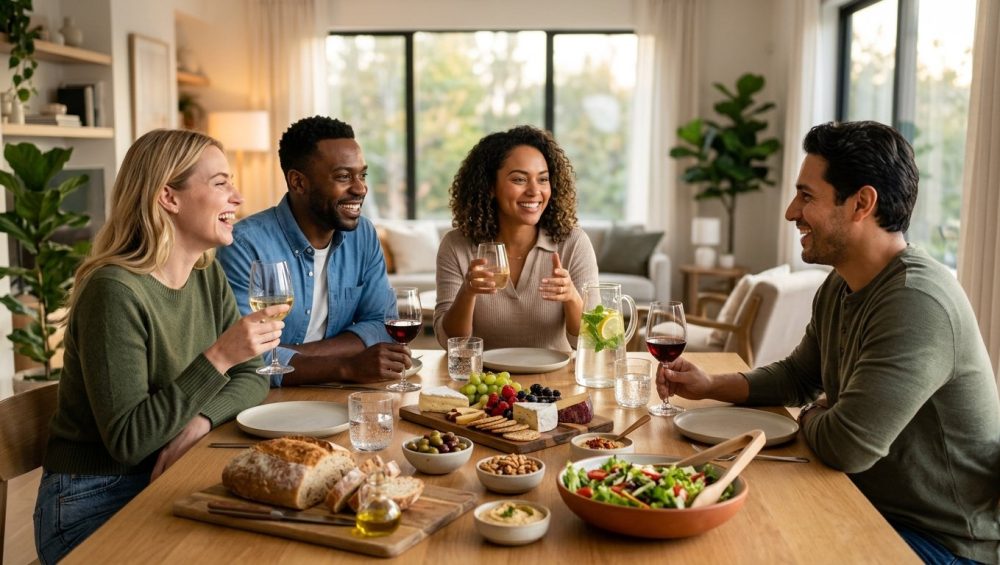
Your guests are not food critics; they are your friends. They are just thrilled they don’t have to cook their own dinner or wash their own dishes tonight. The philosophy of the zero-skill dinner party is simple: Ambiance and energy matter infinitely more than the food. If the lighting is moody, the music is good, your glass is full, and you are relaxed, your guests will think the lukewarm, store-bought garlic bread is the greatest thing they have ever tasted. Conversely, if you serve a perfectly executed beef wellington but you are sweating profusely, snapping at your partner, and crying in the kitchen, everyone will be miserable.
You are the thermostat for the evening. If you are stressed, the party is stressed. Therefore, every single decision we make from this point forward is designed to eliminate your stress. We are outsourcing, we are assembling rather than cooking, and we are heavily relying on the magic of distraction.
The “No-Go” Rule: Purging the Toxic Garbage from Your Kitchen
Before I give you my foolproof hosting hacks, we need to address the elephant in the room—or rather, the poison in your cabinets. As your incredibly opinionated culinary fairy godmother, I have a strict “No-Go” rule when it comes to toxic, cheap kitchen gear.
If you are currently cooking on a lightweight, warped, scratched-to-hell non-stick skillet that you bought for $12 at a big-box store five years ago, I want you to walk into your kitchen right now and throw it in the trash. I am not kidding.
Those peeling non-stick coatings are loaded with PFAS (per- and polyfluoroalkyl substances), notoriously known as “forever chemicals” because they do not break down in the environment or in your body. We are finally waking up to how dangerous this garbage is. As of January 2025, Minnesota became the first state to outright ban the sale of nonstick cookware coated with PFAS, with several other states actively following suit. Why? Because the science is terrifying. A groundbreaking April 2026 study from Michigan State University linked long-term PFAS exposure to a weakened immune system, proving that these chemicals actively reduce the body’s ability to produce protective antibodies.
You cannot host a beautiful dinner party if you are actively feeding your friends flaking chemical polymers. Furthermore, those cheap “mystery metal” pans distribute heat terribly. You probably think you are a bad cook because your chicken burns on the outside and stays raw on the inside. Half the time, it’s not your lack of skill; it’s your garbage equipment actively sabotaging you.
What to use instead: You only need a few good pieces to conquer the kitchen. Invest in a heavy-bottomed stainless steel skillet, a solid enameled cast-iron Dutch oven (like a Le Creuset or Staub—yes, they are expensive, but they will literally outlive you), and a simple, bare cast-iron pan. These materials are non-toxic, they retain and distribute heat beautifully, and they give you the kind of gorgeous, golden-brown sear that makes food look professional. Treat your kitchenware like an investment in your health and your sanity.
Menu Planning: The Art of Strategic Assembly
The secret to a zero-skill dinner party is that you aren’t actually cooking a meal; you are strategically assembling one. We are going to build a menu that requires zero precise timing, zero complex techniques, and zero last-minute panic.
The “Store-Bought but Make It Fancy” Strategy
You are going to buy pre-made items from the grocery store and disguise them. The trick is to never serve anything in its original plastic packaging. The moment you take store-bought hummus out of its plastic tub, swoop it onto a beautiful ceramic bowl with the back of a spoon, drizzle it with high-quality olive oil, and sprinkle it with smoked paprika and toasted pine nuts, it ceases to be Sabra. It becomes artisanal.
Appetizers: The Grazing Board Masterclass
Do not make hot appetizers. I repeat: do not make hot appetizers. Trying to time a batch of bacon-wrapped dates while simultaneously managing a main course is how novice cooks end up in tears.
Your appetizer is a massive, visually overwhelming grazing board. It looks incredibly impressive, requires zero cooking, and keeps guests occupied for an hour while you pretend to be busy in the kitchen. Here is the foolproof 3-3-3-3 rule for a perfect board:
- 3 Cheeses: One hard (aged cheddar or manchego), one soft (brie or camembert), one funky or crumbly (blue cheese or goat cheese).
- 3 Meats: Prosciutto (draped like ribbons, not laid flat), salami, and perhaps a spicy capicola.
- 3 Carbs: A water cracker, a seeded cracker, and sliced baguette.
- 3 Accoutrements: Something sweet (fig jam or honey), something briny (castelvetrano olives or cornichons), and something crunchy (marcona almonds or candied pecans).
Fill every single gap on the wooden board with fresh grapes or berries. Abundance is the aesthetic. If you pack it tightly enough, it looks like a Renaissance painting.
The Main Event: Foolproof Centerpieces
If you have zero cooking skills, you must avoid any main course that requires precise timing or à la minute cooking. No steaks. No seared fish (it will stink up your house anyway). No risotto that requires you to stand over a stove stirring for 30 minutes while your guests mingle without you.
You have two foolproof options for a zero-skill main event:
Option 1: The “Set It and Forget It” Braise or Roast Pork shoulder or beef chuck roast. These are tough, cheap cuts of meat that become melt-in-your-mouth tender when you literally just throw them in your (non-toxic!) Dutch oven with some broth, wine, and onions, and bake them at 300°F for four hours. You cannot overcook them. If they are done early, they happily sit in their own juices and stay warm. Serve this shredded meat over store-bought polenta (the kind that comes in a tube—just heat it up with butter and parmesan) or mashed potatoes.
Option 2: The Interactive Bar People love customizing their food. A high-end Taco Bar or a Mediterranean Cava-style bowl station is incredibly easy. You can buy pre-marinated meats to roast in the oven, warm up some tortillas or pita, and spend your time simply chopping fresh toppings. Put everything in beautiful little bowls. The guests do the work of assembling their plates, and they find it charming and interactive.
Side Dishes: Low Effort, High Reward
Do not overcomplicate the sides.
- The Salad Hack: Buy two bags of pre-washed spring mix. Throw away the sad, chemical-tasting dressing packet that comes with it. Toss the greens in a massive wooden bowl. Add one “fancy” fruit (sliced pears or pomegranate seeds), one nut (candied walnuts), and one cheese (shaved parmesan or feta). Dress it simply with olive oil, lemon juice, salt, and pepper right before serving.
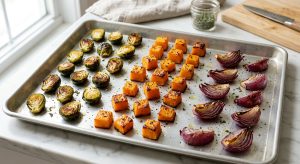
- The Roasted Veggie: Buy pre-chopped vegetables (broccoli florets or baby carrots). Toss them in olive oil, salt, and pepper. Roast them at 425°F until the edges are dark brown and crispy. Burnt edges equal flavor.
Dessert: Outsourcing with Pride
Baking is a science. If you have zero cooking skills, science is not your friend today. Do not attempt to bake a cake from scratch. Go to a good local bakery and buy a beautiful tart, a flourless chocolate cake, or a box of high-end macarons. If you want to add a “homemade” touch, buy some heavy whipping cream, add a splash of vanilla extract and a spoonful of powdered sugar, and vigorously whisk it until it forms soft peaks. Plop a dollop of your homemade whipped cream next to the store-bought cake. Boom. You are a pastry chef.
The Sassy Sous-Chef’s Ultimate Cheat Sheet: Upgrading Supermarket Staples
If you want to elevate basic, low-effort food into something that tastes like it came from a trendy bistro, you need to employ my holy trinity of culinary smoke and mirrors. These are the low-effort, high-impact upgrades you must keep in your kitchen:
1. The “Good” Olive Oil You need two types of olive oil in your house. One cheap one for cooking, and one expensive, grassy, peppery extra-virgin olive oil for finishing. You do not cook with the good stuff. You drizzle it over your store-bought hummus, over your bagged salad, over your roasted vegetables, and over a block of feta cheese. It makes everything taste richer.
2. Flaky Sea Salt Throw away your iodized table salt right now. It tastes like tin. Buy a box of Maldon flaky sea salt. When you finish your roasted meats, your sliced tomatoes, or even your store-bought chocolate chip cookies, sprinkle a pinch of these massive, crunchy salt crystals on top. It provides a textural crunch and a burst of flavor that screams “professional chef.”
3. Fresh Herbs Dried herbs taste like dust. Fresh herbs are the cheapest way to make a dish look expensive. Buy a bunch of fresh flat-leaf parsley, cilantro, or basil. Roughly chop it and throw it over literally everything right before serving. A frozen, store-bought lasagna looks like a frozen lasagna. A frozen lasagna showered in fresh basil and a drizzle of olive oil looks like a rustic Italian masterpiece.
4. Acid is Everything If you taste something you made and think, “This is boring, it needs something,” 90% of the time it doesn’t need salt; it needs acid. Keep fresh lemons and limes on hand. A squeeze of fresh lemon juice over roasted vegetables or a heavy meat dish instantly brightens the entire flavor profile.
Ambiance: Distracting Them From the Food with Flawless Vibes
Remember our philosophy: Ambiance over agony. If your house feels like a sanctuary, your guests will be too relaxed to notice if the chicken is slightly dry.
Lighting: The Magic of Low Expectations
The most egregious crime a host can commit is leaving the “big light” (the overhead ceiling light) on. Overhead lighting is for operating rooms and interrogations. It makes everyone look tired and makes your living room feel like a waiting area. Turn off the overheads. Rely entirely on floor lamps, table lamps, and candles. You want warm-toned bulbs (look for 2700K color temperature). Light at least five unscented candles and place them around the dining and living areas. Unscented is crucial here—you do not want a “Vanilla Pumpkin Spice” candle competing with the smell of your garlic bread. Dim, warm lighting hides dust on your baseboards, hides blemishes on your face, and makes your cheap wine look like a vintage Bordeaux.
Tablescaping for Beginners
You do not need fine china. You just need intention.
- The Tablecloth: If your table is ugly, buy a cheap, neutral linen tablecloth. Iron it. Wrinkles are the enemy of chic.
- Plates and Napkins: Use real plates. Buy cloth napkins. You can get a pack of cotton napkins online for $15. Tossing a cloth napkin on a plate instantly signals to your guests that this is a real dinner party, not a pizza night.
- The Centerpiece: Keep it low. Guests need to be able to see each other across the table. Do not buy a massive, towering floral arrangement. Instead, buy a bunch of eucalyptus from the grocery store and lay it flat down the center of the table like a runner. Nestle a few tea lights in the leaves. It takes two minutes, costs $10, and looks like a wedding Pinterest board.
The Playlist: Setting the Vibe
Silence is awkward. You need music playing the absolute second your first guest walks through the door. The volume should be loud enough to fill lulls in conversation but soft enough that no one has to yell. Do not play aggressive EDM or top-40 pop hits. You want a vibe that says “effortlessly cool lounge.” Search Spotify or Apple Music for playlists labeled “Bossa Nova Covers,” “Lo-Fi Beats,” “French Cafe,” or “Dinner Party Soul.” Put it on shuffle and hide your phone.
Beverages: Liquid Courage and Clever Cocktails
You are already anxious; do not turn yourself into a made-to-order bartender. If you are shaking individual martinis for six different people, you will spend the entire night in the kitchen covered in sticky simple syrup.
Wine Pairings for Dummies
Do not stress about pairing the perfect terroir with your roasted chicken. The rule for zero-skill hosts is simple: Buy what you like to drink. Have one white option (like a crisp Sauvignon Blanc) and one red option (like a crowd-pleasing Pinot Noir). The Ultimate Sassy Hack: If you buy cheap wine, decant it. Pour that $12 bottle of red into a glass decanter or a pretty glass pitcher an hour before guests arrive. Throw away the bottle. No one will know, and oxygenating the cheap wine actually makes it taste smoother.
The Batch Cocktail Hack
If you want to serve a cocktail, make a pitcher drink. Sangria, a massive batch of margaritas, or a pre-mixed Negroni. Mix it in a beautiful glass pitcher with ice and fruit slices before anyone arrives. Set it on a side table with a stack of glasses and let people serve themselves.
The Hydration Station
People forget to drink water when they are socializing, which leads to messy guests and terrible hangovers. Set up a “Hydration Station.” Fill a large pitcher with ice water, drop in some cucumber slices and mint leaves (again, making it look expensive!), and leave it on the table. It prevents you from having to constantly refill water glasses all night.
Handling Dietary Restrictions Without Losing Your Mind
In today’s world, someone at your table is going to be vegan, gluten-free, dairy-free, or doing keto. Do not panic, and absolutely do not cook three separate meals. You are a host, not a short-order cook.
First, always ask about dietary restrictions in your invitation text. Surprises on the night of the party are how meltdowns happen.
Second, the solution to dietary restrictions is modular eating. This is why the “Interactive Bar” (like a taco bar or mezze platter) is so brilliant. If you serve a massive salad, roasted vegetables, a grain (like quinoa or rice), and a protein on the side, everyone can build their own plate according to their needs.
- Gluten-Free? Skip the bread, load up on the meat and veggies.
- Vegan? Skip the meat, load up on the veggies, grains, and hummus.
- Dairy-Free? Keep the cheese on a separate board, not mixed into the salad.
By keeping components separate rather than mixing them into one giant casserole, you accommodate everyone effortlessly without doing any extra work.
The Timeline: Your Foolproof Countdown to Showtime
The difference between a stressed host and a relaxed host is entirely dictated by what they do in the 24 hours leading up to the party. If you are chopping onions when your guests ring the doorbell, you have failed. Here is your definitive, zero-stress timeline.
One Week Out
- Finalize the Menu: Lock in your zero-skill recipes and your store-bought hacks.
- Send the Invites: Text your friends. Ask for dietary restrictions.
- Inventory Check: Do you have enough plates, forks, and wine glasses? Do you have toilet paper? (Do not be the host who runs out of toilet paper. It is an unforgivable sin.)
The Day Before
- Grocery Shopping: Buy everything. Do not leave this for the day of the party. The grocery store on a Saturday afternoon is a warzone that will drain your will to live.
- Prep the Veggies: Wash the lettuce. Chop the vegetables you plan to roast. Put them in Tupperware in the fridge.
- Set the Table: Put the tablecloth down, set out the plates, fold the napkins, and build your eucalyptus centerpiece. Doing this the night before makes you feel incredibly accomplished when you wake up on party day.
The Day Of
- Morning: Empty the dishwasher and empty the kitchen trash can. This is the most important tip in this entire article. If your dishwasher is empty when guests arrive, you can put dirty plates directly into it after dinner instead of letting them pile up in the sink.
- Afternoon (4 Hours Before): Assemble your grazing board, wrap it tightly in plastic wrap, and stick it in the fridge. Chill the white wine. If you are doing a slow-roast main course, get it in the oven now.
- 2 Hours Before: Take the grazing board out of the fridge so the cheese can come to room temperature (cold cheese tastes like nothing). Make your batch cocktail.
One Hour Before: The Golden Hour
This is where novice hosts usually lose their minds. Not you. Because you followed this guide, the food is essentially done.
- 60 Minutes Before: Go take a shower. Put on an outfit that makes you feel fabulous but is comfortable enough to move around in.
- 30 Minutes Before: Turn off the overhead lights. Turn on the lamps. Light the unscented candles. Turn on the playlist.
- 15 Minutes Before: Take your store-bought hummus out of the plastic tub, swoop it into a bowl, and hit it with your good olive oil.
- 10 Minutes Before: Pour yourself a glass of wine.
When the doorbell rings, you will have a drink in your hand, your house will smell amazing, the lighting will be flawless, and you will not have a single drop of sweat on your brow.
Final Thoughts: Pour the Wine and Have Fun
Hosting a dinner party is not a culinary exam; it is an act of generosity. You are opening your home to the people you care about and providing them with a safe, warm space to escape the chaos of the outside world.
If you burn the garlic bread, laugh about it and throw it away. If you spill wine on the tablecloth, throw some salt on it and keep telling your story. Perfection is intimidating and frankly, a little boring. Vulnerability, laughter, and a relaxed atmosphere are what make a dinner party legendary.
You now possess the hacks, the timeline, and the snarky confidence required to pull this off. Throw away your toxic pans, buy the good olive oil, outsource your dessert, and text your friends. You’ve got this, chef. Now go pour the wine.