Picture this: It is a beautiful Friday evening. You have curated the perfect ambient playlist, poured yourself a crisp, chilled glass of Assyrtiko, and you are preparing a gorgeous, mindful mezze board for your friends. You want this spread to be perfect. You want the centerpiece to be a swoosh of velvet-smooth, restaurant-quality hummus that your guests will obsess over. You open a can of chickpeas, dump them into your food processor with a glob of tahini, hit the pulse button, and eagerly dip a spoon in to taste your creation.
And it tastes like wet sand.
Look, I love you, and I am your biggest cheerleader in the kitchen, but we need to have a serious talk about your hummus. I have zero patience for pretentious chef-speak, but I also have zero tolerance for dips that possess the textural charm of drywall. You do not need a culinary degree to make mind-blowing Mediterranean food, but you do need a basic understanding of kitchen science. If your goal is to host a relaxed dinner party where you actually get to sit down and enjoy the fruits of your labor, you need reliable, foolproof techniques that work every single time.
During the week, I am all about survival. I rely on clever hacks and ruthless efficiency to get dinner on the table. But the weekend? The weekend is when we slow down, embrace the process, and become absolute perfectionists. Today, we are going to transform your gritty, dense, sad chickpea paste into an ethereal, cloud-like emulsion using nothing but alkaline heat and thermal shock.
Grab your apron. Class is in session.
The Anatomy of a Chickpea Disaster
Before we can fix your hummus, we need to understand why it is currently failing. Why do your chickpeas stubbornly refuse to blend into a smooth puree, no matter how long you let that food processor run?
The answer lies in the cellular structure of the legume itself. Chickpeas are protected by a tough outer skin and robust cell walls held together by a polysaccharide called pectin. Think of pectin as the structural cement of the plant world. In its natural state, this cement is incredibly rigid.
If you are using canned chickpeas—which, let’s be honest, most of us do for the sake of convenience—you are fighting an uphill battle. Canned chickpeas are commercially processed with a preservative called calcium chloride. Food manufacturers add this firming agent to prevent the beans from turning into mush while sitting on the supermarket shelf. The calcium ions reinforce the pectin structure, keeping the chickpeas bouncy, firm, and aesthetically pleasing.
While this is great for a chunky salad, it is an absolute nightmare for hummus. When you throw firm, calcium-fortified chickpeas into a blender, the blades do not magically liquefy them. They simply chop them into microscopic, hard pebbles. You are essentially pureeing tiny rocks. No amount of high-speed blending will turn a hard pebble into a liquid. To achieve a silky texture, we have to chemically dismantle that structural cement before the beans ever touch the blender blade.
The Baking Soda Miracle: Mastering Alkaline Heat
If you want to break down pectin and defeat that firming calcium chloride, you need to manipulate the pH of your cooking environment. This is where sodium bicarbonate—good old-fashioned baking soda—enters the chat.
The Chemistry of Softening Legumes
Legumes cook faster and break down much more thoroughly in an alkaline (basic) environment rather than an acidic one. When you add baking soda to your boiling water, it significantly raises the pH. This alkaline environment performs a brilliant chemical magic trick: it breaks down the sturdy calcium ions that are holding the chickpea together and introduces softer sodium ions in their place.
Simultaneously, the high pH causes the pectin in the chickpea skins to weaken and dissolve. If you are starting with dried chickpeas (the gold standard for weekend perfectionists), you should add a teaspoon of baking soda to their overnight soaking water, and another pinch when you boil them.
But what if it is Friday night and you only have canned chickpeas? You can still use this trick. Drain and rinse your canned chickpeas, toss them into a pot, cover them with a few inches of water, and add a half-teaspoon of baking soda. Boil them aggressively for about 15 to 20 minutes.
The Visual Cues of Success
As the baking soda works its magic, you will witness the skins literally detach from the beans and float to the surface of the simmering water. You can easily skim these off with a slotted spoon. By the end of the boiling time, the chickpeas will be bloated, mushy, and falling apart at the slightest touch. This is exactly what you want.
A quick word of warning, though: please ensure you are using high-quality, heavy-bottomed cookware for this step. If you are boiling these alkaline legumes in a cheap, scratched, mystery-metal pot, you are actively ruining your nonstick pans and leeching toxic chemicals into your beautiful appetizer. We will discuss my zero-tolerance policy on toxic gear shortly, but for now, stick to stainless steel.
The Ice Water Emulsion: Thermal Shock and Fat Stabilization
Now that you have chemically dismantled your chickpeas into a soft, pliable mush, you might think you are ready to just blend everything together. Stop right there. Hummus is not just a puree; it is a delicate, scientific emulsion.
Understanding the Volatility of Tahini
Tahini is the soul of a good mezze board, but it is notoriously temperamental. It is a metastable suspension made up of ground sesame solids—roughly 55 to 65 percent oil, 20 to 25 percent protein, and a good amount of fiber. When you introduce liquid to dry sesame paste, capillary action draws moisture into the hydrophilic protein matrices, causing immediate swelling and a collapse of surface tension.
If you just haphazardly stir warm tap water or hot chickpeas into your tahini, you will trigger a catastrophic failure. The uncontrolled hydration ruptures the oil droplets, releasing free fatty acids. Just like when your salad dressing separates, a broken tahini mixture results in a greasy, split, unappetizing puddle. Worse, the neutral pH and warm temperature activate endogenous sesame lipase enzymes, which accelerates oxidation and turns the tahini bitter incredibly fast.
The Power of Cold Shocking
To prevent this emulsion from breaking, we must utilize thermal shock. Enter: ice cubes and ice-cold water.
Dropping the temperature of the mixture while blending does two critical things. First, the cold environment stabilizes the emulsion by forming secure oil-in-water micelles, locking in the viscosity and preventing the oil from separating. Second, as the hard ice cubes are pulverized by the blender blades, they introduce tiny, trapped pockets of air into the thick paste.
This mechanical whipping action, combined with the stabilized fat, aerates the mixture. It transforms the dense paste into a light, fluffy, cloud-like consistency. Harnessing this thermal shock is the absolute secret to ultra-smooth hummus that rivals the most expensive Mediterranean restaurants in your city.
The Gear Trap: My No-Go Rule on Toxic Kitchenware
Let’s take a brief, highly necessary detour to talk about your equipment. I am a fierce advocate for the home cook, and I firmly believe you can produce Michelin-level food in a standard kitchen. However, you cannot achieve professional-level emulsification if your gear is actively fighting you—or worse, poisoning you.
I absolutely despise cheap, toxic kitchenware. When you are blending a thick, viscous paste like hummus for three to five minutes, the friction of the blades generates a massive amount of mechanical heat. If you are using a $15 plastic blender from a discount big-box store, that cheap plastic pitcher can warp. Even more horrifying, low-grade plastics degrade under high heat and shear force, leaching microplastics and endocrine disruptors directly into your food.
This is exactly why I am so relentlessly passionate about banishing toxic kitchen gear from your countertops. You do not need to take out a second mortgage to equip your kitchen, but you do need to invest in safety and durability.
For a masterclass hummus, you need a high-powered blender (like a Vitamix) equipped with a BPA-free Tritan pitcher, or a heavy-duty food processor featuring a thick glass or high-quality polycarbonate bowl. You need a motor that won’t burn out when faced with a thick emulsion, and you need materials that remain completely inert, regardless of the temperature or acidity of the ingredients inside. Buy it once, buy it right, and protect your health.
Sourcing the Right Ingredients: No Place to Hide
A recipe with only five primary ingredients is terrifying in its simplicity. There is nowhere for mediocre ingredients to hide. If you skimp on quality here, your final dish will loudly announce your shortcuts to everyone at the table.
The Tahini
Do not buy the jar of tahini that has been sitting at the back of the supermarket shelf since 2019. If the oil has separated into a two-inch slick at the top and the bottom is a concrete block of sesame sediment, leave it there. You are looking for high-quality, single-origin Ethiopian or Levantine tahini. It should be runny, pourable, and smell sweet and nutty. Before you even begin cooking, test your tahini: give it a stir and smell it. If it smells like paint thinner or wet cardboard, it has oxidized and will ruin your dish.
The Garlic
I am begging you, step away from the garlic press. Using a garlic press makes food bitter because it violently crushes the cell walls of the garlic, releasing an overwhelming amount of harsh, pungent sulfur compounds (allicin). Instead, finely mince your garlic with a sharp chef’s knife, or use the side of your blade to mash it into a gentle paste with a pinch of coarse kosher salt.
The Lemon Juice
Put down the little plastic squeeze bottle shaped like a lemon. We are adults hosting a mindful gathering. Buy real, fresh lemons and juice them yourself. The bright, volatile citrus oils in fresh lemon juice are non-negotiable. Always remember that your dinner actually needs acid to cut through and balance out the heavy, rich fats of the sesame paste and olive oil. Without adequate fresh acid, your hummus will taste flat and heavy.
The Olive Oil
Here is a cardinal rule of modern cooking: never, ever blend extra virgin olive oil into your hummus while the food processor is running. High-quality extra virgin olive oil is packed with complex polyphenols. When subjected to the violent, high-speed shear force of a blender blade, these molecular compounds are torn apart, instantly releasing incredibly bitter-tasting notes. Your olive oil is a finishing ingredient only. We will use it to dress the final plate.
The Masterclass Recipe and Methodology
We have covered the science, the gear, and the ingredients. Now, it is time to execute. Follow this methodology precisely, and I promise you will never go back to store-bought dips again.
Step 1: The Alkaline Boil
If using dried chickpeas, soak 1 cup of them overnight in plenty of water with 1 teaspoon of baking soda. The next day, rinse them thoroughly, place them in a heavy-bottomed stainless steel pot, cover with two inches of fresh water, add another 1/2 teaspoon of baking soda, and simmer until they are literally falling apart (about 45 to 60 minutes).
If using two 15-ounce cans of chickpeas, rinse them, boil them in water with 1/2 teaspoon of baking soda for 20 minutes until mushy. Skim off any floating skins. Drain them well and let them cool slightly.
Step 2: The Tahini Pre-Whip
Before the chickpeas even look at the food processor, we must build our emulsion. In your high-powered blender or food processor, combine 1/2 cup of high-quality tahini, 1/4 cup of fresh lemon juice, and your gently mashed garlic clove. Turn the machine on. The mixture will initially seize up and look thick and broken. Do not panic; this is the protein matrix absorbing the liquid. While the motor is running, drizzle in 2 to 3 tablespoons of ice-cold water. Watch as the mixture miraculously transforms into a pale, fluffy, whipped cream-like consistency. You have just successfully stabilized your emulsion.
Step 3: The Chickpea Integration
Add your soft, alkaline-boiled chickpeas to the whipped tahini base, along with a generous pinch of kosher salt and a dash of ground cumin. Turn the machine on and let it run. Do not pulse it a few times and call it a day. Let that motor run for a full two to three minutes.
Step 4: The Ice Cube Drop
While the machine is continuously running, drop in two or three whole ice cubes. You will hear a loud crunching as the blades obliterate the ice. Keep blending for another two minutes. The thermal shock will lock the emulsion, and the crushed ice will whip microscopic air bubbles into the paste. Stop the machine, taste for seasoning (add more salt or lemon if needed), and marvel at the silky, cloud-like texture you have just created.
Step 5: The Plating
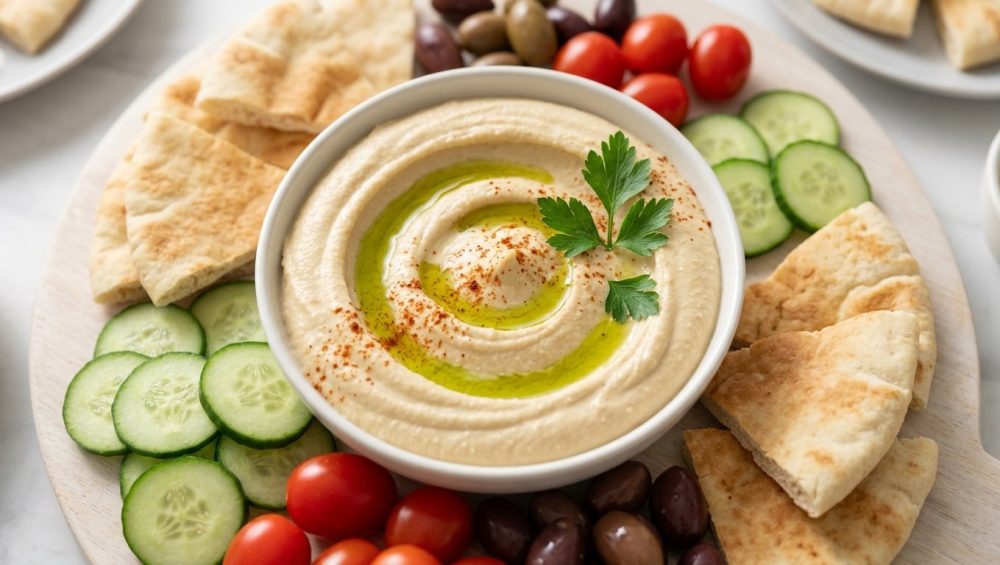
Hummus is a canvas, and presentation matters. Spoon the warm, freshly whipped hummus into a wide, shallow bowl. Use the back of a spoon to create a deep, beautiful swoosh or well in the center. Now, take your high-quality, cold-pressed extra virgin olive oil and generously pool it into that well. Sprinkle with sumac, toasted pine nuts, or fresh parsley. If you are making fresh flatbread to accompany this masterpiece, you really need a bench scraper to divide the sticky dough cleanly before tossing it onto a hot cast-iron skillet.
Curating the Mindful Mezze Board
You have conquered the chemistry of the chickpea. The hard work is done. Now, we shift our focus to the art of the gathering. A mindful mezze board is not about rigid formality; it is about creating an environment of abundance, connection, and sharing.
The Philosophy of the Spread
When you build a communal appetizer board, you are inviting your guests to interact with their food and with each other. Break out your safest, most beautiful ceramic platters. Surround your spectacular bowl of hummus with an array of thoughtful, colorful accompaniments.
Provide stacks of warm, pillowy pita bread. Offer vibrant, crisp vegetables like Persian cucumbers, radishes, and bell peppers. Add small bowls of marinated kalamata olives, chunks of sheep’s milk feta drizzled with honey, and perhaps some roasted red peppers.
When preparing your fresh vegetable crudités, pay attention to the details. Nobody wants to dip into a bowl with sad, wilted garnishes, and we all know how fast fresh herbs get slimy if they aren’t stored properly in the fridge. Wash your produce, dry it thoroughly, and keep it crisp in a damp paper towel until the exact moment your guests arrive.
Effortless Hosting
By mastering this scientifically backed hummus technique, you have eliminated the stress and guesswork from your appetizer course. You know it won’t break, you know it won’t be gritty, and you know the flavor profile is perfectly balanced. You can confidently pop open that bottle of wine, step out from behind the kitchen island, and actually engage in meaningful conversation with the people you love.
The Aftermath: Proper Storage
If, by some miracle, you actually have leftover hummus at the end of the night, it stores beautifully. Transfer it to an airtight glass container and press a piece of plastic wrap directly against the surface of the hummus to prevent a skin from forming, then seal it with a lid. It will keep in the refrigerator for up to four days.
Just a quick cleanup tip from your favorite sassy sous-chef: if you do end up using plastic storage containers for your leftovers, make sure to wash them immediately with hot, soapy water once they are empty. Otherwise, your plastic containers stay greasy for weeks from the residual, stubborn sesame oil.
You are now armed with the knowledge of alkaline heat, thermal shock emulsions, and the absolute importance of non-toxic gear. Go forth, boil those chickpeas into submission, drop those ice cubes into the blender, and host the most spectacular, relaxed mezze night your friends have ever experienced. You’ve got this.