Welcome back to my kitchen, where we refuse to eat sad, gray food just because it happens to be a Tuesday morning. We need to have a serious heart-to-heart about your breakfast routine. Specifically, we need to talk about that bowl of mucilaginous, wallpaper-paste sludge you force down your throat every morning in the name of “health” and “fiber.”
You know exactly what I am talking about. You buy a premium bag of rolled oats, hoping to transform into one of those effortlessly chic lifestyle influencers who eats a pristine, steaming bowl of porridge while gazing thoughtfully out a bay window. Instead, you end up with a gelatinous mound that tastes like glue and has the structural integrity of wet cement. You choke it down, tell yourself it is good for your heart, and spend the rest of the morning feeling vaguely unsatisfied.
You are not a Victorian orphan, so why are you eating gruel?
The truth is, anyone can make mind-blowing, restaurant-quality food at home without a culinary degree. You just need to understand a tiny bit of kitchen science. The reason your morning porridge resembles a science experiment gone wrong is that you are committing one of the most common rookie kitchen mistakes in the culinary world: you are boiling raw starches without establishing a flavor base or altering their chemical structure first.
But do not panic. I am here to be your culinary cheerleader and your brutally honest kitchen coach. Today, we are going to completely revolutionize your weekday mornings with a technique that takes exactly three minutes, requires zero pretentious chef-speak, and will permanently banish the slime from your breakfast bowl. We are going to talk about the absolute magic of toasting your oats.
The 2026 Oatmeal Boom: Why We Keep Torturing Ourselves
Before we fix the problem, let’s look at why we are all suddenly drowning in mediocre porridge. If it feels like oats are absolutely everywhere right now, you aren’t imagining things. The global oatmeal market reached a massive $10.4 billion in 2024, and industry analysts project it will skyrocket to anywhere between $13.06 billion and $17.5 billion by 2030 to 2034.
Why the sudden explosion? Because the modern consumer is desperately hunting for functional, plant-based foods. We want clean labels, we want heart-healthy fiber, and we want it fast. Oats check every single box. They are packed with protein, they lower blood pressure, and they are praised by health organizations globally for their ability to manage blood sugar and cholesterol. The agricultural sector is even seeing a massive push toward sustainable oat farming because oats are incredibly environmentally friendly compared to resource-heavy animal proteins.
But here is the tragic irony: as our consumption of oats has skyrocketed, our actual cooking methods have completely devolved. We have traded the slow, mindful preparation of whole grains for the convenience of the microwave. We dump water on raw flakes, hit start, and pray for the best. The result is a culinary disaster. To understand why your breakfast is failing you, we have to put on our lab coats and look at the chemistry of the grain itself.
The Science of the Slime: What Actually Happens in Your Pot
Let’s get a little nerdy, but I promise to keep the fluff to an absolute minimum. When you look at a dry rolled oat, you are looking at a complex matrix of biomacromolecules. Specifically, oats are loaded with two types of starches—amylose and amylopectin—alongside a highly soluble, health-boosting fiber known as beta-glucan.
Beta-glucan is the darling of the nutrition world. It is the exact compound responsible for lowering your cholesterol and keeping your gut microbiome happy. However, it is also highly viscous. When beta-glucan interacts with hot water, it creates a thick, gel-like substance.
But the real culprit behind your gummy breakfast is a process called “starch gelatinization.” When you take raw oats and dump them directly into boiling liquid (or worse, cold water that you subsequently heat up), the starch granules act like microscopic sponges. They absorb the water and begin to swell. As the temperature rises, these granules swell so much that they literally burst open, violently releasing long, branching chains of amylopectin and amylose directly into your cooking water.
When those massive starch molecules unravel and tangle together in the water, they create a sticky, mucilaginous trap. The longer you stir, the more you agitate the burst starches, and the more gluey the mixture becomes. This is why standard stovetop directions yield a bowl of paste. You are essentially making a rudimentary flour-and-water glue, just with slightly more texture.
The Magic Bullet: Dextrinization and the Maillard Reaction
So, how do we stop the starches from exploding into a gummy mess? We attack them with dry heat before they ever see a single drop of water.
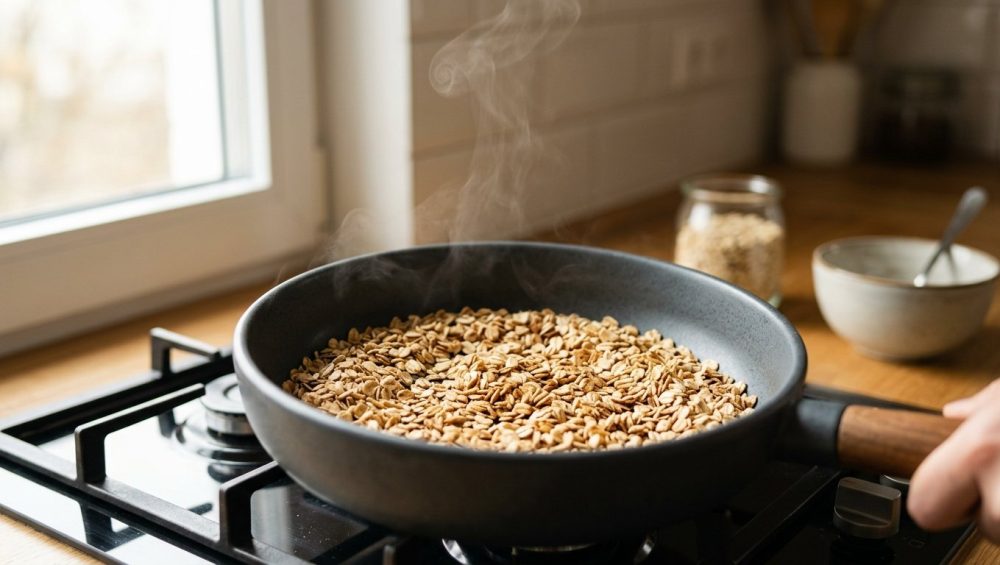
When you place raw oats into a hot, dry skillet, a miraculous chemical transformation occurs. The application of dry heat triggers a process called dextrinization. During dextrinization, the intense heat literally breaks down those massive, branching starch molecules into much smaller, sweeter fragments called pyrodextrins.
Because you have structurally altered and broken down the starches through dry heat, they lose their ability to swell and burst aggressively when you finally introduce liquid. Instead of dissolving into a sticky paste, the toasted oats hold their shape. They retain a satisfying, distinct, chewy bite. The slime production is completely halted at the molecular level. Furthermore, toasting reduces anti-nutritional factors like phytic acid, which actually improves your body’s ability to absorb vital micronutrients like iron and zinc.
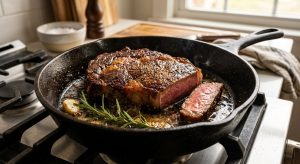
But the texture is only half the victory. The other half is the flavor, courtesy of our favorite culinary phenomenon: the Maillard reaction. When the amino acids and reducing sugars in the oats are subjected to temperatures between 140°C and 165°C, they react to form hundreds of brand-new, highly complex flavor compounds. This is the exact same chemical reaction that makes a seared steak taste incredible, turns pale dough into a golden-brown bread crust, and gives roasted coffee its depth.
By simply spending three minutes toasting your oats, you are replacing a bland, raw, cardboard flavor with deep, warm notes of caramel, butterscotch, and roasted nuts. It is a zero-effort upgrade that yields professional-level results in a standard home kitchen.
The Sassy Sous-Chef’s “No-Go” Gear Warning
Before we get into the exact methodology, we need to have a serious intervention about your cookware. As your biggest cheerleader, I want you to succeed, but I absolutely despise cheap, toxic kitchenware. If I catch you trying to toast your beautiful, organic oats in a scratched, peeling Teflon pan, we are going to have a problem.
Toasting requires dry, medium-high heat. When you heat traditional PTFE (Teflon) non-stick coatings above 260°C—a temperature easily reached on a standard home burner when the pan is empty—the coating begins to degrade and break down, releasing invisible, toxic PFAS “forever chemicals” directly into your food and the air you breathe.
The regulatory landscape in 2026 has finally caught up to the science. As of January 1, 2025, Minnesota officially banned the sale of cookware containing intentionally added PFAS on food contact surfaces. Colorado and Maine followed suit, enacting their own strict PFAS bans on January 1, 2026. The industry is facing massive legal reckonings; in early 2026, a federal court even approved a $2.5 million settlement against HexClad, legally barring the brand from marketing its PTFE-coated pans as “non-toxic”.
If you still have these peeling chemical hazards sitting in your cabinets, it is time to throw out that toxic kitchen gear immediately. You deserve better, and your food deserves better.
For toasting oats, you need safe, durable, high-quality metals. A heavy-bottomed stainless steel skillet, a well-seasoned carbon steel pan, or a traditional cast iron skillet are your best friends here. If you are terrified of your food sticking to uncoated metal, simply use the water drop test to ensure your stainless steel pan is properly preheated before adding your fat. And for the love of all things culinary, never use those cheap aerosol cooking sprays because they leave a polymerized, sticky residue that will ruin the finish of your beautiful safe pans. A cast iron skillet is virtually indestructible and can be easily cleaned with a chainmail scrubber and a splash of hot water. Invest in good gear once, and it will take care of you for a lifetime.
The Anatomy of an Oat: Choosing Your Fighter
Not all oats are created equal, and knowing which one to buy is the first step toward breakfast perfection.
Steel-Cut Oats (The Irish/Scottish Standard)
These are the least processed of the bunch. The whole oat groat is simply chopped into two or three pieces with a steel blade. They take the longest to cook (usually 20 to 30 minutes), but they offer the most incredible, caviar-like pop and chew. Toasting steel-cut oats is an absolute revelation; because they are so dense, they take on a deeply roasted, hazelnut-like flavor.
Rolled Oats (Old-Fashioned)
The undisputed workhorse of the modern home kitchen. The groats are steamed to make them pliable and then rolled flat through heavy rollers. They cook in about 5 to 10 minutes and offer a perfect balance of chew and creaminess. This is the ideal oat for our daily toasting technique.
Quick Oats
These are rolled oats that have been rolled even thinner and cut into smaller pieces so they cook in just a minute or two. You can toast them, but you must watch them like a hawk. Because they are so thin, they will go from perfectly golden to acrid and burnt in roughly fourteen seconds.
Instant Oats
These are heavily processed, pre-cooked, dehydrated, and usually pumped full of artificial flavors and refined sugars. Do not toast these. In fact, do not buy these. We are trying to elevate your cooking, not microwave a powdered sugar packet.
The Masterclass: How to Toast Your Oats Like a Pro
We operate on the “Time is Money” philosophy for weekday meals. You do not have forty-five minutes to stand over a stove on a Tuesday morning when you have emails to ignore and a commute to survive. This stovetop method adds exactly three minutes to your routine and pays massive dividends in flavor and texture.
The 3-Minute Weekday Stovetop Method
- Preheat the Pan: Place your safe, PFAS-free skillet (stainless, carbon, or cast iron) over medium heat. Let it get warm for about 60 seconds.
- Add the Fat (Optional, but Highly Recommended): You can absolutely dry-toast your oats if you are strictly watching your calories. However, adding a small amount of fat acts as a thermal conductor, ensuring even browning and preventing scorched spots. Drop in a half-tablespoon of grass-fed butter, coconut oil, or ghee. As it melts, it will coat the grains and add an unbelievable richness.
- The Toss: Pour in your dry rolled or steel-cut oats. Spread them into an even layer.
- The Agitation: Do not walk away to check your phone. Stand there and stir them frequently with a heat-safe spatula or a wooden spoon. (Side note: if your cheap wooden spoons keep cracking and leaving splinters in your food, please upgrade to a solid piece of olive wood or a high-quality silicone spatula).
- The Sensory Cues: You are looking for two things. First, a visual shift: the pale, ghostly oats will begin to take on a beautiful, golden-brown hue. Second, an olfactory shift: your kitchen will suddenly smell like warm butter, toasted popcorn, and roasted nuts. This usually takes between 3 to 5 minutes.
- The Simmer: Once they are perfectly golden, immediately pour in your cooking liquid (water or milk). Be prepared for a satisfying sizzle. Lower the heat, cover, and simmer according to your normal recipe.
The Weekend Batch-Prep (The Oven Method)
If you want to buy yourself even more time during the week, you can embrace your inner perfectionist on Sunday afternoon and batch-toast an entire bag of oats at once.
Preheat your oven to 350°F (175°C). Spread an entire bag of rolled or steel-cut oats in an even layer across a large, bare aluminum baking sheet. Do not crowd the pan; if the layer is too thick, the oats will steam instead of toasting. Bake them for 10 to 15 minutes, pulling the pan out halfway through to give them a thorough stir.
Once they are deeply fragrant and golden, pull them out and let them cool completely on the baking sheet. If you put warm oats into a container, the residual steam will create condensation, leading to mold. Once cooled, transfer them to an airtight glass jar in your pantry. Congratulations, you just bought yourself a month of instant, gourmet, pre-toasted breakfasts with zero morning prep time.
Flavor Upgrades: Taking Your Bowl from Basic to Brilliant
Now that you have mastered the foundational technique of halting the slime, it is time to build a flavor profile that actually makes you excited to get out of bed.
The Liquid Ratios
The standard ratio for rolled oats is 1 part oats to 2 parts liquid. For steel-cut, it is 1 part oats to 3 or 4 parts liquid.
- Water: Cooking toasted oats in filtered water allows the pure, nutty, roasted flavor of the grain to take center stage. It is clean, light, and foolproof.
- Dairy Milk: Cooking in whole milk adds a luxurious, creamy mouthfeel. However, milk contains natural sugars (lactose) and proteins that can easily scorch on the bottom of the pan. If you use milk, keep the heat low and stir often.
- Oat Milk: Yes, oat-on-oat crime is highly encouraged. It reinforces the flavor profile beautifully.
Blooming Your Spices
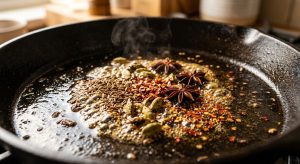
If you are currently dumping raw cinnamon, nutmeg, or cardamom on top of your wet, finished oatmeal, you are missing out on 80% of the spice’s potential flavor. Spices contain volatile essential oils that are fat-soluble. Instead of sprinkling them at the end, toss your spices into the skillet during the last 30 seconds of the toasting process. By combining the spices with the hot butter and the toasted grains, you are blooming them in oil, which awakens and magnifies their flavor exponentially.
Savory Oats: The Ultimate Plot Twist
Who decided oatmeal had to be sweet? In 2026, savory oatmeal is taking the culinary world by storm, and it is the perfect canvas for your newly toasted grains. Toast your oats in a high-quality extra virgin olive oil instead of butter. Add a pinch of smoked paprika and cracked black pepper. Cook them in a rich chicken or vegetable bone broth instead of water. Top the finished bowl with a perfectly fried egg, a handful of sharp cheddar cheese, and some blistered cherry tomatoes. It is a hearty, protein-packed dinner masquerading as breakfast.
The Toppings
Texture is everything. You have already secured a chewy, satisfying base by toasting the oats, but you need contrasting crunch. Add toasted pepitas, sliced almonds, or cacao nibs. If you are adding fresh fruit, make sure you store your produce properly in ventilated containers so you aren’t constantly complaining that your berries mold so fast in the crisper drawer. A handful of fresh blueberries and a drizzle of real, high-quality maple syrup over toasted, buttered oats is a religious experience.
Troubleshooting Common Disasters
Even with a foolproof method, things can go sideways if you aren’t paying attention. Here is how to fix the most common hiccups:
My oats taste bitter and look black.
You burned them, my friend. Dextrinization is a beautiful thing, but carbonization is not. You left the stove to scroll through social media. Oats have a very low moisture content, meaning they go from perfectly toasted to incinerated in the blink of an eye. Throw the burnt batch away, lower your heat to medium, and stay at the stove.
My oats are still tough and chewy after cooking.
Toasting alters the exterior of the starch granules. Because they hold their shape better, they can sometimes take an extra minute or two to fully absorb the cooking liquid. If your oats are too al dente for your liking, simply add an extra splash of water or milk, cover the pot with a tight-fitting lid, and let it simmer on low for another two minutes.
The liquid boiled over and made a mess on my stove.
You had the heat too high. Once you add the liquid to the hot, toasted oats, it will immediately bubble up. Give it a quick stir to calm it down, and immediately drop your burner to the lowest possible simmer setting before putting the lid on.
The Final Verdict
Cooking does not have to be a stressful, chaotic chore, and eating healthy does not mean you have to suffer through bland, uninspired meals. By understanding the simple food science behind starch gelatinization and dextrinization, you can completely manipulate the texture of your food to suit your exact preferences.
You no longer have an excuse to tolerate gummy, mucilaginous breakfasts. It is officially time to stop eating mushy oatmeal and start treating your morning routine with the culinary respect it deserves. Grab a safe skillet, drop in a pat of butter, and give your grains the golden-brown toast they have been begging for.
Your palate, your gut microbiome, and your sanity will thank you. Now go conquer your kitchen, and I will see you next time.