The cast iron skillet is arguably the most misunderstood piece of equipment in the modern home kitchen. For some reason, otherwise rational adults treat this heavy, indestructible slab of metal like a cursed historical artifact or a delicate Fabergé egg that will shatter if you look at it wrong.
The statistics show that we love the idea of these pans. The United States cast iron cookware market is absolutely exploding, projected to reach over $2.5 billion by 2033 with a steady annual growth rate. A recent industry report noted that skillets specifically are driving massive growth in the housewares sector due to a spike in at-home entertaining. We are buying these heavy-duty pans in droves because we want to sear a steak like a professional chef. But the harsh reality? We are utterly terrified of the cleanup.
We cook a beautiful meal, and then we stare at the crusty, carbonized fond cemented to the bottom of the pan, sweating with anxiety. We wonder need a chainmail scrubber or some other magical tool to fix the mess without ruining the pan forever. I am here to tell you, as your favorite snarky sous-chef, that you are drastically overcomplicating this.
You don’t need a culinary degree to maintain cast iron, and you certainly don’t need to sacrifice your weeknight sanity to the cleanup gods. You just need to understand a tiny bit of basic kitchen chemistry, throw away your toxic abrasive sponges, and embrace the medieval genius of a chainmail scrubber. Grab a glass of wine, pull up a stool, and let’s get into it.
The Cult of Cast Iron and the Paralyzing Fear of Cleanup
If you spend five minutes reading cast iron advice on the internet, you will leave feeling like you need a hazmat suit and a PhD in metallurgy just to fry an egg. The cult of cast iron has invented a ridiculous set of rules designed to make weekend hobbyists feel inferior. They tell you to never wash it. They tell you to wipe it with a dirty, greasy rag and hide it in the oven. They tell you that a single drop of water will instantly turn it into a pile of rust.
This fear paralyzes everyday home cooks. You cook a gorgeous, mindful meal, but the kitchen looks like a disaster zone. You look at your skillet, crusted with the blackened remnants of ribeye fat and caramelized onions. You could try turning burnt bits into sauce by deglazing with a splash of wine, but sometimes you just have a stubborn, crusty mess left over that a wooden spoon can’t fix. So, paralyzed by the fear of ruining the pan, you let it sit on the back of the stove for three days until it becomes a permanent kitchen fixture.
Stop it. Cast iron is the ultimate workhorse. It survived the Oregon Trail strapped to the side of a covered wagon; it can survive your Tuesday night chicken thighs. The problem isn’t the pan. The problem is that your cleaning tools are actively working against the chemistry of your cookware.
What Exactly Is “Seasoning”? A No-Nonsense Chemistry Lesson
Before we can talk about how to clean your skillet, we have to talk about what we are actually trying to protect. “Seasoning” is a terrible, misleading word. It sounds like we are talking about salt, pepper, and garlic powder. What we are actually talking about is a highly durable, slick layer of plastic-like material created through a fascinating chemical process called radical polymerization.
When you apply a microscopically thin layer of cooking oil to raw, porous cast iron and heat it past its smoke point, the intense heat causes the oil’s triglycerides to physically break down. The glycerol burns off as smoke, leaving behind free fatty acids. If you use an oil that is high in polyunsaturated fats—specifically those containing multiple carbon-carbon double bonds, like the alpha-linolenic acid (ALA) found in flaxseed or grapeseed oil—the intense heat causes these molecules to form highly reactive free radicals.
These free radicals frantically seek out something to bond with. They cross-link with each other and bond directly to the iron itself, creating a tough, hard, polymerized matrix. It is essentially a natural, non-toxic form of Teflon that is molecularly anchored to your pan.
But it is not invincible. If your seasoning is weak, or if you apply the oil too thickly during the baking process, it won’t fully cross-link. This is exactly why your pan sometimes leaves black specks in your food—that’s half-baked, sticky oil flaking off, not actual metal. A properly polymerized layer is hard, slick, and incredibly resilient. But there is one common kitchen item that will destroy it in seconds.
The Green Sponge Menace: Why You Are Scrubbing Away Your Hard Work
Here is where the culinary tragedy occurs. You have a beautiful, perfectly polymerized skillet. You cook some bacon. A little bit of sugar from the cure sticks to the pan. You grab that ubiquitous, heavy-duty green scouring pad sitting next to your sink. You scrub the pan. You think to yourself, “It’s just a rough plastic sponge, how much damage can it really do?”
I need you to brace yourself for this. That green pad is not just plastic.
The structure of heavy-duty green scouring pads, like the classic Scotch-Brite, is made of synthetic polymer fibers that are heavily impregnated with industrial abrasive minerals—specifically aluminum oxide (alumina) and titanium dioxide. Aluminum oxide is an incredibly hard, aggressive mineral widely used in industrial metalworking, grinding, and sanding applications. It is designed to self-fracture as you use it, constantly exposing microscopic, razor-sharp fresh cutting edges to whatever surface you are scrubbing.
Let me be brutally clear: Aluminum oxide is harder than most steels. A heavy-duty green pad is so intensely abrasive that it will literally scratch solid glass.
When you take that weaponized green sponge to your cast iron, you are essentially taking fine-grit industrial sandpaper to your hard-earned polymerized oil layer. You are micro-sanding the seasoning right off the pan. You might not see it immediately with the naked eye, but over a few weeks, your pans start losing their slip. Food starts sticking aggressively. The surface looks dull, gray, and lifeless. You have successfully stripped away the protective polymer matrix, exposing the raw, vulnerable iron underneath.
Rust 101: The Inevitable Chemistry of a Ruined Skillet
Once you have sanded away the seasoning with your abrasive sponge, you have left raw iron exposed to the elements. And iron has a very predictable, highly destructive relationship with oxygen and water.
Rust is simply iron oxide. It forms when iron reacts with oxygen in the presence of moisture. In the culinary world, we deal with a nightmare scenario known as “flash rust.” If you expose raw, unseasoned cast iron to water, a microscopic layer of bright orange rust can form in a matter of minutes.
This is exactly why soaking a cast iron pan in the sink overnight is the culinary equivalent of a war crime. The water penetrates any weak spots or micro-scratches in the seasoning, attacks the raw iron, and begins the oxidation process. The rust expands as it forms, bubbling up underneath the remaining good seasoning, causing it to flake off in large, tragic chunks.
Even if you don’t soak it, simply washing it and leaving it on the drying rack is enough to invite disaster. The ambient humidity in your kitchen is all the moisture the raw iron needs to start oxidizing. Knowing the secret to a rust-free skillet is understanding that moisture is the ultimate enemy, and a fully intact, un-scratched polymer layer is your only shield against it.
Enter the Chainmail Scrubber: Medieval Armor for Modern Kitchens
So, if we absolutely cannot use abrasive green sponges, and we cannot let the pan soak to soften the food, how on earth do we remove that stubborn, carbonized crust of burnt garlic and steak fond?
You borrow technology from the 12th century. You use a chainmail scrubber.
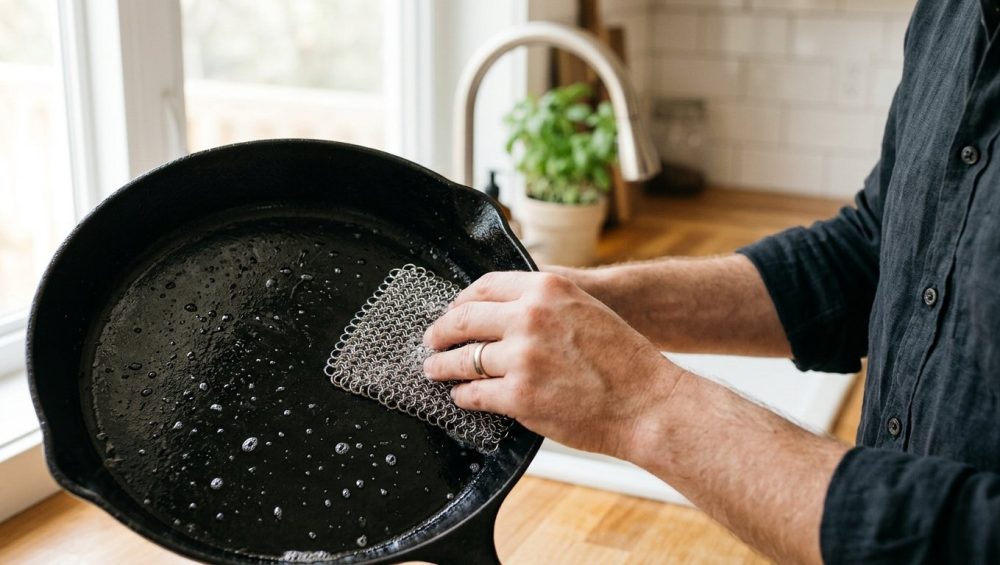
A culinary chainmail scrubber is a small, flexible square composed of interlocking rings made from food-grade stainless steel. It looks exactly like a swatch of armor a medieval knight would wear under his breastplate. And it is, without a shadow of a doubt, the single greatest maintenance tool ever invented for cast iron cookware.
To understand why it works so brilliantly, we have to look at the physics of shear force versus abrasion.
As we discussed, green sponges and steel wool clean through micro-abrasion. They have thousands of microscopic, jagged edges that dig into the surface they are scrubbing. They don’t care if they are digging into burnt food or your precious polymerized seasoning; they just dig, scratch, and destroy.
Chainmail, on the other hand, is made of perfectly smooth, rounded rings. When you drag a chainmail scrubber across the surface of your skillet, it does not dig. It glides. However, because the rings are made of heavy stainless steel, they apply a massive amount of concentrated shear force to anything protruding above the surface of the pan.
Burnt, carbonized food is highly brittle. When the smooth, heavy rings of the chainmail hit a brittle piece of burnt food, the shear force snaps the food right off the surface of the pan. But because the rings are perfectly smooth and rounded, they glide harmlessly over the hard, slick, polymerized seasoning without scratching or gouging it.
It is an elegant, scientifically sound solution. It removes the debris while perfectly preserving the polymer matrix. This is exactly why I am constantly preaching about banishing toxic kitchen gear and investing in simple, lifetime metal tools that actually respect the chemistry of your food and your cookware.
How to Clean Your Cast Iron Like a Professional (Without the Stress)
Now that you understand the science of why chainmail is superior, let’s talk about the execution. Cleaning your cast iron should take exactly 60 seconds. If you are sweating, scrubbing frantically, or cursing my name, you are doing it wrong. Here is the definitive, effortless weekday routine.
Step 1: The Warm Pan Advantage
Never try to clean a cast iron skillet when it is ice cold. The fats and sugars from your dinner will have congealed into a concrete-like substance that will fight you every step of the way. Conversely, never take a screaming hot pan straight from a high-heat sear and plunge it under cold tap water. The extreme thermal shock can actually crack the brittle iron, which is the exact same reason your cheap aluminum frying pans keep warping.
Wait until the pan is warm to the touch—comfortable enough to handle bare-handed, but still retaining some residual heat. This warmth keeps the fats pliable and ready to release.
Step 2: The Hot Water Flush
Place the warm pan in the sink and run hot tap water over it. The hot water will immediately melt away the loose, un-polymerized cooking greases and soften the carbonized food bits.
Step 3: The Chainmail Glide
Take your chainmail scrubber and lay it flat in the pan. Using the flat of your palm or your fingers, rub the chainmail in gentle, circular motions over the surface of the pan. Do not press down with the force of a thousand suns. Let the heavy weight of the stainless steel rings do the work. You will feel the satisfying, gritty feedback of the burnt bits snapping off the iron. Within 15 to 20 seconds, the surface will feel completely smooth to the touch.
Step 4: The Towel Dry and Heat
Rinse the pan one final time to wash away the loose debris. Now, immediately dry the pan thoroughly with a dedicated kitchen towel (cast iron will eventually stain your pristine white towels, so use a dark one).
But towel drying is not enough. Remember flash rust? To ensure absolutely zero moisture remains in the microscopic pores of the iron, place the skillet back on the stove over medium-low heat for about three to five minutes. Watch closely as the last invisible traces of water evaporate into the air.
Step 5: The Micro-Oil Polish
While the pan is still warm on the stove, add a tiny drop of a neutral, high-smoke-point oil (like grapeseed, canola, or sunflower oil). Take a paper towel and aggressively wipe the oil over the entire interior surface of the pan. Now, take a clean paper towel and try to wipe all the oil out. You want the pan to look dry and matte, not greasy and wet. This microscopic layer of fresh oil protects the pan from ambient humidity in your cabinets and sets you up for a perfect non-stick experience the next time you cook.
Debunking the “No Soap” Myth Once and For All
I cannot write a definitive masterclass on cast iron maintenance without addressing the elephant in the room: Soap.
Somewhere along the line, a culinary myth was born that if a single drop of dish soap touches your cast iron, the pan will instantly lose its seasoning, the culinary gods will strike you down, and you will be cursed with sticky food for seven generations. This is absolute, unadulterated nonsense.
This myth stems from a time when our great-grandmothers made their own soap using leftover animal fat and lye. Lye is a highly caustic, aggressive alkaline substance. If you put lye on a polymerized oil matrix, it will absolutely strip it down to bare metal.
Modern liquid dish soaps (like Dawn) do not contain lye. They are mild, pH-balanced synthetic detergents. They are designed to break down loose, un-polymerized fats (like the bacon grease left over from breakfast). They are completely chemically incapable of breaking the cross-linked molecular bonds of a fully cured, polymerized seasoning layer.
So, if you just cooked a piece of salmon and your pan smells aggressively like the ocean, please, for the love of all things culinary, put a drop of dish soap in your pan before you use your chainmail scrubber. You will wash away the smelly surface grease, your chainmail will knock off the burnt bits, and your hard-earned seasoning will remain completely intact. The real chemical threat to your non-stick surface isn’t mild dish soap; it’s the fact that cooking spray is the enemy. Cheap aerosol sprays contain emulsifiers like soy lecithin that burn at low temperatures and leave a sticky, gummy residue that genuinely ruins your seasoning over time. Stick to liquid oils and mild soap, and you will be fine.
Cast Iron vs. Carbon Steel: Does the Chainmail Rule Still Apply?
If you are a true kitchen aficionado, you probably also own a carbon steel skillet or wok. Carbon steel is cast iron’s lighter, smoother cousin. It seasons exactly the same way—through the radical polymerization of fats—but because the metal is stamped or spun rather than cast in sand, the surface is microscopically smoother out of the box.
Because the surface is smoother, the polymer layer is often thinner and has less physical texture to grip onto. Does chainmail still work? Yes, absolutely. The physics of shear force remains the same. However, you must use a slightly lighter touch on carbon steel. Let the weight of the rings do the work, and avoid aggressive scrubbing.
The Rescue Mission: What to Do if You’ve Already Sanded Your Skillet to Death
Let’s say you are reading this article in horror, realizing that you have been using a green Scotch-Brite pad on your skillet for the last three years. Your pan is gray, patchy, and everything you cook fuses to the metal. Can it be saved?
Yes. Cast iron is practically immortal. You just need to hit the reset button.
If your seasoning is patchy and ruined, you need to strip it completely. You can do this by spraying the pan with a lye-based oven cleaner (like yellow-cap Easy-Off), sealing it in a trash bag for 24 hours, and then scrubbing it down to the bare, silver iron. Neutralize the lye with a wash of equal parts white vinegar and water.
Once you have bare iron, dry it immediately to prevent flash rust. Rub a microscopic layer of flaxseed or grapeseed oil all over the pan (wiping off as much as humanly possible), and bake it upside down in a 450°F oven for one hour. Let it cool in the oven. Repeat this very thin oiling and baking process three to four times. You will build a brand new, incredibly strong, cross-linked polymer matrix. From that day forward, banish the green sponges and only let chainmail touch your pan.
Buying Guide: Don’t Buy Cheap, Toxic Junk
Because the cast iron renaissance is in full swing, the market is currently flooded with cheap, knock-off chainmail scrubbers drop-shipped from anonymous overseas factories. As your sassy sous-chef, I strictly forbid you from buying mystery metals for your kitchen.
1. Insist on 316 Stainless Steel
You are going to be using this tool in water, covered in salt, acidic food bits, and grease, every single day. If you buy a cheap scrubber made of low-grade steel, it will rust in your sink and transfer that rust to your pan. You must look for “316 Stainless Steel” (often referred to as marine-grade stainless). 316 stainless contains molybdenum, which drastically increases its resistance to corrosion and pitting from chlorides (salt).
2. Welded Rings vs. Pulled Rings
Cheap chainmail is made by taking a piece of wire, bending it into a circle, and pinching it shut. This leaves a tiny, microscopic gap where the two ends meet. That tiny gap acts like a razor-sharp tooth that will scratch your seasoning. High-quality chainmail features rings that are individually welded shut, creating a perfectly smooth, continuous circle of metal that will never snag.
3. Silicone Inserts
Some modern chainmail scrubbers feature a silicone core (it looks like a silicone sponge wearing chainmail armor). These are fantastic for ergonomics, allowing you to get a better grip and apply more even pressure without cramping your hand. However, you must ensure the core is made from high-quality, non-porous food-grade silicone that won’t harbor bacteria or melt if you accidentally touch a hot pan.
If you buy the right chainmail scrubber, it is a one-time purchase. It will outlive you. You will never have to buy another abrasive green sponge again. You will save money, you will save your cookware, and you will save your sanity. This is the exact same philosophy I apply when I tell you why food sticks to your stainless steel—you absolutely have to understand the tools and the physics to succeed in the kitchen.
Conclusion: Reclaim Your Kitchen
Cooking should be an act of joy, creativity, and relaxation, not an exercise in weeknight anxiety. You do not need a culinary degree to cook a mind-blowing meal, and you certainly don’t need to live in fear of cleaning up your cookware afterward.
The cast iron skillet is a brilliant, indestructible tool that can give you the best crust on a steak you’ve ever had. But it demands respect for its chemistry. Stop treating it like a delicate flower, and stop attacking it with industrial abrasives meant for sanding metal.
Embrace the medieval genius of the chainmail scrubber. Let the smooth stainless steel rings shear away your culinary mistakes while protecting the slick, polymerized patina you’ve worked so hard to build. Master the temperature of your pan, learn the water drop test, and let the right tools do the heavy lifting.
Now, go pour yourself a heavy pour of wine, pull that heavy iron skillet out of the cupboard, and go sear something spectacular. You’ve got this.