Let’s set the scene: It is a beautiful Saturday morning. You have finally decided to treat yourself. You bypassed the watery, paper-thin supermarket bacon and invested in the good stuff—thick-cut, dry-cured, beautifully marbled pork belly that cost more than your first car. You lay those gorgeous strips into your favorite skillet, anticipating the symphony of sizzling fat and the promise of a shatteringly crisp breakfast.
But then, tragedy strikes.
As the heat rises, the meat begins to writhe. The ends lift off the pan. The center bows upward like a yoga instructor demonstrating the perfect upward dog. Within minutes, your expensive bacon has transformed into a deformed, curly U-shape. The edges are burnt to a crisp, while the center remains a flabby, un-rendered, rubbery disappointment.
If you have ever stared into a frying pan and felt personally victimized by a curling pork chop, a bowing steak, or a floppy piece of bacon, I am here to tell you that it is not your fault. You do not lack culinary talent; you simply lack an understanding of meat thermodynamics and the proper hardware to bend it to your will.
Today, we are skipping the pretentious chef-speak and diving deep into the actual physics of pan-searing. We are going to explore exactly why meat contorts under heat, the science of the Maillard reaction, and why a specific, brilliant little tool—the vented stainless steel chef’s press—is the ultimate secret weapon for the home cook.
The Physics of the Curl: Why Good Meat Goes Bad in a Hot Pan
To understand why we need to press our food, we first have to understand why food throws a tantrum in a hot skillet. Cooking is not magic; it is applied chemistry and physics. When you drop a piece of raw animal protein into a hot pan, you are initiating a violent cascade of subcellular changes.
The Anatomy of a Shrinking Protein
Meat is essentially a complex matrix composed of roughly 75% water, 20% protein, and 5% fat and carbohydrates. The proteins that matter most when you are standing over a stove are the myofibrillar proteins (myosin and actin) and connective tissue (collagen).
When heat is applied, these tightly coiled protein structures begin to denature, which is a fancy scientific term for “unwinding and shrinking.” Myosin begins to denature and shrink at around 104°F (40°C), with a massive structural change occurring at 122°F (50°C). Meanwhile, the collagen in the connective tissue starts to shrink noticeably between 122°F and 160°F (50°C to 71°C).
Here is where the problem starts. A piece of bacon or a fat-capped pork chop is not a uniform block of protein. It is a striped landscape of muscle fibers, connective tissue, and fat. These different components do not shrink at the same rate. The muscle fibers contract violently and rapidly, squeezing out water, while the fat renders and melts at a completely different pace.
When one side of a strip of meat shrinks faster than the other, the entire structure warps. This differential contraction is the exact scientific reason why your bacon curls up the second it hits the heat. The meat is literally pulling itself out of shape.
The Steam Trap: The Enemy of the Maillard Reaction
When the meat curls, it creates a physical gap between the surface of the food and the hot surface of your pan. This gap is the death of flavor.
As the muscle fibers contract, they squeeze out internal moisture. That water pools in the newly formed gap beneath the curled meat. When that water hits the hot pan, it evaporates into steam. Steam, at standard atmospheric pressure, sits at 212°F (100°C).
If your meat is elevated off the pan and sitting in a cloud of 212°F vapor, you are no longer searing your expensive cut of pork or beef. You are steaming it. You are boiling it in its own leaked juices. This is why the center of a curled piece of bacon remains rubbery, and why a warped steak develops a sad, gray ring instead of a crust. Steaming is a fantastic way to cook broccoli; it is an absolute crime against a prime ribeye.
The Maillard Reaction: The Holy Grail of Home Cooking
To truly grasp why curling is such a disaster, we have to talk about the single most important chemical process in the culinary arts. If you want to cook like an expert without going to culinary school, this is the one concept you must memorize.
What It Is and Why You Need It
The Maillard reaction is a complex chemical process that occurs when amino acids (the building blocks of proteins) and reducing sugars react under high heat. This reaction is what turns a pale, raw steak into a deeply browned, savory, crusty masterpiece. It is responsible for the smell of baking bread, the flavor of roasted coffee, and the undeniable appeal of a perfectly seared burger.
However, the Maillard reaction is incredibly picky. It generally requires temperatures north of 280°F to 330°F (140°C to 160°C) to occur rapidly.
Do you remember what temperature steam sits at? 212°F.
If there is liquid water or trapped steam sitting between your meat and the pan, the surface temperature of the food is physically capped at 212°F until every last drop of that water evaporates. The Maillard reaction simply cannot happen in a wet environment. If you are interested in mastering the Maillard reaction, your primary goal as a cook is the ruthless elimination of surface moisture.
The Surface Area Equation
Achieving that gorgeous, flavorful crust is a game of surface area. Flat, flush contact between the meat and the hot metal of the skillet is absolutely non-negotiable.
When a steak bows in the center, you lose up to 40% of your conductive surface contact. The edges burn because they are taking the brunt of the heat, while the center steams in a puddle of its own making. If your steaks turn out gray and lack that steakhouse-quality crust, it is almost always because the meat warped and lost contact with the pan.
This is also why I constantly remind my readers that preheating the pan changes everything. If the skillet isn’t hot enough to instantly flash off the moisture being squeezed out of the shrinking muscle fibers, that moisture will pool, create steam, and ruin your sear. But even with a screaming hot pan, the physical curling of the meat will sabotage you. You need mechanical intervention.
Enter the Vented Chef’s Press: The Unsung Hero of the Professional Kitchen
For decades, the standard solution to curling meat was the cast iron grill press. You have probably seen them: heavy, black iron rectangles with a wooden handle, often featuring a raised pig silhouette on the top. They are heavy, they are clunky, and quite frankly, they are fundamentally flawed.
What Exactly Is a Chef’s Press?
In 2004, a brilliant San Francisco chef named Bruce Hill was running the kitchen at Bix Restaurant, a beloved spot hidden down a secret alley. The kitchen at Bix was tiny, and during a dinner rush, every single second counted. Chef Hill’s cooks were using traditional cast iron bacon presses to keep meat flat, but Hill noticed a massive problem: those solid iron blocks were trapping steam.
Because a solid cast iron press has nowhere for moisture to go, the steam squeezed out of the meat gets trapped under the heavy iron. The bottom of the meat might be searing against the pan, but the top of the meat is literally being boiled by the trapped steam. Furthermore, those iron blocks were too heavy for delicate proteins like fish, often crushing the flesh and squeezing out the internal juices.
Out of pure kitchen necessity, Chef Hill invented a better way. He designed a weight-adjustable, stackable tool made from heavy-gauge, USA-forged stainless steel. Most importantly, he designed it with vents—long slits cut entirely through the steel.
This invention changed the game. If you want to cook with the precision and speed of a restaurant line cook, you absolutely need a vented chef’s press in your kitchen arsenal. It is the bridge between amateur frustration and professional perfection.
Why Traditional Cast Iron Grill Presses Are Garbage
Let me take a moment to invoke my absolute, uncompromising “No-Go” rule on toxic, poorly designed kitchen gear. I have zero patience for equipment that actively makes your food worse or leaches mystery chemicals into your family’s dinner.
Traditional cast iron presses are a nightmare to maintain. Because they are constantly exposed to the steam coming off your food, they rust incessantly. Unless you are meticulously seasoning and oiling your bacon press after every single use (and let’s be honest, you aren’t doing that on a Tuesday morning), it is going to turn into a rusty, unsanitary hazard.
Even worse are the cheap, lightweight aluminum presses coated in non-stick Teflon or mystery black paint. When you press a piece of jagged, bone-in meat, that cheap coating inevitably scratches. Within a few months, those toxic black flakes of peeling non-stick coating are ending up right in your food. I am notoriously ruthless about banishing toxic kitchen gear from my home, and coated grill presses are at the top of my hit list.
A vented press made of pure, uncoated 300-series stainless steel is indestructible. It will never rust, it will never peel, and it will never poison your breakfast.
The Magic of the Vents: Why Escaping Steam Changes Everything
The true genius of the vented chef’s press isn’t just the weight; it is the thermodynamics of the ventilation slots.
The Thermodynamics of a Perfect Sear
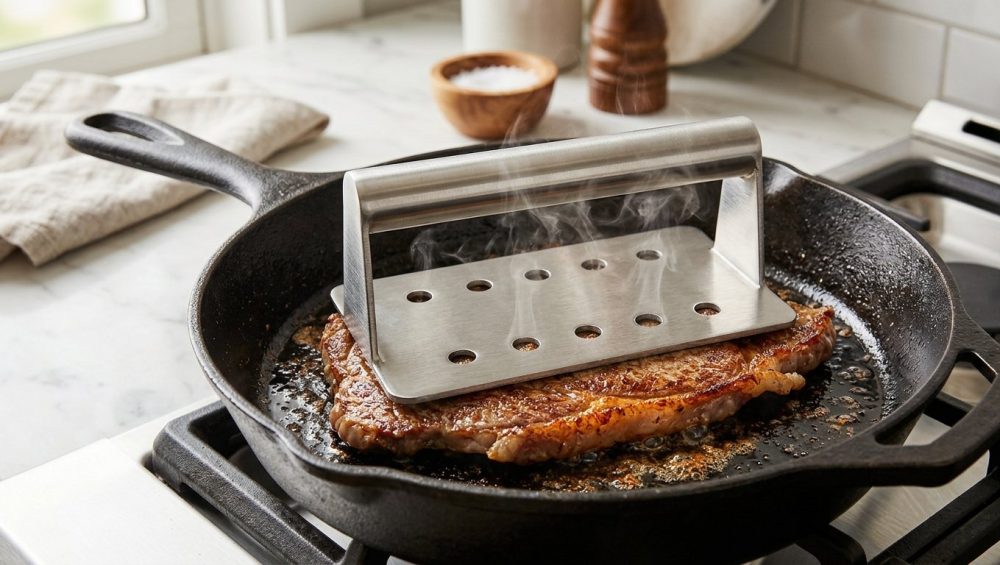
When you place a vented stainless steel press on top of a cooking chicken thigh or a strip of bacon, the weight forces the meat to lay perfectly flat against the hot skillet. This maximizes your conductive surface area, ensuring that every millimeter of the meat is in direct contact with the heat source.
But as the meat cooks and releases water, those vents perform a crucial job: they allow the 212°F steam to escape directly into the atmosphere. By letting the vapor vent away, the surface temperature of the meat in contact with the pan can rapidly climb past the boiling point and enter the 300°F+ territory required for the Maillard reaction.
Because the steam isn’t trapped on top of the food, the top side of the meat doesn’t boil. The ambient heat of the pan radiates up through the stainless steel press, actually helping to cook the top of the food simultaneously. This dual-action thermal conductivity means that a vented press allows food to cook 20% to 30% faster than it would without one.
Weight Distribution Without Mutilation
Another massive flaw of the old-school cast iron press is the lack of weight control. A standard iron press can weigh upwards of three to four pounds. If you drop a four-pound iron brick onto a delicate piece of salmon or a thin chicken breast, you are going to obliterate the cellular structure of the meat.
When you apply too much pressure, you physically wring the meat out like a wet sponge. The juices are forced out into the pan, leaving you with a dry, stringy, unpalatable mess. Nobody wants to be chewing on tough meat just because they used the wrong tool to keep it flat.
A proper vented chef’s press is modular. They are typically sold in lighter, calibrated weights—usually 8 ounces, 13 ounces, and 18 ounces. Because they are designed to interlock and stack on top of one another, you can customize the exact amount of pressure you need.
Cooking a delicate filet of fish? Use a single 8-ounce press to keep the skin flat without crushing the flaky meat. Cooking a stubborn, thick-cut pork chop that desperately wants to curl? Stack two 13-ounce presses together to force it into submission. You are in complete control of the physics.
Beyond the Pig: How a Chef’s Press Transforms Your Entire Menu
While it is often colloquially referred to as a “bacon press,” using a vented stainless steel press strictly for breakfast meats is a massive waste of its potential. This tool solves some of the most common, frustrating problems that home cooks face across the entire culinary spectrum.
Searing Poultry: Eradicating Rubbery Chicken Skin
There are few things more disappointing than cooking a beautiful, bone-in, skin-on chicken thigh, only to end up with flabby, rubbery skin. Chicken skin contains a massive amount of fat and collagen. When it hits a hot pan, it shrinks violently, pulling away from the meat and lifting off the cooking surface.
If your chicken skin never gets crispy, it is because it is steaming in the gap it created when it curled. By placing a vented press on top of the chicken thigh, you pin the skin flush against the hot metal. The fat renders out beautifully, the steam escapes through the vents, and you are left with skin that is as shatteringly crisp as a potato chip.
The Ultimate Steak: Edge-to-Edge Crust
Cooking a steak in a skillet often results in a “bullseye” effect—a dark crust on the very outer edges, and a pale, gray center where the meat bowed upward and lost contact with the pan.
A vented press eliminates this entirely. By applying gentle, even pressure across the surface of a New York Strip or a Ribeye, you ensure that the entire face of the meat maintains aggressive contact with the hot oil. The result is a steakhouse-quality, edge-to-edge crust that is nearly impossible to achieve bare-handed. Furthermore, you can use the press to hold the steak upright on its side, allowing you to easily render down the thick fat cap on the edge of the cut.
Smashing Burgers, Grilling Sandwiches, and Weeknight Speed
For the weekend culinary hobbyist, the press is a precision tool for perfect searing. But for the busy professional just trying to survive a Tuesday night, it is a ruthless efficiency hack.
Because the vented steel traps radiant heat and presses the food firmly against the conductive surface of the pan, your cooking times are slashed by up to 30%. A thick grilled cheese sandwich or a panini crisps up in record time, with perfectly melted cheese in the center. A smash burger gets flattened to maximum thinness, developing those highly sought-after lacy, crispy edges.
If you want to master simple weeknight dinners without spending an hour standing over the stove, a vented press is the ultimate shortcut. It forces the heat into the food faster, without sacrificing the quality of the sear.
How to Choose, Use, and Maintain a Vented Stainless Steel Press
Not all presses are created equal, and the market is unfortunately flooded with cheap knock-offs. If you are going to invest in a tool to elevate your cooking, you need to know exactly what to look for and how to care for it.
The “No-Go” Rule on Mystery Metals
Do not buy a press made of cast aluminum. Do not buy a press with a silicone-wrapped handle that will melt if it gets too close to a gas flame. And under absolutely no circumstances should you buy a press with a non-stick coating.
You want a press made entirely of heavy-gauge, 300-series stainless steel. It should feel incredibly sturdy in your hand, with zero flex. The handle should be integrated into the design, made of the exact same steel, so that it can easily withstand the ambient heat of a hot skillet or even the broiler.
Stacking and Calibrating Weight
When you acquire your presses, I highly recommend buying them in pairs. Having two 8-ounce presses or two 13-ounce presses gives you incredible versatility.
You can use them side-by-side to cover a large flank steak or a long strip of bacon. You can stagger them to cover the awkward geometry of a spatchcocked chicken. Or, you can stack them directly on top of one another—their handles are designed to interlock—to create a concentrated, heavy weight for stubborn, thick cuts of meat.
Cleaning and Care
This is perhaps my favorite feature of the stainless steel vented press: it requires absolutely zero maintenance.
Unlike cast iron, which requires a tedious ritual of washing without harsh soaps, immediate hand-drying, and rubbing down with neutral oil to prevent rust, a stainless steel press is indestructible. When you are done cooking, you can throw it directly into the dishwasher.
If you are cooking a particularly sugary marinade and the caramelized gunk sticks to your stainless steel press, you don’t have to panic. You can soak it in soapy water overnight. You can scrub it with abrasive steel wool. You can hit it with heavy-duty degreaser. Because it is solid stainless steel, you cannot hurt it. It will emerge from the cleaning process gleaming and ready for your next culinary project.
Stop Accepting Mediocre Searing
Cooking incredible food at home does not require a culinary degree, a massive kitchen, or a pantry full of pretentious ingredients. It simply requires a basic understanding of the physics happening in your pan, and the refusal to accept bad kitchen gear.
The next time you buy a beautiful cut of meat, do not let it curl up and steam itself into a rubbery disappointment. Take control of the thermodynamics. Maximize your surface area. Let the steam escape. Drop a vented stainless steel chef’s press onto that bacon, and watch the Maillard reaction do exactly what it was meant to do. You deserve the perfect crust, and now, you finally know exactly how to get it.