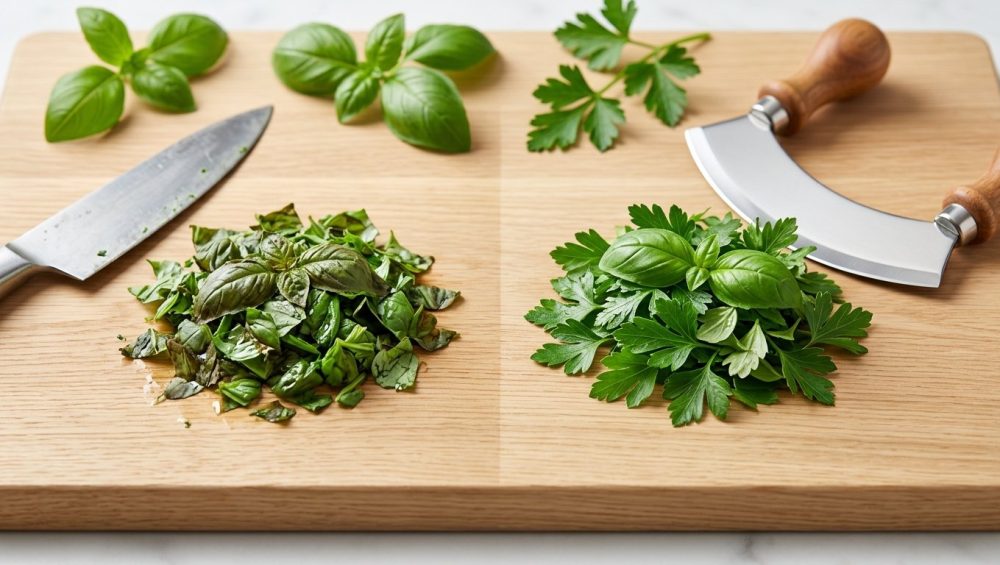
The Scene of the Culinary Crime: Why Your Garnish Looks Like Lawn Clippings
Picture this: It is a beautiful Saturday evening. You have spent the last three hours meticulously crafting a gorgeous, restaurant-quality pasta dish. The sauce has been simmering away, the kitchen smells like an Italian grandmother’s dream, and you are ready for the final, crowning touch. You grab a vibrant, fragrant bunch of fresh sweet basil, lay it on your cutting board, and go to town with your chef’s knife. You sprinkle the chopped herbs over your masterpiece, turn around to pour a glass of wine, and when you look back at the plate?
Your beautiful, bright green garnish has transformed into a bruised, blackened, wet pile of sadness that looks suspiciously like used tea leaves.
I know exactly what you are thinking right now. Did I buy bad basil? Was it too cold in the fridge? Did I look at it wrong?
No, sweetheart. You didn’t buy bad herbs. You just bludgeoned them to death on your cutting board.
As a home cook who has ruined more than my fair share of dinner parties through trial and error, I am here to tell you that this is one of the most common, frustrating, and easily fixable problems in the kitchen. We spend so much time focusing on the main proteins and the complex sauces that we completely neglect the delicate science of fresh herbs. And let me be brutally honest: nobody wants to watch their expensive fresh herbs turn to slime before the guests even arrive.
The good news? You do not need a culinary degree from a pretentious French institute to fix this. You do not need to spend hours meticulously slicing individual leaves with tweezers and a razor blade. You just need to understand a little bit of basic plant biology, recognize the mechanical flaws in your current chopping technique, and introduce a highly specialized, incredibly efficient tool into your arsenal: the mezzaluna.
Grab your wine, pull up a stool, and let’s dive deep into the microscopic murder happening on your cutting board, and how a simple half-moon blade is going to change your weekend cooking projects forever.
The Microscopic Murder: The Science of Herb Oxidation
To understand why your basil, mint, and parsley are turning into a black, mushy mess, we need to take a brief, completely unpretentious detour into the world of cellular biology. Do not panic; there will not be a quiz at the end, but understanding this science is the secret to unlocking pro-level results in a standard home kitchen.
Every single leaf of a fresh herb is made up of thousands of microscopic plant cells. These cells have rigid outer walls made of cellulose. Inside these walls, the plant stores all the good stuff: water, vibrant green chlorophyll, highly aromatic essential oils, and a variety of complex chemical compounds.
When you make a perfectly clean, razor-sharp cut through a basil leaf, you are only slicing open the specific cells that lie directly on that microscopic cutting line. The cells immediately adjacent to the cut remain completely intact, holding onto their moisture, their green color, and their flavor.
However, when you crush the leaf instead of slicing it, you cause a catastrophic structural failure across a massive area of the plant tissue. You are essentially setting off a microscopic bomb. When those plant cells are crushed and ruptured, an enzyme called polyphenol oxidase (PPO) is released from its safe little cellular compartment.
The Polyphenol Oxidase Chain Reaction
When PPO is suddenly exposed to the phenolic compounds in the plant and the oxygen in your kitchen air, a rapid chemical reaction occurs. This enzymatic browning process creates brown and black pigments called melanins. It is the exact same biological defense mechanism that causes a sliced apple to turn brown or an avocado to turn gray when left on the counter. In nature, this browning helps protect the wounded plant from infection. In your kitchen, it ruins your dinner.
Basil and mint are particularly susceptible to this rapid oxidation because their cellular structures are incredibly delicate, and they are packed to the brim with these reactive enzymes. When you crush them with a dull blade or a heavy hand, you are hyper-accelerating the oxidation process.
Furthermore, when you crush the cell walls, all of those beautiful, volatile essential oils—the exact compounds that give herbs their incredible flavor and aroma—are squeezed out of the leaf and pressed directly into your wooden cutting board. Have you ever noticed that after chopping herbs, your cutting board smells absolutely divine, but the herbs themselves taste like wet paper? That is because you left all the flavor on the wood.
In professional kitchens, chefs are ruthlessly trained to respect the cell wall. But in household kitchens across the globe, a staggering amount of food is wasted simply because it looks unappetizing. Recent studies on household food waste estimate that home cooks throw away a massive portion of their fresh produce and herbs—sometimes up to 30% or more—simply because improper prep and storage lead to rapid deterioration. We are literally throwing our money in the compost bin because we are using the wrong tools and techniques.
The Problem with Your Chef’s Knife (And Your Wrist)
Now, you might be looking defensively at your expensive, German-steel chef’s knife and thinking, “My knife is great! It’s not crushing anything!”
Listen, I love a good chef’s knife as much as the next cook. It is the workhorse of the kitchen. But unless your knife is honed to a microscopic, razor-sharp edge, and unless your knife skills are flawlessly executed every single time, you are probably crushing your herbs.
To properly mince herbs with a standard chef’s knife, you have to execute a flawless “rock chop.” This involves keeping the tip of the knife anchored to the board while the heel of the blade moves up and down in a smooth, fluid, circular slicing motion. The blade must glide forward through the herbs, utilizing the sharp edge to cleanly sever the plant fibers.
But let’s be real about what actually happens on a frantic Tuesday night. You are tired. The pasta water is boiling over. The dog is underfoot. You grab a handful of parsley, grip your knife like a medieval broadsword, and start hacking straight down. Thwack, thwack, thwack.
That downward hacking motion is a guillotine. It is not slicing; it is applying blunt-force trauma. You are relying on the weight of the blade and the force of your arm to break through the herbs, which brutally crushes the cell walls against the hard surface of the cutting board. Incidentally, this cellular crushing action is the exact same botanical mechanism that explains why you cry chopping onions. When you smash an onion instead of slicing it cleanly, you rupture thousands of extra cells, releasing a massive cloud of the irritating gas (syn-propanethial-S-oxide) right into your eyeballs.
Even if you have a decent knife, the natural mechanics of the human wrist make it incredibly difficult for the average, untrained home cook to maintain a perfect, continuous slicing motion for a prolonged period. Your wrist gets tired, your form gets sloppy, and before you know it, you are back to hacking and smashing.
This is where we stop fighting our own anatomy and start utilizing a tool that forces us to use the correct technique by its very design.
Enter the Mezzaluna: The Half-Moon Hero
If you want to avoid pretentious recipe jargon and just get dinner on the table with professional-looking results, you need tools that work with you, not against you. Enter the mezzaluna.
The word mezzaluna literally translates to “half moon” in Italian, a perfectly poetic description of its crescent-shaped blade. This tool is not a modern gimmick invented for late-night infomercials; it is a centuries-old, traditional culinary instrument. For generations, Italian grandmothers have used the mezzaluna to rapidly mince garlic and herbs for soffritto or to hand-chop basil for authentic, rustic pesto. In the Middle East, similar curved blades are heavily utilized to finely chop mulukhiyah (jute mallow leaves) without turning them into a slimy, stringy mess.
The Genius of the Geometry
The brilliance of the mezzaluna lies in its physical geometry. A standard mezzaluna features a deeply curved, crescent blade with a vertical handle attached to each end.
Because you are holding a handle in each hand, your wrists remain in a neutral, highly ergonomic, and stable position. You are physically incapable of executing that terrible, downward hacking motion. Instead, the dual handles and the curved belly of the blade force you to use a natural, side-to-side rocking motion.
As you rock the mezzaluna back and forth, the blade acts as a continuous fulcrum. It never lifts completely off the board. Because it is always rolling forward or backward through the ingredients, it is always slicing. The curved edge cleanly severs the delicate plant cell walls of your herbs with minimal downward pressure.
The result? The cell walls are cleanly cut, not crushed. The polyphenol oxidase enzyme remains largely contained. The essential oils stay locked inside the leaf fragments rather than being squeezed into your cutting board. Your basil stays vibrantly, shockingly green, and your food actually tastes like the expensive herbs you bought.
The “No-Go” Rule on Toxic and Gimmicky Gear
Now, before you rush out to buy the first mezzaluna you see on the internet, we need to have a very serious conversation. If you know anything about my cooking philosophy, you know my absolute, non-negotiable rule regarding banishing toxic kitchen gear from your life.
I have zero patience for cheap, gimmicky, corner-cutting kitchenware. The market is absolutely flooded with low-quality mezzalunas that are more dangerous than they are useful.
What to Avoid at All Costs
1. Peeling Non-Stick Coatings:
Do not, under any circumstances, buy a mezzaluna that features a black or colored “non-stick” coating on the blade. These are usually cheap Teflon knock-offs sprayed over a flimsy base metal. The constant friction of rocking the blade against a hard cutting board will cause that toxic coating to micro-chip and flake off directly into your food. You do not want to serve your guests a side of forever chemicals with their parsley.
2. Mystery Metals:
Avoid blades that simply say “stainless” without specifying the grade, or ones that feel incredibly lightweight and flimsy. Cheap steel will not hold an edge. A dull mezzaluna is completely useless because, without a sharp edge, you will end up having to push down incredibly hard to cut anything, which brings us right back to crushing the herbs.
3. The Multi-Blade Gimmick:
You will often see mezzalunas with two, three, or even five parallel blades. The marketing claims that this will cut your prep time in thirds. Do not fall for it. While a double-blade mezzaluna can be useful for high-volume commercial prep, for a home cook, multi-blade models are an absolute nightmare to clean. Herbs get tightly wedged in the narrow gaps between the blades, requiring you to dig them out with a toothpick. Stick to a high-quality, single-blade mezzaluna. It is elegant, easy to clean, and perfectly efficient.
The Anatomy of a Perfect Mezzaluna
When shopping for this tool, you want to view it as a lifetime investment. Look for a blade forged from high-carbon stainless steel or pure carbon steel. High-carbon stainless steel offers the perfect balance: it is hard enough to hold a razor-sharp edge for a very long time, but it contains enough chromium to resist rust and acidic corrosion from ingredients like lemon juice or tomatoes.
Pay close attention to the handles. They should be securely riveted or welded to the blade tang. Solid hardwoods like walnut, olive wood, or maple are excellent choices because they offer a comfortable, warm grip that won’t slip if your hands are slightly damp. High-grade, seamless stainless steel handles are also fantastic for a more modern, easily sanitized option.
The Masterclass: How to Actually Use a Mezzaluna
Buying the right tool is only half the battle; using it correctly is where the magic happens. Here is your definitive, no-nonsense masterclass on rocking the mezzaluna like an Italian nonna.
Step 1: Choosing Your Board
You have two options here: a standard flat cutting board, or a specialized concave mezzaluna bowl (sometimes called a herb board).
A concave board has a shallow, bowl-like depression carved into the center that perfectly matches the curvature of the mezzaluna blade. This is a fantastic luxury because it naturally corrals the herbs, keeping them constantly falling back into the center of the cutting zone.
However, a concave board is absolutely not a requirement. A standard, flat, heavy wooden cutting board works beautifully. Just ensure it is a high-quality, end-grain or edge-grain wood board, and make sure you maintain it properly; if you let it dry out, your wooden cutting board keeps cracking, creating unsanitary fissures that trap bacteria. Never use a glass or marble cutting board with a mezzaluna—or any knife, for that matter—as the extreme hardness of glass will instantly roll and destroy the microscopic edge of your steel blade.
Step 2: The Setup
Wash and thoroughly dry your herbs. Wet herbs will stick to the blade and turn to mush regardless of how sharp your knife is. Pluck the leaves from the tough stems (unless you are using soft-stemmed herbs like cilantro or parsley, where the upper stems pack great flavor). Pile the dry leaves into a tight, compact mound in the center of your board.
Step 3: The Grip
Place a hand lightly on each handle. Do not white-knuckle the grips; you do not need to apply massive downward pressure. Your grip should be relaxed and fluid. Let the weight of the steel and the sharpness of the edge do the heavy lifting.
Step 4: The Rocking Motion
Place the center belly of the blade directly on top of the herb pile. Push down gently and rock the blade forward, lifting the back handle while pressing down on the front handle. Then, reverse the motion, rocking backward.
Keep a steady, rhythmic, see-saw motion going. You will notice that the blade never leaves the board; it simply rolls back and forth, slicing cleanly through the leaves with every pass.
Step 5: The Gather
As you chop, the herbs will naturally spread out across the board. Pause your rocking, use the flat side of the mezzaluna blade to swiftly scrape the herbs back into a neat, tight pile in the center, and resume rocking.
Because you are using both hands and utilizing a continuous motion, you will find that you can reduce a massive pile of basil into a perfect, uniform, unbruised mince in a fraction of the time it would take with a standard chef’s knife. Preventing sloppy, rushed knife work is one of the easiest ways to fix those beginner cooking mistakes that ultimately sabotage the presentation of your final dish.
Time is Money: Weekday Efficiency Hacks
I am a firm believer that anyone can cook like an expert, but I am also a realist. While I love spending three hours on a Sunday afternoon meticulously crafting a complex ragù, on a Wednesday night at 6:30 PM, time is money. Weekday meals require rigorous efficiency, smart shortcuts, and tools that pull double duty.
The mezzaluna is not just a tool for preserving the aesthetic beauty of your herbs; it is a massive time-saver. Because the dual-handle rocking motion utilizes larger muscle groups (your arms and shoulders rather than just the fine motor skills of your wrist), you can process ingredients at a significantly faster rate.
When your Tuesday night dinner tastes boring, the fastest, most effective way to elevate it from “bland survival food” to “culinary artistry” is by adding a hit of fresh, vibrant, aromatic herbs right at the end of the cooking process.
The 60-Second Gremolata
Gremolata is a classic Italian condiment made of chopped parsley, lemon zest, and raw garlic. It is the ultimate flavor-bomb for finishing roasted meats, grilled fish, or simple roasted vegetables.
With a standard knife, mincing parsley and garlic evenly takes time and focus. With a mezzaluna, you simply throw a handful of dry parsley leaves, two peeled cloves of garlic, and the zest of one lemon into a pile on your board. Grab your mezzaluna and rock back and forth. In literally 60 seconds, the blade will simultaneously mince and blend the ingredients together perfectly. The sharp slicing action ensures the garlic is cut cleanly rather than crushed, preventing the release of harsh, acrid sulfur compounds that can overpower the dish.
The Superior Hand-Chopped Pesto
We all love the convenience of throwing basil, pine nuts, garlic, parmesan, and olive oil into a food processor. But have you ever noticed that machine-made pesto often looks a bit dull and carries a slightly bitter aftertaste?
Food processor blades spin at thousands of revolutions per minute. They do not slice; they violently tear and obliterate the ingredients. This extreme mechanical trauma obliterates the basil cell walls, rapidly accelerating the polyphenol oxidase browning reaction we discussed earlier. Furthermore, the high-speed blades actually shear the polyphenols in the extra virgin olive oil, which is the secret reason why your pesto tastes bitter when made in a machine.
Using a mezzaluna allows you to make a rustic, hand-chopped pesto in about five minutes. You pile the basil, garlic, and pine nuts on the board and rock until finely minced. You transfer it to a bowl, gently fold in the cheese, and stream in the olive oil by hand. The flavor difference is staggering. The basil stays bright green and sweet, the olive oil remains smooth and buttery, and the texture has a beautiful, rustic mouthfeel that a food processor simply cannot replicate.
Beyond the Garnish: Unexpected Uses for Your Mezzaluna
While it is marketed primarily as an herb chopper, a high-quality, single-blade mezzaluna is a surprisingly versatile workhorse that can handle a variety of frustrating kitchen tasks.
1. Taming the Flying Nuts:
Chopping toasted almonds, walnuts, or pecans with a standard chef’s knife is an exercise in pure frustration. The hard, rounded nuts act like little projectiles, shooting off the cutting board and rolling under the refrigerator every time the blade strikes them.
Because the mezzaluna blade curves over the ingredients and traps them underneath the belly of the crescent, you can easily rock through a pile of hard nuts without sending them flying across the room.
2. Artisan Chocolate Shards:
If you are baking cookies or melting chocolate for a ganache, you need to chop your chocolate bars into uniform shards. Pushing a chef’s knife through a thick block of high-quality baking chocolate requires a dangerous amount of downward force, and the knife often twists or slips. The two-handed grip of a mezzaluna allows you to safely apply even, controlled body weight directly over the blade, cleanly snapping through the chocolate block with zero risk of the blade slipping sideways into your fingers.
3. The Ultimate Pizza Slicer:
If you invest in a larger mezzaluna (blades ranging from 12 to 14 inches long), you have just acquired the greatest pizza cutter on earth. Those cheap, wobbly pizza wheels just push the cheese and toppings off the slice as they roll. A large mezzaluna spans the entire width of a homemade pizza. You simply place it across the pie, press down on the two handles, and rock once. A perfect, clean cut through the crust without displacing a single pepperoni.
Care, Maintenance, and Avoiding Rookie Mistakes
You have invested in a beautiful, high-carbon steel mezzaluna. You understand the cellular science of your herbs. You are rocking and slicing like a pro. Do not ruin it all by treating your new tool like garbage. Proper maintenance is non-negotiable.
The Dishwasher is a Death Sentence
Never, ever put a good kitchen knife—especially a mezzaluna—in the dishwasher. The harsh, abrasive, highly alkaline detergents will pit and corrode the steel. The intense heat and prolonged moisture will warp and crack the wooden handles. Furthermore, the high-pressure water jets will rattle the delicate, razor-thin edge of the blade against ceramic plates and metal silverware. This violent agitation is the exact same reason why your kitchen knives go dull so incredibly fast if you refuse to hand-wash them.
Just like using metal spatulas is ruining your nonstick pans, tossing a fine blade in the dishwasher is a death sentence for its longevity. Wash your mezzaluna by hand with warm water and mild dish soap immediately after use. Dry it completely with a clean towel before putting it away. If you have a high-carbon steel blade (which is prone to patina and rust if left wet), you should occasionally rub the blade and the wooden handles with a few drops of food-safe mineral oil to protect the metal and condition the wood.
Honing the Crescent
Because the blade is deeply curved, you cannot sharpen or hone a mezzaluna on a standard flat whetstone or pull it through a cheap electric sharpener.
To keep the edge aligned, you need a ceramic honing rod. Hold the rod vertically, resting the tip on a damp towel on your counter. Hold one handle of the mezzaluna and carefully swipe the curved edge down the rod, following the natural arc of the blade. A few gentle swipes on each side of the bevel every few weeks will keep the microscopic edge perfectly aligned, ensuring you are always slicing your herbs, never crushing them.
The Final Slice
Cooking beautiful, vibrant, intensely flavorful food at home does not require you to possess the knife skills of a Michelin-starred executive chef. It simply requires a little bit of respect for the ingredients and the willingness to use the right tool for the job.
Your fresh herbs are delicate, complex little biological wonders. They are packed with essential oils and volatile compounds just waiting to elevate your weekday dinners and weekend feasts. Stop bludgeoning them to death with a dull chef’s knife. Stop turning your beautiful basil into a bruised, blackened, oxidized science experiment.
Invest in a quality, solid-steel mezzaluna. Embrace the smooth, rhythmic, two-handed rock. Slice cleanly through those cell walls, keep the polyphenol oxidase in check, and keep the flavor where it belongs—in your food, not soaked into your cutting board.
Now, go grab a bunch of fresh parsley, pour yourself that glass of wine, and start rocking. You’ve got this.