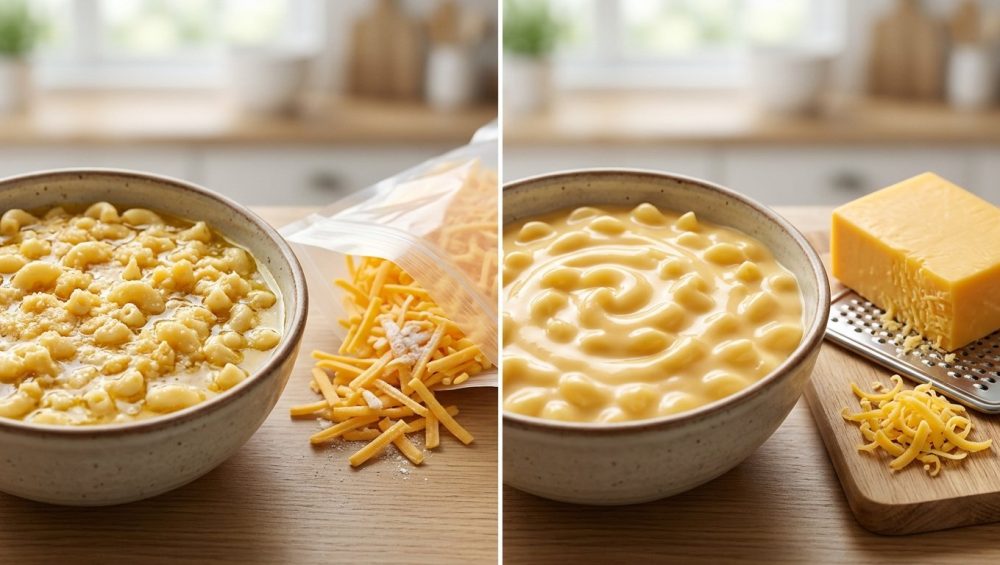
Have you ever spent a Tuesday evening whisking a beautiful, bubbling béchamel, dreaming of a velvety, soul-warming macaroni and cheese, only to stir in your cheese and watch it instantly transform into a greasy, separated puddle of despair? You stare into the saucepan, questioning your culinary worth as pools of neon-orange oil separate from gritty, sand-like clumps of dairy. It is a culinary tragedy of the highest order.
Let me stop you right there before you throw your whisk across the room. You did not fail because you lack a culinary degree. You failed because you fell for one of the modern food industry’s greatest cons: the bag of pre-shredded cheese.
As a home cook who has set off the smoke detector more times than I care to admit, I know firsthand that weekday dinners are a race against the clock. I am the first to advocate for brilliant, time-saving kitchen hacks. Time is money, and when you are trying to feed a family on a Wednesday night, efficiency is everything. But there is a massive, undeniable difference between a smart culinary shortcut and a heavily processed product that chemically sabotages your food. If you want to finally understand why your cheese sauce breaks, you need to look at the ingredient label on that convenient little plastic bag.
Today, we are taking a brutally honest, extraordinarily detailed masterclass into the chemistry of melting cheese, the hidden additives lurking in your grocery store dairy aisle, and exactly why grating your own block cheese is the single most important rule for achieving liquid gold. Grab a glass of wine, pull up a stool, and let’s dive into the science of the melt.
The Anatomy of a Cheese Emulsion
To understand why pre-shredded cheese is the ultimate enemy of a smooth sauce, we first need to understand what cheese actually is. I promise not to go full lab-coat on you, but a little foundational food science is the secret weapon that separates the amateur from the confident home chef.
At its core, cheese is an emulsion. It is a delicate, meticulously balanced suspension of milk fat globules and water, trapped within a microscopic three-dimensional matrix of proteins—specifically, casein proteins. When cheese is sitting cold in your refrigerator, this protein matrix is firm and stable. The casein proteins are tightly bound together by tiny ionic bridges made of calcium. It is a happy, solid little family of fat, water, and protein.
When you introduce heat to this stable structure, things get chaotic. As the temperature rises above 150°F (65°C), the solid milk fat liquefies and begins to expand. Simultaneously, the heat causes those casein protein chains to violently contract, squeezing out the water and the newly liquefied fat. In the culinary world, this moisture-expelling panic is known as syneresis.
If you simply throw a handful of naked cheddar into a hot pan, that syneresis happens rapidly. The calcium bridges tighten, the proteins clump together into rubbery, chewy wads, and the fat escapes to form a depressing oil slick. This is exactly why your beautifully planned dinner turns oily and grainy if you aren’t careful with your heat control.
To create a perfectly smooth, flowing sauce, we have to control that melt. We have to introduce stabilizers—like the swollen starches in a roux or specialized emulsifying salts—to coat those proteins, absorb the released water, and keep the fat happily suspended. It is a delicate chemical dance. And it is a dance that is violently interrupted by the additives heavily dusted onto bagged shredded cheese.
The Billion-Dollar Convenience Trap
Before we dissect the chemicals, let’s look at why pre-shredded cheese is absolutely everywhere. Make no mistake: the pre-shredded cheese industry is a financial juggernaut. In 2025, the global shredded cheese market was valued at a staggering $21.8 billion, and it is projected to skyrocket to $34.2 billion by 2034. Mozzarella shreds alone command nearly half of that market (around 38.5% to 47.2%, depending on the specific industry report), driven heavily by the global pizza industry and our collective obsession with fast, stretchy cheese.
The driving force behind this massive growth is exactly what you’d expect: convenience. We are all exhausted. The food industry knows that after a long day of work, the thought of dirtying a box grater feels like an insurmountable hurdle. A recent 2024 survey of U.S. quick-service restaurants revealed that 72% had transitioned entirely to pre-shredded or pre-sliced cheese just to survive peak service hours. Consumers are so desperate for this convenience that they are willing to pay a 30% to 40% premium per ounce for bagged cheese compared to a solid block.
But here is the harsh reality that the dairy industry does not want you to think about: you are paying a massive premium for a product that is objectively worse for cooking. To ensure that those millions of tons of shredded cheese survive the grueling journey from the factory to the supermarket to your fridge without melting into a solid, moldy brick, manufacturers have to coat the cheese in a cocktail of anti-caking agents and chemical preservatives. You are paying extra money to ruin your own food.
Meet the Chemical Saboteurs
When you open a bag of shredded cheddar, you will notice a fine, powdery dust coating every single strand. That dust is the reason you are reading this article. It is the reason you need to stop buying pre-shredded cheese for good. Let’s meet the lineup of chemical saboteurs that are actively destroying your weeknight dinners.
Powdered Cellulose: The Wood Pulp Problem
The most infamous additive in bagged cheese is powdered cellulose (often listed as E460ii). Yes, the internet rumors are true: commercial powdered cellulose is frequently derived from refined wood pulp and plant waste, such as cotton lint. Now, before we panic and assume we are eating literal lumber, let’s be scientifically accurate. Cellulose is a naturally occurring structural component found in the cell walls of all green plants. It is entirely safe for human consumption; the FDA classifies it as Generally Recognized as Safe (GRAS), and it acts as an insoluble dietary fiber because human bodies cannot digest it.
But just because a substance is safe to eat does not mean it belongs in a delicate mornay sauce.
Manufacturers add powdered cellulose at a rate of 2% to 4% by weight to act as an anti-caking agent. Because freshly shredded cheese is full of natural moisture, the strands will stick together and form a giant clump within hours if left uncoated. Powdered cellulose solves this by aggressively absorbing surface moisture and creating a microscopic physical barrier between the cheese shreds.
The fatal flaw? Cellulose is completely insoluble. It does not dissolve in water, and it certainly does not dissolve in melted milk fat. When you melt a bag of cellulose-coated cheese, that wood pulp remains completely intact, floating around in your sauce and leaving behind a gritty, sandy mouthfeel. If you have ever wondered why your cheese sauce is gritty, this insoluble plant fiber is your primary suspect.
Potato Starch and Corn Starch
Because consumers started getting wise to the “wood pulp” headlines and filing class-action lawsuits, many premium cheese brands transitioned to using starch blends—typically potato starch, corn starch, or a mixture of both, sometimes paired with calcium sulfate. A 2020 study from North Carolina State University found that consumers actually preferred the visual appearance of cheese coated in 100% potato starch because it looks less “dusty” in the bag than cellulose.
While potato starch doesn’t sound quite as terrifying as wood pulp, it is an absolute nightmare for a delicate emulsion. Starches have a massive Water Absorption Index (WAI). They act like microscopic sponges. When you dump potato-starch-coated cheese into a hot liquid, the starch rapidly absorbs the ambient water in the sauce. By aggressively stealing this water, the starch throws off the delicate fat-to-water ratio needed to keep the cheese emulsified. The casein proteins seize up, the fat is expelled, and your sauce breaks in spectacular fashion.
Natamycin: The Mold Inhibitor
The final nail in the pre-shredded coffin is Natamycin (also known as pimaricin). Natamycin is a naturally occurring antifungal compound that is widely used as a food preservative to prevent yeast and mold growth. It is highly effective and incredibly heat-resistant, surviving temperatures up to 212°F (100°C) for 30 minutes.
Because shredding a block of cheese exponentially increases its surface area, it becomes a massive target for airborne mold spores. To combat this, manufacturers spray the shreds with an aqueous suspension or powder of natamycin. While it keeps the cheese shelf-stable for months, it adds yet another foreign variable to your saucepan. You aren’t just melting pure dairy; you are melting dairy, plant fiber, root starches, and antifungal sprays. It is a recipe for a textural nightmare.
The Thermodynamics of a Broken Sauce
Let’s paint a picture of exactly what happens when you try to make a comforting bowl of macaroni and cheese using a bag of pre-shredded cheddar.
You start by doing everything right. You make a beautiful classic roux—melting butter and whisking in flour—and then you slowly whisk in whole milk to create a silky white béchamel. The starches from the flour swell and coat the liquid, creating a perfectly thickened, stable base. You turn the heat down to low, you pat yourself on the back, and you drop in two cups of bagged shredded cheese.
Chaos ensues almost immediately.
First, the heat hits the casein proteins. The calcium bridges tighten, and the proteins begin to contract and expel their fat and moisture. In a normal scenario, your béchamel’s flour starches would gently catch that fat and water, keeping everything suspended in harmony.
But the bagged cheese brought its own army of saboteurs. The powdered cellulose refuses to dissolve, floating around in the liquid like microscopic sand. The potato starch coating violently absorbs the water out of your béchamel, leaving the expelled milk fat with nowhere to go. Without enough water to sustain the emulsion, the fat separates entirely, floating to the surface as a slick of neon orange grease. Meanwhile, the casein proteins, robbed of their moisture, bind together into tight, chewy, grainy clumps.
In less than sixty seconds, you have ruined dinner. And this is exactly why your cheese sauce gets grainy. The anti-caking agents disrupted the thermodynamics of the melt, creating a hostile chemical environment where a smooth emulsion is physically impossible.
The Block Cheese Manifesto
The solution to this madness is so simple it almost hurts: buy a block of cheese and grate it yourself.
I know, I know. You are exhausted. You just got home from a brutal commute, the dog is barking, and the last thing you want to do is exert physical effort over a cutting board. But as your snarky, uncompromising culinary cheerleader, I am telling you that this is a non-negotiable rule of the kitchen.
When you grate a block of high-quality cheddar, gruyère, or fontina, you are working with pure, unadulterated dairy. There is no wood pulp. There is no potato starch. There is no antifungal spray. The moisture content is exactly what the cheesemaker intended. When you gently fold freshly grated block cheese into a warm base, the casein proteins relax naturally, the fat melts evenly, and the sauce becomes a glossy, velvety masterpiece.
If you want to stop serving subpar meals and constantly wondering why your food turns grainy, you have to put down the bag.
Banishing Toxic Gear: How to Grate Like a Pro
“But grating cheese takes too long!” I hear you cry. No, it doesn’t. You are just using the wrong tools.
If you are struggling to grate cheese, it is probably because you are using a dull, flimsy, plastic-handled grater that you bought at a discount store a decade ago. I have a strict “no-go” rule when it comes to cheap, toxic kitchenware. We are officially banishing toxic kitchen gear from your life today.
Flimsy plastic rotary graters are notorious for shedding microplastics into your food, and cheap metal graters with peeling non-stick coatings are a literal health hazard. You do not need a fancy, over-engineered gadget. You need a heavy-duty, solid stainless steel box grater. A sharp, high-quality box grater will tear through an 8-ounce block of cheddar in less than 90 seconds.
If you are cooking for a crowd on the weekend and making a massive batch of baked ziti, pull out your food processor. Equip it with the stainless steel shredding disc, and you can shred two pounds of cheese in ten seconds flat. There is absolutely no excuse to rely on chemically coated convenience products when the right tools make the job effortless.
The Masterclass on Melting: Two Paths to Liquid Gold
Now that we have established that block cheese is mandatory, let’s talk about how to melt it properly. Even pure block cheese can break if you abuse it. There are two primary methods for achieving a flawless cheese sauce, and both rely on respecting the chemistry of the emulsion.
Method 1: The Classic Roux (Béchamel to Mornay)
This is the traditional French method, and it is the backbone of classic macaroni and cheese.
- The Fat and Flour: Melt equal parts butter and all-purpose flour in a saucepan over medium heat. Whisk constantly for about two minutes to cook out the raw flour taste.
- The Liquid: Slowly whisk in cold or room-temperature whole milk. The starches in the flour will swell and thicken the milk, creating a stable béchamel.
- The Heat Control: This is the critical step. Turn off the heat completely. Never, ever boil your cheese. If the liquid is bubbling, it is too hot, and the extreme heat will cause the proteins to seize.
- The Cheese: Add your freshly grated block cheese a handful at a time, whisking gently until smooth. The residual heat of the béchamel is more than enough to melt the cheese, while the swollen starches hold the fat and water together perfectly.
Method 2: The Modernist Miracle (Sodium Citrate)
If you want to achieve the impossibly silky, glossy texture of processed American cheese, but with the complex, sharp flavor of a high-quality aged cheddar, you need to use sodium citrate.
Sodium citrate (Na₃C₆H₅O₇) is a food-safe salt derived from citric acid. It is the ultimate secret weapon for the home cook. Remember those calcium bridges that hold the casein proteins together? Sodium citrate is a highly effective chelating agent. When you dissolve a little sodium citrate into a splash of water or milk and heat it, the citrate ions aggressively bind to the calcium ions in the cheese.
By removing the calcium, the sodium citrate effectively “deconstructs” the protein matrix. The tightly bound casein micelles disassemble into individual, amphiphilic protein strands. These liberated proteins suddenly act as super-emulsifiers, effortlessly binding the fat and water together without the need for a flour roux.
To do this:
- Simmer 1/2 cup of liquid (water, milk, or even beer) in a saucepan.
- Whisk in 1/2 teaspoon of sodium citrate until dissolved.
- Gradually whisk in 8 ounces of freshly grated block cheese.
- Watch in amazement as it melts into a perfectly uniform, glossy liquid that will never separate, even as it cools.
Troubleshooting Your Kitchen Disasters
Even with the best intentions, things can go wrong. Let’s troubleshoot some common dairy disasters so you know exactly how to recover without ordering takeout.
What if your sauce still breaks?
If you used block cheese and your sauce still turned into an oil slick, you likely overheated it. Remember, heat is the enemy of an emulsion. If the sauce boils, the proteins violently contract. To fix a broken sauce, remove it from the heat immediately. Add a splash of cold heavy cream or a tablespoon of ice water, and whisk vigorously. The sudden drop in temperature and the introduction of fresh water and fat can sometimes shock the emulsion back together.
What if you are using heavily aged cheese?
Aged cheeses, like a 3-year sharp cheddar or Parmigiano-Reggiano, have significantly less moisture than young cheeses (like mozzarella or Monterey Jack). During the aging process, water evaporates, leaving behind tightly clumped proteins and concentrated fat. Because they lack water, aged cheeses are highly prone to breaking when melted. If you try to make a sauce entirely out of aged cheddar, it will almost certainly ruin a perfect melt. You must blend it with a high-moisture melting cheese (like Gruyère or Fontina), or rely on the sodium citrate method to force the emulsion to hold.
What about pasta dishes?
If you are making a delicate Cacio e Pepe or a simple parmesan cream sauce, and you notice your pasta sauce separates, the solution is starchy pasta water. The starch released by the boiling pasta acts just like the flour in a roux. Vigorously tossing your hot pasta, grated cheese, and a ladle of starchy cooking water creates a mechanical emulsion, binding the cheese fat to the liquid.
What about pan sauces?
If you are deglazing a skillet after searing a steak, and you notice your pan sauces are watery or your butter is separating, you lack gelatin and emulsifiers. Whisking in a pat of cold butter at the very end (a technique known as monter au beurre) off the heat will thicken and emulsify the sauce beautifully.
The Hidden Variables: Acid and Agitation
While we have thoroughly established that pre-shredded cheese is a culinary crime, there are two other variables you must master to achieve perfection: acid and agitation.
The Role of Acid
Cheese itself is slightly acidic, a byproduct of the lactic acid fermentation process that turns milk into cheese. However, introducing too much additional acid to a hot cheese sauce can cause the casein proteins to instantly curdle. If you have ever tried to make a creamy tomato soup and had the dairy separate into horrifying white specks, you have experienced acid curdling.
If your recipe calls for white wine (like in a classic Swiss fondue), the acid in the wine actually helps keep the proteins from clumping too tightly, but only if the heat is strictly controlled. If you boil wine and cheese together, the combination of high heat and high acid will destroy the emulsion. Always reduce your wine first, lower the heat, and then gently fold in the cheese.
The Danger of Over-Agitation
We often think that if a sauce is looking a little lumpy, the solution is to whisk it harder. This is a trap. While gentle, consistent stirring is necessary to distribute the melting cheese into the liquid base, aggressive, violent whisking can actually encourage the fat to separate. Think about how butter is made: heavy cream is agitated until the fat globules smash together, separate from the buttermilk, and form solid butter. If you aggressively whisk a hot cheese sauce, you risk churning the dairy, forcing the fat out of the emulsion. Stir gently with a wooden spoon or a silicone spatula, using a figure-eight motion to fold the cheese into the liquid.
The Final Verdict on the Cheese Drawer
I know that the modern world demands efficiency. We are all looking for ways to shave ten minutes off our evening routines. But cooking is fundamentally an act of chemistry. When you try to cheat the chemistry, the chemistry bites back.
Bagged, pre-shredded cheese is a triumph of industrial food engineering. It is a product designed to sit in a refrigerated truck for a week, survive on a grocery store shelf for a month, and sit in your fridge for another two months without sprouting mold or forming a solid block. It is a marvel of commercial logistics. But it is an absolute disaster for your cooking.
The anti-caking agents—whether it is insoluble powdered cellulose or water-stealing potato starch—fundamentally alter the thermodynamics of the cheese. They create physical barriers, absorb critical moisture, and guarantee that your emulsion will fail.
You do not need a culinary degree to cook like a professional. You just need to respect your ingredients. Grating a block of cheese takes exactly two minutes. It is two minutes of manual labor that will completely transform the quality of your food. It will save you from the heartbreak of a ruined sauce, and it will ensure that every plate of macaroni and cheese, every bowl of queso, and every fondue pot you ever make is a resounding, velvety success.
So, the next time you are standing in the dairy aisle, staring at the convenience of those colorful plastic bags, walk away. Buy the block. Grab your stainless steel grater. Your tastebuds, your dinner guests, and your sanity will thank you.
And if you still refuse to grate your own cheese? Well, don’t say I didn’t warn you when your mac and cheese looks like a science experiment gone wrong. Happy cooking, and remember: if you wouldn’t eat a spoonful of wood pulp on its own, you probably shouldn’t put it in your dinner.