Welcome to another brutally honest session in my kitchen. Pour yourself a glass of whatever gets you through a Tuesday evening, because we need to have a serious intervention about a crime happening on your cutting board.
Picture this: You’ve had a long day. You decide to treat yourself to a beautiful, home-cooked pasta dish. You follow the recipe, you splurge on the good San Marzano tomatoes, and you even grate real Parmigiano-Reggiano instead of using that sawdust in the green shaker. You sit down, take a bite, and… bam. An aggressive, metallic, violently bitter flavor hijacks your palate. It overpowers the sweet tomatoes. It ruins the delicate basil. Your breath instantly becomes a weapon of mass destruction.
What went wrong? You used a garlic press.
Yes, that clunky, impossible-to-clean, single-use gadget lurking in the back of your utensil drawer is secretly sabotaging your food. I know, I know—some of you are already clutching your pearls. “But it saves me so much time!” you cry. Does it, though? Does it really save you time when you spend ten minutes picking fibrous garlic pulp out of tiny metal holes with a toothpick?
As your resident culinary cheerleader and relentless pragmatist, I am here to tell you that you do not need a culinary degree to cook like a Michelin-starred chef, but you do need to understand the basic science of your ingredients. Today, we are taking a massive, exhaustive deep dive into the food science of Allium sativum. We are going to explore exactly why your garlic tastes bitter, the hidden chemical warfare happening inside those little cloves, and how you can take back control of your flavor profiles using nothing but a chef’s knife and a little bit of know-how.
The Anatomy of a Clove: What Garlic Actually Is
To understand why the garlic press is the enemy of good taste, we first have to understand what garlic actually is. From a botanical perspective, garlic (Allium sativum) is a species in the onion genus, closely related to shallots, leeks, and chives. But from an evolutionary perspective, garlic is a masterclass in chemical defense.
Think about it from the plant’s point of view. It grows underground, surrounded by hungry nematodes, fungi, insects, and burrowing mammals. It can’t run away. So, it developed a brilliant biological booby trap.
If you pick up a whole, unpeeled head of garlic and smell it, what do you notice? Almost nothing. It might smell faintly earthy or papery, but it doesn’t smell like garlic. That signature, mouth-watering aroma does not exist until the plant is damaged. The plant has evolved so that its potent, pungent compounds are only created on demand, specifically when a pest takes a bite out of it.
This defense mechanism is entirely dependent on the physical cellular structure of the clove. Inside the garlic clove, there are millions of microscopic cells. Within these cells, the plant stores a non-volatile, odorless amino acid derivative called alliin. Safely sequestered in an entirely separate compartment of the cell (the vacuole) is an enzyme called alliinase.
As long as the cell walls remain perfectly intact, the alliin and the alliinase never meet. They live in peaceful, odorless isolation. But the moment those cell walls are breached—whether by the teeth of a hungry gopher or the blade of your kitchen knife—the compartments rupture. The enzyme and the amino acid crash into each other, and a violent chemical reaction occurs.
The Chemistry of Flavor: Alliin, Alliinase, and the Allicin Bomb
When alliin and alliinase mix, they instantly form a highly reactive, volatile sulfur compound called allicin (diallyl thiosulfinate).
Allicin is the magic word today. It is the alpha and omega of garlic flavor. It is the compound responsible for the sharp, pungent, spicy, and sometimes overwhelmingly bitter taste of fresh garlic. It is also what gives garlic its famous antimicrobial and antifungal properties. In nature, a blast of allicin is usually enough to make a pest spit the bulb out and run away. In the kitchen, it is the fundamental building block of savory cooking.
But here is the critical food science secret that separates professional chefs from weekend hobbyists: The amount of allicin produced is directly proportional to the amount of cellular damage inflicted on the clove.
Let me say that again, because it is the most important sentence in this entire masterclass. The more cell walls you break, the more allicin is created, and the stronger, sharper, and more bitter the garlic flavor becomes.
If you take a razor-sharp knife and carefully slice a clove of garlic into thin, elegant wafers, you are only rupturing the cells directly along the path of the blade. The vast majority of the cells remain intact. As a result, the allicin production is relatively low. The resulting flavor will be mild, sweet, and aromatic.
If you chop the garlic roughly, you break more cells. More allicin. Stronger flavor.
If you mince it finely, you break even more cells. A robust, punchy flavor.
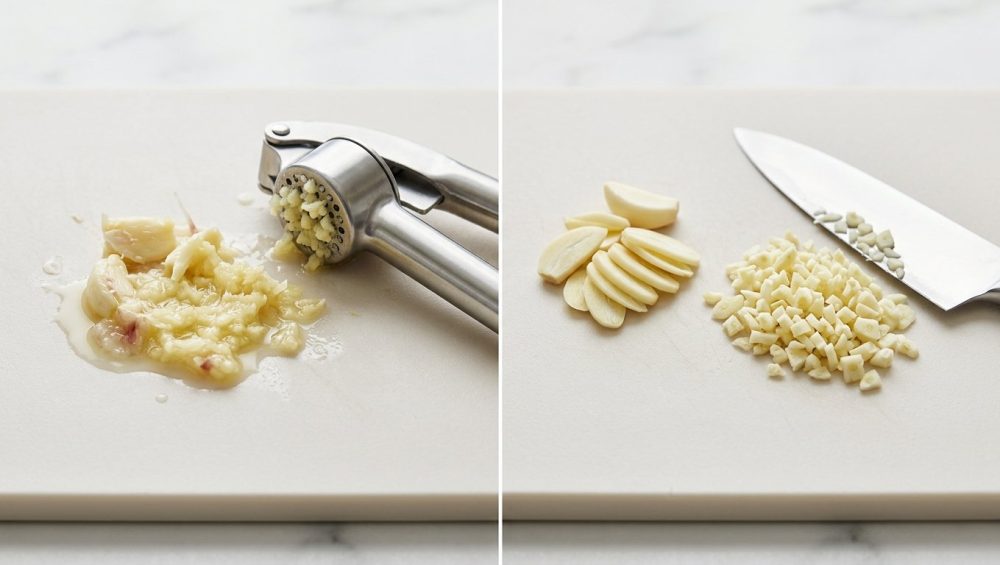
And what happens if you shove that clove into a mechanical piston and crush it through a grid of tiny holes under immense pressure? You obliterate nearly 100% of the cell walls simultaneously. You don’t just create allicin; you detonate an allicin bomb. This catastrophic cellular destruction produces a massive, overwhelming wave of sulfurous compounds. The flavor profile shifts from savory and aromatic to harsh, acrid, and aggressively bitter.
This is why your food tastes wrong. You aren’t controlling the flavor; you are letting a heavy-handed gadget dictate the chemistry of your dinner. It is one of the most common rookie kitchen mistakes that keeps home cooks from achieving restaurant-quality flavor profiles.
The Garlic Press: A Medieval Torture Device for Your Food
Let’s talk about the history of this kitchen villain. The modern garlic press was patented in 1948 by Karl Zysset, a Swiss bicycle mechanic. That makes perfect sense, doesn’t it? The tool feels like it belongs in a mechanic’s garage, not a delicate culinary workspace.
The fundamental flaw of the garlic press is that it does not cut. It crushes, mangles, and extrudes. When you force a clove through the press, you are subjecting it to immense blunt-force trauma. Instead of clean, precise cuts that leave the structural integrity of the remaining pieces intact, the press tears the fibers apart, squeezing out the essential oils and cellular fluids in a wet, highly volatile mush.
Because the allicin reaction happens instantly upon cellular rupture, that wet mush is chemically peaking the moment it hits your cutting board. And unfortunately, allicin is highly unstable. Within minutes of exposure to air, it begins to break down into secondary sulfur compounds (like diallyl disulfide and diallyl trisulfide), which carry even more pungent, sometimes metallic off-notes.
When you use a press, you are sacrificing all nuance. You are taking an ingredient that has the potential to be sweet, nutty, and deeply savory, and you are reducing it to a one-dimensional slap in the face.
The “No-Go” Rule: Toxic Gear and the Cheap Metal Press
We need to take a brief detour here, because if you’ve been reading my blog for a while, you know I have a very strict, uncompromising rule: I absolutely despise cheap, toxic kitchenware. I refuse to let you poison yourselves or your food with garbage tools.
Take a good, hard look at your garlic press. What is it made of? Unless you spent a premium on a high-grade, 18/10 stainless steel model, there is a very high probability that your press is made of a cheap zinc alloy or cast aluminum, often coated with a flimsy non-stick finish or a faux-chrome plating.
Garlic is highly acidic, and its sulfur compounds are incredibly reactive. When you crush garlic against cheap, reactive metals, a chemical exchange occurs. The sulfur reacts with the aluminum or the deteriorating zinc, creating a literal metallic taste that leaches directly into your food. This is why pressed garlic sometimes tastes like you’re chewing on a piece of tin foil.
Furthermore, the physical stress of squeezing the handles causes the cheap plating to flake and peel over time. Where do you think those microscopic flakes of mystery metal and toxic non-stick coating are going? They are going straight into your marinara sauce.
Throw it away. Seriously. Open your drawer right now, take out that peeling, oxidized, impossible-to-clean contraption, and put it in the recycling bin. You deserve better. If you are serious about upgrading your culinary skills, you must actively banish toxic kitchen gear from your life entirely. A high-quality chef’s knife and a solid wooden cutting board are the only beginner kitchen tools you truly need to process aromatics safely and effectively.
The Thermodynamics of the Sauté: Why Pressed Garlic Burns
Let’s step away from the prep station and move over to the stove. The cellular destruction caused by the garlic press doesn’t just ruin the flavor in its raw state; it creates a thermodynamic nightmare when you apply heat.
When you sauté aromatics, you are looking to trigger the Maillard reaction—a complex chemical process where amino acids and reducing sugars brown under heat, creating hundreds of new, deeply savory flavor compounds. To achieve this beautifully golden, sweet result, the ingredient needs to heat up evenly.
When you slice or mince garlic with a knife, the pieces are relatively uniform in size. They have structural integrity. They contain a balanced amount of moisture. When they hit the hot oil, they fry gently, turning a beautiful golden brown and releasing a sweet, nutty aroma.
Pressed garlic, on the other hand, is a chaotic, fibrous mush. It consists of microscopic shreds of plant matter suspended in a puddle of highly reactive garlic juice. When you drop this wet paste into hot oil, the thermodynamics go completely haywire. The tiny shreds have almost no thermal mass. The water content flashes off into steam instantly, leaving the delicate sugars and volatile sulfur compounds completely exposed to the searing heat of the pan.
Within seconds, the pressed garlic goes from raw to burnt. There is no gentle browning; there is only scorching. Burnt garlic is irreversibly bitter. It tastes like ash and acrid sulfur. If you have ever wondered why your minced garlic always burns before your onions are even translucent, the press is likely the culprit. The pieces are simply too small and too damaged to withstand the heat.
If you want to stop burning your garlic, you have to stop turning it into a hyper-combustible paste. Furthermore, you need to rethink your timing. Many poorly written recipes tell you to add the garlic to the hot oil at the exact same time as the onions. This is a trap. Onions contain a massive amount of water and take anywhere from 7 to 15 minutes to sweat down and soften. Garlic takes about 30 seconds to cook. If you want to save your dish, you must stop adding garlic first. Always add it in the last minute of sautéing your other aromatics.
Knife Skills 101: Taking Back Control of Your Garlic
Alright, I’ve yelled at you enough about the press. Now, as your biggest cheerleader, I am going to empower you with the skills you actually need. You don’t need to be intimidated by knife work. It just takes a little practice, a sharp blade, and an understanding of what you are trying to achieve.
(Side note: If you are tearing up while chopping onions or struggling to cut through a simple clove of garlic, the problem is not your technique. The problem is using a dull knife. A dull knife crushes cells instead of slicing them, which ironically causes the exact same over-production of allicin that we are trying to avoid. Sharpen your knives!)
Here is your definitive guide to controlling garlic’s pungency and sweetness through precise knife skills.
The Sweet Slices
The Technique: Lay the peeled clove flat on your board. Using a sharp chef’s knife, slice the clove crosswise as thinly as you possibly can.
The Science: Slicing causes the absolute minimum amount of cellular damage. Very little alliinase is released, meaning allicin production is kept to a bare minimum.
The Result: A highly aromatic, sweet, and mellow garlic flavor. This is the authentic Italian method (think of the famous razor-blade scene in the movie Goodfellas).
When to Use It: Slow-cooked tomato sauces, infusing olive oil, roasting alongside meats, or any dish where you want a background hum of garlic without it overpowering the palate. When you cook slices slowly in oil, they turn into crispy, sweet little garlic chips.
The Rough Chop
The Technique: Slice the clove, then turn your knife 90 degrees and chop across the slices a few times. The pieces should be about the size of a match head.
The Science: You are breaking more cell walls here, increasing the allicin yield.
The Result: A balanced, noticeable garlic presence that won’t blow your head off.
When to Use It: Hearty stews, braises, chunky salsas, and stir-fries. The pieces are large enough that they won’t burn instantly in a hot wok, but small enough to distribute flavor throughout the dish.
The Fine Mince
The Technique: Start with a rough chop. Then, place your non-dominant hand flat on the spine of your chef’s knife near the tip. Keeping the tip planted on the board, rock the blade up and down over the garlic, pivoting in a fan motion. Keep gathering the garlic back into a pile and mincing until the pieces are tiny and uniform.
The Science: We are now breaking a significant number of cell walls, triggering a robust allicin reaction. However, because the knife is slicing cleanly through the fibers rather than crushing them, the pieces retain their structural integrity. They aren’t leaking a puddle of bitter juice.
The Result: A strong, punchy, traditional garlic flavor.
When to Use It: This is your everyday workhorse cut. Use it for marinades, quick sautés, garlic bread, and vinaigrettes.
(Pro Tip: Once you have minced your garlic, do not drag the sharp edge of your knife across the cutting board to scoop it up. This rolls the microscopic edge of the blade and ruins your knife. Instead, flip the knife over and use the spine, or better yet, use a bench scraper to transfer your ingredients to the pan.)
The Chef’s Paste
The Technique: What if you actually want a garlic paste for a raw application, like a Caesar salad dressing or a garlic butter, but you don’t want the harsh bitterness of the press? Here is the professional chef hack. Mince the garlic finely. Then, sprinkle a generous pinch of coarse kosher salt over the pile. Using the flat side of your chef’s knife blade, press down firmly and drag the blade across the garlic, scraping it against the cutting board. Gather it up, and repeat.
The Science: The coarse salt acts as a mechanical abrasive, breaking down the cell walls thoroughly but cleanly. More importantly, the salt immediately begins drawing out the moisture through osmosis, and the chloride ions help to stabilize the volatile sulfur compounds.
The Result: A perfectly smooth, intensely flavorful paste that is vibrant and punchy, but completely lacks the oxidized, metallic bitterness of pressed garlic.
If you absolutely refuse to use a knife and insist on a gadget, let’s talk about what to buy instead. A ceramic ginger grater or a high-quality microplane will give you a beautiful, fine puree without the blunt-force trauma of a press. Just be mindful that microplaned garlic is highly potent, so use it sparingly.
The Acid Trick: How to Stop the Allicin Reaction in Its Tracks
Let’s say you are making a raw preparation—like hummus, tzatziki, or a sharp vinaigrette. You want that bright, raw garlic flavor, but you don’t want it to burn your tongue or leave you with garlic breath for three business days.
Here is a brilliant piece of food science to keep in your back pocket: The enzyme alliinase is highly sensitive to pH.
Alliinase thrives in a neutral environment. But if you drop the pH by introducing an acid, the enzyme is instantly denatured. It changes shape and stops working. If the enzyme stops working, the allicin production halts immediately.
To use this to your advantage, mince your raw garlic and immediately submerge it in whatever acidic ingredient your recipe calls for—lemon juice, lime juice, or vinegar. Let it sit in the acid for 10 to 15 minutes before adding the rest of your ingredients (like the olive oil, chickpeas, or yogurt).
The acid will neutralize the alliinase, effectively “cooking” the garlic chemically. The resulting flavor will be bright, garlicky, and incredibly smooth, with absolutely zero harsh, bitter bite. It is a total game-changer for raw applications.
Conversely, heat also denatures alliinase. If you throw whole, unpeeled cloves of garlic into a 400-degree oven, the heat destroys the enzyme before it ever gets a chance to mix with the alliin. This is why roasted garlic is so astonishingly sweet, creamy, and mild. You can literally eat it whole, spread it on toast like butter, and it won’t have even a fraction of the pungency of a single raw, crushed clove.
Cooking Applications: When to Use Which Cut
To make your busy weekday evenings as efficient as possible, here is a quick cheat sheet on how to handle your garlic based on what you are cooking. Remember, time is money, but flavor is everything.
- For Sunday Gravy or Long-Simmered Tomato Sauce: Slice it thin. Let it infuse the olive oil slowly over medium-low heat until it just begins to turn blonde. The sweetness will perfectly complement the acidity of the tomatoes.
- For Weeknight Stir-Fries: Rough chop. The pieces need to be big enough to survive the intense, blistering heat of a wok without turning to bitter ash.
- For Sautéed Spinach or Greens: Fine mince. Add it to the pan with the greens, not before. The water releasing from the spinach will drop the temperature of the pan and prevent the minced garlic from burning.
- For Garlic Bread: Chef’s paste with coarse salt. Cream it into softened high-quality butter with some fresh parsley. Because the garlic is protected by the fat of the butter, it will melt beautifully into the bread without scorching.
- For Pan-Seared Steak or Chicken: Crush a whole clove lightly with the heel of your hand—just enough to split the skin—and toss it whole into the pan with your butter and herbs. It will baste the meat with a rich, mellow flavor and won’t burn during the long sear. Be sure you wait until the meat is nearly done before adding it to the pan to avoid prolonged heat exposure.
The Sassy Sous-Chef’s Final Verdict
Cooking is not about following a rigid set of rules; it is about understanding your ingredients so you can make them do exactly what you want. Garlic is one of the most magnificent, versatile, and transformative ingredients on the planet. It can be a gentle, sweet whisper in the background of a braise, or it can be a loud, proud, spicy punch in a raw salsa.
But it can only be those things if you treat it with respect.
The garlic press strips you of your control. It homogenizes the ingredient, maximizes the cellular damage, and guarantees a harsh, bitter, allicin-heavy result. It is a relic of an era when convenience was prioritized over quality, and frankly, it doesn’t even offer real convenience when you factor in the cleanup.
So, put down the medieval torture device. Pick up your chef’s knife. Take a deep breath, practice your mincing, and reclaim the flavor of your food. I promise you, once you taste the sweet, aromatic difference of properly sliced and minced garlic, you will never look at that little metal crusher the same way again.
Now, go pour yourself another glass of wine, preheat your skillet, and let’s get cooking. You’ve got this.
Stay sassy, stay sharp, and for the love of all things holy, stop burning your aromatics.