Picture this: It’s a beautiful Saturday evening. You’ve decided that tonight is the night you transcend your usual takeout habit. You’ve invited a few friends over for a DIY summer roll night. You’ve julienned your carrots, plucked your mint leaves, and laid out a gorgeous, vibrant spread of fresh ingredients. You confidently grab a sheet of translucent rice paper, dunk it into a bowl of steaming hot water just like you saw someone do on the internet, and lay it on your plate. Ten seconds later, you attempt to roll it.
Instead of a sleek, tight, professional-looking spring roll, you are left wrestling with a gelatinous, sticky blob that has permanently fused itself to your ceramic plate. As you frantically try to peel it off, it tears, spilling shrimp, herbs, and vermicelli all over the counter. You panic, your guests politely pretend not to notice your rising blood pressure, and your dream of an effortless, aesthetic meal dies a messy, starchy death.
Welcome to the club. We have all been there.
But it absolutely does not have to be this way. As a home cook who learned by setting off the smoke detector and ruining countless dinners before finally figuring it out, I am here to tell you that mastering the Vietnamese summer roll (gỏi cuốn) is entirely within your grasp. You do not need a culinary degree to make mind-blowing food. You just need to understand a little bit of food science, respect your ingredients, and set up your workspace properly. When you are hosting a relaxed dinner party, the last thing you want is to be chained to the stove or wrestling with sticky wrappers in front of an audience.
Today, we are leaving no stone unturned. We are going to completely deconstruct the mechanics of the summer roll. We will explore the molecular reality of tapioca starch, debunk the most persistent and destructive myths about water temperature, and teach you how to engineer a rolling station that practically guarantees success. Grab a glass of wine, sharpen your chef’s knife, and let’s get to work on the ultimate mindful rolling party.
The Tapioca Trap: The Food Science Behind Rice Paper Hydration
If you want to stop tearing your wrappers, you first need to understand what you are actually holding in your hands. Most home cooks look at a sheet of dry rice paper and assume it is just, well, rice. But that is only a fraction of the story.
Authentic Vietnamese rice paper, known as bánh tráng, is actually a highly engineered composite film. According to food science analyses, a standard commercial wrapper is typically composed of 70 to 75 percent milled rice flour, 20 to 25 percent tapioca starch, and a minimal 3 to 5 percent water content. Some premium modern brands even push the ratio to 95 percent rice flour and 5 percent tapioca starch to perfectly balance flexibility and strength.
Why does this matter? Because the tapioca starch is the secret weapon—and the hidden trap. Rice flour provides the structural backbone and the classic opaque-to-translucent visual transition. However, pure rice flour wrappers are notoriously brittle and prone to shattering. Manufacturers add tapioca starch to provide elasticity, allowing the wrapper to stretch tightly around your fillings without immediately bursting.
But tapioca starch is incredibly thirsty. When exposed to water, the starch granules undergo a process called hydration hysteresis. They absorb moisture rapidly and begin to gelatinize. If they absorb too much water too quickly, that vital elasticity turns into pure, unadulterated glue. This is the exact moment your wrapper transforms from a delicate culinary vessel into a sticky nightmare that adheres to your fingers, your cutting board, and itself.
Furthermore, let’s talk about the nutritional profile, because I know my weekend culinary hobbyists love a clean, healthy meal. A standard USDA small rice paper sheet (about 5 grams) contains a mere 16 calories, making it an incredibly light and healthy vehicle for your fresh vegetables and proteins. It is naturally gluten-free and completely fat-free. But that delicate, low-calorie structure means it has zero fat to protect it from sticking. You are working with pure carbohydrates that desperately want to bind to whatever they touch. Understanding this molecular reality is the first step to conquering the roll.
The Culinary Heritage of Bánh Tráng
Before modern commercial manufacturing, bánh tráng was entirely handmade in Vietnamese villages. The process is a beautiful testament to culinary ingenuity. Soaked raw rice is ground with water into a delicate slurry. This batter is then spread incredibly thinly over a cloth stretched tightly over a pot of boiling water. It is steamed for just 30 to 45 seconds until it sets into a translucent crepe.
Once steamed, the delicate wet crepe is carefully transferred onto woven bamboo mats and left out in the sun to dry. This traditional drying method is exactly why authentic rice paper has that distinct, cross-hatched rattan pattern embossed on its surface. While modern factories now use machines to steam and dry the wrappers for consistency and hygiene, that signature woven texture remains a beautiful nod to its artisanal origins. The heavy addition of tapioca starch is a relatively modern innovation, designed to make the papers more pliable and easier for home cooks to manage without requiring the boiling hot water that the old-school, pure-rice wrappers demanded.
Temperature Tantrums: The Great Warm Water Lie
If you take away only one piece of advice from this entire masterclass, let it be this: Stop using warm water.
I don’t care what the back of the package says. I don’t care what that pretentious food blog you read in 2014 told you. The instruction to “soak rice paper in warm water until soft” is the single biggest lie in home cooking, and it is the primary reason your summer rolls are tearing.
Here is the brutal truth: Hot or warm water accelerates the hydration of that tapioca starch at a violent rate. It makes the rice paper incredibly sticky, overly fragile, and highly prone to breaking. When you plunge a wrapper into warm water, the exterior starches gelatinize instantly while the interior remains stiff. By the time the whole sheet feels soft in the water, it is already over-hydrated. The moment you pull it out, it collapses on itself like a wet plastic bag.
The revelation that will change your life is using room temperature or even slightly cool water. Yes, it sounds counterintuitive, but trust the science. When you use room temperature water, the hydration process is drastically slowed down, giving you a much wider window of control.
Here is the exact technique you must employ: The Two-Second Dip.
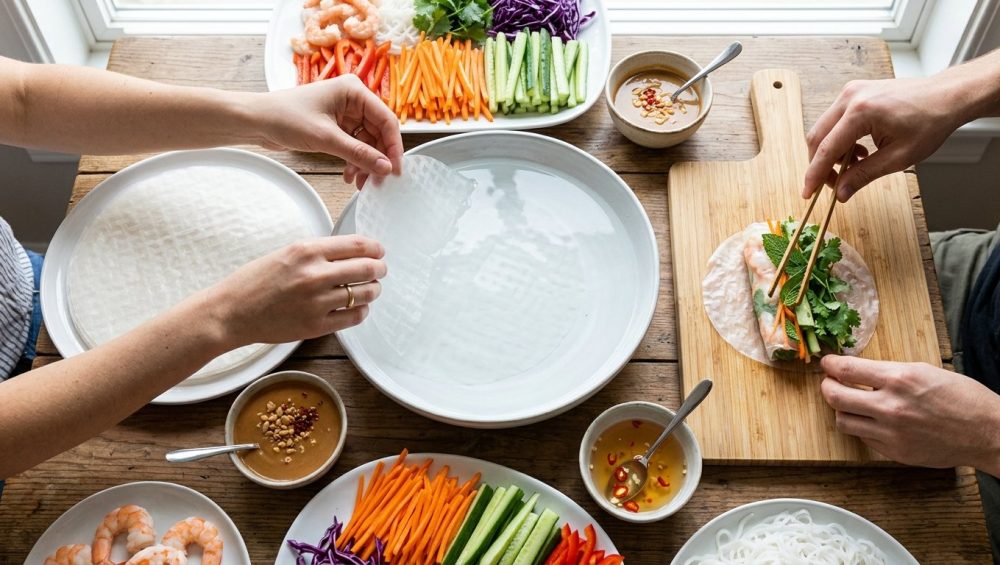
Fill a wide, shallow vessel—a pie dish or a large skillet works perfectly—with room temperature water. Take your sheet of rice paper and slide it into the water. Rotate it quickly so the entire surface gets wet, and pull it out immediately. The entire process should take no more than two to three seconds.
When you pull it out, the wrapper will still feel stiff. It will feel like a thin piece of plastic. This is exactly what you want. Do not panic and dunk it back in. As you lay the moistened wrapper on your prep surface and begin to pile on your ingredients, the residual water clinging to the surface will continue to absorb into the starches. By the time you have finished building your filling—usually about 30 to 45 seconds—the wrapper will have perfectly softened into a pliable, stretchy, durable skin. It will be sticky enough to seal, but firm enough to withstand the tension of a tight roll.
The Anti-Chaos Blueprint: Engineering Your Rolling Station
Now that we have solved the hydration puzzle, we need to address your workspace. A successful summer roll party is won or lost in the setup. If your prep station is chaotic, your rolls will be chaotic. Much like executing a stress-free folding night with potstickers, the secret to summer rolls is setting up a highly organized assembly line.
First, let’s talk about the rolling surface. This is where 90% of beginners fail. If you place a wet rice paper wrapper on a dry ceramic dinner plate, it will act like a suction cup and permanently glue itself to the dish. If you roll on a dry, cheap plastic cutting board, you will face the exact same problem.
I am a massive advocate for banishing toxic kitchen gear from your home, and that absolutely includes those peeling, deeply scarred plastic cutting mats that harbor bacteria and ruin your food’s texture. You deserve better, and your ingredients deserve better.
The undisputed champion of rolling surfaces is the damp kitchen towel method. Take a clean, lint-free cotton kitchen towel (do not use terry cloth unless you want fuzzy rolls) and run it under the tap. Wring it out completely so it is only slightly damp, not soaking wet. Stretch that damp towel over a heavy, high-quality wooden cutting board to create a stable, non-slip base.
When you place your freshly dipped, still-stiff rice paper onto the damp towel, two magical things happen. First, the dampness of the towel prevents the starches from sticking to the surface. Second, the towel acts as a moisture reservoir, gently hydrating the underside of the wrapper while you work, ensuring an even, supple texture.
Next, organize your mise en place. Your ingredients should be fully prepped, cooled, and arranged in a semi-circle around your rolling board. Do not store your prepped ingredients in cheap, greasy plastic containers that impart weird fridge odors into your fresh herbs. Use glass or ceramic prep bowls. Everything must be within arm’s reach. Once that wrapper hits the damp towel, the clock is ticking. You do not have time to go rummaging through the crisper drawer for cilantro.
Culinary Architecture: Knife Skills and the “Lettuce Barrier”
A summer roll is an exercise in structural engineering. The rice paper is your exterior envelope, and the ingredients are your load-bearing walls. If your ingredients are prepped carelessly, the envelope will fail.
Let’s talk about knife skills. The vegetables inside a summer roll must be cut with precision. You are aiming for a fine julienne—matchstick-sized pieces that are uniform in length and thickness. If you find yourself hacking at vegetables or using a dull knife, you are going to end up with jagged, uneven chunks that will immediately puncture your delicate wrapper.
Carrots, cucumbers, and bell peppers should be sliced into thin, elegant strips. Not only does this prevent tearing, but it also ensures a harmonious mouthfeel. You want to bite through a delicate crunch, not wrestle with a massive block of raw carrot. If you want to stop eating mushy veggies, you must respect the raw, crisp integrity of the produce going into these rolls by cutting them properly.
But even with perfect julienne cuts, firm vegetables pose a puncture risk. This is where professional chefs use a brilliant architectural trick known as the “Lettuce Barrier.”
Instead of piling sharp, crunchy vegetables directly onto the fragile rice paper, you use a soft, pliable leaf of butter lettuce (or Bibb lettuce) as a protective shield. You lay the lettuce leaf down first, place your julienned vegetables and slippery rice noodles inside the natural cup of the lettuce, and roll the lettuce around them slightly. This creates a secure, structural pod. When you finally roll the rice paper over the top, it only comes into contact with the smooth, forgiving surface of the lettuce leaf, drastically reducing the chances of a blowout.
Advanced Flavor Architecture and Pairings
Once you master the basic lettuce, noodle, and carrot combination, it is time to elevate your flavor profile. A true Vietnamese summer roll is an explosion of fresh, aromatic herbs. Do not limit yourself to a single sad sprig of cilantro. You want to build a complex bouquet.
Incorporate Thai basil, which brings a spicy, anise-like licorice note that cuts through the richness of the proteins. Add fresh mint for a cooling sensation, and look for perilla leaves (shiso), which offer a fascinating earthy, almost cinnamon-like flavor. Garlic chives are another traditional addition; leave them long so they playfully stick out of the ends of the finished roll, adding both visual flair and a mild allium bite.
When layering these herbs, place them right against the rice paper (or the “window” side) so their vibrant green leaves are visible from the outside. We eat with our eyes first, and a roll that showcases beautifully arranged, bright green herbs looks infinitely more appetizing than a muddy, disorganized tube of noodles.
Protein and Noodle Prep: Mastering Texture and Moisture
A mindful rolling party relies heavily on contrasting textures. The chew of the wrapper, the crunch of the vegetables, the softness of the noodles, and the savory punch of the protein.
Let’s address the vermicelli noodles first. Rice vermicelli (also known as cellophane noodles or bean thread noodles) is a staple filling, but if prepared incorrectly, it turns into a massive, impenetrable gummy clump. To prepare them perfectly, boil them according to the package directions (usually just a few minutes), then immediately drain them and shock them under cold running water. You must rinse away the excess surface starch and halt the cooking process. Once drained, toss them with a tiny drop of toasted sesame oil. This microscopic fat layer will keep the noodle strands distinct and easy to portion out during the rolling process.
Next, your proteins. Whether you are using classic poached shrimp, marinated tofu, or lemongrass pork, temperature control is paramount. Never put hot ingredients into a rice paper wrapper. The heat will create steam, which will over-hydrate the wrapper from the inside out, causing it to melt and split. All proteins must be cooked and completely cooled to room temperature before they hit the rolling station.
When searing your tofu or pork, use a proper carbon steel or cast iron skillet instead of ruining your nonstick pans with high-heat aerosol sprays. You want a deep, flavorful crust that holds up to the moisture of the roll. For shrimp, the classic aesthetic technique is to boil them gently, cool them, and then slice them in half horizontally. This creates a flat surface that lays flush against the wrapper, ensuring they don’t roll around or poke through the skin.
The Flawless Fold: A Step-by-Step Masterclass in Wrapping
You have your room-temperature water. You have your damp towel over a solid board. Your ingredients are meticulously julienned, your noodles are chilled, and your proteins are sliced. It is time to roll. If you have ever hosted a mindful hand-roll night with nori, you know that managing moisture and tension is the key to preventing a soggy disaster. Rice paper requires the exact same level of respect.
Here is the definitive, step-by-step technique for a flawless, aesthetic summer roll:
Step 1: The Dip and Rest
Submerge your rice paper in the room-temperature water for two to three seconds. Shake off the excess water and lay it flat on your damp towel. Wait about 10 seconds for it to begin softening.
Step 2: The Foundation
Mentally divide your wrapper into horizontal thirds. In the bottom third (the section closest to you), lay down your butter lettuce leaf. Inside the lettuce, add a small pinch of cold vermicelli noodles, a few strips of cucumber and carrot, and a couple of fresh mint or cilantro leaves.
Rule of Thumb: Do not overstuff. The biggest rookie mistake is treating a summer roll like a massive burrito. Less is more. You want a tight, elegant cylinder, not an overstuffed football.
Step 3: The Protein Placement (The Window)
If you want your rolls to look like they came from a high-end Vietnamese restaurant, you need to utilize the “window” technique. Place your halved shrimp (pink side down) or your seared tofu in the middle third of the wrapper, completely separate from the vegetable pile. This ensures that when the roll is finished, the protein is proudly displayed through the translucent outer layer.
Step 4: The First Tension Fold
Take the bottom edge of the rice paper (the side closest to you) and lift it up and over the lettuce/vegetable mound. Using your fingers, gently pull the wrapper back towards yourself to create tension. You want to compress the vegetables into a tight log. This tension is what gives the roll its structural integrity.
Step 5: The Side Tucks
Fold the left side of the wrapper in toward the center, then fold the right side in. It should now look like an open envelope. Press gently on the folded sides to seal them; the natural stickiness of the hydrating rice paper will act as an adhesive.
Step 6: The Final Roll
Keep the tension tight and roll the vegetable mound forward, over the shrimp or tofu in the middle section, and continue rolling until the wrapper is completely sealed. The result should be a firm, smooth, translucent cylinder with vibrant colors peeking through the skin.
Staging a Mindful Communal Rolling Party
The absolute best part about summer rolls is that they are inherently communal. You do not need to stand in the kitchen for two hours pre-rolling 30 of these for your guests. In fact, you shouldn’t. Pre-rolled summer rolls dry out in the fridge, and the wrappers can become tough and leathery.
Instead, turn the assembly into the main event. A Mindful Rolling Party is the ultimate interactive dinner party. It relieves you of the pressure of plating, encourages conversation, and allows every guest to customize their meal to their own dietary preferences. Even if you haven’t fully built out your beautifully organized dream kitchen just yet, you can still execute this meal with a few basic, high-quality prep bowls and a solid table.
To set up the table, create a central “ingredient buffet.” Arrange your proteins on one platter, your julienned vegetables on another, and your fresh herbs in small bowls. Place a wide, shallow dish of room-temperature water in the center of the table (or one at each end if you have a larger group).
Provide each guest with their own rolling surface. If you don’t have enough wooden cutting boards for everyone, large, heavy ceramic plates covered with individual damp kitchen towels work perfectly. Give a quick, 60-second demonstration of the “Two-Second Dip” and the “Lettuce Barrier,” and then let them loose.
The Holy Trinity of Dipping Sauces
A summer roll without a dipping sauce is like a beautiful sports car with no engine—it looks great, but it isn’t going anywhere. Because the roll itself is relatively unseasoned (relying purely on the natural flavors of the fresh ingredients), the sauce is where the seasoning happens. You must provide your guests with options.
1. Classic Peanut Hoisin Sauce: This is the crowd-pleaser. Whisk together creamy peanut butter, high-quality hoisin sauce, a splash of warm water to thin it out, a dash of rice vinegar for acidity, and a drizzle of toasted sesame oil. Top it with crushed roasted peanuts and a smear of sambal oelek or chili garlic sauce for heat. It is rich, savory, and coats the roll beautifully.
2. Authentic Nước Chấm: This is the bright, funky, acidic soul of Vietnamese cuisine. It is a balanced blend of warm water, sugar, fresh lime juice, and premium fish sauce, heavily studded with minced garlic and fiery bird’s eye chilies. It provides a sharp, refreshing contrast to the dense chew of the rice paper and noodles.
3. Sweet Chili Mango Emulsion: For a modern twist, blend fresh mango, sweet chili sauce, a squeeze of lime, and a pinch of salt. This works phenomenally well if you are serving rolls stuffed with grilled shrimp or fresh avocado, offering a sweet, tropical counterpoint to the savory fillings.
Troubleshooting Common Summer Roll Catastrophes
Even with the best preparation, things can occasionally go sideways. Here is how to handle the inevitable hiccups without losing your cool.
The Catastrophe: The rolls are sticking together on the serving platter.
If you do decide to pre-roll a batch before your guests arrive, you will quickly discover that rice paper loves to stick to other rice paper. If two rolls touch, they will fuse together, and attempting to separate them will tear the skin.
The Fix: Never let the rolls touch. Space them out on your serving platter. To keep them from drying out while they sit, drape a slightly damp paper towel over the entire platter, and wrap the whole thing tightly in plastic wrap. Alternatively, you can rest each finished roll on a small square of parchment paper or an individual lettuce leaf to act as a non-stick barrier.
The Catastrophe: The wrapper is too dry and won’t seal.
If you were too timid with your water dip, or if the air in your kitchen is incredibly dry, the final edge of the wrapper might not stick to itself.
The Fix: Do not re-dunk the roll. Simply dip your index finger into your water bowl and lightly dab the dry edge of the wrapper. The localized moisture will instantly reactivate the tapioca starch, turning it back into a gentle adhesive. Press firmly to seal.
The Catastrophe: The wrapper is a mushy, tearing mess.
You left it in the water too long, or you used hot water.
The Fix: Throw it away. Seriously. I am all for saving food, but a blown-out, over-hydrated rice paper wrapper cannot be salvaged. It costs pennies per sheet. Toss the ruined wrapper in the compost, retrieve your fillings, and start over with a fresh sheet and a faster dip.
You Are Ready to Roll
At the end of the day, cooking should never be a source of stress. It is a craft, a daily practice, and a way to connect with the people you care about. By understanding the simple food science behind tapioca hydration and respecting the prep process, you have officially eliminated the chaos from summer rolls.
You now possess the knowledge to execute a flawless, aesthetic, and completely mindful rolling party. So ditch the takeout menus, set up your damp towels, and get ready to impress your friends—and yourself. You’ve got this, chef. Now go make something beautiful.