Let’s set the scene: It is a Tuesday night. You bought a block of extra-firm tofu with the grand, optimistic vision of creating perfectly golden, shatteringly crisp cubes tossed in a glossy garlic-ginger sauce. You heated your pan, you dropped in the soy protein, and then… tragedy struck. Instead of a beautiful sear, you ended up with a mangled, scrambled, pale mess that is aggressively glued to the bottom of your skillet. It is infuriating. You scrape, you curse, you ruin your spatula, and inevitably, you reach for your phone to order overpriced takeout.
Let me stop you right there and get one thing perfectly straight: You are not a bad cook. Your kitchen is not cursed. The problem is not a lack of culinary talent; the problem is a fundamental misunderstanding of kitchen physics. Tofu is a notoriously unforgiving ingredient if you treat it like a piece of steak. But once you understand the underlying science of moisture extraction, the chemical reactions of hot metal, and the absolute magic of temperature control, you will never scrape a mangled soy-scramble off a pan again.
Today, we are leaving the frustration behind. We are taking an exhaustive, no-nonsense deep dive into the culinary science of why plant-based proteins adhere to cookware. We are going to fix your technique, upgrade your gear, and then, because I firmly believe that cooking should be a joyful, shared experience rather than a solitary punishment, we are going to use this newfound knowledge to host a relaxed dinner party centered entirely around an interactive, low-stress, build-your-own stir-fry bar. Grab a glass of wine, put on your apron, and let’s get to work.
The Culinary Science of Why Tofu Hates Your Cookware
To defeat your enemy, you must first understand it. Why does tofu behave like industrial superglue the second it hits a hot skillet? The answer lies in a microscopic battle between water, protein structures, and metal ions.
Moisture is the Ultimate Enemy of the Sear
If you take nothing else away from this masterclass, remember this golden rule of the kitchen: moisture is the mortal enemy of crispiness. Tofu is essentially a delicate sponge made of coagulated soy milk. Even the dense blocks proudly labeled “extra-firm” at the grocery store boast a staggering moisture content of around 80 percent. It is practically a solid block of water held together by a fragile web of soy proteins.
When you take a waterlogged cube of tofu and drop it into a pan of hot oil, you are not actually frying it. You are violently steaming it. The immense volume of water inside the tofu rapidly expands into steam as it hits the heat, which immediately drops the localized temperature of your pan. Without sustained, blistering high heat, the exterior of the tofu cannot dehydrate fast enough to form a crust. Instead, the soft, porous, wet surface makes direct, intimate contact with the microscopic pores and valleys of your cookware.
The Maillard Reaction and Protein Bonding
Here is where the chemistry of preventing protein adhesion comes into play. Proteins are incredibly complex molecules folded into tight, intricate shapes. When they are exposed to heat, they denature. This means their structure unwinds, and they actively look for new things to bond with.
If your pan is not hot enough to instantly sear the exterior of the food—a magical browning process known as the Maillard reaction, which typically requires temperatures above 140°C (285°F)—those unfolded, sticky soy proteins will chemically bond with the metal atoms in your pan. Once those molecular bonds form, the tofu and the pan are practically welded together. You can scrape with all your might, but you are going to leave half of your dinner permanently attached to the metal. To prevent this, we have to manipulate both the tofu and the pan so that a protective crust forms before the proteins ever get a chance to stick.
The Toxic Pan Epidemic: Why We Are Breaking Up with Teflon
I can already hear some of you protesting through the screen: “But Sassy Sous-Chef, my tofu never sticks to my cheap non-stick skillet!” Oh, honey. We need to have a serious, brutally honest conversation about what is actually flaking off into your Tuesday night dinner.
The 2026 PFAS Bans and Forever Chemicals
I have absolutely zero patience for cheap, peeling, heavily coated non-stick cookware. We are living in the year 2026, and the global regulatory landscape is finally catching up to what culinary nerds and environmental scientists have been screaming about for a decade. Massive bans on PFAS (per- and polyfluoroalkyl substances)—the toxic “forever chemicals” used to make those slippery coatings—are sweeping across the globe. From comprehensive EU restrictions to strict state-level bans in Colorado, Maine, and Minnesota taking effect this year, the era of toxic kitchenware is officially ending.
When you heat a cheap non-stick pan to the aggressive temperatures required for a proper, restaurant-quality stir-fry sear, those chemical coatings begin to thermally degrade. They off-gas invisible, noxious fumes and slowly leach microplastics and forever chemicals right into your beautifully prepped organic vegetables. Banishing toxic kitchen gear is the very first step to becoming a better, safer, and more confident home cook. You deserve better than mystery metals and peeling Teflon.
The Carbon Steel Solution
If you want professional-level results in a standard home kitchen, you need to cook on materials that can actually handle the heat. This is precisely why you need a carbon steel wok or a high-quality carbon steel skillet.
Carbon steel is the undisputed, heavyweight champion of the stir-fry world. It is significantly lighter and more responsive than cast iron, meaning it heats up in seconds and cools down quickly when you adjust the flame. More importantly, when seasoned correctly with a thin layer of polymerized oil, carbon steel develops a naturally non-stick, glass-like patina that is 100% chemical-free. It can safely reach the blistering temperatures needed to sear tofu instantly, sealing the exterior before the proteins can even think about bonding to the metal.
The Holy Trinity of Tofu Preparation
Now that we have thrown out the toxic pans and upgraded our gear, let’s fix how you handle the tofu. You cannot just rip open the plastic package, roughly chop the block, and throw it into the skillet. That is a rookie mistake that guarantees failure. Perfect tofu requires a three-step preparation process. I call it the Holy Trinity of Tofu Prep.
Proper Pressing and the Freezing Hack
First and foremost, you must extract the water. And no, gently patting it with a single paper towel is not going to cut it. Wrap the entire block of firm or extra-firm tofu in a clean, lint-free kitchen towel. Place it between two flat cutting boards, and stack something heavy on top—a cast-iron skillet, a heavy cookbook, or a few large cans of tomatoes. Leave it alone for at least 30 to 45 minutes. You want to physically force out as much of that internal moisture as possible.
If you want to elevate your texture to absolute mind-blowing, restaurant-quality perfection, you need to utilize the freezer. Toss the entire sealed package of tofu into the freezer overnight. The next day, let it thaw completely on the counter before pressing it. As the water inside the tofu freezes, it expands into jagged ice crystals, tearing tiny microscopic holes throughout the protein matrix. When it thaws and you press the water out, you are left with a highly porous, sponge-like structure. This radically improves its chewiness, and knowing how the freezer changes everything will completely revolutionize how your plant-based proteins absorb marinades and sauces.
The Starch Shield: Cornstarch vs. Potato Starch
Even after a rigorous pressing, the surface of your tofu will still be slightly damp. To guarantee a shatteringly crisp exterior that absolutely will not stick to your hot pan, you need to build a starch shield.
Once your tofu is pressed and cubed, toss it in a bowl with a light, even dusting of starch. While cornstarch is the most common pantry staple, potato starch is actually the culinary secret weapon here. Potato starch has larger granules that crisp up lighter, fry fluffier, and stay crunchy significantly longer than cornstarch.
This starch layer serves two critical functions. First, it absorbs any residual surface moisture left on the tofu. Second, it creates a physical, starchy barrier between the sticky soy proteins and the hot metal of the pan. When that starch hits the hot oil, it instantly gelatinizes and fries into a beautiful, golden, protective crust.
The Marinade Mistake
Here is a hard truth: Do not marinate your tofu before frying it. I repeat, step away from the soy sauce.
If you take your beautifully pressed, perfectly dried tofu and soak it in a watery, salty marinade for an hour, you are completely undoing all of your hard work. You are just re-saturating the sponge. Wet tofu will steam, stick, and turn into a sad, mushy disaster in the pan. You want to fry your starch-coated tofu completely naked. Once it is perfectly golden, crispy, and structurally sound on all sides, then you introduce the flavor. You toss the crispy cubes in your sticky, aromatic sauce right at the very end, letting the crispy starch crust absorb the glaze like a flavor magnet during the final thirty seconds of cooking.
Pan Temperatures and the Magic of the Leidenfrost Effect
This is the most critical, scientific portion of today’s masterclass. The difference between a flawless, non-stick sear and a tragic, sticky mess comes down entirely to precise temperature control and a little thing called the Leidenfrost effect.
Decoding the Leidenfrost Temperature Zone
If you are cooking on bare metals like carbon steel or stainless steel, you must harness the Leidenfrost effect. Discovered by a German doctor in the 18th century, this is a physical phenomenon where a liquid (in this case, the trace amounts of moisture left in the tofu) comes into contact with a surface that is significantly hotter than its boiling point.
Instead of instantly evaporating and allowing the food to touch the metal, the very bottom layer of the moisture vaporizes immediately, creating a microscopic, insulating cushion of steam. The food literally hovers above the pan on a microscopic cloud of vapor, completely preventing the proteins from bonding to the metal.
For this thermodynamic miracle to work, your understanding of carbon steel pan thermodynamics is vital. The surface of the pan needs to be in a very specific sweet spot—approximately 193°C to 215°C (379°F to 420°F). If the pan is too cold, the steam cushion never forms, and the tofu glues itself to the steel. If the pan is too hot, your cooking oil will instantly hit its smoke point and combust, filling your kitchen with acrid smoke and ruining the flavor of your food.
The Visual Cues for Perfect Heat
You do not need an expensive infrared thermometer to find this magical temperature zone; in fact, IR thermometers often fail on shiny metal surfaces due to high emissivity. Instead, you use the classic water drop test.
Place your dry pan over medium to medium-high heat. Let it warm up for a few minutes. Then, wet your fingers and flick a tiny drop of water into the center of the pan.
- If the water just sits there and lazily bubbles away, the pan is too cold. Keep waiting.
- If the water instantly shatters into a dozen tiny, aggressive droplets that vanish in a millisecond, the pan is too hot. Take it off the heat for a moment.
- What you are looking for is a single, cohesive bead of water that dances, hovers, and glides smoothly across the surface of the metal like a little marble of liquid mercury.
Once you see that dancing bead, quickly wipe it out with a paper towel, add a generous splash of high-smoke-point oil (like avocado, grapeseed, or peanut oil), and wait just a few seconds for the oil to shimmer. Now, carefully add your starch-coated tofu.
The Golden Rule of Patience
Once the tofu hits the hot oil, you must obey the hardest rule in cooking: do not touch it. I know you want to poke it. I know you want to shake the pan back and forth like a celebrity chef on a cooking show. Stop it. Put the spatula down and walk away.
Let the tofu sit completely undisturbed for at least two to three full minutes. It takes time for the starch to fry, for the Maillard reaction to work its magic, and for the crust to fully form. If you try to force a flip too early, you will tear the delicate crust right off, exposing the sticky interior. When the tofu is actually ready to be flipped, it will naturally release from the pan with absolutely zero resistance.
The Mindful Stir-Fry Night: A Stress-Free Dinner Party Concept
Now that you have officially mastered the complex science of crispy, non-stick tofu, it is time to show off. But we are not going to host a stuffy, exhausting dinner party. We are going to change the way you entertain.
Rethinking the Traditional Dinner Party
Let’s be honest: traditional dinner parties are often a logistical nightmare for the host. You spend three days grocery shopping, twelve hours sweating over a hot stove, and the entire evening stressing about timing the roast perfectly with the side dishes. By the time the food actually hits the dining table, you are too exhausted, sweaty, and resentful to actually enjoy the company of your friends.
We are throwing that outdated, pretentious model out the window. A mindful gathering should be about human connection, laughter, and shared experiences, not performing a high-wire culinary act. To completely eliminate bottlenecks in the kitchen and keep your sanity intact, we are shifting the focus from plated, formal dining to interactive, communal eating.
The Build-Your-Own Stir-Fry Bar
Enter the Stir-Fry Bar. This is the ultimate, foolproof, low-stress hosting hack for the modern home cook. The beauty of this concept is that you do 95 percent of the actual work hours before anyone even rings your doorbell.
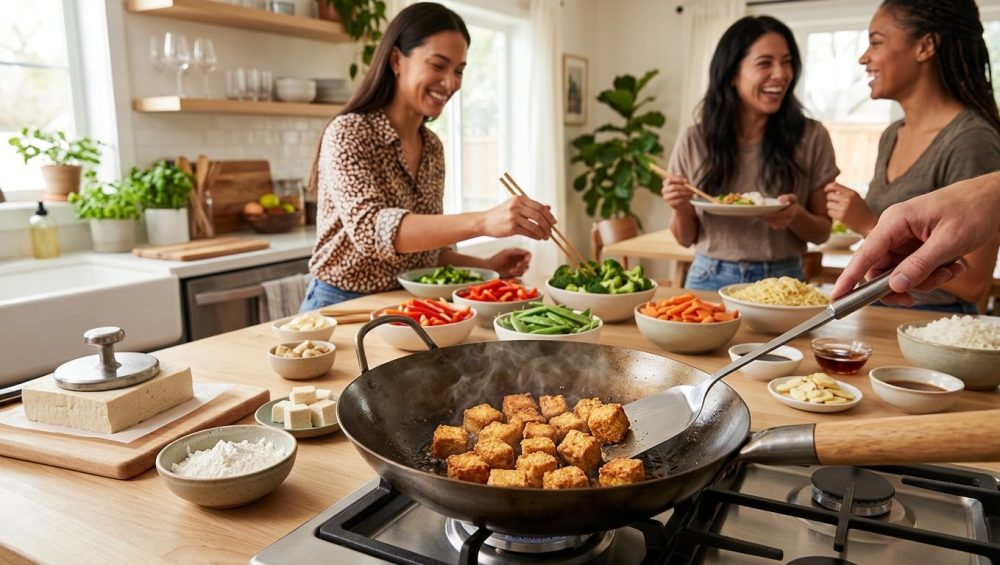
You set up your kitchen island, dining table, or countertop with a sprawling, colorful array of beautifully prepped, raw ingredients organized in separate aesthetic bowls. We are talking a massive bowl of your flawlessly crispy tofu (pre-fried and resting on a wire rack to maintain its crunch), an assortment of vibrant, crisp vegetables, different types of noodles or grains, and a lineup of killer homemade sauces. When it is time to eat, you hand everyone a bowl and let them customize their own perfect meal.
Interactive Wok Stations
If you have a portable induction burner, or just a spacious stovetop, you can act as the short-order cook for the evening. Because all the ingredients are pre-sliced and your carbon steel wok is screaming hot, rapidly flash-frying each person’s custom bowl takes maybe three minutes flat. It is dinner and a show.
Alternatively, if your friends are culinary enthusiasts or just naturally curious, hand them the spatula! Teach them the water drop test. Let them experience the absolute joy of the Leidenfrost effect for themselves. Cooking together breaks down social barriers, gives people something fun to do with their hands, and creates a wonderfully chaotic, joyful atmosphere.
Prep and Staging for the Ultimate Stir-Fry Bar
The entire success of this dinner party hinges on your mise en place—a pretentious French culinary term that simply means “having all your stuff chopped, organized, and ready to go before you turn on the stove.”
The Veggie Matrix and Knife Work
A great stir-fry is all about a diverse, harmonious mix of textures, colors, and flavors. You want the sharp crunch of snow peas, the vibrant sweetness of red bell peppers, the deep earthiness of shiitake mushrooms, and the tender bite of baby bok choy.
This is where efficient vegetable prep will save you hours of frustration. Use a sharply honed knife to cut everything into uniform sizes so that they cook at the exact same rate in the wok. For hard, dense vegetables like carrots or broccoli stems, slice them on a bias (a sharp diagonal angle). This technique exposes significantly more surface area to the blistering heat of the pan, helping them cook faster while retaining their essential, satisfying crunch. Keep watery vegetables like zucchini separate, as they cook in seconds and can quickly turn a stir-fry into a soggy soup if added too early.
The Foolproof Master Sauce Formula
Please, for the love of all things culinary, do not buy bottled, pre-made stir-fry sauces from the supermarket. They are almost universally packed with cheap corn syrup, artificial thickeners, and disappointment. Making a world-class stir-fry sauce from scratch takes exactly two minutes and relies on a simple balancing act of salty, sweet, sour, and umami.
Here is the only master sauce ratio you will ever need to memorize:
- 4 parts salty (high-quality soy sauce or gluten-free tamari)
- 2 parts sweet (maple syrup, brown sugar, or mirin)
- 1 part sour (rice wine vinegar or fresh lime juice)
- 1 part aromatics (freshly minced garlic, grated ginger, and a dash of toasted sesame oil)
Whisk this liquid gold together in a large mason jar. If you want a thicker, glossier sauce that beautifully clings to your ingredients like they do at your favorite takeout spot, whisk in a teaspoon of cornstarch to create a slurry before adding it to the hot wok.
And a quick pro-tip for the host: If you are offering a meat option alongside the tofu for your omnivore friends, you need to know how baking soda transforms tough cuts of beef or chicken. Simply toss the thinly sliced meat in a tiny pinch of baking soda thirty minutes before cooking. This process, known as velveting, alters the pH of the meat, preventing the proteins from seizing up in the hot pan and ensuring the meat stays incredibly tender.
Noodle and Grain Management
The final pillar of your stir-fry bar is the carbohydrate base. If you are serving noodles—whether they are chewy udon, delicate rice noodles, or earthy soba—cook them right before your guests arrive. The moment they are al dente, drain them and rinse them thoroughly under cold running water. This stops the cooking process immediately and washes away the excess surface starch that causes noodles to stick together. Toss them in a few drops of toasted sesame oil to keep them loose, separate, and ready for the wok.
If you are serving rice, remember the golden rule of fried rice: fresh rice is the enemy. You want day-old, chilled rice. Sitting in the refrigerator allows the rice grains to dehydrate and firm up, meaning they will separate beautifully in the wok and absorb your delicious sauce without turning into a gummy, unmanageable mush.
Finally, do not forget the garnishes. The art of food plating matters, even in a highly casual, build-your-own setting. Set out small, attractive bowls filled with toasted sesame seeds, thinly sliced scallions, fresh cilantro leaves, crushed roasted peanuts, and a high-quality, spicy chili crisp. These finishing touches add vital layers of texture, heat, and visual appeal to the final dish.
The Final Sear
Cooking beautiful, plant-based meals at home does not have to be a stressful, tear-inducing battle against sticking proteins and toxic, peeling pans. By taking the time to understand the high moisture content of your ingredients, respecting the thermal dynamics of your cookware, and utilizing the undeniable science of the Leidenfrost effect, you can effortlessly achieve professional, restaurant-quality results in your very own kitchen.
Tofu is no longer your stubborn enemy; it is a versatile, protein-packed blank canvas just waiting for your culinary artistry. So put down the takeout menu, ditch the peeling Teflon, fire up that carbon steel pan, and invite your favorite people over for a mindful, interactive stir-fry night they won’t soon forget. You have the knowledge, you have the technique, and you absolutely have got this. Now get cooking!