Listen up. We need to have a serious, brutally honest conversation about your kebabs. You know exactly what I am talking about: those sad, chalky, overcooked chunks of chicken and gray, chewy beef that require a massive gallon of tzatziki sauce just to swallow. Far too many home cooks treat their skewers like a dumping ground for random fridge leftovers, arbitrarily stabbing whatever they find onto a stick, throwing it over an inferno, and simply hoping for the best. And frankly, it shows.
But here is the incredibly good news: you do not need a culinary degree, a commercial kitchen, or a Michelin star to fix this. I firmly believe that absolutely anyone can create mind-blowing, restaurant-quality food at home, provided you stop repeating the same easily avoidable mistakes. If you are tired of serving dry, uninspired, and frankly embarrassing meat to your friends on the weekends, you are in the exact right place.
We are going to break down the exhaustive meat fiber science, the delicate balance of enzymatic marinades, and the strict rules of thermal spacing required to achieve perfectly juicy skewered meats every single time. More importantly, we are going to outline a stress-free blueprint for hosting a slow, interactive tabletop grilling experience that will have your dinner party guests begging for your culinary secrets. Grab a glass of wine, take out your notepad, and let’s get to work.
The Anatomy of a Tragedy: Why Your Skewers Are Currently Drying Out
Before we can build the perfect kebab, we have to diagnose exactly why your current skewers taste like seasoned sawdust. It comes down to a fundamental misunderstanding of thermodynamics and moisture retention.
The Thermodynamics of Tiny Meat Chunks
When you take a beautiful, expensive cut of meat and chop it into tiny, uniform one-inch cubes, you are fundamentally altering its thermodynamic profile. Specifically, you are drastically increasing the surface-to-volume ratio. In simple terms, you are exposing a massive amount of surface area to direct, aggressive heat while leaving very little internal volume to hold onto moisture.
Animal muscle is surrounded by tough connective tissues that, when cooked properly through low and slow methods, turn into rich, lubricating gelatin sacs that make the meat taste incredibly tender. However, when you blast tiny chunks of meat over a 450°F grill without proper preparation, the water molecules inside the muscle fibers rapidly reach their boiling point. Those protective gelatin bags literally burst, and the internal moisture violently evaporates into the atmosphere. The result? You are left with a dry, fibrous husk of protein.
Furthermore, this rapid moisture loss actively prevents the meat from browning properly. When meat hits the grill, you want to trigger the Maillard reaction—a complex chemical reaction between amino acids and reducing sugars that gives browned food its distinctive, savory flavor. But this reaction only happens at high temperatures (typically above 285°F). If your meat is leaking water, the thermal energy from the grill is entirely consumed by evaporating that liquid—a process known as evaporative cooling. The temperature of the meat’s surface cannot rise above the boiling point of water (212°F) until the moisture is completely gone. By the time the water finally evaporates and the Maillard reaction begins to form a crust, the inside of your tiny meat cube is hopelessly overcooked.
The “Mixed Grill” Fallacy
We need to immediately address the most offensive rookie mistake in the history of backyard barbecues: the “mixed grill” skewer. Stop threading cherry tomatoes, raw red onions, bell peppers, and raw chicken onto the exact same stick. Just stop it. This is a culinary crime born from aesthetically pleasing magazine photos, not actual cooking science.
Vegetables possess a massive water content—a standard zucchini is about 94% water, while a piece of beef is roughly 70% water. When you put a 94% water vegetable directly next to a dense protein on a metal stick, you are creating a localized steam bath. As the vegetable violently releases its water over the heat, it physically steams the adjacent meat, completely inhibiting the Maillard reaction.
More importantly, they cook at entirely different rates. If you wait for your chicken to reach a food-safe internal temperature of 165°F, your cherry tomatoes will have exploded into a charred, bitter paste. Conversely, if you pull the skewer off the heat when the bell peppers are perfectly crisp-tender, you are serving raw poultry to your guests. By cooking them on completely separate sticks, you can easily save those sad veggies from total incineration and ensure your proteins are cooked to absolute perfection.
The Science of the Marinade: Enzymatic Magic vs. Acidic Disaster
Most people think a marinade is just a bath of cheap, store-bought Italian dressing. Wrong. The liquid you soak your meat in is a highly active chemical tenderizing agent, and if you misuse it, you will ruin your dinner before you even fire up the grill.
Acidic Marinades: The Ceviche Effect
Acidic marinades rely on low-pH ingredients like lemon juice, distilled vinegar, and wine. Acids work by denaturing the proteins on the surface of the meat. When exposed to an acidic environment, the tightly wound protein coils unwind and form a loose, tangled mesh. While this sounds great for tenderizing, there is a massive catch.
If you leave your meat in a highly acidic marinade for too long, those unwound proteins will eventually tighten back up, aggressively squeezing out all the trapped water. It literally “cooks” the outside of the meat without any heat—a chemical phenomenon commonly known as the ceviche effect. If your chicken cubes look opaque, white, and stringy around the edges before they even hit the grill grates, congratulations: you have already over-marinated them into a mushy, dry disaster.
Enzymatic Marinades: Your Secret Weapon
If you want truly tender, melt-in-your-mouth kebabs, you need to harness the power of biological enzymes. Enzymatic marinades utilize specific proteases found naturally in tropical fruits and rhizomes: bromelain in pineapple, papain in papaya, actinidin in kiwi, and zingibain in fresh ginger. These enzymes act like microscopic biological scissors; they actively chop up and break down tough muscle fiber proteins, collagen, and elastin.
But this is a dangerous double-edged sword. These enzymes work incredibly fast. Bromelain is so effective at breaking down proteins that workers in pineapple canneries historically had to wear thick gloves to prevent the fruit juice from digesting their own fingerprints. If you leave your beef chunks in a fresh pineapple puree overnight, you will wake up to a powdery, digested meat sludge that is physically impossible to thread onto a skewer. When using highly active enzymes, you must strictly limit your marinating time to 30 to 60 minutes.
For a much safer and more forgiving approach, turn to dairy. A yogurt-based marinade is the ultimate cheat code for Middle Eastern and Mediterranean kebabs. Yogurt contains lactic acid, which is far gentler than the harsh citric acid found in lemons. It slowly and gently tenderizes the meat over several hours, while the thick dairy fats coat the exterior, protecting the chunks from the intense heat of the grill and promoting a beautiful, caramelized crust.
The Non-Negotiable Power of Salt
Whether you use an acidic, enzymatic, or dairy-based foundation, the true workhorse of any marinade is salt. Through the process of osmosis, salt initially draws moisture out of the meat and onto the surface. As the salt dissolves in this extracted liquid, the heavily seasoned brine is reabsorbed back into the muscle fibers, pulling the flavors deep into the center of the cube.
Furthermore, the chloride ions in the salt bind to the muscle filaments, increasing their net negative charge and causing the proteins to repel each other. This creates microscopic gaps that trap water. The magic of dry brining is real, even for cubed meat, because it physically alters the protein structures so they hold onto their natural juices during the violent cooking process. If you skip the salt, you are just giving your meat a superficial, flavored surface bath.
The Architecture of the Perfect Skewer: Spacing and Construction
How you physically thread your meat onto the skewer dictates exactly how it will cook. It is an architectural science, and you need to pay attention to the details.
The Shape of the Cut
Stop cutting your meat into perfectly symmetrical cubes. A cube has sharp, distinct corners, and those thin corners will inevitably burn to a crisp before the dense center is cooked through. Instead, aim for slightly flattened, rectangular strips that you can thread onto the skewer in a folded “ribbon” or “accordion” style. This creates a uniform thickness across the entire skewer, ensuring that the meat cooks evenly across its entire surface area without burning the edges.
Thermal Spacing: The Goldilocks Zone
Do you pack your meat tightly, or do you space it out? The answer depends entirely on the protein you are cooking.
If you space your meat chunks a quarter-inch apart, you allow the radiant heat of the grill to circulate entirely around all six sides of the piece. This maximizes the surface area exposed to the fire, resulting in a rapid, aggressive sear and a heavy crust. This spacing method is ideal for fast-cooking, delicate proteins like shrimp, scallops, or beef tenderloin that need a quick sear without overcooking the center.
However, if you are working with cuts that require a slightly longer cooking time to properly render their internal fat and break down connective tissues—like chicken thighs or lamb shoulder—you should pack the pieces tightly together, shoulder-to-shoulder. By compressing the meat, you effectively eliminate the gaps, transforming a dozen small pieces into one large, solid thermal mass. The grill will only heavily sear the exterior of this newly formed “log,” while the interior pieces insulate each other, cooking gently and slowly through internal conduction. This drastically reduces the risk of the meat drying out over a longer cook time.
The Alternating Fat Method and Flavor Sequencing
If you are using a notoriously lean cut of meat (which I strongly advise against for kebabs, as fat equals moisture), you must manually introduce external fat. The alternating fat method involves threading a small piece of high-quality animal fat—such as a square of thick-cut bacon, pancetta, or traditional lamb tail fat—between every two pieces of lean meat. As the skewer cooks over the heat, the fat renders and slowly bastes the lean muscle fibers, providing a continuous, self-lubricating coating of moisture and flavor.
You also need to think critically about what goes onto the outside of the meat. So many home cooks ruin their beautiful kebabs by coating them in freshly minced garlic right before grilling. Garlic burns incredibly rapidly over an open flame, turning acrid, black, and horribly bitter. You must learn to stop adding garlic first if it is going to be subjected to 500°F direct heat. Instead, use dehydrated garlic powder in your spice rub, or better yet, brush a fresh garlic-and-herb butter onto the kebabs during the final thirty seconds of cooking.
A Brutally Honest Word on Skewer Hardware (No Toxic Junk Allowed)
I have absolutely zero patience for cheap, gimmicky kitchenware, and I will not tolerate toxic gear in my kitchen. The tools you use matter just as much as the ingredients.
The Mystery Metal and Peeling Non-Stick Epidemic
If you are currently buying flimsy, wire-thin skewers coated in a mystery “non-stick” black paint from a discount bin, throw them in the trash immediately. I mean it. That cheap, synthetic coating is absolutely not designed to withstand the searing 500°F direct heat of a charcoal grill. It will rapidly degrade, blister, and peel directly into your food. Actively banishing toxic kitchen gear from your home is the very first step to taking your cooking seriously. You deserve better, and your guests certainly deserve better than eating flaking Teflon with their dinner.
Furthermore, cheap plated steel or aluminum alloys can leach metallic off-flavors into your food when exposed to highly acidic marinades. Always demand high-quality materials.
What You Should Actually Buy: Flat Stainless Steel vs. Bamboo
When it comes to skewers, you have two acceptable, safe options, and they each serve a completely different thermodynamic purpose.
Flat Stainless Steel Skewers: High-quality, food-grade stainless steel is an excellent thermal conductor. When you place a metal skewer over a hot grill, the metal absorbs the heat from the fire and carries it directly into the center of the meat. This means your kebabs are literally cooking from the inside out simultaneously as the outside sears. This is incredibly advantageous for dense, thick cuts of beef, pork, or lamb that need to cook through efficiently. Furthermore, you must buy flat metal blades, not round ones. A flat blade physically prevents the meat from spinning freely when you try to flip the skewer, giving you total, precision control over the sear.
Natural Bamboo Skewers: Bamboo is a natural thermal insulator. It does not conduct heat, meaning the meat will only cook from the outside in, much like it would in a standard frying pan. This slower, gentler internal cooking process is perfect for delicate proteins like seafood or small, fragile vegetables. However, because bamboo is organic wood, it will incinerate over an open flame. You absolutely must soak bamboo skewers in cold water for a minimum of 30 to 60 minutes before threading your food to prevent them from catching fire.
Bamboo is also the vastly superior choice if you are hosting a massive party with children running around; unlike a scorching hot steel handle that retains thermal energy, the exposed end of a bamboo skewer remains relatively cool to the touch, preventing nasty accidental burns.
The Blueprint for a Mindful, Communal Kebab Night
Now that we have rigorously covered the rigid science of meat preparation, let us talk about the art of hosting. A dinner party should not end with you sweating profusely over a smoky grill in the dark backyard while your friends eat without you inside. That defeats the entire purpose of gathering.
Prepping the Zones (Mise en Place for the People)
The secret to a stress-free gathering is relentless, unapologetic preparation. You can easily eliminate kitchen chaos by adopting the strict French culinary concept of mise en place (everything in its place). Do all of your slicing, dicing, and marinating the day before. Set up dedicated, beautiful stations in your kitchen or dining room: a raw protein zone, a vibrant vegetable zone, and a sauce zone.
If you are serving interactive components like sliced apples for a sweet finish or raw potatoes for grilling, a quick dip in acidulated water (cold water mixed with a splash of lemon juice) is absolutely essential for preventing enzymatic browning before your guests arrive. When the doorbell finally rings, your only job should be pouring the wine and enjoying the company, not frantically chopping raw chicken on a messy counter.
Tabletop Grilling: The Interactive Experience
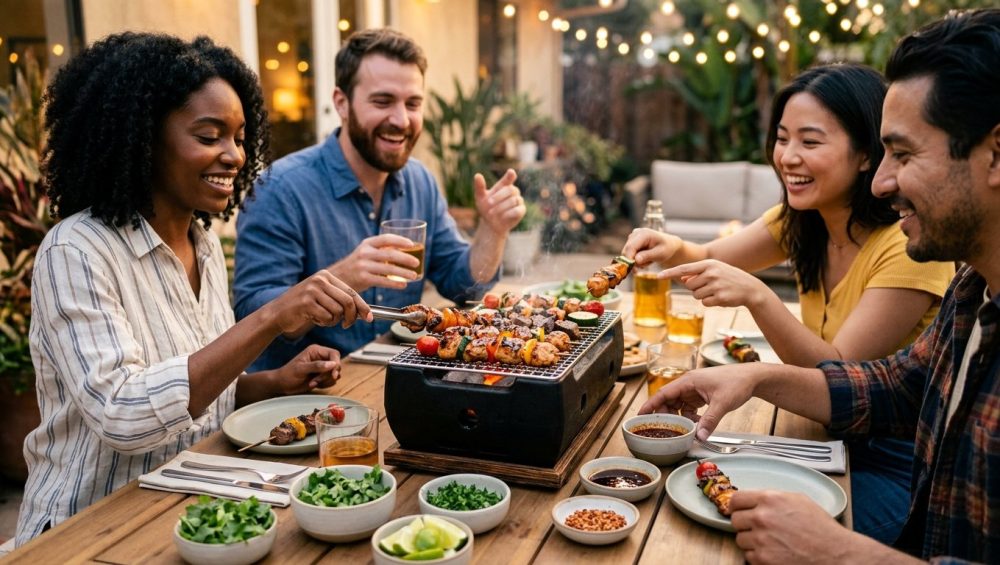
The ultimate way to host a memorable kebab night is to literally bring the fire to the table. By investing in a safe, high-quality tabletop grill (such as a traditional Japanese konro grill utilizing clean-burning, smokeless binchotan charcoal, or a modern electric indoor grill), you transform a standard, boring dinner into an engaging, communal event. Actively breaking your takeout habit becomes effortless when the act of cooking your own food is this wildly entertaining.
Place the gorgeous platters of perfectly marinated, pre-threaded skewers directly in the center of the table. Let your guests take charge of their own meals. Not only does this take all the cooking pressure off you as the host, but it also allows everyone to cook their meat exactly to their own specific liking.
The Importance of High-Impact Sauces
A kebab without a sauce is just naked meat on a stick. Because the meat is cooked quickly over high heat, you need contrasting, high-impact condiments to elevate the meal and provide necessary acidity and moisture.
- Tzatziki: The undisputed classic. Use freshly grated cucumber (heavily salted and squeezed completely dry in a kitchen towel to prevent watering down the sauce), full-fat Greek yogurt, minced garlic, lemon juice, and fresh dill.
- Chimichurri: A sharp, highly acidic counterpoint to rich, fatty meats like beef or lamb. Combine finely chopped parsley, oregano, garlic, red wine vinegar, and the best olive oil you own.
- Toum: A traditional Lebanese garlic emulsion that is essentially a fluffy, pungent cloud of pure garlic, neutral oil, and lemon juice. It pairs flawlessly with chicken.
Flavor Pacing and Holding Temperatures
A truly elegant evening is not a frantic race to the finish line. The beauty of mindful dinner gatherings lies in the slow, deliberate pacing. Encourage your guests to grill just one or two small skewers at a time, savoring the distinct flavors and enjoying the conversation, rather than piling a massive, cold mountain of food onto their plates all at once.
If you prefer to do the grilling yourself in the kitchen in larger batches, you must fiercely manage your holding temperatures. Do not pile freshly grilled, hot kebabs onto a freezing cold ceramic platter; the sudden, drastic drop in temperature will instantly congeal the rendered animal fats and completely ruin the mouthfeel and texture. Always pre-warm your serving platters in a low oven (around 200°F) before plating the meat.
You also need to abandon the guesswork and rely on proper beginner kitchen tools, specifically a high-quality, fast-reading digital meat thermometer. Stop guessing when the meat is done by slicing it open and letting all the precious juices bleed out onto the cutting board. Chicken must hit 165°F to be safe, while beef and lamb are beautifully juicy and medium-rare at 145°F.
Finally, if you are cooking indoors on a flat stainless steel griddle instead of open grill grates, ensure you preheat the pan properly. By utilizing the Leidenfrost effect—where a water droplet dances and glides across the hot surface—you create a natural vapor barrier that prevents your delicate marinades from sticking to the metal and violently tearing the meat.
The Final Sear
At the end of the day, grilling the perfect kebab is an exercise in respecting the ingredients. It is about deeply understanding how thermal energy transfers, how acidic and enzymatic marinades interact with tough muscle fibers, and how to control your cooking environment. You do not need to be a professional chef to pull this off. You just need a little bit of applied science, the right high-quality equipment, and the confidence to execute the plan. So ditch the toxic coated pans, throw away the bottled supermarket dressing, and start treating your skewers with the immense respect they deserve. Your friends, your palate, and your sanity will thank you. Now get out there and light the fire.