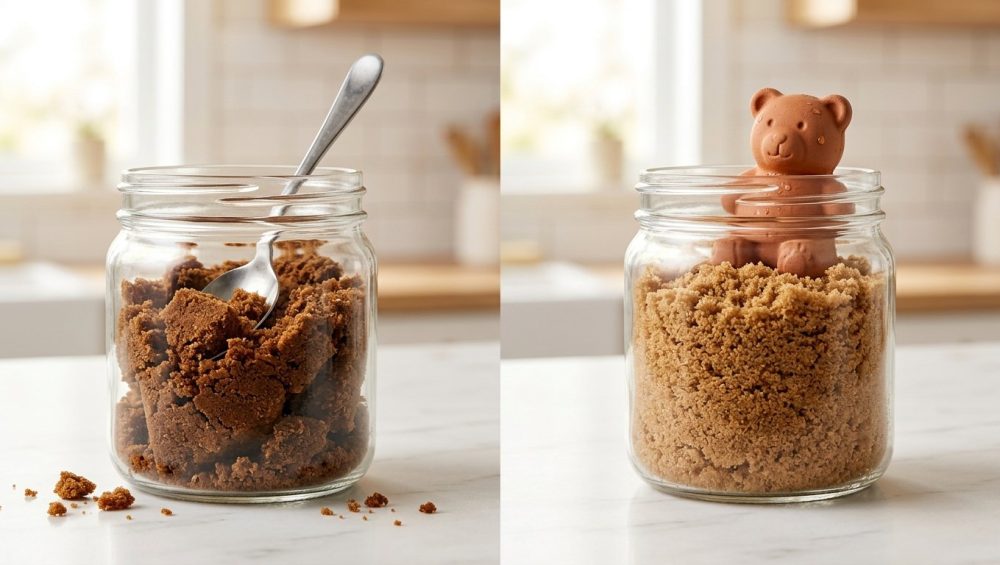
Picture this: It is a beautiful Saturday afternoon. You have finally carved out a few precious hours from your chaotic, meeting-filled week to tackle that elaborate, highly demanding chocolate chip cookie recipe you have been eyeing. You have your mise en place ready, the butter is perfectly softened to room temperature, the vanilla extract is measured, and you reach into the dark recesses of the pantry for the dark brown sugar. But instead of scooping out soft, sandy, molasses-rich sweetness, your measuring spoon violently ricochets off a solid, impenetrable brick. You are now the proud owner of a sweet, caramelized weapon.
We have all been there, aggressively chiseling away at a hardened lump of sugar with a butter knife, wondering where it all went wrong and contemplating if a jackhammer is a standard kitchen utensil. As everyday home cooks, we already have enough on our plates without having to perform impromptu geological excavations in our own pantries. You absolutely do not need a culinary degree to bake like a professional, but you do need to stop wasting your valuable weekend time fighting your ingredients. While there are plenty of essential tools every beginner needs to succeed in a modern kitchen, sometimes the most brilliant solutions are the cheapest and the oldest.
I am here to tell you that you can permanently solve this maddening issue with a five-dollar piece of baked mud. Yes, you read that correctly. An unglazed terra cotta disk—often marketed simply as a brown sugar saver—is the ultimate, scientifically sound method for keeping your brown sugar perfectly soft and scoopable for months, or even years, on end. It is one of those rare essential kitchen tools for beginners that actually lives up to the hype, requiring virtually zero effort while delivering flawless, reliable results.
In this definitive masterclass, we are going to completely demystify the science of why your sugar turns into a fossil, why all those old wives’ tales and viral internet hacks are actively ruining your baking, and exactly how to harness the ancient power of porous clay to maintain your pantry staples. Grab a cup of coffee, and let us fix this annoying problem once and for all.
The Anatomy of a Brick: The Science of Why Brown Sugar Hardens
To defeat the enemy, you must first understand the enemy. Let us strip away the pretentious chef-speak and look at the actual food science and chemistry behind your pantry disaster.
Brown sugar is not simply white granulated sugar that decided to get a tan. From a chemical and structural perspective, food scientists classify brown sugar as a “metastable colloidal suspension”. Standard white sugar is highly refined, consisting of 99.95% pure sucrose with virtually zero moisture. Brown sugar, on the other hand, is composed of roughly 96% to 97% sucrose and 3% to 5% molasses. That thin, viscous film of molasses coating each individual crystal is the magic ingredient; it provides the rich, complex caramel flavor, the slightly acidic pH, and the crucial 3% to 4% moisture content that makes your baked goods incredibly chewy and delicious. In fact, if you have ever wondered why your cookies spread into thin, sad, crispy puddles on the baking sheet, a lack of proper moisture in your brown sugar is often a major contributing factor.
The fundamental problem arises from the concept of water activity (often abbreviated in food science as aw). The moisture trapped within the molasses film is highly volatile. When brown sugar is exposed to air—even the ambient air circulating inside a loosely rolled plastic bag—that moisture begins to evaporate into the surrounding environment. As the water leaves the molasses, the remaining syrup becomes supersaturated and eventually crystallizes.
When this crystallization occurs, the microscopic sucrose particles bind and interlock together into a rigid, cement-like matrix. This is not spoilage. Your sugar has not gone bad, and it has not technically expired. It is simply undergoing a physical reorganization driven by thermodynamic equilibrium. The crystals are literally gluing themselves together. And the harder the clump becomes, the more complete the intercrystalline bridging is. This is exactly why you cannot just smash the brick with a rolling pin and expect it to behave normally in your mixing bowl; the moisture is completely gone, the structural integrity of the ingredient has been compromised, and without that moisture, your delicate pastry recipes will inevitably suffer.
The Faux Fixes: Why the Old Hacks Are Actually Ruining Your Sugar
If you run a quick internet search on how to soften brown sugar, you will be bombarded with a slew of “clever” kitchen hacks and viral shortcuts. As someone who strictly values efficiency and hates ruining good food, I am begging you to ignore them. Most of these shortcuts are either temporary illusions, detrimental to the flavor of your food, or outright food safety hazards. Let us break down exactly why these popular methods fail.
The Microwave Method
The most common advice floating around the internet is to blast the hard sugar in the microwave alongside a damp paper towel or inside a sealed plastic bag. Yes, this will temporarily soften the brick, allowing you to scoop what you need for that exact moment. But it is a massive trap. Microwaving creates aggressive, uneven thermal hotspots that can easily exceed the glass transition point of dried molasses (around 140°F or 60°C) and even approach the caramelization onset of sucrose (320°F or 160°C). This extreme heat causes the volatile aromatic compounds in the molasses to degrade, permanently altering the flavor profile of the sugar. Worse, it forces rapid, violent evaporation. The moment that heated sugar cools down on your counter, it will harden into an even more impenetrable, brittle state. It is a vicious cycle that degrades the quality of your ingredient every single time you do it.
The Slice of Bread
Your grandmother probably told you to throw a slice of cheap white bread into the sugar container. While the hygroscopic sugar will indeed steal the moisture from the bread and soften up, you are now introducing foreign organic matter into a relatively sterile environment. Bread contains yeast, gluten, and rapid-forming mold spores. Leaving a slice of bread in a sealed container of sugar for months is a fantastic way to cultivate a horrifying science experiment. Furthermore, picking dried, crusty breadcrumbs out of your measuring cup is infuriating, much like the realization that you should stop scooping your flour directly with a measuring cup—it is just bad, messy kitchen practice that leads to inaccurate baking.
The Apple Wedge
Similar to the bread trick, tossing an apple slice into your sugar jar is a recipe for absolute disaster. The apple will inevitably rot. As it decays, it will transfer a weird, fermented, fruity flavor to your molasses. More importantly, the localized moisture from the wet fruit is so high that it will actually dissolve the sugar immediately touching it, creating a puddle of sticky, unusable syrup while the rest of the jar remains a hard, frustrating brick.
If you are tired of your baking sheets keep warping and your ingredients constantly failing you, it is time to stop relying on desperate, poorly-thought-out band-aid fixes and start using the right tools for the job.
Enter the Terra Cotta Disk: The Ancient Science of Clay
This brings us to the hero of our story: the terra cotta brown sugar saver. This is not a new, gimmicky modern invention. The use of unglazed earthenware for food preservation, water cooling, and moisture regulation dates back thousands of years. But how exactly does a hard, seemingly dry piece of clay keep your sugar soft and pliable?
It all comes down to the microscopic structure and the thermal processing of the material. Terra cotta (which translates to “baked earth” in Italian) is a type of porous, sedimentary clay. When manufactured specifically for moisture control and culinary use, these disks are fired in a kiln at a very specific, relatively low temperature—typically around what potters refer to as “Cone 06,” which is approximately 1828°F (998°C).
Firing the clay at this specific low temperature is crucial because it prevents the silica within the clay body from fully vitrifying (turning into a solid, non-porous glass). The result is a structurally solid disk that boasts an incredible porosity rate of 8% to 12%. This means the clay is essentially a rigid, microscopic sponge. When you soak the disk in water, capillary action draws the liquid deep into the intricate, microscopic network of pores. The disk absorbs a significant amount of water without feeling “wet” or dripping on the surface.
Once you place this water-loaded disk into a sealed container of brown sugar, simple physics takes over. The dry environment of the sugar naturally pulls the moisture out of the clay. The terra cotta acts as a slow-release humidifier, gently and consistently emitting water vapor until the relative humidity inside the jar reaches a perfect equilibrium. The dehydrated molasses reabsorbs this ambient moisture, the crystallized bonds gently dissolve, and your sugar returns to its glorious, sandy state. It is a brilliant, completely natural, and entirely passive system that requires no electricity, no maintenance, and no toxic chemicals.
The “No-Go” Rule on Toxic Gear: Choosing Safe Terra Cotta
Before you run out to your backyard, smash a cheap gardening flower pot with a hammer, and toss a jagged shard into your pantry, we need to have a very serious conversation about kitchen safety and material sourcing. I have a very strict, non-negotiable rule when it comes to the equipment I review and recommend: I absolutely despise cheap, toxic kitchenware. We are actively banishing toxic kitchen gear from our homes, and that philosophy extends to mystery clays.
You must understand that not all terra cotta is created equal. Commercial gardening pots, decorative earthenware, and industrial bricks are made from raw sedimentary materials that act as nature’s trace element library. Because of their geological origins, these cheap clays are heavily contaminated with what the industry refers to as “soluble salts”—a mixture of iron, calcium, magnesium, sodium, and potassium. Even more concerning, cheap imported decorative clays can contain heavy metals like lead and cadmium. Furthermore, industrial brick and tile manufacturers often add toxic chemical compounds like barium carbonate to their clay mixtures to precipitate out those salts during the drying process and prevent white streaks. You absolutely do not want barium carbonate or lead leeching into the sugar you are going to feed your family.
When purchasing a brown sugar saver, you must ensure that it is explicitly marketed for culinary use. It must be made from 100% food-safe, unglazed terra cotta. Glazed pieces are entirely useless because the glass coating seals the pores, preventing any moisture absorption or release. Look for reputable kitchenware brands that clearly state their clay is tested, food-grade, and free of heavy metals. These culinary disks usually cost between $4 and $8. It is a minuscule investment for a lifetime of safety, convenience, and peace of mind. Do not compromise on this rule.
The Step-by-Step Masterclass: How to Prep, Use, and Maintain Your Sugar Saver
Using a terra cotta disk is incredibly simple, but there is a specific, non-negotiable protocol you must follow to get professional-level results. If you do this wrong, you will end up with a localized puddle of syrup or a moldy disaster.
Step 1: The Initial Soak
Take your food-safe terra cotta disk and submerge it completely in a small bowl of clean, warm water. Let it soak for 15 to 20 minutes. You might actually see tiny bubbles escaping from the clay as the water displaces the air inside the microscopic pores. Do not leave it soaking for days on end; 20 minutes is more than enough time for the clay to reach its maximum absorption capacity.
Step 2: The Crucial Pat-Down
This is the step most people mess up, and it is the most important part of the process. Once the soaking time is up, remove the disk from the water and aggressively dry the outside of it with a clean dish towel or a heavy-duty paper towel. The surface of the disk should look matte and feel completely dry to the touch. It should feel significantly heavier due to the absorbed internal water, but it should never be dripping, glistening, or visibly wet on the exterior. If you put a wet disk directly into your sugar, the sugar will instantly melt, stick to the clay, and create a localized syrup puddle.
Step 3: The Burial
Take your dried-off, water-loaded disk and bury it right in the middle of your hardened brown sugar. If your sugar is a solid, impenetrable brick that you cannot even dig into, just rest the disk directly on top of the clump and tightly seal the container.
Step 4: The Waiting Game
Patience is key here. The moisture transfer is a slow, passive, thermodynamic process. It will take anywhere from 12 to 24 hours for the disk to fully release its moisture and break down the crystallized molasses bonds. Just like learning that throwing away sad veggies is a massive waste when you can easily revive them in a shock of ice water, tossing hard sugar is a waste when a little time and clay can resurrect it. Check on it the next day, and you will be amazed to find that your rock-hard sugar has miraculously transformed back into a soft, scoopable, perfectly hydrated masterpiece.
Storage Synergy: Pairing the Disk with the Right Container
Here is a brutal truth that many home cooks fail to realize: your brand new, perfectly soaked terra cotta disk is going to be completely useless if you drop it into a flimsy, unsealed container. The disk works by creating a microclimate of balanced humidity. If your container leaks air, the disk will simply release all its moisture into your entire kitchen, dry out in two days, and leave your sugar just as hard as before.
First and foremost, throw away the thin plastic bag or the cardboard box the sugar came in. Cardboard absorbs ambient moisture rapidly, offers zero protection against pests, and is generally unacceptable for long-term pantry storage.
You need a truly airtight environment. Glass mason jars are fantastic, but only if they have a rubber or silicone dual-gasket lid. Standard metal flat lids do not provide a sufficient hermetic seal for long-term moisture retention. If you prefer plastic because it is lighter and shatterproof, ensure it is made from High-Density Polyethylene (HDPE resin #2) or a high-quality, impact-resistant acrylic canister equipped with a locking silicone gasket.
A tight seal is critical because if the relative humidity inside the container fluctuates wildly, it defeats the entire purpose of the disk. In fact, prolonged storage at humidity levels above 60% without a proper seal can permit osmophilic yeasts (like Zygosaccharomyces rouxii) to metabolize the trace organics in the molasses, producing off-flavors and ruining the sugar.
Furthermore, make sure your container is impeccably clean before transferring your sugar. If you are constantly wondering why your plastic containers stay greasy even after washing, it is because microscopic fat molecules cling stubbornly to porous plastics, which can eventually turn rancid and taint the flavor of your sugar. Wash your storage bins thoroughly with hot water and a strong grease-cutting dish soap, and ensure they are 100% bone-dry before adding the sugar and the terra cotta disk.
The Deep Clean: Resetting Your Terra Cotta
Your terra cotta disk is endlessly reusable. It does not expire, and unless you drop it on a tile floor and shatter it, it will outlive most of your kitchen appliances. However, it does require a bit of maintenance to keep performing at its peak. Over the course of six to eight months of continuous use, the microscopic pores of the clay will slowly become clogged with microscopic sugar dust and sticky molasses residue. When this happens, the disk will lose its ability to absorb and release water efficiently.
When you notice that your sugar is starting to harden faster than usual, or the disk doesn’t seem to hold water like it used to, it is time for a deep clean and reset.
The Golden Rule of Cleaning Terra Cotta
NEVER, under any circumstances, use dish soap to clean your terra cotta disk.
Because the clay is highly porous, it will aggressively absorb the chemical surfactants and artificial fragrances in your dish soap. The next time you soak the disk and put it in your sugar, it will release those soap molecules right into your ingredients, and your cookies will taste like a lavender-scented bubble bath. It is a surefire way to ruin a batch of expensive baked goods. If you want to know how to fix your food when disaster strikes, the best method is absolute prevention—keep soap far away from unglazed clay.
The Boiling Method
To properly clean the disk, simply place it in a small saucepan of plain, rapidly boiling water for 10 to 15 minutes. The rolling boiling water will naturally dissolve and flush out the trapped sugars, clear the microscopic pores, and completely sanitize the clay from any potential bacteria or yeast spores. Carefully remove the disk with tongs and let it cool on a wire rack.
If you want to store the disk away in a drawer for a while without using it, you must ensure it is completely bone-dry to prevent mold growth. Place the boiled, clean disk on a baking sheet in a 250°F (121°C) oven for 30 minutes. This gentle heat will evaporate every last drop of internal moisture, resetting the clay to its factory original state and ensuring it is safe for long-term storage.
Beyond Brown Sugar: Unexpected Uses for the Terra Cotta Disk
Once you realize the sheer power and versatility of this tiny clay gadget, you will want to buy a half-dozen of them to scatter throughout your pantry. Because the terra cotta disk is simply a master regulator of humidity, its utility extends far beyond the brown sugar jar.
The Humidifier (Wet Use)
Any pantry item that relies on residual moisture to maintain its texture can benefit from a soaked disk.
- Marshmallows: Keep a soaked and patted-dry disk in your marshmallow bag or airtight container to prevent them from turning into chalky, chewy bullets.
- Dried Fruit: Raisins, apricots, and dates that have become unpleasantly tough and leathery can be revived to their plump, sticky glory with a disk.
- Baked Goods: Toss a disk into your cookie jar or bread box. The gentle release of moisture will dramatically extend the shelf life and chewiness of your homemade treats, preventing them from going stale prematurely.
The Desiccant (Dry Use)
This is where the real magic happens. If you take a bone-dry, baked terra cotta disk and place it into a container, it does the exact opposite—it aggressively absorbs ambient moisture from the air.
Have you ever gone to season a simmering dish only to find that your spices turn into hard bricks? Spices clump because they absorb humidity from your kitchen environment, especially if you store them near the stove. Drop a clean, completely dry terra cotta disk into your bulk spice jars, your salt cellar, or your container of homemade crackers. The thirsty clay will act as a powerful, natural desiccant, pulling moisture out of the air and keeping your dry goods perfectly powdery and crisp. It is a brilliant, reusable, food-safe alternative to those little toxic silica gel packets that come in commercial packaging.
Conclusion: Work Smarter, Not Harder
Cooking and baking should be a joy, a creative outlet, and a way to unwind. It should not be a stressful battle against your own ingredients. As weekend home cooks, we do not have the luxury of commercial prep teams or industrial, climate-controlled pantries. We have to be resourceful. We have to rigorously value our time. And most importantly, we have to rely on smart, scientifically sound solutions that actually work in the real world.
The terra cotta brown sugar saver is the absolute epitome of smart kitchen management. For less than the cost of a fancy coffee shop latte, you can permanently eliminate the frustration of rock-hard sugar, protect the integrity and flavor profile of your recipes, and reclaim your precious time. It requires no electricity, no maintenance beyond an occasional boiling, and it relies on a natural, highly effective physical mechanism that has been utilized by clever humans for millennia.
So, do yourself a massive favor today. Ditch the microwave hacks, keep the bread out of your sugar jar, and invest in a food-safe piece of clay. Pair it with a high-quality airtight container, follow the soaking protocol, and never chisel away at a sugar brick again. Your weekend baking projects, your sanity, and your perfectly chewy chocolate chip cookies will thank you. Now get out of here, go prep your pantry, and let us get back to making incredible food.