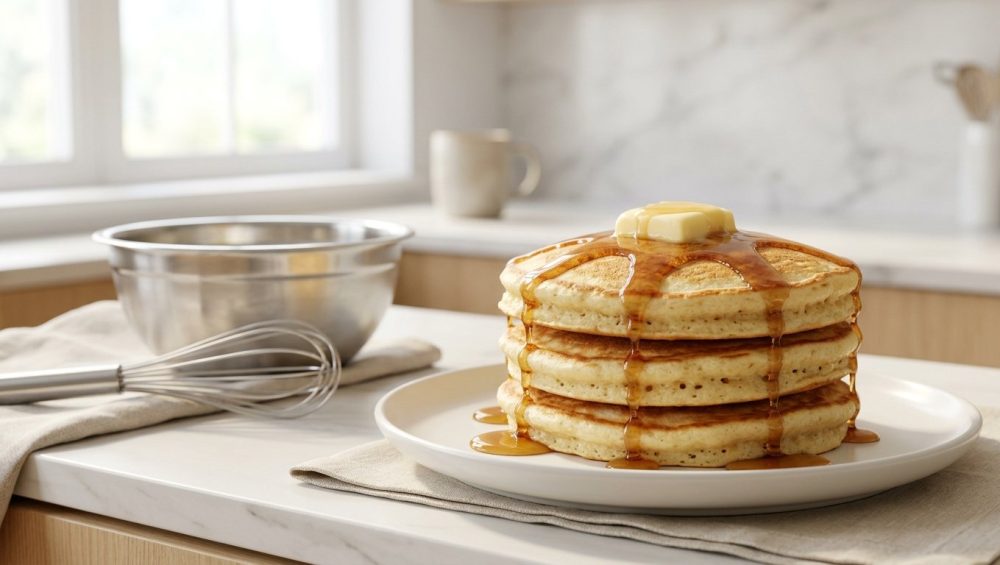
Listen, I know exactly what your Sunday morning looks like. You wake up with the best of intentions, pour yourself a cup of coffee, and decide that today is the day you are finally going to make diner-quality, mile-high flapjacks from scratch. You pull out the mixing bowl, crack some eggs, measure out your milk, and dump in the dry ingredients. But then, a primal, chaotic instinct takes over. You spot a dry, ugly lump of unmixed flour floating in your batter, and you absolutely panic.
You grab your wire whisk, and you begin to beat that batter like it owes you money. You stir, you whip, you agitate, and you aggressively scrape the sides of the bowl until the mixture is as flawlessly smooth as a fresh jar of interior house paint. You stare down at your perfectly homogenous creation with a profound sense of accomplishment.
And then? You ladle it into your skillet, and instead of rising into a glorious, fluffy cloud of breakfast perfection, the batter just sits there. It cooks into a dense, rubbery, chewy disc that requires a steak knife to cut through. Congratulations, my friend. You have just made a very sweet, very sad pita bread.
Put down the whisk, and back away slowly.
As your resident culinary realist, I am here to tell you that your relentless perfectionism is the exact thing ruining your breakfast. In the highly scientific world of pancake batter, visual imperfection is actually the secret to textural perfection. Those dry, powdery, ugly little flour lumps you have been so aggressively trying to eradicate? They are the absolute key to achieving a melt-in-your-mouth crumb.
Today, we are going to dive incredibly deep into the fascinating, wildly counterintuitive science of gluten development, chemical leaveners, and thermodynamic batter resting. We are going to fix your flapjacks once and for all, and it is going to cost you absolutely zero dollars. In fact, by doing less work, you are going to save precious time. Grab your coffee, pull up a stool, and let’s get into the chemistry of the breakfast table.
The Science of Pancake Batter: What Actually Happens When You Mix Flour and Water
Baking is not an abstract art form where you can just throw things into a bowl and hope the universe rewards your enthusiasm; it is edible chemistry. When you blindly mix ingredients together, you are ignoring the microscopic war zone you have just created. To truly understand why your pancakes are turning out tough, chewy, and dense, we have to zoom way in on the primary structural component of your batter: wheat flour.
The Anatomy of a Wheat Kernel and Flour Proteins
Whether you are using a fancy artisanal bag or the cheapest generic brand on the supermarket shelf, standard all-purpose flour—the foundational backbone of the American pancake—contains two highly important storage proteins: gliadin and glutenin.
Sitting perfectly dry in your pantry, these proteins are completely inert. They are essentially microscopic, tightly coiled-up springs just minding their own business. Gliadin is the protein responsible for extensibility, which is the ability of a dough or batter to stretch out without tearing. Glutenin, on the other hand, provides elasticity, which is the ability of that dough to snap back into its original shape after being stretched.
As long as the flour remains dry, these proteins do absolutely nothing. But the exact second you introduce a liquid—like milk, water, or buttermilk—you ignite an irreversible chemical chain reaction.
Hydration: The Spark That Ignites the Gluten Network
When water molecules interact with flour, they hydrate the gliadin and glutenin proteins. This hydration causes those tightly coiled microscopic springs to unfurl, reach out, bond together, and form a brand-new, highly complex, viscoelastic protein network known as gluten.
Gluten is an absolute miracle of nature. It is the incredibly strong webbing that gives a crusty sourdough baguette its magnificent chew, allows a Neapolitan pizza crust to be tossed high in the air without ripping, and gives artisan bagels their dense, satisfying pull.
But here is the brutal, undeniable truth: you absolutely do not want your pancakes to have the texture of a New York bagel.
In a pancake, you want the absolute minimum amount of gluten development required to hold the batter together so it doesn’t instantly disintegrate when you try to flip it. You want profound tenderness. You want a crumb that yields instantly to the side of a fork without putting up a fight. The moment your wet ingredients touch your dry ingredients, the gluten clock starts ticking, and you are officially in a race against time.
Mechanical Action: Why Your Whisk is a Weapon of Mass Destruction
Hydration alone will slowly form gluten over time, but mechanical action—stirring, whisking, beating, and folding—acts as a massive hyper-accelerator. When you drag a whisk through your pancake batter, you are physically forcing the newly hydrated gliadin and glutenin molecules to crash into each other, align in parallel structures, and form incredibly strong, cross-linked disulfide bonds.
Food scientists and rheologists have actually measured this phenomenon in laboratory settings. In controlled trials using specialized rheometers to test batter elasticity, researchers found that mechanical agitation and cumulative shear force drastically increase the elastic modulus of a batter. In fact, batter mixed for 90 seconds developed over three times more elastic resistance than batter mixed gently for a fraction of the time.
Every single time your whisk completes a revolution in that mixing bowl, you are building a stronger, tighter, more restrictive web of gluten. If you overmix, that web becomes so tight and rubbery that the chemical leaveners in your batter cannot push through it. The expanding gases get trapped in a microscopic straightjacket. The result? A dense, chewy, flat pancake that fights back when you chew it. This is exactly why you must stop scooping your flour blindly, measure your ingredients accurately, and treat your batter with the gentle respect it deserves.
The Lumpy Batter Manifesto: Why Imperfection is the Secret to Perfection
So, if stirring creates tough, miserable pancakes, what exactly are you supposed to do when you see dry flour in your bowl? You are supposed to leave the lumps. I know it goes against every single culinary instinct you possess. You want a smooth, luxurious, homogenous mixture. But for the sake of your breakfast, you have to let it go.
The Thermodynamics of a Flour Lump in a Hot Pan
When you gently fold your wet and dry ingredients together just until the major flour streaks disappear, your batter is going to look incredibly lumpy, ugly, and unfinished. There will be pea-sized pockets of dry, powdery flour suspended throughout the liquid. This is exactly what you want.
You might be terrified that you are going to serve your family a pancake with a pocket of raw, chalky flour hidden inside. But you are forgetting about the magic of thermodynamics and the cooking process itself. When you ladle that lumpy batter onto a hot, buttered griddle, the moisture in the surrounding liquid batter rapidly heats up and turns into steam. That intense steam penetrates the dry flour lumps, instantly hydrating and cooking them from the inside out.
By the time the pancake is golden brown and ready to flip, those terrifying lumps have completely vanished. They dissolve into the matrix of the cake, leaving behind nothing but a perfectly tender, melt-in-your-mouth crumb structure.
Viscosity and Gas Retention: Holding onto the Fluff
Leaving the batter lumpy also serves a vital, secondary mechanical purpose: it maintains a high viscosity. A thicker, lumpier batter is structurally much better at trapping the carbon dioxide bubbles produced by your baking powder.
If you whisk the batter until it is perfectly smooth and liquid, you are not only developing tough gluten, but you are also physically popping all of the delicate air bubbles that your leavening agents have worked so hard to create. You are literally beating the air out of your own breakfast. A lumpy batter acts like a thick, protective blanket, holding onto those precious pockets of gas so they can expand in the heat of the pan.
The Rest Period: Let the Flour Hydrate Itself
The ultimate secret weapon of the lumpy batter method is time. Once you have barely combined your ingredients, you need to step away from the kitchen counter. Giving your bowl a 10 to 15-minute rest period allows the flour to passively hydrate on its own.
During this time, the starches slowly absorb the liquid, the lumps naturally soften without any destructive mechanical agitation, and the minimal gluten network you did accidentally create has a chance to relax. I cannot stress enough how important it is to allow the batter to rest if you are serious about achieving that sky-high, pillowy, diner-style rise.
The Chemical Leaveners: Baking Soda, Baking Powder, and the Race Against Time
You cannot master the pancake without mastering the chemical leaveners. These are the microscopic engines that pump your batter full of gas, creating the lift and fluffiness that separates a proper American pancake from a flat, dense French crepe.
Single-Acting vs. Double-Acting Baking Powder
Most modern home cooks use baking powder, but very few understand how it actually functions. Baking powder is a complete, self-contained chemical leavening system. It contains both a base (sodium bicarbonate) and a weak powdered acid, separated by a moisture-absorbing buffer like cornstarch to prevent premature reactions in the tin.
In 1843, a pharmacist named Alfred Bird invented single-acting baking powder, which released all of its carbon dioxide the exact second it touched liquid. This meant you had to frantically race to get your batter into the pan before the bubbles completely escaped into the air. Thankfully, in the 1860s, Eben Norton Horsford revolutionized the baking world by developing double-acting baking powder.
The Acid-Base Reaction in Your Skillet
When you look at a modern container of double-acting baking powder, that word “double” refers to a highly specific, two-stage chemical reaction.
Stage One: When the powder meets the wet ingredients in your mixing bowl, the first acid reacts with the sodium bicarbonate at room temperature. This initial cold reaction releases roughly 15% of the total available carbon dioxide. This creates tiny nucleation sites—microscopic bubbles—distributed evenly throughout the batter.
Stage Two: The remaining 85% of the leavening power is strictly heat-activated. It doesn’t trigger until the batter hits the hot skillet and reaches an internal temperature of around 104°F to 110°F (40°C to 43°C). As the heat from the stove penetrates the batter, the second acid reacts, violently expanding those initial nucleation sites and causing the pancake to puff up beautifully.
If you aggressively whisk your batter trying to smooth out the lumps, you utterly destroy the delicate nucleation sites formed in Stage One. You pop the bubbles, leaving the massive Stage Two reaction with no existing air pockets to expand into. The gas just tunnels out and escapes, leaving you with a flat, depressing disc.
The Real Cost of Toxic Cookware on Your Breakfast (And Your Health)
Now that we have completely fixed your batter chemistry, we need to have a very serious, brutally honest conversation about what you are actually cooking these pancakes on. As your Sassy Sous-Chef, I have a strict, uncompromising “No-Go” rule on toxic kitchen gear. If you are pouring your beautifully rested, perfectly lumpy batter onto a cheap, scratched, peeling non-stick pan you bought at a discount store in 2014, you are committing a culinary crime and actively poisoning yourself and your family.
The PFAS Problem: Why Your Peeling Non-Stick is Ruining Everything
Let’s talk about the massive, toxic elephant in the kitchen: PFAS (per- and polyfluoroalkyl substances). These are a class of over 15,000 synthetic “forever chemicals” traditionally used to create the slick polytetrafluoroethylene (PTFE) coating on traditional non-stick pans, most commonly known by the brand name Teflon.
These chemicals do not break down in the environment, and they certainly do not break down in your body. Recent studies and health data through 2025 and 2026 have continually linked chronic PFAS exposure to severe health risks, including liver damage, kidney cancer, thyroid disease, and immune system suppression.
When a cheap non-stick pan is heated above 500°F (which happens significantly faster than you think when preheating a pan on a modern gas or induction stove), the chemical coating begins to degrade on a molecular level, releasing invisible, highly toxic fumes. Inhaling these fumes causes a well-documented medical condition known as “polymer fume fever” or the “Teflon flu,” cases of which saw a notable, alarming spike in recent years.
Worse, when these cheap, mass-produced pans inevitably get scratched by a metal fork or spatula, they begin flaking microplastics and toxic compounds directly into your food. Those cheap pans lose their non-stick slip incredibly fast anyway, turning your morning breakfast routine into a sticky, toxic nightmare.
Upgrading to Safe, High-Performance Alternatives
The cookware industry has spent millions of dollars lobbying against state-level PFAS bans, trying desperately to convince you that their new chemical formulations are perfectly safe. Do not fall for the corporate spin. You absolutely do not need PFAS to cook a perfect, slide-off-the-pan pancake.
If you want to cook like a pro and protect your long-term health, you need to invest in durable, non-toxic materials with high thermal mass. A well-seasoned carbon steel skillet or a classic, heavy cast-iron griddle will quite literally outlive you. Once properly polymerized with a natural oil seasoning, they are just as non-stick as any toxic Teflon pan on the market.
If you absolutely demand modern convenience and zero maintenance, high-quality, genuinely PFAS-free ceramic coated pans (which use sand-derived sol-gel technology) are a fantastic, safe alternative. Stop buying cheap, disposable pans that you have to throw in a landfill every two years. Buy good gear once, and treat it right.
A Masterclass in the “Muffin Method” for Pancake Batter
Alright, we understand the cellular science, we know how the leaveners work, and we have safe, heavy-duty cookware ready to go. Now, let’s execute. To achieve the lightest, fluffiest pancakes mathematically possible, you must employ what culinary professionals call the “Muffin Method.” This is a foundational technique designed specifically to minimize gluten development in quick breads and batters.
Step 1: The Dry Whisk
First, combine all of your dry ingredients—flour, sugar, salt, baking powder, and baking soda—in a large mixing bowl. This is the only time in the entire process where you are allowed to wield your whisk aggressively. Whisking the dry ingredients thoroughly aerates the flour and ensures the chemical leaveners are evenly distributed.
For absolute precision and to guarantee you aren’t accidentally packing too much flour into your measuring cups, using a digital kitchen scale to measure your ingredients in grams rather than volume will drastically improve your consistency.
Step 2: The Wet Emulsion
In a separate, smaller bowl, combine all of your wet ingredients. This usually includes your milk (or buttermilk), eggs, vanilla extract, and melted butter or oil. Whisk this wet mixture aggressively until the eggs are completely broken down and beaten, and the fat is fully emulsified into the liquid. You want this mixture to be perfectly homogenous because once it hits the dry flour, your mixing time is strictly limited.
Step 3: The Fold (The 10-Second Rule)
Make a well in the center of your dry ingredients and pour the wet emulsion directly into it. Now, put the wire whisk away. Grab a silicone spatula or a specialized Danish dough whisk—which is engineered specifically with thick wire loops to cut through heavy batters without over-agitating the gluten—and gently fold the ingredients together.
Drag your tool around the outside edge of the bowl and cut straight through the center. Do this no more than ten to twelve times. The entire folding process should take you about ten seconds. The exact moment you no longer see massive, dry streaks of unmixed flour, stop moving your hands. The batter will be lumpy. It will look messy. It will look wrong. Leave it alone. Let it rest on the counter for 15 minutes, and then proceed to your preheated griddle.
Diagnosing Your Pancake Failures: A Troubleshooting Guide
Even with the perfect batter chemistry, the stovetop griddle can be a chaotic, unforgiving place. If things go sideways during the cook, here is how you diagnose the symptoms and cure the disease.
The Pucks (Too Dense)
If your pancakes resemble heavy hockey pucks rather than fluffy clouds, one of two things happened: you either ignored my advice and overmixed the batter, developing a tough gluten network, or your baking powder is dead. Baking powder loses its potency over time, especially in humid kitchens. To test it, drop a spoonful into a cup of hot water; if it doesn’t violently fizz and bubble immediately, throw the entire tin in the trash and buy a fresh one.
The Crepes (Too Thin and Spreading)
If your batter runs all over the pan like water the second you pour it, your hydration ratio is way off. This usually happens when people measure flour by scooping it directly out of the bag with a measuring cup, which compresses the flour and leads to wildly inaccurate amounts. Alternatively, you skipped the 15-minute rest period, so the starches never had a chance to absorb the liquid and thicken the viscosity of the batter.
The Burned-but-Raw-Inside Dilemma
This is easily the most common heat management failure in the amateur home kitchen. If your pancakes burn on the outside but remain raw, runny, and gooey in the center, your pan is simply too hot. Pancakes require a patient, medium-low, sustained heat. If the pan is scorching hot, the sugars in the batter will rapidly caramelize and burn via the Maillard reaction long before the internal temperature of the batter can rise enough to set the crumb. Turn the dial down, let the pan temperature stabilize, and be patient.
The Metallic Tasting Flapjack
If you take a bite of your pancake and it tastes strangely bitter, soapy, or metallic, you have an issue with your chemical leaveners. This almost always means you used too much baking soda (which is highly alkaline) without enough acidic ingredients (like buttermilk or lemon juice) in the batter to neutralize it. Always measure your leaveners precisely.
Advanced Moves: Elevating the Weekend Flapjack
Once you have mastered the basic lumpy batter technique and banished your overmixing habits, you can start incorporating advanced culinary tricks to elevate your breakfast from “good” to “mind-blowing.”
Buttermilk and Lactic Acid Magic
Swapping standard whole milk for real, cultured buttermilk is the single greatest flavor and texture upgrade you can make to a pancake recipe. Buttermilk contains lactic acid, which actively tenderizes the gluten network even further. More importantly, that acid reacts explosively with the alkaline baking soda in your dry mix, creating a massive, instant surge of carbon dioxide for an unparalleled, airy rise.
The Egg White Whip
If you want to be an absolute overachiever on a Sunday morning, separate your eggs. Mix the yolks into your wet ingredients as usual. Then, whip the egg whites in a separate, impeccably clean glass or metal bowl until they form stiff, glossy peaks. After you have gently folded your wet and dry ingredients together (leaving the lumps, obviously!), carefully fold the whipped egg whites into the rested batter right before cooking. This introduces millions of tiny, mechanically trapped air bubbles that will give your pancakes an impossibly light, soufflé-like texture.
Fat Content: Butter vs. Oil in the Batter
Using melted butter in your batter provides incredible, rich flavor, but butter contains water and milk solids that can slightly toughen the final crumb. Substituting a neutral oil (like avocado or canola oil) actually coats the flour proteins much more effectively, actively inhibiting gluten formation and yielding an even more tender pancake. I personally prefer a 50/50 split: half melted butter for that classic diner flavor, and half neutral oil for maximum tenderness.
And please, for the love of all things culinary, when it comes time to flip your masterpiece, use a thin, flexible, stainless steel fish spatula. Trying to flip a delicate, airy pancake with a thick, clumsy plastic flipper will just smash the air right out of it. It’s absolutely crucial to have the right beginner kitchen tools if you want to master the art of cooking without losing your mind. Oh, and make sure you aren’t using cheap, degrading rubber tools that melt on the rim of the pan, resulting in silicone spatulas tasting like soap and ruining the flavor profile of your perfectly crafted breakfast.
Conclusion: Step Away from the Bowl
Cooking at home is not about possessing some innate, magical talent; it is about understanding the basic rules of chemistry and physics so you can manipulate them to your advantage. You do not need a fancy culinary degree to make phenomenal, restaurant-quality food in your own kitchen, but you do need to stop letting your anxiety dictate your whisking habits.
The next time you set out to make a stack of pancakes, I want you to embrace the mess. Accept the lumps. Protect your delicate nucleation sites, respect your flour’s gluten network, and banish those toxic, peeling, chemical-laden non-stick pans to the garbage where they belong. Step away from the mixing bowl, let the batter rest in peace, and watch as your pancakes rise into the fluffy, golden, tender masterpieces you truly deserve. Now go put on a fresh pot of coffee, put down the whisk, and let’s get cooking.