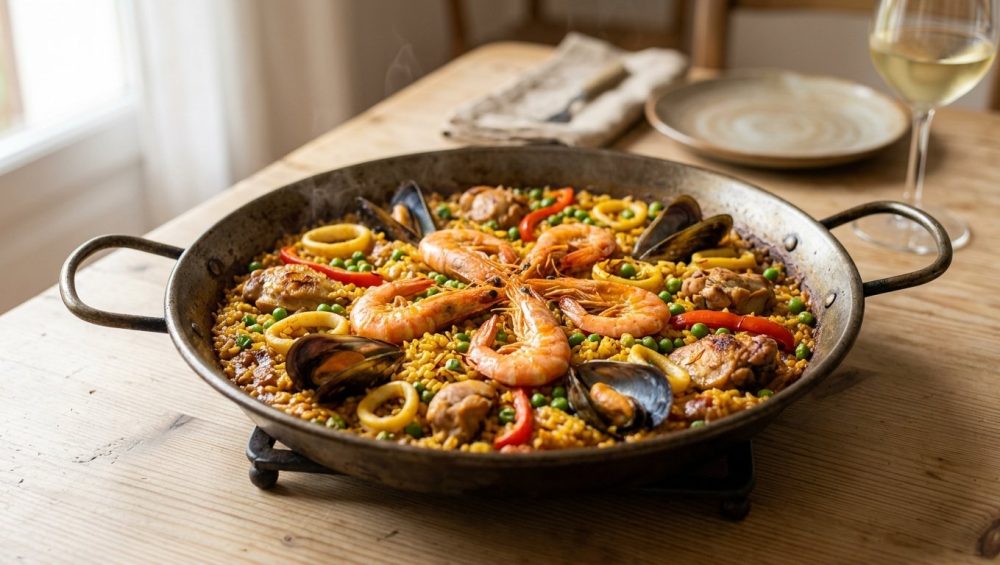
We have all been there. You get invited to a weekend dinner party by a well-meaning friend who proudly announces they are making paella. You arrive, grab a glass of Albariño, and gather around the kitchen island. The host dramatically carries a massive, steaming pan to the center of the table. You lean in, expecting a majestic, golden mosaic of distinct rice grains, perfectly seared seafood, and a caramelized crust.
Instead, you are greeted by a sad, monolithic slab of gummy seafood oatmeal. It is pasty. It is clumped together. It requires a spoon rather than a fork, and it tastes vaguely of disappointment and overcooked shrimp.
As a home cook who learned the hard way by setting off the smoke detector more times than I care to admit, I have zero patience for pretentious chef-speak. But I also refuse to accept mediocre food when the solution is entirely rooted in basic, accessible kitchen science. You do not need a culinary degree from San Sebastián to make mind-blowing paella. You simply need to understand the molecular behavior of starch, the thermal dynamics of your cookware, and the absolute necessity of leaving your food alone. Consider this your essential kitchen survival guide to rescuing the ultimate weekend centerpiece.
Paella is not risotto. It is not a casserole. It is a dry rice dish built on precise evaporation and undisturbed starch gelatinization. If you want to master a stress-free, communal meal that encourages slow, mindful grazing, you have to stop treating your paella pan like a witch’s cauldron. Let’s break down exactly why your paella rice gets mushy, and how to achieve that mythical, crispy socarrat every single time.
The Anatomy of Paella Rice: Bomba, Amylose, and the Starch Spectrum
If you attempt to make authentic paella with standard long-grain supermarket white rice, or worse, sticky sushi rice, you have already failed before you even turn on the stove. Rice is not a monolithic ingredient; it is a highly complex botanical seed with distinct genetic properties that dictate how it behaves under heat and hydration.
The Molecular Architecture of a Rice Grain
To understand why your rice turns into a gummy paste, we have to look at the two primary starch molecules found in the endosperm of the rice grain: amylose and amylopectin.
Amylose is a long, straight-chain polymer. Because of its linear structure, amylose molecules pack tightly together. Rice varieties with high amylose content (like Basmati or Jasmine) tend to cook up firm, dry, and separate. Amylopectin, on the other hand, is a highly branched molecule. It loves to grab onto water, swell up, and turn into a sticky, gelatinous glue. Short-grain Asian varieties used for sushi are packed with amylopectin, which is why they clump together beautifully for chopsticks.
If you have ever wondered why your rice is always mushy on a random weeknight, it usually comes down to a fundamental mismatch between the rice’s amylose-to-amylopectin ratio and the cooking method you applied.
Why Bomba Rice is Non-Negotiable
For paella, you need a rice that can absorb a massive amount of highly flavorful broth without rupturing its cellular walls and spilling its starchy guts into the pan. This is where Oryza sativa varieties native to the Valencia region of Spain—specifically Bomba and Sénia—become non-negotiable.
Bomba rice is a genetic marvel. It contains around 22% to 25% amylose. This specific ratio is the culinary sweet spot. It is high enough to resist turning to mush, but low enough to allow the surface of the grain to dry out and form a crust. Unlike long-grain rice that expands lengthwise when cooked, Bomba rice expands outward, expanding like an accordion. It can absorb up to three times its weight in liquid before bursting.
When you substitute generic “short-grain rice” (which usually hovers around 15% to 18% amylose) for Bomba, the grains simply cannot handle the prolonged simmering required to reduce the paella broth. The cellular walls collapse, the amylopectin leaches out, and you are left with a sticky, clumped disaster.
The Cardinal Sin: Why You Must Never Stir Paella
I am going to say this once, and I need you to internalize it: Put the wooden spoon down and step away from the stove.
The single biggest mistake everyday home cooks make when preparing paella is treating it like risotto. In a risotto, the goal is to create a rich, creamy, velvety emulsion. We achieve this through constant mechanical agitation. When you stir rice in hot liquid, the friction physically shears the outer layers of the swollen starch granules, releasing a flood of sticky amylopectin into the broth.
While I have actively advocated that you can stop stirring constantly when utilizing specific modern risotto techniques, the rule for paella is absolute: stirring is an unforgivable crime.
The Physics of Starch Gelatinization
When Bomba rice is introduced to your simmering broth, the starch granules begin to absorb water and swell like microscopic water balloons. Clinical studies on the physicochemical properties of rice show that starch gelatinization for these varieties occurs at temperatures between 57.9°C and 64.4°C.
As the temperature rises and the grains reach their maximum volume, they become incredibly fragile. If you drag a spoon through the pan at this critical stage, you will tear those swollen starch balloons apart. The released starch will immediately thicken the cooking liquid, turning your vibrant, saffron-infused broth into a heavy gravy.
This thickened liquid traps steam within the rice bed. Instead of the moisture evaporating cleanly into the air, it gets locked inside the gummy matrix. The rice at the bottom of the pan will burn before the rice at the top is fully cooked, destroying any chance of achieving a proper texture. Once the rice is evenly distributed in the pan, you must let the heat and the geometry of the cookware do the work.
Pan Geometry: Why Your Cookware Dictates Your Success
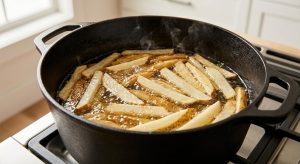
A true paella pan (a paellera) is not just a wide skillet; it is a purpose-built, precision-engineered evaporation tool. The word “paella” actually refers to the pan itself, not just the dish. If you try to make this dish in a standard Dutch oven or a deep saucepan, you are fighting a losing battle against physics.
The Evaporation Equation
The fundamental goal of paella is to cook the rice in a very thin layer—ideally no more than half an inch to an inch deep. Why? Because paella is a dry rice dish. The liquid must evaporate at the exact rate that the rice absorbs it.
Lab-validated tests on paella pan geometry dictate that a proper pan must have an aspect ratio (diameter-to-depth) of at least 5:1. Furthermore, the sidewalls should have a gentle 12° to 18° outward slope. This specific geometry maximizes the surface area exposed to the air, promoting rapid, uniform evaporation across the entire bed of rice. If you use a deep pot, the aspect ratio is ruined. The moisture cannot escape, and the rice effectively steams itself into a soggy, clumped mess.
The Superiority of Carbon Steel
Material matters immensely. Traditional paella pans are made of carbon steel, and for good reason. Understanding the thermodynamics of carbon steel is the key to mastering heat control. A high-quality carbon steel paella pan should have a base thickness between 1.2 mm and 1.8 mm.
This specific thickness provides enough thermal mass to distribute heat evenly across the wide base, but it is thin enough to remain highly responsive. When you lower the heat on your stove, the pan cools almost instantly. When you crank the heat to achieve the final sear, the pan responds without a massive thermal lag. Carbon steel also develops a natural, polymerized patina over time, which imparts a subtle, authentic flavor to the dish and provides a naturally non-stick surface.
The “No-Go” Rule on Toxic Gear
This brings me to a subject I am deeply passionate about. I am a relentless advocate for banishing toxic kitchen gear from your home. You absolutely must not cook paella in a cheap, thin aluminum pan coated in mystery non-stick Teflon.
Achieving the perfect paella requires a final blast of high heat to caramelize the bottom layer of rice. Subjecting a cheap, thin-gauge non-stick pan to temperatures exceeding 400°F is not just ruining your nonstick pans; it is actively dangerous. At sustained high heat, PTFE coatings degrade, off-gassing toxic trifluoroacetic acid (TFA) and flaking chemical polymers directly into your food. Furthermore, the slick surface of a non-stick pan actually prevents the rice from gripping the bottom, making it physically impossible to form the crust you are trying to achieve. Stick to carbon steel or high-quality stainless-clad cookware.
The Heat Map: Thermal Dynamics of the Perfect Cook
You do not need a picturesque open wood fire in a Valencian orange grove to make great paella (though it certainly helps with the smoky flavor). You can achieve professional-level results on a standard home gas or induction stove by rigorously managing your thermal zones. The cooking process is divided into three distinct thermal phases.
Phase 1: The Rolling Boil (100°C)
Before the rice even enters the pan, you must build your flavor base, known as the sofrito—a deeply caramelized reduction of tomatoes, garlic, paprika, and olive oil. Once the sofrito is dark and jammy, you add your liquid (usually a high-quality seafood or chicken broth infused with real saffron). You must bring this liquid to a vigorous, rolling boil at 100°C. The high heat emulsifies the fat from the olive oil and proteins into the water, creating a rich, homogenous cooking medium.
Phase 2: The Simmer (95°C – 98°C)
Sprinkle the Bomba rice evenly across the pan. Give it one gentle nudge with a spatula to ensure every grain is submerged, and then step back. Lower the heat to maintain a steady, gentle simmer. The temperature of the liquid will stabilize around 95°C to 98°C.
This is the gelatinization phase. The rice is slowly hydrating, absorbing the saffron-infused liquid, and swelling. If you are cooking on a standard home stove, your burner is likely much smaller than your paella pan. To prevent the center from burning while the edges remain raw, you must manually rotate the pan every few minutes, shifting it around the burner to distribute the heat evenly.
Phase 3: The Sizzle
As the 15-to-18-minute mark approaches, the liquid will drop below the surface of the rice. The grains will begin to look plump and distinct. The thermal dynamics of the pan are about to shift drastically, leading us to the most critical stage of the entire process.
The Holy Grail: Mastering the Socarrat
The socarrat is the caramelized, crispy, golden-brown crust of rice that forms at the very bottom of the paella pan. The term translates roughly to “singed” or “toasted” in the Valencian dialect of Catalan. It is the undisputed soul of the dish. A paella without socarrat is just a wide pan of boiled rice.
Let me be incredibly clear: socarrat is not burnt rice. It is the glorious result of precise chemical reactions, specifically the caramelization of starches and the Maillard reaction.
The Chemistry of the Crust
While there are many techniques for accelerating the Maillard reaction in everyday weeknight cooking, achieving it in a paella pan requires patience and nerve.
The Maillard reaction is a complex chemical interaction between amino acids (from your proteins and broth) and reducing sugars (from the rice starch) that produces deep, savory, complex flavor compounds. However, this reaction only occurs rapidly at temperatures above 120°C (250°F).
As long as there is liquid water at the bottom of the pan, the temperature cannot exceed 100°C (the boiling point of water). It is only when the very last drops of moisture evaporate that the temperature of the carbon steel pan spikes, shooting up to 120°C – 150°C. This sudden thermal spike triggers the Maillard reaction, frying the bottom layer of rice in the residual olive oil and rendered fats.
Sensory Cues: How to Listen to Your Rice
Because the socarrat forms at the bottom of an opaque bed of rice, you cannot rely on your eyes to tell you when it is done. You must use your ears and your nose.
- The Auditory Cue: During the simmering phase, the pan will make a wet, rhythmic “glug-glug-glug” sound as the water boils. When the water evaporates and the oil begins to fry the rice, the sound will abruptly shift to a sharp, dry, aggressive “crackle-snap-pop”.
- The Olfactory Cue: Lean over the pan and smell the steam. You are looking for the warm, intoxicating aroma of toasted nuts, baking bread, and caramelized sugar. The exact second you detect a sharp, acrid note of bitter smoke, cut the heat immediately. You have crossed the line from caramelization into carbonization.
- The Tactile Cue: If you gently poke the surface of the rice with the tip of a spoon (without stirring!), the bottom layer should feel solid and slightly resistant, gripping the carbon steel base.
The “Reposo”: The Science of Resting Your Paella
You have successfully navigated the thermal phases. You have achieved the auditory crackle of the socarrat. You pull the pan off the stove, and your guests cheer. Do you serve it immediately? Absolutely not.
You must let the paella rest (the reposo) off the heat, uncovered, for at least 5 to 10 minutes. Skipping this step is a rookie mistake that will instantly ruin the texture you just worked so hard to build.
When the rice is pulled fresh off the heat, the starch molecules are at their maximum state of thermal excitation. The grains are incredibly fragile and prone to mashing. Just as skipping the cooling phase is why your fried rice is always mushy, failing to rest your paella prevents the starches from setting.
During the reposo, a process called starch retrogradation begins. As the temperature drops slightly, the amylose network tightens and realigns. The grains firm up, transforming from fragile, swollen balloons into distinct, resilient morsels with a satisfying chew. Additionally, the brief resting period allows any trapped pockets of residual steam to gently evaporate, ensuring the final dish is dry, not wet.
The Secret to a Relaxed Tapas Gathering
Ultimately, the reason I champion paella for weekend culinary hobbyists is that it perfectly aligns with a stress-free hosting philosophy. Mastering the art of effortless hosting means choosing centerpiece dishes that do not require you to be chained to a cutting board while your guests mingle in the living room without you.
Paella is heavily front-loaded. You can chop your vegetables, prepare your proteins, and simmer your homemade seafood broth hours before anyone knocks on your door. Once the guests arrive, you simply fire up the stove, build the sofrito, and add the rice.
Because the golden rule of paella is that you are literally forbidden from touching it once the rice is in the pan, you are granted 20 glorious minutes of uninterrupted freedom. You can pour yourself a glass of Tempranillo, set out a board of Manchego cheese and Marcona almonds, and actually participate in the conversation. If you want to host a relaxed dinner party, delegating the heavy lifting to the passive physics of evaporation is the smartest move you can make.
When the reposo is finished, do not bother with pretentious, individualized plating in the kitchen. Carry the massive carbon steel pan directly to the center of the table. Hand everyone a wooden spoon or a fork, and let them serve themselves. The act of scraping the bottom of the pan to unearth the crunchy, deeply savory socarrat is inherently communal. It breaks down formalities, encourages slow grazing, and transforms a simple rice dish into an unforgettable shared experience.
You don’t need a culinary degree to pull this off. Respect the starch, invest in a proper carbon steel pan, manage your heat, and above all else—stop stirring the rice.