Picture this: It is a Tuesday night. You are exhausted from a long day of emails, meetings, and pretending to care about synergy, but you have somehow mustered the sheer willpower to cook a vibrant, beautiful stir-fry instead of ordering takeout for the third time this week. You have your mise en place ready. Your vegetables are perfectly chopped. Your protein is marinated. And then, you reach for the final boss of the cutting board: a knobby, stubborn, wildly irregular piece of fresh ginger.
You grab your trusty metal box grater or your microplane, determined to add that punchy, aromatic heat to your wok. You start grating. And grating. And grating. But instead of a beautiful, juicy paste, you are suddenly holding a wet, hairy, fibrous clump that looks suspiciously like something you would pull out of a shower drain. You scrape this stringy mess into your pan anyway, and later, while trying to enjoy your dinner, you end up flossing your teeth with a tough, unchewable ginger thread.
It is enough to make any home cook throw in the towel. But listen to me, weekend warriors: it is not your fault. You do not lack culinary skill, and you certainly don’t need a degree from Le Cordon Bleu to make restaurant-quality Asian dishes at home. You are simply using the wrong equipment for the job. Making rookie kitchen mistakes like attacking a highly fibrous rhizome with a standard cheese grater is exactly what separates a stressful, chaotic cooking experience from a joyful, efficient one.
Today, we are going to banish the stringy ginger curse forever. We are going to dive deep into the botanical anatomy of this frustrating root, ruthlessly analyze why your current kitchen tools are failing you, and introduce you to the elegant, scientifically perfect solution: the Japanese ceramic grater.
The Botanical Anatomy of Ginger: Why It Fights Back
To defeat the enemy, we must first understand the enemy. I have zero patience for pretentious chef-speak, but we need to talk briefly about plant biology so you can understand exactly why your ginger is bullying you.
First of all, ginger (Zingiber officinale) is not actually a root; it is a rhizome, which is a subterranean, horizontal plant stem that sends out roots and shoots from its nodes. Because it is a structural stem designed to survive underground, it is built like an absolute fortress.
If you were to take a cross-section of a ginger rhizome and look at it under a microscope, you would see a fascinating and slightly terrifying architectural marvel. The outer layer consists of the epidermis and cork, which act as a protective, hydrophobic shield. Inside this shield is the cortex, which is packed full of thin-walled parenchyma cells. These soft, fleshy, microscopic water balloons are the holy grail of flavor. They contain the plant’s starch grains and the yellow-brown oleoresin—the incredibly pungent essential oils and juices that make ginger taste like ginger.
However, nature did not just leave those precious flavor cells unprotected. Running longitudinally throughout the entire rhizome are vascular bundles (the xylem and phloem, which transport water and nutrients up and down the plant). These vascular bundles are heavily armored. They are capped by sclerenchyma fibers, which are thick, lignified, incredibly tough strings of cellulose.
When you bite into a piece of ginger and get a mouthful of woody threads, you are chewing on those sclerenchyma fibers. If you want to stop eating mushy veggies and enjoy a perfectly crisp, texturally flawless stir-fry, the absolute last thing you want is an unchewable, fibrous knot ruining the mouthfeel of your dish. Your primary goal as a cook is to extract the delicious juice and meat from the soft parenchyma cells while completely isolating and discarding the tough sclerenchyma fibers.
The Usual Suspects: Why Your Current Tools Are Ruining Your Food
Now that we know we are dealing with soft juice balloons trapped inside a matrix of tough cellulose strings, let’s look at the medieval torture devices you are currently using to prep your ginger, and why they are failing spectacularly.
The Metal Box Grater: A Crude Weapon
The standard four-sided metal box grater is a fantastic tool for shredding cheddar cheese or grating a zucchini. But for ginger? It is a blunt, clumsy instrument. The large, punched-out metal holes tear at the ginger haphazardly. Instead of separating the soft flesh from the tough fibers, the box grater just violently shreds the vascular bundles into shorter, thicker strings, leaving you with giant chunks of woody fiber mixed directly into your ginger paste. Furthermore, grating a small, knobby, slippery rhizome on a vertical metal tower is practically a guaranteed way to shave off your knuckles. We are trying to cook dinner, not perform triage.
The Microplane: The Right Tool for the Wrong Job
Look, I absolutely love my microplane. I use it constantly for zesting lemons, showering pasta in clouds of Parmigiano-Reggiano, and dusting desserts with fresh nutmeg. It is one of those beginner kitchen tools that everyone should own. But when it comes to ginger, the microplane is a total disaster.
Why? Because of the physics of its design. A microplane consists of hundreds of tiny, razor-sharp etched blades. When you drag ginger across these blades, they attempt to slice across the incredibly tough vascular bundles. But because the cellulose fibers are so strong, they don’t cleanly slice; instead, they instantly snag and wrap around the tiny blades, completely clogging the holes. After three swipes, your microplane is choked with wet hair. You end up with a microscopic amount of usable ginger paste on your cutting board, while the rest of the root is hopelessly wedged in the metal track, forcing you to bang the tool aggressively against the counter just to dislodge a fraction of a teaspoon of flavor.
The Chef’s Knife: A Tedious Bottleneck
You can, of course, mince ginger by hand. But let’s be honest: mincing fibrous ginger with a chef’s knife is tedious, annoying, and incredibly time-consuming. First, you have to slice it into thin planks, then julienne those planks into matchsticks, and then finely cross-hatch those matchsticks into a mince. Unless you possess the elite knife skills of a Michelin-starred sushi master, you are inevitably going to leave behind uneven, biting chunks of raw ginger that will overpower a single bite of your dish.
And let’s talk about blade sharpness. Just like weeping over onions because your dull blade is crushing the cell walls instead of slicing them cleanly, trying to force a subpar knife through lignified ginger fibers will just smash the root, leaving your cutting board covered in wasted, flavorful juice that should have ended up in your pan.
The Garlic Press: A Crime Against Aromatics
Please, I am begging you, stop trying to squeeze ginger through a garlic press. It physically pains me to even write about this. Just like how a garlic press makes food bitter by violently crushing garlic cell walls and extracting harsh sulfur compounds while leaving behind a dry puck of useless matter, doing this to ginger is a tragic waste of a beautiful ingredient. The press simply squeezes out a few watery drops of ginger juice, completely trapping the flavorful meat and the fibers inside the metal hopper. You waste 90% of the root for a fraction of the flavor.
Enter the Japanese Ceramic Grater: The Oroshigane Evolution
The solution to the stringy ginger problem is not a trendy new infomercial gadget; it is an evolution of an ancient, brilliant Japanese design. To find the answer, we have to look at the oroshigane (translating roughly to “grating metal”), a traditional Japanese kitchen tool engineered specifically to turn tough root vegetables into delicate, airy pastes.
Historically, professional Japanese chefs used graters made from wooden boards covered in rough sharkskin (specifically for fresh wasabi, to achieve an ultra-fine texture) or heavy, tin-coated copper plates with hundreds of tiny, hand-gouged spikes. These traditional copper oroshigane are incredibly effective, but they are also expensive, require meticulous maintenance to prevent tarnishing, and can be intimidating for the average home cook to care for.
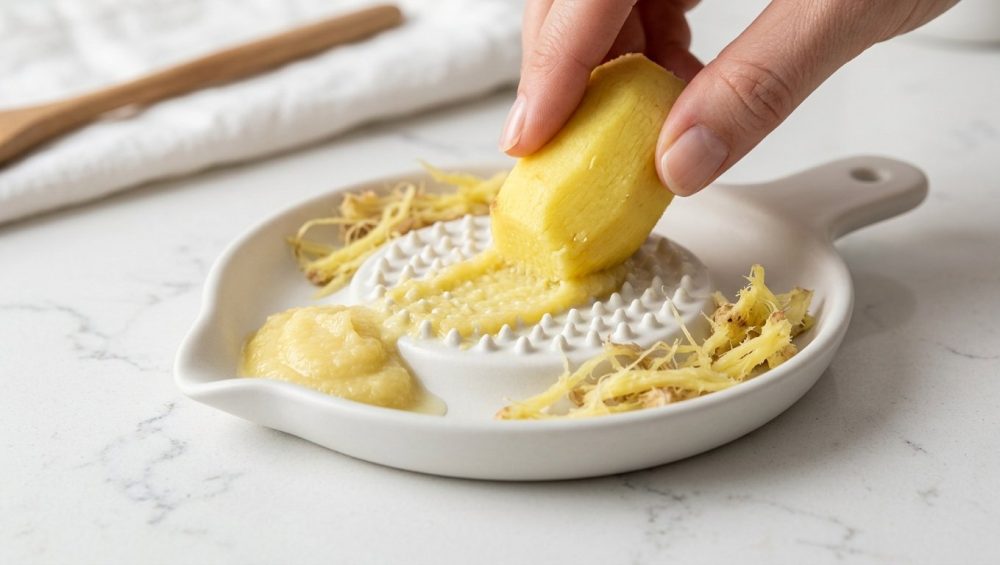
Thankfully, modern culinary science has stepped in to give us the ultimate upgrade: the Japanese ceramic ginger grater. Popularized by advanced ceramics manufacturers like Kyocera, this tool is the undisputed champion of aromatics. It is a simple, elegant, shallow ceramic dish featuring a raised center covered in rows of hard, unyielding ceramic teeth, surrounded by a deep catch-moat.
This unassuming little dish will eliminate kitchen chaos. It is specifically engineered to solve the exact botanical problem of the ginger rhizome, and it does so with flawless, elegant physics.
The Elegant Physics of Ceramic Teeth
Here is where the magic actually happens. When you take a knobby piece of ginger and rub it in a firm, circular motion over the raised ceramic teeth, you are not actually slicing the root at all. The ceramic nibs are not razor-sharp blades; they are dull but highly effective abrasive points. They act more like a highly efficient, targeted mortar and pestle.
Because the parenchyma cells (the juicy flesh holding the flavor) are soft and delicate, the friction of the ceramic teeth easily ruptures them, pulverizing the meat into a wet, highly aromatic puree.
But what about those tough sclerenchyma fibers? Because the ceramic teeth are not sharp blades, they cannot cut through the lignified cellulose strings. Instead, as you rub the root in a circle, the ceramic teeth aggressively push the soft flesh away while leaving the tough, stringy fibers completely intact. The fibers either stay attached to the main knob of ginger in your hand, or they roll up harmlessly into a neat little fibrous tumbleweed that sits on top of the ceramic teeth, ready to be plucked off and tossed into the compost bin.
The result? The surrounding moat fills up with 100% pure, perfectly smooth, fiber-free, restaurant-quality ginger paste. No strings. No hairy clumps. No bleeding knuckles. Just pure, unadulterated flavor.
The “No-Go” Rule: Why Material Matters
If you have read my articles before, you know I have a notoriously strict, uncompromising rule about kitchen equipment: if it is toxic, cheaply made, or features a peeling non-stick coating, it goes directly in the trash. I am fiercely dedicated to banishing toxic kitchen gear from the homes of weekend culinary hobbyists. You deserve tools that are safe, durable, and reliable.
When shopping for a ginger grater, do not be tempted to buy a cheap plastic knockoff. Plastic teeth will inevitably dull over time, rendering the tool useless. Even worse, the aggressive abrasive action of grating a tough root against cheap plastic will eventually shave microscopic plastic particles directly into your food.
Similarly, avoid “mystery metal” graters that you find in the discount bin. Acidic juices from ginger, garlic, and citrus can react with cheap metals, causing them to rust or leach a harsh, metallic tang into your pristine aromatics.
High-fired zirconia ceramic or high-quality porcelain is the absolute only way to go. Ceramic is completely non-reactive, meaning it will never alter the delicate flavor profile of your food. It is exceptionally hard—second only to diamonds in terms of material hardness—meaning those little ceramic teeth will literally never dull, even after decades of daily, aggressive use. It is food-safe, incredibly durable, and an absolute joy to work with. A good ceramic grater is a lifetime purchase that usually costs less than twenty dollars. There is simply no excuse not to own one.
The Chemistry of Flavor: Gingerol and Volatile Oils
Now, let’s get into the culinary science of why you actually want a pureed paste in the first place. Why go through the trouble of grating? Why not just toss a few chopped slices of ginger into your wok and call it a day?
It all comes down to biochemistry. Raw ginger contains a potent, bioactive chemical compound called gingerol (specifically 6-gingerol), which is responsible for that fiery, sweet, throaty burn that we love in fresh ginger. It also contains highly volatile essential oils and terpenes (like zingiberene and farnesene) that provide the bright, citrusy, floral aroma.
When you slice ginger with a knife, you are only rupturing the plant cells directly along the precise cut line. The vast majority of the gingerol and volatile oils remain safely trapped inside the intact cells of the chunks. When you throw those chunks into a pan, they will flavor the oil slightly, but you are leaving massive amounts of flavor locked away.
When you use a ceramic grater to pulverize the root into a fine paste, you are systematically obliterating millions of cell walls, exponentially increasing the surface area of the ingredient. This violent cellular disruption triggers an immediate, massive release of gingerol and essential oils into the resulting juice.
If you have ever wondered why your chicken is always dry or why your marinades lack that punchy, complex, restaurant-quality depth, it is almost always because you are not properly extracting the essential oils from your aromatics. A ceramic grater ensures that every single microscopic drop of flavor is utilized, infusing your stir-fries, salad dressings, and broths with a profound, spicy warmth that chunky, hand-minced ginger simply cannot achieve.
Furthermore, heat alters the chemical structure of ginger. When exposed to high temperatures, gingerol dehydrates and transforms into shogaol, which is roughly twice as pungent and spicy as gingerol. By starting with a fine, evenly distributed paste rather than large chunks, you ensure that the heat of your pan evenly converts these compounds, creating a balanced, consistent heat throughout the entire dish rather than isolated, overwhelming bites of raw spice.
Time is Money: Weekday Efficiency
I love an elaborate, multi-hour Sunday cooking project as much as the next perfectionist. Give me a glass of wine, a complex French recipe, and a free afternoon, and I am in heaven. But during the week? Time is money, people. We are tired. We are hungry. We need maximum flavor with minimum effort.
When you are trying to throw together simple weeknight dinners, tedious prep work is the ultimate bottleneck. Mincing ginger by hand takes three to five minutes of careful, focused knife work. Using a ceramic grater takes the entire process down to about ten seconds.
And here is a pro-tip that will save you even more time: you don’t even need to peel the ginger first. Yes, you heard me correctly. Most home cooks waste precious minutes meticulously scraping the skin off a knobby ginger root with the edge of a spoon or a vegetable peeler. But the skin of the ginger (the cuticle and epidermis) is incredibly thin, completely edible, and is actually packed with its own high concentration of flavorful terpenes.
Just give the root a good, vigorous scrub under warm water to remove any residual dirt. When you grate unpeeled ginger on a ceramic plate, the dull teeth will naturally push the papery skin aside along with the tough sclerenchyma fibers. You save time, you reduce food waste, and you get right to the actual cooking. It is a win-win-win scenario.
The Cleanup: A Home Cook’s Dream
This might actually be my favorite part of the entire ceramic grater experience. Let’s revisit the dreaded microplane for a moment. Cleaning a microplane after grating ginger is an exercise in pure frustration. You have to carefully pick out the trapped fibers with your fingernails, scrub it with a specialized brush, and pray you don’t slice your dish sponge to ribbons on the razor-sharp etched blades. It is annoying enough to make you avoid using fresh ginger altogether.
A ceramic grater? You literally just hold it under warm running water. Because there are no holes for the food to get trapped in, and because the ceramic surface is glazed and non-porous, the leftover fibers and ginger paste just slide right off into the sink. Give it a quick, five-second swipe with a soapy sponge, rinse it, and you are completely done.
When you can minimize your prep time and spend significantly less time scrubbing your skillet and cleaning your prep tools, you are far more likely to actually enjoy the daily habit of cooking. The best kitchen tools are the ones that remove friction from your routine, and the ceramic grater is the ultimate friction-remover.
Beyond Ginger: The Ceramic Grater’s Versatility
While it is the undisputed, heavyweight champion of ginger prep, a high-quality ceramic grater is absolutely not a unitasker. Once you have one sitting on your counter, you will find yourself reaching for it constantly for a variety of ingredients.
Garlic Puree in Seconds
Need a perfectly smooth garlic paste for a homemade aioli, a pungent Caesar salad dressing, or a garlic butter that won’t have raw chunks in it? The ceramic grater reduces whole cloves of garlic to a fine, incredibly potent puree in seconds. Because it ruptures the alliinase enzymes so thoroughly, the resulting garlic paste is exceptionally strong and flavorful.
Daikon Radish and Root Vegetables
If you want to serve homemade tempura, grilled fish, or cold soba noodles the traditional Japanese way, you need daikon oroshi—finely grated daikon radish. The ceramic grater produces a snowy, wet, perfectly textured radish paste that cuts through the richness of fried foods beautifully.
Fresh Turmeric
Turmeric is a rhizome, biologically identical in structure to ginger. The ceramic grater handles its tough fibers just as beautifully. (A quick word of warning, however: fresh turmeric is highly pigmented and will temporarily stain the white ceramic teeth yellow. Don’t panic; it will fade after a few washes and some exposure to sunlight, and it won’t affect the performance of the tool).
Hard Fruits for Marinades
Many traditional Korean marinades for dishes like Bulgogi or Galbi rely on grated Asian pear or apple to provide natural sweetness and enzymatic tenderization to the meat. The ceramic teeth make incredibly quick work of hard fruits, turning them into a sweet, juicy slurry that integrates perfectly into soy sauce and sesame oil.
Hard Cheeses and Spices
In a pinch, if your microplane is in the dishwasher, you can absolutely use a ceramic grater to turn hard blocks of Parmesan or Pecorino Romano into a fine, snowy powder. It also works brilliantly for grating whole nutmeg or whole cinnamon sticks directly into your baking batters or morning coffee.
How to Buy and Use Your Ceramic Grater Like a Pro
If I have convinced you to finally upgrade your prep game, there are a few things you need to know before you hit the “checkout” button. Not all ceramic graters are created equal. When shopping for your new favorite kitchen tool, keep these non-negotiable features in mind:
1. The Silicone Base is Mandatory
You must buy a model that features a silicone ring or a non-slip rubber base permanently attached to the bottom. When you are grating a tough root, you will be applying firm, downward, circular pressure. If the smooth ceramic dish slips on your wet, slippery kitchen countertop, it is going to fly off the edge and shatter on your floor. The silicone base anchors the tool safely in place, allowing you to grate aggressively with one hand.
2. Prioritize High-Fired Zirconia
Look for reputable brands that specialize in advanced ceramics. Kyocera is generally considered the gold standard in this category, as they use proprietary zirconia ceramic that is incredibly durable and resistant to chipping.
3. Check the Catch-Moat Capacity
Ensure the dish you are buying has a deep enough trough around the teeth to hold at least two to three tablespoons of liquid. Ginger is incredibly juicy, and you do not want that precious, flavorful liquid overflowing onto your cutting board.
The Grating Technique
Once you have your grater, using it correctly is key to maximizing your yield. Hold the ginger root perpendicular to the ceramic teeth. Apply firm, steady downward pressure, and move the root in a tight, continuous circular motion.
Do not just drag the ginger back and forth in a straight line like you are sawing a piece of wood. The circular motion is critical; it ensures that the ceramic teeth hit the soft parenchyma cells from multiple different angles, breaking them down efficiently while naturally winding the tough, stringy fibers into a neat, easily removable little bundle.
Once you have grated the amount you need, simply pluck the fibrous tumbleweed off the teeth and discard it. Then, take a small spoon, a pastry brush, or a mini silicone spatula, and sweep the pristine, juicy paste from the moat directly into your pan, marinade, or teapot.
The Final Word: Work Smarter, Not Harder
Stop settling for mediocre tools that make your life in the kitchen harder than it needs to be. You do not need to attend culinary school to cook like an absolute expert, but you do need to respect the botanical science of your ingredients. Ginger is a fibrous, stubborn, beautiful rhizome that demands the right physical approach.
By ditching the knuckle-shredding metal box graters and the instantly clogged microplanes, and by embracing the elegant, ancient physics of a Japanese ceramic grater, you instantly elevate the texture of your dishes. You unlock a deeper, more pungent, and more complex flavor profile by maximizing the release of gingerol and essential oils. And most importantly, you save yourself precious, frustrating minutes of prep time and cleanup on a busy Tuesday night.
Cooking should be a joyful, creative process, not a battle against fibrous root vegetables. So do yourself a massive favor: go buy a ceramic grater, grab a fresh knob of ginger, and let’s get cooking. Your stir-fries, your marinades, and your knuckles will thank you.