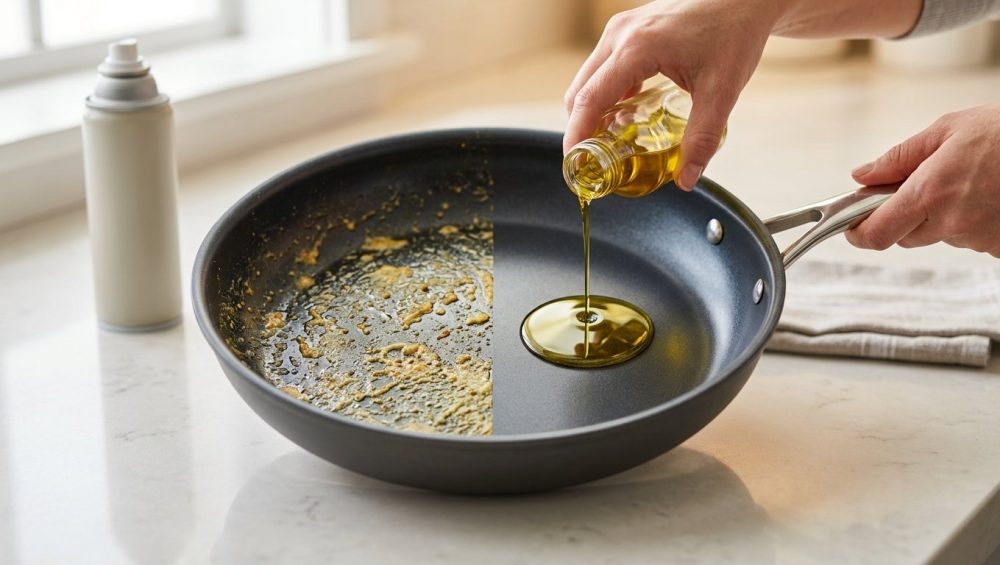
Picture this: you just dropped fifty bucks on a gorgeous, brand-new nonstick skillet. For the first few weeks, it is an absolute dream. You are flipping omelets with the flick of a wrist, pancakes are practically levitating off the surface, and cleanup takes all of three seconds. You feel like an absolute culinary genius. But fast forward six months, and the honeymoon is over. Your eggs are clinging to the pan for dear life, there is a mysterious, sticky brown halo baked into the edges of the skillet, and no amount of gentle scrubbing seems to make a dent. You assume you just bought a cheap pan, or perhaps you blame the dishwasher.
But I am here to deliver some hard, brutal culinary truth. The villain in this story isn’t the manufacturer, and it isn’t your spatula. The culprit is sitting right there in your pantry, masquerading as a convenient, healthy shortcut. It is that innocent-looking aerosol can of cooking spray.
As a home cook who has ruined more than my fair share of cookware over the years, I have zero patience for kitchen gimmicks that destroy our hard-earned equipment. We all make rookie kitchen mistakes, but actively spraying chemical adhesives onto our delicate cookware should not be one of them. Today, we are going to dive deep into the fascinating, slightly horrifying science of why cooking spray is the ultimate enemy of your nonstick pans, why you need to banish it from your kitchen immediately, and how you can achieve perfectly slick, professional-level searing without destroying your health or your cookware. Grab a glass of wine, take a seat, and let’s get into it.
The Anatomy of a Nonstick Pan: Why It Is So Fragile
To understand why cooking spray is such a lethal weapon against your skillets, we first need to understand the microscopic battlefield of a nonstick surface. When we talk about traditional nonstick pans, we are usually talking about Polytetrafluoroethylene (PTFE), most commonly known by the brand name Teflon.
PTFE is a synthetic fluoropolymer of tetrafluoroethylene. In plain English, it is a type of plastic that has an incredibly low coefficient of friction. It is so slick that practically nothing bonds to it naturally. Water beads up and rolls off, and proteins cannot easily attach their molecular hooks into the surface. However, this miraculous slickness comes with a massive structural vulnerability: the coating is relatively soft and highly porous at a microscopic level.
Because PTFE is inherently non-porous to water and oils, food glides right over it. But when you subject this delicate polymer matrix to extreme heat, abrasive sponges, or incompatible chemical agents, the microscopic valleys of the pan’s surface begin to warp, scratch, and fill with debris. Once those microscopic valleys are filled with carbonized gunk, the pan loses its frictionless properties. Instead of learning how to stop scrubbing stainless steel pans by mastering proper temperature control, many home cooks rely entirely on nonstick surfaces for everything, subjecting these fragile PTFE coatings to high-heat searing that they simply were not designed to handle.
And this is exactly where aerosol cooking sprays enter the picture to deliver the final, fatal blow.
Deconstructing the Aerosol Can: A Chemical Nightmare
If you look at the front label of a standard can of cooking spray, you will see marketing buzzwords like “100% Pure Canola Oil,” “Heart Healthy,” and “Fat-Free.” But if you flip that can around and read the fine print, you will quickly realize that you are not just spraying oil. You are spraying a highly engineered chemical cocktail designed to survive inside a pressurized metal tube.
The Emulsifier Trap: Soy Lecithin
The primary additive in almost every mainstream cooking spray is an emulsifier, most commonly soy lecithin. Lecithin is a fatty substance found in eggs, soybeans, and sunflower seeds. In the context of an aerosol can, its job is to keep the oil mixed with the other ingredients and to prevent the spray nozzle from clogging.
Lecithin is perfectly safe to eat—in fact, it is often taken as a dietary supplement. But while it might be friendly to your heart, it is the absolute nemesis of your nonstick pan. We will get into the exact chemistry of this reaction in a moment, but spoiler alert: this is the ingredient that forms the permanent, sticky glue on your skillet.
Propellants: Spraying Fossil Fuels on Your Breakfast
How exactly does the oil shoot out of the can in such a perfect, ultra-fine mist? It isn’t magic; it is liquefied petroleum gas. Most conventional cooking sprays use hydrocarbon propellants like butane, isobutane, and propane to drive the fluid out of the can. Yes, you read that correctly. The exact same highly flammable fossil fuels that power your outdoor camping stove and your cigarette lighter are being used to blast canola oil onto your morning eggs.
While the FDA generally recognizes these propellants as safe for consumption because they supposedly dissipate into the air as soon as they leave the nozzle, their presence fundamentally changes how the oil behaves when it hits a hot pan. These propellants can cause the ultra-fine oil mist to scorch almost instantly upon contact with heat, accelerating the degradation of your pan’s coating.
Anti-Foaming Agents: Dimethyl Silicone
If you blast oil mixed with propane out of a tiny nozzle at high speeds, it naturally wants to foam up and splatter. To prevent this, manufacturers often add dimethyl silicone, an anti-foaming agent. So, to recap: when you use a standard cooking spray, you are coating your fragile PTFE pan in a mixture of oil, sticky soy lecithin, liquid silicone, and butane. It is a chemical disaster waiting to happen.
The Chemistry of the Gunk: How Polymerization Ruins Your Pan
Now that we know what is actually inside the can, let’s look at what happens when that mist hits a hot skillet.
When you spray a pan, you are creating an incredibly thin, microscopic layer of oil and soy lecithin. Because the droplets are so fine, they have a massive surface-area-to-volume ratio. This means they heat up, oxidize, and carbonize significantly faster than a regular, visible drop of liquid oil poured from a bottle.
When soy lecithin is exposed to the high heat of a stovetop, it undergoes a rapid chemical reaction called polymerization. The molecules link together, forming a hard, cross-linked plastic-like resin. If you own a cast-iron skillet, you are already familiar with polymerization—it is the exact process we use to “season” cast iron and create a nonstick patina.
But while polymerized oil is a blessing for cast iron, it is a death sentence for a nonstick pan. The sticky, polymerized lecithin bonds fiercely to the microscopic pores of the PTFE coating. Because the residue usually builds up around the sloped edges of the pan (where the food isn’t actively cooking and absorbing the heat), it forms a thick, yellowish-brown, gummy lacquer.
Once this lecithin layer polymerizes, your pan is officially compromised. Your food is no longer making contact with the slick Teflon; it is making contact with a sticky wall of baked-on soy lecithin. You will notice the friction immediately. If you try to power through it, you will likely end up with a mess that makes your scrambled eggs leak water as they tear and stick to the ruined surface.
Why Soap and Water Won’t Save You
The most frustrating part of lecithin buildup is that it is virtually impervious to standard dish soap. Soap is a surfactant designed to break up loose, liquid fats. It is completely powerless against a cross-linked polymer matrix. You can soak that pan in soapy water for three days, and the sticky brown residue will still be there, mocking you.
The Toxic Truth: Why Scrubbing Your Pan is a Dangerous Game
When home cooks realize their pan has lost its slickness and developed a sticky brown ring, their first instinct is to break out the elbow grease. They grab the abrasive green side of the sponge, a stiff bristle brush, or—heaven forbid—a pad of steel wool, and they start scrubbing.
This brings us to my absolute, non-negotiable “No-Go” rule on toxic kitchen gear. I despise cheap, peeling nonstick pans, and I will shout it from the rooftops: If you scratch a PTFE nonstick pan, you must throw it in the garbage immediately.
The PFAS “Forever Chemical” Crisis
Teflon and similar nonstick coatings belong to a class of chemicals known as PFAS (per- and polyfluoroalkyl substances), notoriously dubbed “forever chemicals” because they do not break down in the environment or in the human body. While older pans used a highly toxic variant called PFOA (which was phased out after being linked to kidney and testicular cancer), modern pans use newer generation PFAS like GenX. Unfortunately, emerging toxicological studies suggest these regrettable substitutions carry many of the exact same risks, including immune system suppression, liver damage, and hormone disruption.
When you aggressively scrub the polymerized cooking spray off your pan, you inevitably scratch the soft PTFE coating. A groundbreaking 2022 study by the Global Centre for Environmental Remediation found that a single, microscopic surface scratch on a Teflon-coated pan can release over 9,000 toxic microplastics and nanoparticles directly into your food. If the pan is visibly worn or peeling, you are shedding literally millions of PFAS particles into your family’s dinner.
This is not a drill, and it is not alarmist hype. California’s Senate Bill 682 is actively attempting to ban PFAS in cookware entirely due to these profound public health risks. Throwing away a scratched pan is a non-negotiable step in banishing toxic kitchen gear from your life forever. Do not risk your long-term health just to save a twenty-dollar skillet you ruined with a can of butane-laced canola oil.
The Ceramic Pan Dilemma: Not as Safe as You Think
“But Sassy Sous-Chef,” you might be saying, “I don’t use Teflon! I bought one of those trendy, aesthetic, pastel-colored ceramic pans off Instagram. I’m safe, right?”
Wrong.
If you have been using aerosol sprays, you will inevitably find yourself wondering why your ceramic pan lost its non-stick properties even faster than your old Teflon one did. Ceramic nonstick pans do not actually contain ceramic in the traditional pottery sense. They utilize a “sol-gel” (solution-gel) technology derived from silica (sand) to create a glossy, slick surface.
While ceramic pans are genuinely free of PFAS and PTFE—making them a much safer, non-toxic alternative—their nonstick coating is actually far more brittle and delicate than Teflon. The sol-gel layer is highly susceptible to microscopic carbonization. Because cooking sprays distribute such ultra-fine, microscopic droplets of oil, those tiny droplets burn and carbonize rapidly under high heat. These invisible carbonized particles embed themselves deep into the microscopic silica matrix of the ceramic pan.
Within just a few weeks of using cooking spray, a high-end ceramic skillet will lose its release properties entirely. Your food will stick like glue, and because ceramic cannot be aggressively scrubbed without permanently destroying the sol-gel finish, the pan becomes completely useless.
The “Zero Calorie” Lie and the Financial Toll
Beyond the chemical damage to your cookware, cooking sprays are also a masterclass in deceptive marketing. We have all seen the bold “Zero Calories!” and “Fat-Free!” claims plastered across the front of aerosol cans. How can a can filled with literal vegetable oil be fat-free?
It is all thanks to a deeply flawed FDA labeling loophole. If a single serving of a food product contains fewer than 5 calories and less than 0.5 grams of fat, the manufacturer is legally permitted to round down to zero on the nutrition label. To achieve this mathematical illusion, cooking spray brands define a “serving” as a 1/4-second or 1/3-second spray.
Let’s be brutally honest here: no human being on planet Earth has the physical reflexes to press an aerosol nozzle for one-quarter of a second and successfully coat a 10-inch skillet. A normal, practical spray lasts about two to three seconds. By the time you have coated your pan, you have just added 20 to 30 calories and several grams of fat to your meal. You are not saving calories; you are just paying a massive premium for the privilege of spraying propellants onto your food.
When you factor in the exorbitant cost-per-ounce of aerosol oil, combined with the fact that you are actively destroying and replacing your $60 nonstick pans every six months, the financial toll of this “convenience” is staggering. You might as well ask why your homemade pizza is soggy when you insist on baking it on a cold, cheap baking sheet instead of investing in the right tools. Using the wrong product costs you more money in the long run.
The Sassy Sous-Chef’s Arsenal: Safe, Slick Searing Alternatives
Alright, I have thoroughly terrified you about the dangers of polymerized lecithin, butane propellants, and toxic PFAS microplastics. Now, let’s talk solutions. Because my core philosophy is that time is money, especially on a busy weeknight, I am not going to suggest you spend twenty minutes meticulously rendering animal fats just to cook a piece of salmon. We need efficient, safe, and pan-friendly alternatives.
If you’ve ever wondered why your chicken won’t brown properly, it is often because cooking sprays inhibit the Maillard reaction by creating a watery, foamy barrier rather than a clean conductive layer of fat. Here is how to grease your pan like a pro, preserve your nonstick coating, and get a gorgeous sear every single time.
1. The Paper Towel Wipe Down
This is the cheapest, easiest, and most foolproof method in the professional kitchen. Pour a dime-sized drop of pure, high-smoke-point oil (like avocado oil, grapeseed oil, or clarified butter) directly into the center of your cold pan. Take a folded paper towel and gently wipe the oil across the entire interior surface of the skillet.
This technique deposits a microscopic, perfectly even layer of pure fat across the pan. There is no lecithin to polymerize, no propellants to scorch, and no excess oil pooling in the corners to deep-fry your food. It takes exactly four seconds and costs pennies.
2. The Reusable Pump Mister
If you simply cannot let go of the convenience of a spray, you need to invest in a reusable, manual oil mister. These are stainless steel or glass bottles equipped with a manual pump mechanism. You fill the bottle with your own high-quality olive or avocado oil, pump the cap a few times to build up natural air pressure, and press the nozzle to release a fine mist.
Because you are using 100% pure oil with no chemical emulsifiers or liquid butane, there is zero risk of sticky residue buildup. Just be sure to “burp” the bottle (release the pressure) after each use to prevent the nozzle from clogging.
3. Pure Fats and High Smoke Points
If you are cooking on a nonstick pan, you should generally be using medium or medium-low heat anyway to protect the PTFE coating. But the type of fat you use still matters. Avoid unrefined oils with low smoke points (like extra-virgin olive oil or unrefined coconut oil) for anything other than a gentle sauté, as their natural milk solids and impurities can burn and stick to the pan. Stick to pure, refined avocado oil, ghee, or standard butter. And remember, knowing that your dinner actually needs acid won’t save a meal if the foundational cooking fat tastes like burnt, bitter plastic.
Rescue Operations: Can You Save a Gunked-Up Pan?
Let’s say you are reading this article, and you suddenly realize your favorite nonstick pan is currently sitting on the stove, covered in a thick, sticky layer of polymerized cooking spray. Is it destined for the landfill?
That depends. If you have already taken a scouring pad to it and scratched the black coating to reveal the silver metal underneath, yes. Throw it away immediately. But if the coating is still intact and simply buried under a layer of sticky gunk, we can attempt a rescue mission.
The Boiling Vinegar Trick
Because dish soap cannot break the polymerized bonds of soy lecithin, we need to use mild acidity and heat to lift the resin.
- Fill the sticky pan with a mixture of two parts water and one part distilled white vinegar.
- Place the pan on the stove and bring the liquid to a gentle simmer over medium heat. Let it simmer for about 5 to 10 minutes. The heat and acetic acid will begin to soften the cross-linked polymer matrix.
- Turn off the heat and (very carefully) add a tablespoon of baking soda. It will fizz violently—this is normal.
- Let the pan cool until it is safe to handle.
- Take a non-abrasive microfiber cloth or a soft sponge and gently wipe the sticky areas. The gunk should begin to lift away.
If the residue is incredibly stubborn, you can make a thick paste of baking soda and water, apply it to the sticky spots, and let it sit overnight before gently wiping it away. Just like understanding why your spices turn into hard bricks requires knowing how moisture interacts with cell walls, understanding how to clean a pan requires knowing how acids interact with polymerized fats.
However, I will be brutally honest: if the pan has been subjected to high heat and cooking spray daily for over a year, the carbonization may be permanent. If the pan still feels sticky after the vinegar boil, it is time to cut your losses, buy a new pan, and swear a solemn oath to never buy an aerosol cooking spray again.
The Final Word
Cooking is supposed to be an enjoyable, creative outlet, not a stressful battle against degrading equipment and toxic chemicals. By simply ditching the aerosol can and switching to pure, unadulterated fats, you will instantly extend the lifespan of your nonstick cookware by years, save yourself a small fortune, and protect your family from ingesting forever chemicals.
This small change will help turn your cooking into a peaceful daily habit rather than a frustrating chore. You don’t need a culinary degree to cook like a professional, but you do need to respect your tools. Treat your nonstick skillets with the gentle care they deserve, keep the butane where it belongs (in your lighter), and let the pure, delicious flavor of real food shine through. Now, go check your pantry, throw that aerosol can in the trash, and let’s get cooking.