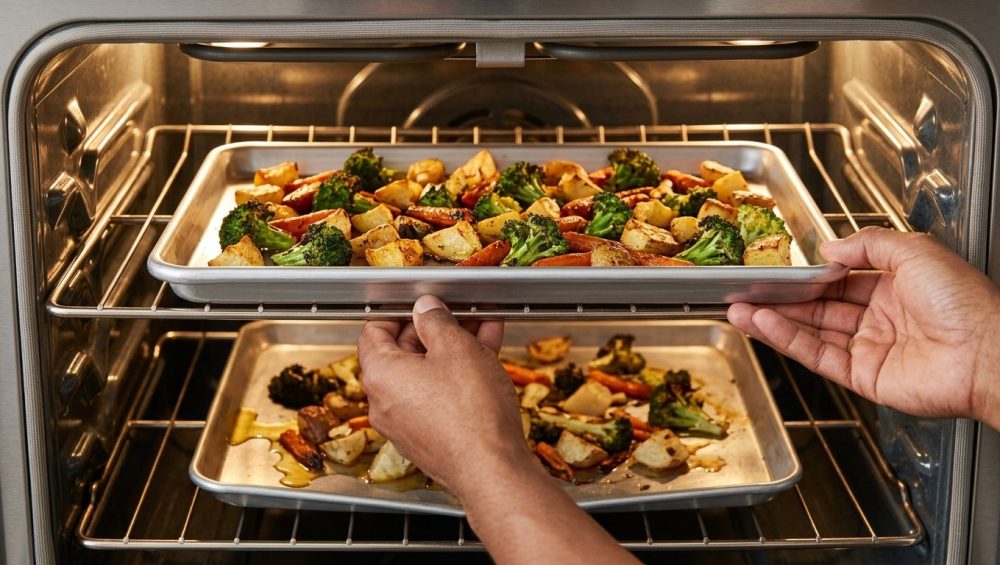
Picture this. It is 6:45 PM on a chaotic Tuesday. You are completely exhausted from the workday, but you have heroically decided to roast some broccoli and chicken thighs instead of ordering expensive, lukewarm takeout for the third time this week. You toss your carefully seasoned ingredients onto your trusty, slightly rusted baking sheet, shove it into a 425°F oven, and pour yourself a well-deserved glass of Pinot Noir. You finally sit down at the kitchen island, take a deep, relaxing sip of wine, and then—BANG!
It sounds like a small, metallic explosive just discharged inside your kitchen. You rush to the oven, peer through the smudged glass door, and behold the culinary tragedy unfolding before your eyes: your baking sheet has violently twisted itself into a metal pretzel. Your expensive extra-virgin olive oil has pooled into one sad, deep corner, drowning half of your broccoli florets in a greasy, soggy bath, while the other half of the pan is left high and dry, destined to become charred, desiccated little trees.
If this highly specific scenario triggers your fight-or-flight response, welcome to the club. You are a victim of the dreaded sheet pan “pop.”
I hear this exact complaint constantly from weekend culinary hobbyists and busy professionals alike. When your food cooks unevenly or your vegetables end up soggy instead of crisp, you automatically assume you are doing something wrong. You think you are cursed in the kitchen. You think you need a formal culinary degree or years of professional training for mastering the art of basic weeknight roasting. Let me stop you right there and offer you some aggressive, much-needed validation: It is not you. It is your garbage pan.
As someone who learned to cook through brute-force trial, error, and setting off the smoke detector more times than my landlord appreciated, I have zero patience for pretentious chef-speak. But I have even less patience for flimsy tools that actively sabotage your dinner. Time is money, people. You cannot afford to waste your precious weekday evenings battling warped metal and ruined food. Today, we are going deep into the material science of bakeware to fix this problem permanently.
The Physics of the “Pop”: Why Your Pans Are Throwing Tantrums
Let’s get straight into the actual science of why cheap pans warp, pop, and twist in the oven. I promise I will not bore you with a dry, textbook physics lecture, but understanding the basic physics of your cookware is the very first step to surviving kitchen disasters and finally taking control of your oven.
The culprit behind the terrifying oven “bang” is a principle called rapid thermal expansion. Every metal has a specific thermal expansion coefficient. In plain, non-pretentious English, this simply means that when metal gets hot, it physically expands and grows larger. When it cools down, it shrinks back to its original size.
If a baking sheet heats up perfectly evenly across its entire surface, the whole piece of metal expands at the exact same rate. The pan stays perfectly flat, your food cooks beautifully, and you look like a domestic god. But here in the real world, pans do not heat evenly.
Imagine you place four large, fridge-cold chicken breasts right in the dead center of your baking sheet, leaving the outer perimeter of the metal completely bare. You shove this pan into a blazing 425°F oven. The bare outer edges of the pan immediately absorb the ambient heat of the oven and rapidly rise to 425°F, causing that perimeter metal to expand quickly. Meanwhile, the center of the pan is trapped underneath those cold, dense, moisture-heavy chicken breasts. The center stays relatively cool and does not expand nearly as much as the edges.
Now you have a serious physics problem on your hands. The outer edges of the pan are trying to grow larger, but the center is stubbornly staying the exact same size. This massive temperature differential creates immense structural stress within the metal. The pan physically cannot contain the conflicting forces. Eventually, the tension reaches a critical breaking point, and the metal is forced to buckle to relieve the stress.
BANG.
The pan violently pops. One corner shoots up into the air, the opposite corner dives down, and your pan suddenly looks like a metallic skateboard ramp. When this happens, all of your cooking fat pools into the lowest corner, leaving the raised sections of the pan completely dry. Your food fries in the deep end and aggressively burns in the shallow end.
The Hall of Shame: Toxic, Flimsy Bakeware You Need to Trash
If you have read my previous rants, you know I am fiercely dedicated to banishing toxic kitchen gear from the homes of everyday cooks. I have a strict, non-negotiable “No-Go” rule when it comes to cheap, peeling, mysterious kitchenware. The grocery store baking aisle is an absolute minefield of terrible products designed to separate you from your money and ruin your food.
The Flimsy Grocery Store Imposters
When you buy a shiny, five-dollar baking sheet from the supermarket impulse aisle, you are buying a product manufactured with dangerously thin metal. Manufacturers use extremely thin gauges of aluminum or steel to cut production costs. If you can grab a baking sheet with your bare hands and easily twist it or bend it like a piece of cardboard, it belongs in the recycling bin, not in your oven. These ultra-thin pans lack the structural mass required to resist the forces of thermal expansion. They will warp every single time you use them, without fail.
The Dark Non-Stick Nightmare
Even worse than the flimsy bare pans are the cheap, dark-coated, non-stick baking sheets. These pans are a double threat to your culinary success and your health.
First, let’s talk about the cooking performance. Dark colors absorb radiant heat significantly faster than light colors. When you place a dark, almost black non-stick pan into a hot oven, it aggressively absorbs heat. If you attempt to bake delicate chocolate chip cookies on a dark pan, the bottoms of your cookies will scorch and burn to a crisp long before the centers are fully baked.
Second, and far more importantly, let’s talk about toxicity. Traditional non-stick baking sheets rely on fluorinated coatings, specifically PTFE (polytetrafluoroethylene), which is part of the broader PFAS family of chemicals. These are widely known as “forever chemicals” because their carbon-fluorine bonds are incredibly stable and do not break down in the environment or in the human body.
While these coatings are technically considered safe at low temperatures, roasting vegetables or baking pizzas often requires very high heat. When heated above 500°F (260°C), these non-stick coatings begin to break down and degrade on a molecular level. As the coating deteriorates, it releases invisible, highly toxic fumes into your kitchen air. In humans, inhaling these chemical fumes causes a documented medical condition known as “polymer fume fever,” which presents as severe, debilitating flu-like symptoms. For small household pets—particularly birds, which have incredibly sensitive respiratory systems—these fumes are rapidly fatal.
Furthermore, these cheap non-stick coatings are incredibly fragile. The moment you take a metal spatula to them to pry off a stuck potato, the surface scratches. Those chemical flakes peel off and end up directly in your roasted vegetables. Are you really willing to risk your long-term health and ingest forever chemicals just so your frozen tater tots slide around a little easier? It is completely absurd. Throw them away.
The Holy Grail of Bakeware: Commercial-Grade Materials
If you genuinely want to cook like a pro, you have to start shopping exactly where the pros shop: restaurant supply stores. Walk into any Michelin-starred restaurant, bustling local bakery, or high-volume catering kitchen, and you will not find a single flimsy, dark-coated, non-stick pan. You will find massive stacks of battered, scratched, heavily patinated, bare metal pans.
Commercial kitchens operate on razor-thin margins. They understand that time is money, and they simply do not have the time to coddle fragile equipment or constantly replace warped pans. They demand durability, rapid heat conductivity, and warp resistance. To achieve this, commercial pans are forged from two primary materials: Pure Aluminum and Aluminized Steel.
Pure Bare Aluminum: The Unrivaled Workhorse
Pure, uncoated aluminum is the undisputed king of the commercial kitchen. Aluminum is an exceptional conductor of heat. It heats up incredibly fast when placed in the oven, and crucially, it cools down very rapidly once removed from the heat source. This thermal responsiveness gives the cook ultimate control over the baking process, preventing carryover cooking from ruining delicate pastries. Because it is uncoated, you never have to worry about toxic chemicals leaching into your food or peeling finishes. It is relatively lightweight, naturally rust-resistant, and virtually indestructible.
Aluminized Steel: The Heavy-Duty Tank
Aluminized steel is the heavy-duty alternative to pure aluminum. It features a thick, solid core of structural carbon steel sandwiched between layers of aluminum alloy. The steel core provides immense structural rigidity and strength, making it almost completely impervious to warping, while the aluminum coating provides the necessary heat conductivity. These pans are significantly heavier than pure aluminum pans and are often favored by commercial bread bakeries for their intense heat retention and durability.
Once I upgraded my flimsy bakeware to commercial-grade metal, I magically stopped burning dinner and started producing perfectly caramelized vegetables that rivaled my favorite local restaurants.
Anatomy of a Perfect Sheet Pan: What to Look For
When you are ready to curate a permanent, high-quality bakeware collection, you need to know exactly how to read the specifications. A great sheet pan is defined by three critical anatomical features: the gauge, the rim, and the size.
The Gauge Game: Thicker is Always Better
In the world of sheet metal manufacturing, thickness is measured in a unit called “gauge.” The gauge system is famously counterintuitive: the lower the number, the thicker and heavier the metal.
As we discussed, the cheap pans at the grocery store are typically 20-gauge or 22-gauge. A 22-gauge aluminum pan is a measly 0.64 millimeters thick. That is not a cooking vessel; that is a liability.
To permanently stop the warping, you must insist on an 18-gauge pan. An 18-gauge aluminum pan clocks in at roughly 1.02 to 1.2 millimeters thick. This is the absolute commercial standard. It possesses enough physical mass and structural integrity to effectively resist the extreme stress of uneven thermal expansion. If you want a pan that could comfortably survive a nuclear apocalypse, you can even hunt down a 16-gauge or 14-gauge pan (which are even thicker), but for standard home ovens, 18-gauge is the perfect sweet spot of heavy-duty durability and manageable weight.
The Rim: Your Pan’s Skeleton
A flat sheet of metal, no matter how thick, is inherently flexible. To give the pan structural strength, manufacturers roll the outer edges upward to create a rim. But a simple, hollow rolled edge is not enough to stop a pan from popping under high heat.
The absolute best commercial sheet pans feature an “encapsulated galvanized steel wire rim”. During the manufacturing process, a thick, rigid rod of galvanized steel wire is placed along the edge of the pan, and the aluminum lip is tightly rolled and crimped completely around it. This encapsulated steel acts as a rigid skeleton for the pan. It locks the pan’s rectangular geometry firmly in place, making it nearly physically impossible for the pan to twist, buckle, or warp under heat. When shopping, always check the product description for a “reinforced wire rim.”
Size Matters: Decoding the Terminology
Sheet pans come in standardized commercial sizes. Do not buy random, oddly shaped pans. Stick to the industry standards.
- The Full Sheet: A full sheet pan measures exactly 26 by 18 inches. Unless you live in a converted industrial warehouse with a commercial-grade double-door oven, a full sheet pan will absolutely not fit in your standard residential oven. Do not buy this.
- The Half Sheet: Measuring 18 by 13 inches, the half sheet is the undisputed workhorse of the home kitchen. It perfectly maximizes the interior real estate of a standard home oven, allowing adequate airflow around the edges while giving you enough surface area to roast a whole spatchcocked chicken and a pound of potatoes simultaneously.
- The Quarter Sheet: Measuring 9 by 13 inches, the quarter sheet is exactly half the size of a half sheet. These are brilliant for small weeknight dinners, toasting a handful of nuts, or prepping ingredients.
Investing in a matching set of high-quality half sheets is the absolute fastest way to eliminate kitchen chaos and streamline your messy meal prep.
Care and Feeding of Your New Commercial Pans
Commercial pans are incredibly tough, but they are not entirely invincible. To ensure your new 18-gauge pans last for the rest of your life, you need to understand a few basic rules of maintenance and thermodynamics.
The Danger of Thermal Shock
We have previously discussed the critical importance of mitigating thermal shock with your expensive skillets, but the exact same thermodynamic rules apply to your baking sheets.
Thermal shock occurs when a material is subjected to a rapid, extreme change in temperature. If you pull a blazing hot, 450°F aluminum sheet pan out of the oven and immediately toss it into the sink under a stream of freezing cold tap water, the metal will aggressively contract in seconds. Even a heavy-duty 18-gauge pan with a reinforced steel rim can permanently warp if subjected to severe thermal shock. Always, always let your pans cool down to room temperature on the stovetop or a wire rack before you attempt to wash them.
The Dishwasher is the Enemy
Do not put your bare aluminum sheet pans in the dishwasher. Ever. This is not a suggestion; it is a rigid rule of chemistry.
Dishwasher detergents are highly alkaline (they have a very high pH) and contain harsh, caustic chemicals designed to dissolve food proteins. Aluminum is a highly reactive metal. When bare aluminum is exposed to the high heat, abrasive water jets, and alkaline environment of a dishwasher, it triggers a harsh chemical reaction. The detergent literally strips the natural protective oxide layer off the metal, oxidizing the aluminum and leaving the pan covered in a dark, powdery, chalky gray residue. This oxidized residue will permanently ruin the finish of the pan and will constantly rub off onto your hands, your kitchen towels, and your food. Hand wash your aluminum pans with standard dish soap and warm water.
Cleaning Hacks and Embracing the Patina
Because commercial aluminum pans are uncoated, food can and will stick to them if you do not use proper lubrication. For baking cookies or delicate pastries, always line your pan with a sheet of parchment paper or a reusable, non-toxic silicone baking mat. For roasting vegetables or meats, ensure the food is generously tossed in high-heat oil.
When your pans heat evenly and clean up quickly, it becomes infinitely easier to master simple weeknight dinners with minimal effort. But what happens when you accidentally burn a honey-soy glaze onto the bare aluminum?
First, do not panic. Fill the cooled pan with hot water and a generous squirt of dish soap, and let it soak for twenty minutes. A basic metal pastry cutter is often considered the kitchen’s unsung hero for effortlessly lifting stuck-on roasted vegetables from your new bare aluminum pans. Simply glide the flat metal edge across the surface to sheer off the burnt bits. For stubborn grease stains, create a thick paste of baking soda and hydrogen peroxide, smear it over the stains, let it sit for two hours, and scrub it away with a non-scratch sponge.
Finally, you must learn to embrace the patina. A brand new, shiny aluminum pan is beautiful, but it will not stay that way. Over time, as oils polymerize onto the surface from high-heat roasting, the pan will develop a golden-brown, mottled appearance. This is called a patina. It is a badge of honor. It means you are actually cooking. A stained pan is a seasoned pan, and ironically, a heavily patinated aluminum pan will actually become slightly more non-stick over time.
The Sassy Sous-Chef’s Top Recommendations
I have tested dozens of pans over my culinary journey, from cheap grocery store garbage to high-end boutique brands. If you want to stop the warping and upgrade your kitchen arsenal, these are the only brands you should be looking at. Having reliable, heavy-duty equipment is exactly how you survive the kitchen on a chaotic Tuesday night without losing your mind.
Nordic Ware Naturals Half Sheet
This is the gold standard for home cooks and my personal favorite everyday pan. Manufactured in the USA, the Nordic Ware Naturals line is forged from commercial-quality, 18-gauge pure aluminum. It features a fully encapsulated galvanized steel rim that makes it incredibly robust and highly resistant to warping. It conducts heat like an absolute dream, ensuring your cookies bake evenly and your vegetables achieve a perfect, golden-brown Maillard reaction crust. Because it is bare aluminum, you do need to use parchment paper or oil to prevent sticking, but the sheer durability and affordable price point make this the best overall investment for your kitchen.
USA Pan Bakeware Half Sheet
If you absolutely insist on having a non-stick surface but refuse to compromise on structural integrity, the USA Pan is your best option. These pans are constructed from heavy-duty aluminized steel, giving them a satisfying, weighty feel. They feature a unique corrugated (wavy) surface texture that improves structural rigidity and facilitates better airflow under your food. USA Pan coats their bakeware with Americoat, a proprietary, silicone-based non-stick coating that is completely free of PTFE, PFOA, and PFAS. The non-stick performance is practically magical—cookies slide right off without any oil. However, be aware that because it is a coating, it will eventually wear down over years of heavy use, and the steel core makes it slightly more prone to warping at extreme broiler temperatures compared to pure aluminum.
Vollrath Wear-Ever Commercial Half Sheet
If you want the exact pan that the grumpy, chain-smoking line cook at your favorite diner uses, buy a Vollrath. Vollrath is a legendary commercial foodservice brand. Their Wear-Ever line features pans ranging from 18-gauge all the way up to an absurdly thick 10-gauge aluminum. They are not always the prettiest pans—they are built for brutal utility, not Instagram aesthetics—but they are virtually indestructible. They feature a closed bead rim reinforced with galvanized wire and will outlast every other appliance in your kitchen.
Reclaiming Your Oven
You absolutely do not need a culinary degree or a massive trust fund for mastering the art of the weekend roast. You just need to stop handicapping yourself with terrible equipment.
Cooking is fundamentally about applying heat to ingredients. If your tools cannot handle the heat without throwing a metallic tantrum and twisting themselves into modern art sculptures, they are failing at their one and only job. Throw out the flimsy, toxic, dark-coated pans that have been ruining your dinners. Invest twenty dollars into a heavy-duty, 18-gauge, commercial-grade aluminum half sheet. Treat it with respect, keep it out of the dishwasher, and watch as your roasting game instantly transforms from a stressful, oil-pooled disaster into a perfectly caramelized triumph.
Now, go preheat your oven with confidence, pour yourself another glass of wine, and get cooking. Your broccoli deserves better.