Picture this entirely preventable, yet tragically common scenario: The doorbell rings. You are currently sweating profusely over a pan of rapidly burning shallots. Your wine glass has been empty for forty-five minutes. Your guests are awkwardly standing in the hallway, offering to help while secretly hoping you say no, and the beautiful, mindful gathering you envisioned has devolved into a chaotic, high-stakes episode of a frantic cooking competition.
If this sounds familiar, you are not alone. Recent industry statistics reveal that a staggering eight in ten adults feel significant stress and anxiety when hosting dinner parties, with nearly half of all hosts actively regretting overcomplicating their menus by the time the first guest arrives. We romanticize the idea of the effortless weekend dinner party, but the reality is often a frantic, isolated experience where the host is chained to the stove while everyone else has fun.
Entertaining shouldn’t feel like a punishment. If you want to actually enjoy your own parties and master the art of effortless hosting, you need to completely abandon the false, pretentious notion that a good host cooks everything to order while simultaneously charming their guests. You do not need a culinary degree to pull off a flawless dinner. What you need is a basic, unapologetic understanding of thermodynamics, material science, and military-grade time management. We are going to use science to eliminate the active cooking bottleneck, allowing you to stage your food perfectly, hold it at the correct temperature, and actually sit down to drink your own wine.
The Physics of Not Sweating in Your Own Kitchen
The fundamental problem with traditional dinner party prep is what I call the “Active Cooking Bottleneck.” You only have two hands, four burners, and one oven. You physically cannot sear a steak, emulsify a delicate pan sauce, toss a vinaigrette, and greet your guests simultaneously. Attempting to do so is a mathematical impossibility that inevitably leads to burnt food and a frazzled host.
To break this cycle and eliminate kitchen chaos for good, we must entirely decouple the cooking process from the serving process. This is the essence of scientific food staging. Staging is not merely putting food on a platter and hoping for the best; it is the calculated manipulation of heat transfer to ensure that your food remains at peak quality—both gastronomically and biologically—long after it has left the active heat source.
Understanding how heat moves, how it degrades, and how we can trap it is the secret weapon of the savvy home cook. We are going to leverage the immutable laws of physics to turn your kitchen into a highly efficient, stress-free staging ground.
The Thermodynamics of Ambient Food Holding
If you want to hold food successfully without turning it into a cold, congealed mess, you have to understand exactly what you are fighting against. The universe wants your hot food to get cold and your cold food to get warm. Our job is to aggressively interfere with that process.
Newton’s Law of Cooling (And Why It Hates Your Dinner Party)
Sir Isaac Newton may not have been a chef, but his Law of Cooling is the most important rule in your kitchen. In simple terms, the law states that the rate of heat loss of a body is directly proportional to the difference in the temperatures between the body and its surroundings.
Translation: The hotter your food is, and the colder your dining room is, the faster your food will hemorrhage heat. If you pull a 400°F roasted pork loin out of the oven and immediately place it onto a 68°F room-temperature ceramic platter, the temperature delta is massive. The heat from the pork will violently transfer into the cold platter and the surrounding air, leaving you with lukewarm meat in a matter of minutes. To stage food successfully, we have to manipulate the environment to shrink that temperature delta, slowing down the rate of heat transfer to a crawl.
The FDA Danger Zone and Safe Temperature Degradation
We aren’t just staging food for the sake of culinary aesthetics; we are staging it so you don’t inadvertently poison your friends. Leaving food out at ambient room temperature is a biological ticking time bomb.
According to the United States Food and Drug Administration (FDA), the temperature “Danger Zone” lies strictly between 41°F and 135°F (with consumer guidelines often rounding to 40°F and 140°F). Within this precise thermal window, pathogenic bacteria such as Salmonella, E. coli, and Listeria thrive. In fact, at a comfortable room temperature of 70°F, a single bacterium can exponentially multiply, doubling in number every 20 minutes. Within just four hours, that single microscopic entity can explode into a colony of 1.28 million.
Worse still, some of these bacteria release heat-stable toxins as they multiply. This means that once the food has sat out too long, simply tossing it back into the microwave or oven to reheat it will not destroy the toxins, and the threat of severe foodborne illness remains. Ignoring the strict realities of temperature degradation is one of the seven rookie kitchen mistakes that will literally make your guests sick.
The golden rule of food staging is the two-hour limit. Perishable foods must never sit in the Danger Zone for more than two hours—and if you are hosting an outdoor summer gathering where the ambient temperature exceeds 90°F, that window shrinks to a brutally short one hour. Therefore, our scientific staging techniques must guarantee that hot foods are actively held above 135°F, and cold foods are insulated below 41°F, until the exact moment of consumption.
Material Science: Choosing Your Arsenal for Thermal Mass
You cannot execute a scientific food staging protocol with cheap, flimsy cookware. The success of your dinner party relies entirely on the thermal mass of your serving vessels. Thermal mass refers to a material’s ability to absorb, store, and slowly release heat energy.
The “No-Go” Zone: Why Toxic Cookware Sabotages Heat
Let me be perfectly clear: I have absolutely zero patience for cheap, peeling non-stick pans and paper-thin mystery-metal aluminum pots. Beyond the fact that they are an environmental disaster, they are thermodynamically useless for food staging.
Thin aluminum and standard polytetrafluoroethylene (PTFE/Teflon) coated pans have incredibly low thermal mass. They heat up in seconds, which might seem convenient on a busy Tuesday morning, but they also lose that heat the second you turn off the burner. If you try to hold a delicate stew in a thin aluminum pot, the surface temperature will plummet dramatically the moment it leaves the stove.
Furthermore, these toxic coatings are notorious for degrading. When overheated, cheap non-stick coatings can off-gas noxious chemicals, and as they age, they flake directly into your food. When curating your beginner cooking essentials, immediately throw out anything with a flaking chemical coating. We only use safe, durable materials that obey the laws of physics and respect our health.
High-Fired Ceramics: The Gentle Insulator
For slow, gentle heat retention, high-fired ceramics and natural clay are unparalleled. According to the principles of thermo-culinary dynamics, the specific heat capacity of clay and ceramic is exceptionally high—often cited as retaining three to four times more heat energy per gram than standard conductive metals like copper.
Specific heat capacity is the amount of energy required to raise the temperature of one gram of a substance by one degree. Because ceramic has a high specific heat capacity (roughly 0.84 to 1.09 J/g·K) combined with very low thermal conductivity (meaning heat travels through it very slowly), it acts as a phenomenal insulator.
When you preheat a heavy ceramic serving bowl and fill it with mashed potatoes or a creamy gratin, the ceramic absorbs a massive amount of heat energy and then stubbornly refuses to let it go. It radiates that heat back into the food at a slow, gentle trickle, keeping your delicate side dishes safely above the 135°F Danger Zone threshold without scorching the bottom layer.
Enameled Cast Iron: The Heavyweight Heat Battery
If ceramic is a gentle insulator, enameled cast iron is a heavyweight thermal battery. Bare cast iron actually has a relatively low specific heat capacity (0.450 J/g·K) compared to water or ceramic. However, specific heat capacity is calculated per gram. Because cast iron is so incredibly dense and heavy, the total thermal mass of a standard Dutch oven is astronomically high.
A thick, 12-inch cast iron vessel can store thousands of joules of thermal energy. When you drop a cold piece of meat into a thin pan, the pan’s temperature can plummet by 150 degrees. When you drop that same meat into a pre-heated cast iron Dutch oven, the massive thermal reserves of the iron instantly offset the temperature drop, barely flinching.
Now, add the enamel. Enameled cast iron is coated in a layer of fused glass (vitreous enamel) that is fired onto the iron at temperatures exceeding 1,400°F. This non-porous glass layer is completely non-toxic and non-reactive, meaning you can simmer highly acidic tomato sauces for hours without leaching metallic flavors. More importantly for staging, the enamel acts as a slight insulator over the iron, reducing surface thermal conductivity by roughly 68%. This smooths out the heat transfer, preventing hot spots and ensuring a perfectly even, radiant heat distribution.
Furthermore, dark enameled cast iron boasts a phenomenal infrared emissivity (around 0.92 to 0.95), meaning it radiates stored heat into its surroundings with extreme efficiency. Enameled Dutch ovens and braisers are absolute tools for the culinary curious because they act as impenetrable thermal fortresses. You can pull a braise out of the oven, leave the heavy cast iron lid on, and it will safely hold its temperature on a trivet for well over an hour before even approaching the Danger Zone.
The Mathematically Verified Prep Schedule (The Timing Matrix)
Knowing the physics and owning the right heavy-duty gear is only half the battle. The true magic of eliminating the host’s bottleneck lies in the execution of a mathematically precise timing matrix. We are going to completely reverse-engineer your dinner party, working backward from the exact moment your guests take their first bite.
T-Minus 24 Hours: The Thermal Prep Phase
Amateur hosts start cooking two hours before the party. Professional-level home cooks start staging the environment a full day in advance.
Your first task is to manage the cold side of the thermodynamics equation. If you are serving a cold appetizer—say, a vibrant shrimp cocktail, a delicate crudo, or a massive charcuterie spread—the serving vessels must be thermally prepped. Place your ceramic platters, marble boards, or glass bowls directly into the refrigerator or freezer 24 hours in advance. You want the physical mass of the serving ware to drop to 35°F. When you eventually plate the cold food, the frozen platter will actively draw ambient heat away from the delicate ingredients, keeping them well below the 41°F threshold for the duration of the cocktail hour.
Next, stage your dry ingredients and non-perishables. Measure out your spices, set the table, and arrange your cookware. Maintaining a permanently organized kitchen allows you to pull your mise en place together hours in advance without frantically digging through cluttered drawers while your guests are trying to have a conversation with you.
T-Minus 4 Hours: The Active Cooking Bottleneck Elimination
This is the most critical phase of the matrix. Four hours before your guests arrive, your kitchen should be loud, hot, and messy. This is when you execute all the high-heat, high-stress, smoke-producing tasks.
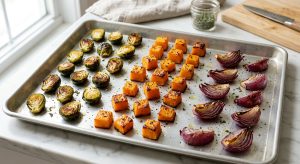
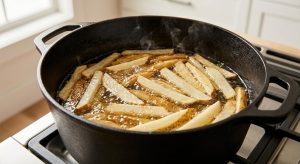
Are you searing a massive chuck roast for a bourguignon? Do it now. Are you caramelizing onions until they are deeply jammy and sweet? Do it now. Are you roasting dense root vegetables that take an eternity to soften? Do it now.
By front-loading the aggressive cooking techniques, you completely eliminate the risk of setting off the smoke detector while your guests are sipping their aperitifs. Once the messy searing and sautéing are done, these components are transferred into your heavy enameled cast iron Dutch ovens to braise or simmer low and slow. The active bottleneck is officially broken.
T-Minus 1 Hour: The Staging Protocol
One hour before the doorbell rings, your active cooking should be 90% complete. You are now transitioning from “cook” to “tactical staging manager.”
Your braises and stews are fully cooked. Turn the oven down to a holding temperature of 170°F to 200°F. Leave the heavy enameled cast iron pots inside. Because of the massive thermal mass of the iron and the insulating properties of the enamel, the food will stop actively cooking but will remain safely quarantined well above the 135°F Danger Zone.
If you need to transfer food into a different serving vessel, you must preheat that vessel. Pour boiling water into your ceramic serving bowls, let them sit for five minutes to absorb the heat energy, and then dry them completely before adding the hot food. Never put hot food into a cold bowl.
A critical warning on material science: When preheating enameled cast iron, you must do so slowly. The coefficient of thermal expansion for the underlying iron (12.0 × 10⁻⁶/°C) differs significantly from the brittle glass enamel coating (6.5–8.5 × 10⁻⁶/°C). If you expose an enameled pot to a sudden, violent temperature shift—such as placing a cold pot on a blazing high burner, or worse, pouring cold water into a screaming hot pan—the iron will expand or contract faster than the glass. This thermal shock creates immense interfacial stress, resulting in microfractures that will permanently chip and ruin your expensive cookware. Always ramp up the heat gradually.
Implementing this rigorous timing matrix turns chaotic, sweaty prep into simple meals for mindful moments where you can actually take a shower, pour a drink, and be psychologically present when your friends arrive.
Advanced Staging Techniques for Mindful Entertaining
For the detail-oriented culinary enthusiast, basic hot and cold holding is just the beginning. To truly elevate your weekend dinner parties without chaining yourself to the stove, you need to master a few advanced staging techniques that leverage the deeper principles of thermodynamics.
The Reverse Sear and Hold
If you are serving premium cuts of meat—like a thick ribeye, a rack of lamb, or a whole roasted tenderloin—traditional cooking methods demand that you babysit the meat at the exact moment your guests are arriving. We reject this. Instead, we use the reverse sear.
The reverse sear involves cooking the meat in a very low oven (around 225°F) until the internal temperature reaches about 10 to 15 degrees below your final target temperature. Once it hits that mark, you pull it out and let it rest.
Here is where the physics of “carryover cooking” comes into play. When you roast a piece of meat, the exterior is significantly hotter than the interior. When you remove the meat from the oven, that thermal energy doesn’t just vanish; it continues to drive inward, seeking equilibrium. The internal temperature of a large roast can easily rise another 10 to 15 degrees as it rests on the counter. Understanding and exploiting carryover cooking is a crucial chapter in any essential kitchen survival guide.
Because you cooked the meat at such a low temperature, the thermal gradient is gentle, meaning the meat can safely rest on a cutting board (loosely tented with foil to trap radiant heat) for 30 to 45 minutes without overcooking or getting cold. Right before serving, you simply flash-sear the exterior in a ripping hot, bare cast iron skillet for 60 seconds per side to trigger the Maillard reaction, slice, and serve. You get edge-to-edge perfection with zero last-minute panic.
The Faux Bain-Marie and Passive Warming
Some dishes, like mashed potatoes, delicate hollandaise sauces, or rich gravies, cannot be held in a 200°F oven without scorching, splitting, or turning into spackle. For these delicate items, we employ the faux bain-marie, leveraging the extraordinary specific heat capacity of water.
Water has a specific heat capacity of 4.18 J/g·K, which is astronomically high. It takes an immense amount of energy to heat water, but once hot, it acts as the ultimate thermal flywheel, releasing a steady, gentle, and highly predictable ambient heat.
To create a passive holding station, fill a large, heavy pot or slow cooker with water and bring it to a gentle simmer (around 150°F to 160°F). Place your delicate sauces or purees in heavy glass or ceramic bowls, and carefully set those bowls directly into the hot water bath. The water will gently envelop the bowl, providing a perfectly stable thermal environment that keeps the food well above the 135°F Danger Zone without ever applying the harsh, direct heat that causes scorching or emulsion failure. You can hold a delicate béarnaise or a velvety potato puree in this state for over an hour with zero degradation in quality.
The Aesthetics of Thermal Plating
Finally, we must address the absolute last mile of the dinner party: the plate itself. You can flawlessly execute a complex menu, but if you serve it incorrectly, the entire thermodynamic system collapses at the finish line.
You eat with your eyes first, and mastering the beautiful art of food plating is highly encouraged. However, the most stunning, perfectly swooshed puree and micro-green garnish means absolutely nothing if the food is freezing cold by the time it reaches the dining room table.
Standard porcelain dinner plates have a high density and are excellent thermal sinks. If you take a perfectly rested, 130°F slice of medium-rare beef and place it onto a 68°F plate, Newton’s Law of Cooling will immediately rob the meat of its heat. The fats will instantly congeal, the juices will turn lukewarm, and the culinary magic will die on the porcelain.
To prevent this, your plates must be staged. Stack your ceramic dinner plates in a warming drawer, or place them in a 150°F oven for 15 minutes before serving. When the hot food hits a hot plate, the temperature delta is virtually zero. The plate actually insulates the food, keeping it steaming hot as you walk it out to the dining room, allowing your guests to experience the dish exactly as you intended.
The Psychological ROI of Scientific Food Staging
Ultimately, the goal of cooking for others is not to prove that you can suffer for your art. It is not an endurance test to see how much stress you can handle before you snap at your spouse over a forgotten garnish. The goal of hosting a dinner party is to share a meaningful moment, break bread with people you care about, and create an environment of warmth and generosity.
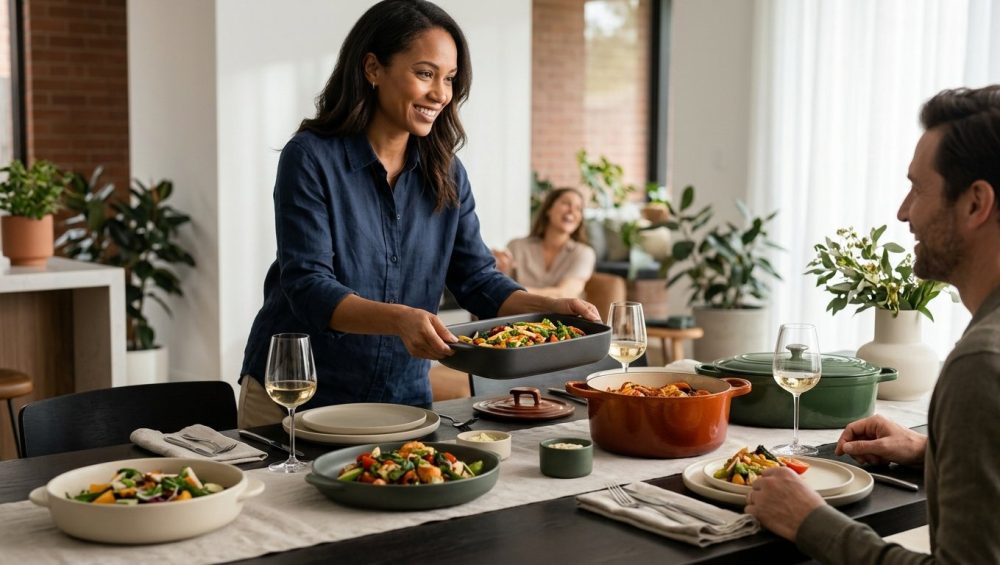
You cannot be generous with your spirit if you are trapped in a cycle of culinary anxiety. By rejecting the chaotic, fly-by-the-seat-of-your-pants approach to cooking, and instead leaning heavily on the proven laws of thermodynamics, you buy yourself the ultimate luxury: psychological presence.
Investing in high-quality, non-toxic, high-thermal-mass cookware isn’t just about aesthetics; it is about equipping yourself with tools that actively work for you, rather than against you. Utilizing a mathematically sound prep schedule isn’t about being rigid; it is about creating a protective buffer of time so that when the inevitable minor hiccup occurs, it doesn’t derail the entire evening.
Following these simple steps to culinary artistry will fundamentally transform your relationship with your kitchen. You will transition from a stressed-out, short-order cook into a tactical, flawless host who seemingly pulls a five-star meal out of thin air, all while holding a perfectly chilled glass of wine.
So the next time you decide to invite people over, don’t just plan the menu. Plan the physics. Respect the Danger Zone, harness the thermal mass of your enameled cast iron, map out your timing matrix, and preheat your plates. Do the math early, execute the messy work before the doorbell rings, and reclaim your dinner party. Your guests will be blown away by the food, but more importantly, they will actually get to spend the evening with you.