Let’s get one thing straight right out of the gate: if the sound of your smoke detector is the only way your family knows dinner is ready, we need to have a serious talk.
I know exactly where you are right now. It’s 6:00 PM on a Tuesday. You’ve just wrapped up a soul-crushing day of emails that could have been meetings and meetings that could have been emails. You open the fridge, stare into the abyss of wilted spinach and mystery Tupperware, and feel that familiar, creeping sense of dread. Cooking, for far too many of us, feels less like a joyful culinary adventure and more like a high-stress hostage negotiation with a hot stove.
But here is the brutally honest truth from someone who has been in the trenches, burned the garlic, and lived to tell the tale: your chaotic cooking routine is not a character flaw. It is simply a lack of a system. You do not need a culinary degree from Le Cordon Bleu to make mind-blowing food in a standard home kitchen. You don’t need a pantry stocked with truffles or a stove that costs more than a used sedan. What you need are foundational techniques, a few uncompromising rules about your equipment, and a fundamental shift in how you approach the physical act of preparing a meal.
Welcome to your masterclass. Grab a glass of wine, tie your apron, and let’s systematically dismantle your kitchen anxiety so we can rebuild it into a peaceful, highly efficient daily habit.
The Psychology of Kitchen Chaos (And Why You Are Drowning)
Before we even touch a chef’s knife, we need to address the mental roadblocks that are setting you up for failure before you even turn on the stove. Cooking anxiety is a very real, documented phenomenon. When you are standing in the middle of a messy kitchen, trying to remember if you salted the pasta water while simultaneously frantically chopping an onion because the garlic is already burning, your brain is experiencing a massive cognitive overload.
Decision Fatigue and the 6:00 PM Crash
By the end of the workday, your brain is suffering from decision fatigue. The sheer act of deciding what to cook is often more exhausting than the cooking itself. When you combine decision fatigue with the pressure of a ticking clock—what researchers and sociologists often refer to as “time scarcity”—the natural human reflex is to panic and order a $35 lukewarm pizza.
The chaos you feel isn’t because cooking is inherently difficult; it’s because you are trying to do three distinct phases of food preparation—planning, prepping, and executing—simultaneously. Professional kitchens do not operate this way. If a restaurant chef tried to figure out what they were cooking, chop their vegetables, and sauté their proteins all at the exact same time to order, the restaurant would burn to the ground in an hour.
To transform your routine, you must separate the thinking from the doing. When it comes to surviving kitchen disasters, preparation is your absolute best friend. You need to walk into the kitchen with a singular focus, knowing that the heavy mental lifting has already been done.
Purging the Poison: Why Toxic, Cheap Gear is Sabotaging Your Peace
I am going to enforce a strict, non-negotiable rule right now: The “No-Go” Rule on Toxic Gear. If you are trying to build a peaceful, joyful cooking habit using a warped, scratched, $10 non-stick pan you bought at a discount store five years ago, you are actively sabotaging your health and your food. I have zero patience for cheap, peeling mystery metals, and neither should you.
The Terrifying Reality of Scratched Teflon
Let’s look at the hard science. A 2022 study conducted by researchers from the Global Centre for Environmental Remediation and published in Science of the Total Environment utilized advanced Raman imaging techniques to analyze what happens when a Teflon (PTFE) coated pan gets scratched. The results should make you immediately walk to your cupboards with a trash bag.
The researchers discovered that a single, microscopic surface scratch on a Teflon coating can shed over 9,000 micro- and nanoparticles of plastic directly into your food. If the pan is heavily worn or has deeper cracks, that number skyrockets to an estimated 2.3 million toxic particles released in the time it takes to cook a single meal.
These aren’t just any plastics. Most non-stick cookware relies on per- and polyfluoroalkyl substances (PFAS), famously known as “forever chemicals”. When these particles are ingested, they accumulate in the human body and refuse to break down. Exposure to these specific chemicals has been strongly linked to severe health conditions, including liver disease, chronic kidney disease, thyroid disorders, immune system suppression, and even testicular and kidney cancers. Furthermore, when these cheap PTFE pans are heated above 500°F (260°C)—a temperature easily reached if you accidentally leave an empty pan on a hot burner—the coating begins to actively decompose, releasing toxic perfluorinated fumes that can cause a condition known as “polymer fume fever”.
Upgrading to Safe, Lifetime Equipment
You cannot cook with confidence if you are terrified of your own cookware. Throw out the flaking non-stick garbage. You only need three safe, high-quality pans to conquer 99% of recipes:
- A Stainless Steel Skillet: The indestructible workhorse for searing, sautéing, and building pan sauces.
- An Enameled Cast Iron Dutch Oven: Your heavy-duty vessel for braises, soups, and deep-frying, completely free of reactive chemicals.
- A Carbon Steel Pan: The professional’s secret weapon. Once properly seasoned, it becomes naturally non-stick without a single drop of synthetic PFAS, and it will literally outlive you.
Investing in beginner cooking essentials that are durable and non-toxic is the first physical step toward respecting your food and your body.
The Golden Rule: Mise en Place (Or, How to Stop Running Around Like a Headless Chicken)
If there is one solitary concept you take away from this masterclass, let it be mise en place. It is a French culinary phrase that translates to “putting in place,” and it is the foundational bedrock of every successful kitchen on earth.
The Anatomy of a Panic Attack
Here is how the amateur cook operates: They turn the stove on high, pour in some oil, and then realize they need to dice an onion. As they are frantically hacking at the onion, the oil starts to smoke. They throw the jagged, uneven onion chunks into the pan, where they immediately begin to burn. Now the recipe calls for minced garlic and a teaspoon of paprika. The cook abandons the burning onions to rummage through a chaotic spice cabinet, knocking over three bottles of expired oregano in the process. By the time the paprika is found, the kitchen is filled with acrid black smoke, the smoke detector is screaming, and the dog is hiding under the sofa.
The Professional Protocol
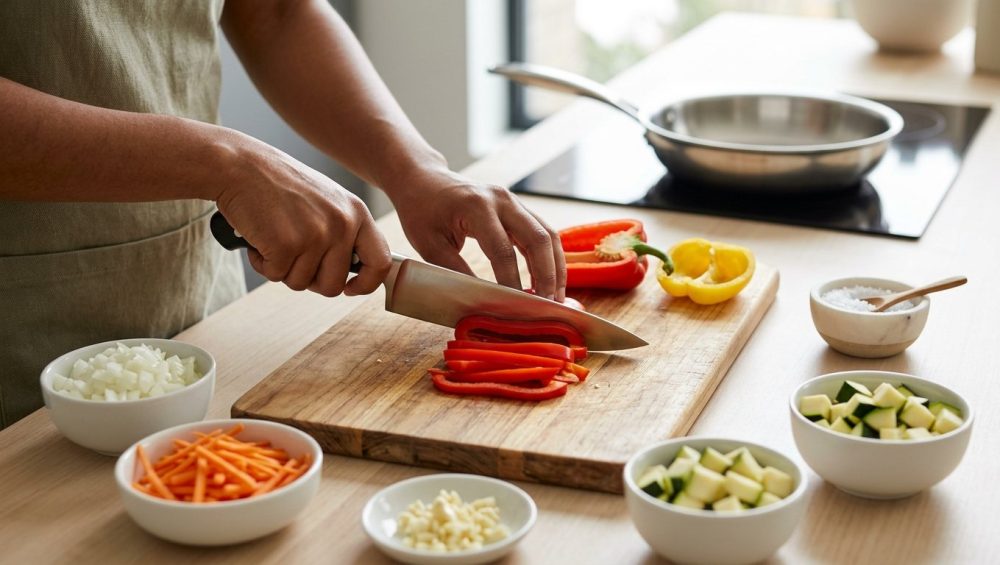
Mise en place eliminates this entirely. It is the practice of gathering, measuring, washing, peeling, and chopping every single ingredient before you even think about turning on the heat.
- Read the Recipe: Read it from start to finish. Twice. Learning to decode pretentious recipe jargon before you start ensures there are no mid-cooking surprises (like realizing you were supposed to marinate the chicken for four hours).
- Clear the Decks: Start with an empty dishwasher, an empty sink, and a clean counter.
- Prep and Portion: Chop your vegetables and put them in small bowls. Measure your spices onto a small plate. Have your cooking oil, salt, and utensils sitting directly next to the stove.
When your mise en place is complete, the actual act of cooking becomes a serene, choreographed dance. You are simply combining ingredients that are already waiting for you. It transforms the process from a frantic scramble into a peaceful, mindful exercise.
Knife Skills 101: Stop Hacking at Your Food
Let’s talk about the most dangerous item in your house. According to consumer safety data and emergency room statistics, kitchen knives are responsible for roughly 350,000 to 400,000 emergency department visits in the United States every single year. Lacerations to the fingers and thumbs make up the vast majority of these injuries.
Do you know why this happens? It is almost never because the knife is too sharp. It is because the knife is dangerously dull, and the cook’s technique is fundamentally flawed.
The Physics of a Dull Blade
A sharp knife bites into the skin of a tomato or the flesh of an onion effortlessly. A dull knife, however, requires you to apply downward physical force. When you apply force to a dull edge, the blade is highly likely to slip off the rounded surface of the food and careen directly into your stabilizing hand. You must keep your knives honed and sharpened. A sharp knife is a predictable knife; a dull knife is a rogue agent of chaos.
The Pinch Grip
If you are gripping your chef’s knife by wrapping your entire fist around the handle like you are holding a tennis racket, or worse, resting your index finger flat along the top spine of the blade, you have zero control.
You need to use the “Pinch Grip.” Choke up on the knife. Pinch the actual base of the metal blade (the bolster) between your thumb and the side of your curved index finger. Wrap your remaining three fingers loosely around the handle. This grip makes the knife an extension of your arm, giving you pinpoint precision and reducing wrist fatigue.
The Claw
Your non-dominant hand—the one holding the food—needs to be protected. Enter “The Claw.” Curl your fingertips inward, like you are holding an invisible tennis ball. Rest the knuckles of your middle and index fingers lightly against the flat side of the knife blade. As you chop, you slowly walk your claw hand backward. Your fingertips are tucked safely away from the razor-sharp edge, and your knuckles act as a physical guide for the blade.
Mastering these two physical mechanics will not only keep you out of the ER, but it will dramatically speed up your prep time. If you are still intimidated, finding a fixing rookie kitchen mistakes tutorial on basic knife safety is mandatory homework.
Temperature Control: The Difference Between Caramelized and Charred
If your food consistently tastes flat, looks gray, or sticks aggressively to your pans, you do not have a recipe problem; you have a temperature control problem. Cooking is applied thermodynamics, and the most important chemical reaction you will ever learn is the Maillard reaction.
The Science of Flavor (The Maillard Reaction)
The Maillard reaction is a complex chemical chain reaction between amino acids (proteins) and reducing sugars that occurs when food is subjected to high heat. It is the scientific reason why a seared steak develops a savory, complex crust, why bread crust turns golden brown, and why roasted coffee beans taste so intoxicating.
Here is the catch: The Maillard reaction does not kick into high gear until the surface temperature of the food reaches approximately 280°F to 330°F (140°C to 165°C). Water, however, boils and turns to steam at 212°F (100°C).
This means if you take a cold, wet chicken breast straight from the fridge and drop it into a lukewarm pan, the temperature of the pan plummets. The moisture in the chicken begins to seep out and boil. Because the temperature is trapped at 212°F (the boiling point of water), the Maillard reaction is physically impossible. You are not searing your chicken; you are boiling it in its own sad, gray juices.
Master the Preheat
To achieve culinary artistry, you must preheat your pan before the food ever touches it. Place your stainless steel or cast iron skillet on medium heat for several minutes. Do not add the oil yet—heating oil for too long degrades it and causes it to smoke prematurely.
To test if your pan is ready, use the water drop test (which demonstrates the Leidenfrost effect). Flick a tiny drop of water into the pan. If it sits there and gently bubbles, the pan is too cold. If it instantly explodes into steam, it’s getting there. But if the water drop forms a perfect, cohesive bead of mercury that glides effortlessly across the surface of the metal without evaporating, your pan is perfectly preheated. Wipe the pan dry, add your oil, wait a few seconds for the oil to shimmer, and then add your patted-dry protein.
Thermometers Are Not Cheating
Stop poking your meat with your finger and guessing if it is done. Professional chefs use instant-read meat thermometers, and so should you. A good digital thermometer removes all anxiety from cooking meat. Chicken is perfectly juicy and safe at 165°F. A medium-rare steak is 130°F to 135°F. Take the guesswork out of the equation and rely on the science.
Designing Your Kitchen for Flow (The 5-Zone System)
Your kitchen’s physical layout heavily dictates your mental state. If you are constantly walking back and forth across the room with dripping cutting boards or searching for spatulas while your garlic burns, your workflow is broken.
To fix this, you need to physically organize your kitchen into functional zones. Even if you have a tiny galley kitchen, compartmentalizing your space is crucial.
1. The Prep Zone
This is your main stretch of counter space. It should house your heavy wooden cutting board, your chef’s knife, and your prep bowls. It is also where you should keep the most brilliant, underrated tool in culinary history: the bench scraper. If you haven’t discovered the myriad uses for your kitchen’s unsung hero, the bench scraper, you are missing out. It allows you to scoop up massive piles of diced onions in one swift motion and easily scrape away debris to keep your cutting board immaculate.
2. The Cook Zone
This is the area immediately surrounding your stove. Only tools related to active cooking belong here. Keep a ceramic crock filled with your wooden spoons, high-heat spatulas, and tongs. Keep a small salt cellar (not a shaker, a cellar you can pinch from) and a pepper grinder within arm’s reach. Your cooking oils should be right next to the burners. You should never have to take more than one step to grab a tool while food is actively searing.
3. The Clean Zone
The sink and the dishwasher. Keep your dish soap, sponges, and a dedicated kitchen towel here. Crucially, your trash can or compost bin must be easily accessible from both the Prep Zone and the Clean Zone.
By strictly maintaining these zones, you eliminate unnecessary movement. You stop fighting your kitchen and start flowing with it. Simple organizational tweaks can drastically make your kitchen feel brighter and more spacious, giving you the mental breathing room you need to focus on the food.
The Weekday Playbook: Time-Saving Hacks That Don’t Sacrifice Flavor
Weekends are for elaborate, multi-hour braises and homemade pasta projects. Weekdays are for ruthless efficiency. Remember my philosophy: Time is money. You can produce exceptional, healthy meals on a Tuesday night without spending two hours on your feet.
Batch Prepping vs. Meal Prepping
I am not a fan of traditional “meal prepping”—the practice of cooking a massive batch of chicken and rice on Sunday and eating the exact same, increasingly soggy meal for five days straight. It kills the joy of eating.
Instead, I advocate for ingredient batch prepping. On Sunday afternoon, spend exactly one hour doing the heavy lifting for the week. Wash and dry all your salad greens and store them in an airtight container with a paper towel. Dice two large onions, mince a head of garlic, and chop your carrots and celery. Store them in deli containers in the fridge.
When Wednesday rolls around and you want to make a quick stir-fry or a pan sauce, the tedious, tear-inducing prep work is already done. You simply grab handfuls of pre-chopped aromatics and toss them in the pan. This strategy is the secret to executing a step-by-step guide to pan-seared salmon on a busy weeknight without breaking a sweat.
Clean As You Go
If you leave a mountain of greasy pots, crusted pans, and sticky cutting boards for after dinner, you are punishing your future self. The dread of the post-dinner cleanup is often what deters people from cooking in the first place.
“Clean as you go” is a non-negotiable habit. When your onions are sautéing for five minutes, do not pull out your phone to scroll social media. Wash your cutting board and your chef’s knife. When your protein is resting on a plate, wipe down the counters. Load the prep bowls into the dishwasher while the sauce is reducing. By the time you sit down to eat, the only things left to clean should be the plates you are eating off of and the pan you cooked in.
Mindful Cooking: Turning a Chore into a Ritual
Once you have purged your toxic gear, mastered your knife skills, understood temperature control, and organized your space, something magical happens. The anxiety dissipates. The chaos fades. And in its place, you discover a deeply satisfying daily ritual.
Cooking is one of the few activities left in our modern, hyper-digital world that requires us to be entirely present in our physical bodies. You cannot successfully sear a steak while answering emails. You have to listen to the sizzle of the oil. You have to smell the garlic turning golden. You have to feel the resistance of the vegetable under your knife.
Use this time as a buffer between the stress of your workday and the relaxation of your evening. Dim the harsh overhead lights. Put on an incredible playlist—jazz, lo-fi beats, classic rock, whatever makes you feel good. Pour yourself a glass of wine or a sparkling water with lime. Make the kitchen a place you actually want to be.
When you approach food preparation with this mindset, it stops being a chore. It becomes a creative outlet. It becomes an act of self-care. And as your confidence grows, you will naturally want to share this joy with others. You will find yourself wanting to master the art of effortless hosting, inviting friends over not to show off, but simply to share a beautiful, stress-free meal together.
The Sassy Sous-Chef’s Final Word
You do not need to be a professional chef to cook like one. You just need to stop making things harder for yourself. Respect your tools, respect the science of heat, and for the love of all things holy, chop your onions before you turn on the stove.
Transforming your chaotic cooking routine into a peaceful daily habit won’t happen overnight. You will still occasionally burn a piece of toast or overcook a chicken breast. That is part of the process. But by implementing these foundational techniques, you are taking back control of your kitchen. You are banishing the 6:00 PM panic and replacing it with competence, efficiency, and a little bit of swagger.
Now, throw away that peeling non-stick pan, sharpen your chef’s knife, and go make something spectacular. You’ve got this.