Welcome to the Modern Kitchen (Where We Don’t Panic Over Grams)
Let’s set the scene: It is a random Tuesday evening. You are exhausted, your patience is hovering somewhere around absolute zero, and you just want to get dinner on the table before you resort to eating shredded cheese straight from the bag while standing in front of the open fridge. You pull up a highly-rated recipe for what claims to be “Easy Weeknight Chicken.”
Suddenly, you are bombarded. The recipe is demanding that you “dry-brine” the poultry, build a “pan emulsion,” and monitor the “Maillard reaction” while tossing in a tablespoon of gochujang. You close the tab, order takeout, and feel a deep sense of culinary defeat.
Stop right there. Take a breath, pour yourself a generous glass of wine, and listen to me.
The modern culinary landscape has undergone a massive transformation over the last few years. Thanks to the explosion of digital food culture—where over 4.6 million #TikTokFood posts are currently dictating what we eat—recipes have evolved. They look less like your grandmother’s grease-stained index cards and more like peer-reviewed scientific journals. But here is the absolute truth that pretentious restaurant chefs do not want you to know: You do not need a culinary degree to cook this way.
Modern recipes are not actually harder; they are just more precise, globally inspired, and unapologetically geeky about the science of food. Behind the intimidating chef-speak are incredibly simple, highly effective techniques that will make your food taste infinitely better. My goal here is to strip away the fluff, translate the jargon, and empower you to take total control of your kitchen. We are going to demystify the trends, toss out the toxic gear that is silently ruining your health, and turn you into the kind of home cook who can look at a 25-ingredient recipe and say, “Yeah, I can hack that.”
Let’s get to work.
The Evolution of the Modern Recipe: Why Everything Sounds So Complicated Now
If you feel like recipes have suddenly become bossy and overly specific, you are not imagining things. The days of “add a pinch of this” and “bake until it looks done” are largely behind us. But this shift toward precision is actually a massive win for the home cook.
From “A Pinch of This” to Grams and Hydration Percentages
If you have dipped your toes into modern baking, you have likely encountered recipes written entirely in grams, complete with terrifying terms like “baker’s percentages” or “75% hydration.” I know it looks like an algebra exam, but it is actually your best friend.
Volume measurements (like cups and tablespoons) are notorious liars. Depending on how heavily you scoop your flour, a “cup” can range anywhere from 120 grams to 150 grams. If a recipe calls for three cups of flour, you could easily be adding almost an entire extra cup of flour to your dough without realizing it. The result? Dense, brick-like bread and dry, crumbly cookies.
When modern recipes ask you to use a digital kitchen scale, they are not trying to be pretentious; they are trying to guarantee your success. Weighing your ingredients is faster, requires zero math on your part, and—best of all—saves you from washing a mountain of measuring cups. You just put your bowl on the scale, hit “tare” (which zeros it out), pour until you hit the magic number, and move on with your life.
The Rise of Global Pantries in Everyday Kitchens
We are no longer living in an era where “exotic” means adding canned pineapple to a ham. According to the 2025 Plate of the Nations report by HelloFresh, which analyzed nearly a billion home-cooked meals, a staggering 83% of markets reported that their most-cooked dish of the year originated from another country. The modern home cook is traveling the globe from their stovetop.
Today’s recipes casually call for ingredients like miso paste, tahini, za’atar, yuzu, and Calabrian chilies. This is a brilliant evolution. These ingredients are essentially flavor cheat codes. They do the heavy lifting for you, providing complex, slow-simmered taste profiles in a fraction of the time. You don’t need to be intimidated by a recipe calling for a global ingredient you’ve never used before. Once you understand what these ingredients actually do (which we will cover in agonizingly helpful detail later), you can start throwing them into your everyday meals like a pro.
Decoding Chef-Speak: A Glossary for the Rest of Us
Food writers and recipe developers love to use fancy terminology because it makes us sound incredibly smart. But behind every intimidating culinary term is a very basic physical or chemical process. Let’s translate the most common offenders.
Sous Vide, Searing, and Maillard Reactions
The Maillard Reaction: You will see this term everywhere. “Ensure a proper Maillard reaction,” the recipe commands. Relax. The Maillard reaction is literally just the scientific term for “browning.” It is a chemical reaction between amino acids and reducing sugars that occurs when food hits high heat (usually around 285°F to 325°F). It is what makes a seared steak taste like a steak instead of boiled rubber, and what makes the crust of bread taste so complex. How to master it: Moisture is the enemy of the Maillard reaction. If your meat is wet, the heat of the pan will be wasted turning that surface moisture into steam, rather than browning the food. Pat your proteins aggressively dry with paper towels before they hit the pan.
Searing: This is the act of cooking food at a very high temperature to achieve that glorious Maillard browning. Newsflash: searing does not “lock in juices.” That is a culinary myth that refuses to die. Searing simply builds flavor. Period.
Sous Vide: This translates to “under vacuum” in French. It involves sealing food in a bag and cooking it in a precisely temperature-controlled water bath. It sounds like science fiction, but it is actually the ultimate lazy-cooking hack. You can leave a steak in a 130°F sous vide bath for two hours, and it will never, ever cook past 130°F. It is physically impossible to overcook food this way. You just take it out, dry it off, sear it for 60 seconds in a screaming hot pan, and serve.
Emulsions and Reductions: Not Just Chemistry Class
Emulsion: Oil and water naturally hate each other. An emulsion is the culinary act of forcing them to hold hands and play nicely. When a recipe tells you to “emulsify” a vinaigrette or a pan sauce, it just means whisking the fat (oil/butter) and the liquid (vinegar/broth) together so vigorously that the fat breaks into microscopic droplets and suspends itself in the liquid, creating a thick, creamy texture. The Hack: You usually need an emulsifier—a chemical matchmaker—to keep the oil and water from separating again. Mustard, honey, egg yolks, and mayonnaise are all brilliant emulsifiers. If your salad dressing keeps separating, throw a teaspoon of Dijon mustard in there and shake it like it owes you money.
Reduction: This simply means boiling a liquid until some of the water evaporates. Why? Because when the water leaves, the flavor stays behind and concentrates. If a recipe says “reduce by half,” you literally just simmer the sauce until the volume looks like it has been cut in half. It will be thicker, glossier, and pack twice the punch.
Weekday Warriors: High-Impact, Low-Effort Modern Techniques
I love an elaborate, multi-day cooking project as much as the next obsessive food nerd, but on a Wednesday at 6:00 PM? Absolutely not. Time is money, and my weekday patience is bankrupt. Modern cooking isn’t just about fancy plating; it is about ruthless efficiency.
The Air Fryer: Convection Cooking for the Impatient
If you still think an air fryer is just a gimmick for heating up frozen chicken nuggets, you need to wake up and smell the beautifully rendered fat. By 2025, the global air fryer market surged to a massive $2.8 billion, with 42% of North American households owning one and using it an average of 4.2 times per week. They have effectively replaced traditional ovens for 35% of cooking occasions.
Let’s be clear about what an air fryer actually is: It is not a fryer. It is a miniature, high-powered convection oven. It uses a very intense heating element and a rapidly spinning fan to blast your food with hot air. Because the cooking chamber is so small, it heats up instantly and cooks food significantly faster than a traditional oven.
The Sassy Sous-Chef Air Fryer Rules:
- Do not overcrowd the basket. The hot air needs to circulate around the food. If you stack things on top of each other, you are just steaming them.
- Use a little oil. Yes, it’s an “air” fryer, but a light spray or toss in olive oil is required to conduct heat and achieve actual crispiness.
- It is for more than just potatoes. Air fryers are phenomenal for roasting vegetables (broccoli gets crispy edges in 8 minutes), reheating pizza (infinitely better than the microwave), and cooking quick proteins like salmon or chicken thighs.
The Sheet Pan Revolution and One-Pot Wonders
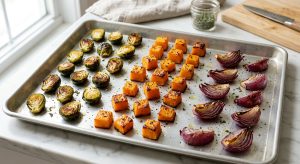
The modern sheet pan meal is a masterclass in low-effort, high-reward cooking. But the reason most people fail at sheet pan meals is that they throw everything onto the pan at the exact same time.
Carrots do not cook at the same speed as shrimp. If you put them in together, you will end up with either raw carrots or shrimp that have the texture of pencil erasers. The Hack: Zone your cooking. Toss your dense, slow-cooking root vegetables (potatoes, carrots, beets) onto the pan first and roast them for 15-20 minutes. Then, pull the pan out and add your fast-cooking ingredients (asparagus, shrimp, cherry tomatoes) for the final 10 minutes. One pan to wash, perfectly cooked food.
Batch Prepping Like a Boss (Without Losing Your Weekend)
I loathe the traditional “meal prep” trend where people cook 14 identical containers of chicken, rice, and broccoli on Sunday, only to stare at them with deep depression by Thursday.
Instead of prepping meals, prep components. Roast a massive tray of mixed vegetables. Cook a large batch of a versatile grain, like quinoa or farro. Whisk together a killer, flavor-packed vinaigrette. Marinate and cook a versatile protein. Now, during the week, you aren’t eating leftovers; you are assembling fresh bowls, tossing things into wraps, or throwing a handful of pre-roasted veggies into a quick omelet. You get variety without the daily labor.
The Gear That Actually Matters (And the Toxic Trash to Toss)
We need to have a serious talk about your cookware. If you are still cooking on cheap, scratched, peeling non-stick pans that you bought for $15 at a discount store five years ago, I need you to walk into your kitchen right now and throw them in the garbage. I am not joking.
The Non-Stick Nightmare: Why PFAS and Mystery Metals Are Ruining Your Food
Traditional non-stick coatings (Teflon and its cousins) are made with PFAS (per- and polyfluoroalkyl substances), notoriously known as “forever chemicals” because they do not break down in the environment or in your body. When these cheap pans are heated past 500°F—which happens much faster than you think on a gas stove—or when they become scratched, they can release toxic fumes and leach microplastics directly into your food.
The regulatory landscape is finally catching up to this nightmare. While California Governor Gavin Newsom controversially vetoed a full PFAS cookware ban in late 2025 citing consumer cost concerns, other states are not messing around. Colorado, Connecticut, Maine, and Rhode Island have aggressive legislation rolling out in 2026 and 2027 to completely ban the sale of cookware containing intentionally added PFAS. The Environmental Working Group (EWG) is actively fighting to get these toxic pans out of our kitchens. You do not need to wait for a government mandate to protect yourself. Ditch the toxic trash.
The Holy Trinity of Safe Cookware: Cast Iron, Carbon Steel, and Stainless
You only need three types of pans in your kitchen to cook like an absolute professional, and all of them are non-toxic, practically indestructible, and will outlive you.
- Stainless Steel (The Workhorse): This is what professionals use for 90% of their cooking. “But my food always sticks to stainless steel!” I hear you whining. That is because you are using it wrong. You must heat the pan before you add the oil, and you must use the Leidenfrost effect. Heat the dry pan over medium heat. Flick a few drops of water into it. If the water sizzles and evaporates, it’s not hot enough. If the water forms a perfect bead and glides around the pan like a mercury marble, your pan is ready. Add your oil, add your food, and it will glide like it’s on ice.
- Cast Iron (The Sear Master): Heavy, cheap, and holds heat like a dragon. This is what you use for searing steaks, baking cornbread, and smashing burgers. Yes, you have to “season” it (bake a thin layer of oil onto it to create a natural non-stick polymer), but no, it is not fragile. You can wash it with mild soap. Just dry it immediately on the stove so it doesn’t rust.
- Carbon Steel (The Egg Whisperer): This is the lovechild of cast iron and stainless steel. It is lighter than cast iron, responds to temperature changes faster, and takes a seasoning beautifully. Once properly seasoned, carbon steel is slick enough to fry an egg on without it sticking, making it the perfect, safe replacement for your toxic non-stick skillet.
Modern Gadgets Worth Your Counter Space
I hate kitchen clutter. I despise unitaskers (looking at you, avocado slicers and strawberry hullers). But there are two modern tools you absolutely must own:
- An Instant-Read Digital Thermometer: If you are cooking meat by poking it and guessing, you are playing a dangerous game of food poisoning roulette. Buy a high-quality digital thermometer. Chicken is done at 165°F. Medium-rare steak is 130°F. Stop guessing. Stop cutting your meat open to “check” and letting all the juices run out onto the cutting board.
- A Digital Kitchen Scale: As discussed, this is non-negotiable for modern baking and makes portioning a breeze.
Navigating Modern Ingredients: You Don’t Need a Culinary Degree to Use Miso
The modern recipe relies heavily on “umami bombs.” Umami is the fifth basic taste (alongside sweet, sour, salty, and bitter). It translates from Japanese as “pleasant savory taste” and is essentially the deep, meaty, mouth-watering flavor that makes food taste incredibly satisfying.
The “Swalty” Revolution and Umami Bombs
If you follow food trends, you know that the “Swicy” trend (sweet and spicy, like hot honey on everything) dominated the early 2020s. But in 2025 and 2026, the culinary world has pivoted hard to “Swalty”—the glorious combination of sweet and salty. Gen Z and Millennials are driving a 32% growth in demand for this flavor profile, leading to modern recipes featuring miso caramel, tahini chocolate chip cookies, and sea salt brownies.
To master modern recipes, you need to stock your fridge with umami-rich, “swalty”-enabling ingredients:
- Miso Paste: This is fermented soybean paste. It is salty, funky, and deeply savory. Do not just use it for soup. Whisk a tablespoon into your salad dressing, mash it into butter to melt over a steak, or fold it into your chocolate chip cookie dough to blow people’s minds.
- Fish Sauce: Put your preconceived notions away. Yes, it smells intense in the bottle. But when you add a splash of fish sauce to a beef stew, a Bolognese, or a chili, it does not make the dish taste like fish. It magically amplifies the meaty, savory notes of the dish. It is liquid gold.
- Gochujang: A Korean fermented chili paste that is spicy, sweet, and deeply savory. It is thick and sticky, perfect for whisking into marinades for chicken or tossing with roasted root vegetables.
- MSG (Monosodium Glutamate): Let’s kill the myth right now. MSG is not bad for you. The panic over MSG was rooted in outdated, highly flawed, and xenophobic 1960s pseudo-science. MSG is literally just isolated umami (glutamate is a naturally occurring amino acid found in tomatoes and parmesan cheese). A pinch of MSG in your soups or savory dishes will make them taste incredible.
Alternative Flours and Binders: Gluten-Free Doesn’t Mean Taste-Free
Modern recipes frequently cater to dietary restrictions without sacrificing quality. If a recipe calls for almond flour or tapioca starch, do not substitute regular all-purpose flour and expect the same result.
- Almond Flour: Provides moisture, healthy fats, and a dense, cakey texture. It burns faster than regular flour, so keep an eye on your oven.
- Xanthan Gum: If you are baking gluten-free, gluten is the structural protein that holds the bread or cake together. Without it, your baked goods will crumble into dust. Xanthan gum acts as the glue to replace the missing gluten. You only need a tiny fraction of a teaspoon, but it is entirely non-negotiable.
The Weekend Project: Mastering Intimidating Modern Trends
Weekdays are for survival and efficiency. Weekends are for rolling up your sleeves, pouring a glass of wine, and tackling the culinary projects that require a little more love, patience, and technique.
Fermentation and Sourdough: It’s Just Bacteria, Relax
Sourdough baking and at-home fermentation exploded a few years ago and have cemented themselves as permanent fixtures in the modern home kitchen. The terminology—”autolyse,” “bulk fermentation,” “levain”—is terrifying. But the actual process is incredibly grounded in nature.
A sourdough starter is just flour and water. When you mix them together and leave them on the counter, wild yeast and lactobacilli (good bacteria) from the air and the flour itself move in and start eating the starches. They release carbon dioxide (which makes the bread rise) and lactic acid (which gives it that sour tang).
You are basically keeping a very low-maintenance microscopic pet. You feed it a little flour and water, and in return, it bakes your bread. If your recipe calls for an “autolyse,” it just means mixing the flour and water together and letting it sit for 30 minutes before adding the salt and starter. This gives the flour time to fully hydrate and allows the gluten network to start forming naturally, meaning you have to knead the dough a lot less. See? It’s not snobbery; it’s a shortcut disguised as a fancy French word.
Reverse Searing and Temperature Control
If you are spending good money on a thick, beautiful cut of steak or a pork chop, cooking it in a pan from start to finish is a recipe for disaster. By the time the center reaches the correct temperature, the outside will be a tough, overcooked gray band of sadness.
Enter the Reverse Sear. This is the modern, foolproof way to cook thick proteins.
- Low and Slow: You put the meat in a very low oven (around 250°F) and let it slowly come up to temperature. Use that digital thermometer we talked about. Pull the meat out when it is about 10 degrees below your target final temperature (e.g., pull a steak at 120°F for medium-rare).
- Rest: Let it sit for 10 minutes.
- Hot and Fast: Get your cast iron skillet screaming hot. Add a high-smoke-point oil (like avocado or grapeseed oil). Sear the meat for no more than 60 seconds per side.
Because the outside of the meat dried out in the low oven, the Maillard reaction will happen almost instantly in the pan. You get an edge-to-edge perfect pink interior and a shatteringly crisp crust. It is restaurant-quality cooking achieved with basic home equipment.
Mindset Shift: Trusting Your Palate Over the Recipe
The most important lesson in this entire masterclass is this: The recipe is a guideline, not a legal contract.
Too many home cooks treat a recipe like a bomb defusal manual. They measure out exactly 1/4 teaspoon of black pepper because that is what the blog said, even if they personally love black pepper. They pull the chicken out of the oven at exactly 20 minutes, even if their oven runs cold and the chicken is still raw.
You must learn to trust your own senses. Ingredients vary wildly. A jalapeño bought in July might be ten times spicier than a jalapeño bought in December. A lemon might yield two tablespoons of juice, or it might yield four. If you blindly follow the recipe without tasting as you go, you are setting yourself up for inconsistency.
Tasting and Adjusting: The Acid-Fat-Salt-Heat Balance
If you taste your dish right before serving and think, “This is missing something, but I don’t know what,” do not immediately reach for more salt. You need to understand the balance of the four primary pillars of flavor:
- Salt: Enhances flavor. If the food tastes flat or dull, it needs salt.
- Acid: Brightens food and cuts through richness. If your soup or stew tastes heavy, muddy, or overly rich, it does not need more salt; it needs a squeeze of fresh lemon juice, a splash of apple cider vinegar, or a dash of hot sauce. Acid is the most underutilized tool in the home cook’s arsenal.
- Fat: Carries flavor and provides a luxurious mouthfeel. If a dish feels thin or astringent, finish it with a pat of cold butter or a drizzle of high-quality olive oil.
- Heat (Spice): Provides dimension. If a dish is too sweet or too rich, a pinch of cayenne or chili flakes will balance it out.
How to fix mistakes:
- Did you over-salt it? You cannot “take salt out.” But you can mask it by adding acid (lemon juice) or a touch of sweetness (honey/sugar), or by bulking out the dish with an unseasoned starch (like throwing in some diced potatoes or serving it over plain rice).
- Is it too spicy? Add fat. Dairy (like heavy cream or yogurt) contains casein, a protein that binds to capsaicin (the chemical that makes chilies hot) and washes it away.
- Is it too sweet? Add acid (vinegar/citrus) or a bitter element (like dark leafy greens) to counteract the sugar.
Conclusion: Your Kitchen, Your Rules
Cooking should not be a source of stress. The modern culinary world, with all its global ingredients, scientific precision, and fancy gadgets, is not designed to lock you out; it is designed to give you better tools.
You don’t need to master everything at once. Buy a food scale and start weighing your flour. Throw away your peeling non-stick skillet and learn to love stainless steel. Buy a jar of miso paste and sneak it into your next batch of cookies. Treat your air fryer with the respect it deserves. And above all, start tasting your food and adjusting it to your preferences, not the preferences of a recipe developer who has never met you.
The kitchen is your domain. Arm yourself with decent gear, understand the basic science of what happens when heat meets food, and give yourself the grace to make a few mistakes along the way. Now, go pour another glass of wine, turn on some music, and go cook something incredible. You’ve got this.