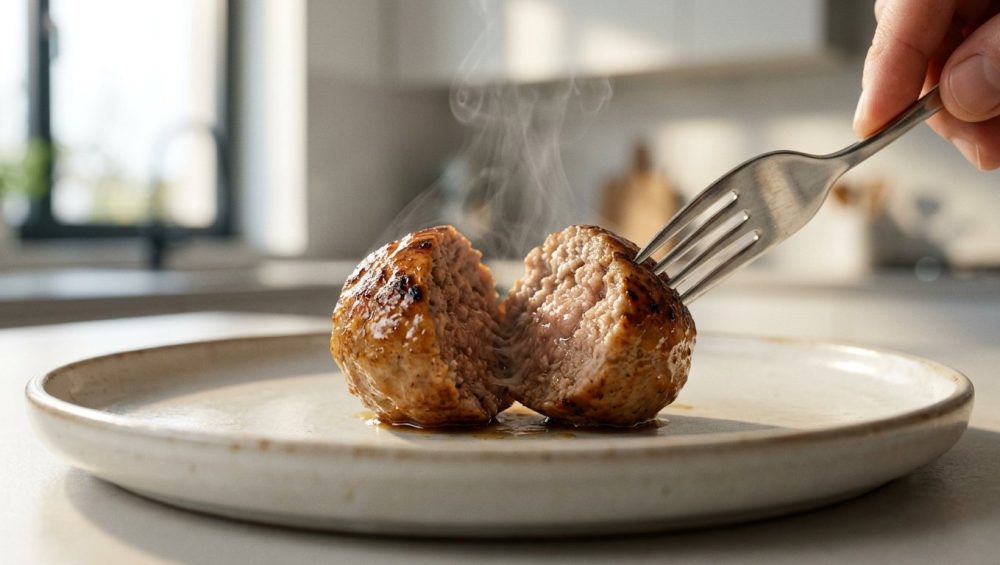
The Tragedy of the Bounceable Meatball
Listen, we need to have a serious talk about your meatballs. Pour yourself a glass of wine, grab a cutting board, and let us get brutally honest for a moment. We have all been to that neighborhood potluck or well-meaning dinner party where someone proudly unveils a slow cooker full of meatballs. You take a bite, and your jaw is immediately subjected to a high-intensity cardiovascular workout. The meatball is dense, dry, and possesses the structural integrity of a Titleist golf ball. If you were to drop it on the floor, it would likely bounce back up and hit you in the eye.
I do not care if your grandmother guards her family recipe like it is the nuclear launch codes. If your meatballs require a steak knife and a prayer to get through, you are doing it wrong. The tragedy here is that ground meat is inherently a blank canvas, practically begging to be transformed into something tender, rich, and melt-in-your-mouth delicious. Yet, time and time again, home cooks treat their ground beef like a stress ball, packing it tightly into dense spheres of inevitable disappointment. When you skip the fundamental food science required to keep ground meat tender, you are setting yourself up for one of the most common and disastrous beginner cooking mistakes.
You do not need a culinary degree from Le Cordon Bleu to fix this. You do not need expensive, hard-to-find ingredients, and you certainly do not need to spend six hours hovering over a hot stove on a Tuesday night. Time is money, especially during the week, and we need weeknight dinners to be efficient, foolproof, and spectacular. The secret to achieving that impossibly light, cloud-like texture in your meatballs and meatloaves comes down to one incredibly simple, almost embarrassingly basic technique: the panade.
The Food Science of a Hockey Puck: Actin, Myosin, and Meat Sweats
I have zero patience for pretentious recipe jargon, but understanding a little bit of food chemistry is the only way you are going to elevate your cooking from “edible” to “mind-blowing.” To understand why the panade is your culinary savior, we first have to understand why meat gets tough in the first place.
Meat is essentially muscle, and muscle is primarily composed of water, fat, and protein. The two main proteins we are concerned with in the kitchen are actin and myosin. In their raw state, these proteins are relatively relaxed. However, when you apply heat—whether you are searing in a skillet, baking in an oven, or braising in a rich marinara sauce—these protein fibers begin to denature, unfold, and then violently contract and link up with one another.
Imagine a sponge full of water. Now imagine squeezing that sponge as hard as you possibly can. That is exactly what actin and myosin are doing to your meatball as the internal temperature rises. As the proteins tighten, they physically squeeze out the moisture and the rendered fat, leaving behind a dry, rubbery matrix of cross-linked protein strands. This phenomenon is often referred to as the “meat sweats,” which is why you will often see a puddle of gray liquid surrounding poorly made burgers or meatballs in a pan.
When you buy ground meat, the butcher has already done you a disservice in the texture department. The mechanical grinding process breaks down the natural cellular structure of the muscle, exposing more of those proteins and making them highly reactive. If you take raw ground beef, add a little salt, and aggressively mix it with your hands, you are actively encouraging those myosin proteins to bind together. By the time you roll them into tight little spheres and throw them into a hot pan, their fate is sealed. They will shrink, they will expel their juices, and they will become tough. If you want to stop making dry meatballs, you need to introduce a physical barrier that prevents those proteins from holding hands quite so tightly.
Enter the Panade: Ancient Moisture Technology
A panade (pronounced puh-NOD) is a culinary term derived from the French word for “bread mash”. At its most fundamental level, a panade is simply a mixture of a starch (usually bread or crackers) and a liquid (usually milk, buttermilk, or stock) mashed together into a thick, uniform paste.
This is not a new, trendy molecular gastronomy trick. This is ancient moisture technology. For centuries, cooks across the globe—from Italian nonnas rolling polpette to Swedish grandmothers crafting traditional köttbullar—have relied on this exact method to stretch expensive meat further and yield a softer, more palatable texture.
But how does it actually work? When you fold a panade into your raw ground meat, you are physically interrupting the protein network. The starchy, milky paste coats the individual strands of actin and myosin. When the meatball hits the heat and the proteins inevitably try to contract and link up, they can’t. The panade acts as a physical roadblock, a lubricating barrier that keeps the protein strands separated.
Furthermore, the starch in the bread undergoes a process called gelatinization when exposed to heat and moisture. The starch granules swell and burst, forming a microscopic gel matrix. This gel acts like an internal sponge. As the meat proteins contract and try to expel their water and rendered fat, the gelatinized starch immediately absorbs and traps those flavorful juices right inside the meatball. The result? A meatball that is structurally sound but yields effortlessly to a fork, releasing a burst of savory, fat-rich moisture with every single bite. Implementing this one step will transform your daily meals without requiring any fancy equipment.
The Liquid Equation: Why Milk is the Undisputed Champion
While you can technically make a panade with almost any liquid—water, beef stock, chicken broth, or even heavy cream—milk is the undisputed champion of the meatball world.
Let us break down why. Water provides moisture, yes, but it provides absolutely zero flavor and zero fat. If you soak your bread in water, you are essentially just watering down the savory profile of your expensive ground meat. Stock or broth is a step up because it adds umami and salt, but it still lacks the critical component that makes milk so magical: dairy fat.
The magic of milk-soaked bread lies in its unique composition. Whole milk contains about 3.25% fat, alongside specialized milk proteins and a naturally occurring sugar called lactose. When you introduce milk fat into the ground meat mixture, it provides an additional layer of lubrication between the meat proteins. Fat is a poor conductor of heat compared to water, which means the dairy fat actually helps to slow down the rate of heat transfer inside the meatball, giving you a wider margin of error before the meat overcooks.
Additionally, milk contains lactic acid. While the acidity level is mild, it is just enough to begin gently tenderizing the meat fibers the moment you mix it in. This slight acidity also balances the heavy, rich, savory notes of the beef and pork, brightening the overall flavor profile of the finished dish. If you are feeling particularly adventurous on a weekend, buttermilk or plain yogurt can be substituted for an even more pronounced tang and tenderizing effect, but for your standard, reliable weeknight dinner, whole milk is the gold standard.
The Starch Selection: Ditch the Dry Breadcrumbs
This is where I see home cooks go off the rails constantly. You open your pantry, grab a cardboard canister of dry, sandy, store-bought breadcrumbs, dump a handful into your raw ground beef, crack an egg, and call it a day.
Stop doing this immediately.
Dry breadcrumbs are a desiccant. They are literally designed to be dry. When you mix un-hydrated, dry breadcrumbs directly into ground meat, they act like tiny little leeches. They aggressively suck the natural moisture out of the meat in an attempt to hydrate themselves. Furthermore, because they are so fine and granular, they fill in all the microscopic textural gaps in your meat mixture, turning the entire thing into a dense, gluey, spackling paste.
For a proper panade, you want fresh or slightly stale bread. And not just any bread. While I am a massive advocate for artisanal sourdoughs and rustic crusty boules, this is not the time for them. Truly mastering the art of the home kitchen means knowing when to be fancy and when to be practical. The best bread for a meatball panade is cheap, standard, squishy white sandwich bread.
Why? Because standard white bread has a highly processed, uniform crumb structure that dissolves seamlessly into a paste when mixed with milk. A crusty sourdough has too much chew, too much gluten development, and a tough exterior that will leave hard, unappetizing lumps in your meatballs.
The Panko Exception
If you absolutely refuse to buy a loaf of white sandwich bread, your best alternative is Panko. Panko breadcrumbs are Japanese-style breadcrumbs made from crustless white bread that is baked using electrical currents, resulting in a light, airy, flaky texture. Because Panko is so porous, it absorbs milk beautifully and breaks down into a respectable panade. However, you must soak the Panko in the milk for a good 10 to 15 minutes before adding it to the meat, allowing it to fully hydrate and turn into a mash.
The Golden Rule of Crusts
If you are using sliced sandwich bread, you must remove the crusts. The crusts are drier, tougher, and will not break down into the smooth paste required for a panade. Save the crusts for croutons or feed them to the birds, but keep them out of your meatballs.
The Golden Ratio: Formulating the Perfect Panade
Cooking is an art, but baking and binding are sciences. You cannot just eyeball a splash of milk and a torn-up piece of bread and expect Michelin-star results. You need a reliable, repeatable ratio.
For standard meatballs and meatloaves, the golden ratio is:
1/2 cup of loosely packed, torn white bread (crusts removed) + 2 to 3 tablespoons of whole milk per 1 pound of ground meat.
If you are using Panko, the ratio shifts slightly because of the volume difference:
1/4 cup of Panko + 1/4 cup of whole milk per 1 pound of ground meat.
Step-by-Step Panade Execution:
- Tear your crustless white bread into small, bite-sized pieces and place them in a wide bowl.
- Pour the milk evenly over the bread.
- Let it sit undisturbed for 5 to 10 minutes. This allows the bread to fully absorb the liquid.
- Take a standard dinner fork and aggressively mash the soaked bread until it transforms into a smooth, thick, uniform paste. There should be no dry spots and no large, discernible chunks of bread remaining.
Congratulations, you have just created a panade. You have officially unlocked the secret to eternal meatball tenderness.
The Meat Matrix: Fat Percentages and Protein Blends
Now that we have our moisture-locking panade, we need to talk about the canvas: the meat.
Ground beef is the classic choice, but not all ground beef is created equal. If you buy 95% lean ground beef to make meatballs, you are fighting a losing battle. Fat is flavor, and fat is moisture. You should always aim for an 80/20 ratio (80% lean meat to 20% fat) when making meatballs or burgers. The fat renders during cooking, basting the meatball from the inside out, while the panade catches and holds onto that rendered fat.
For the absolute best texture and flavor profile, you should utilize a meat blend. The classic Italian-American “meatball mix” found at most butcher counters is a holy trinity of beef, pork, and veal.
- Beef (80/20): Provides the robust, savory, beefy foundation.
- Pork: Ground pork is naturally sweeter and has a softer fat composition that melts beautifully, contributing to a melt-in-your-mouth texture.
- Veal: Veal is very young beef. It is mild in flavor but exceptionally high in natural gelatin. When cooked, this gelatin melts and provides a luxurious, silky mouthfeel that you simply cannot achieve with beef alone.
The Turkey Meatball Dilemma
Let us address the elephant in the room: ground turkey and ground chicken. Lean poultry is notoriously unforgiving. It has very little intramuscular fat and a high propensity for drying out and turning into sawdust. If you are making turkey meatballs, a panade is not just a suggestion; it is a non-negotiable requirement for edibility. When using poultry, I highly recommend using ground dark meat (thighs) rather than breast meat, and adding an extra tablespoon of milk to your panade to compensate for the lack of natural fat.
Mixing Mechanics: Step Away from the Meat
You have your beautiful 80/20 meat blend. You have your perfectly mashed milk panade. You have your aromatics (grated parmesan, minced garlic, fresh parsley, salt, and pepper). Now comes the most critical point of failure in the entire process: the mixing.
As we discussed earlier, mechanical action (kneading, squeezing, pressing) encourages myosin proteins to cross-link and develop a sticky, tight network. If you treat your meatball mixture like you are kneading a tough ball of pizza dough, you will ruin it.
The Claw Method:
Place all of your ingredients into a large, chilled mixing bowl. The bowl should be cold to prevent the fat in the meat from smearing and melting on your hands. Form your hand into a rigid “claw” shape, with your fingers spaced apart. Gently plunge your claw into the mixture and fold it over itself. Do this with a light touch, lifting and folding, just until the ingredients are homogeneously distributed. The moment the panade and the spices are evenly dispersed, stop touching it.
When it comes time to shape the meatballs, do not roll them aggressively between your palms like you are making clay beads. Wet your hands with a little cold water (this prevents sticking) and gently cup the meat into rounds. Pack them only as tightly as necessary to hold their shape. The looser the pack, the more tender the final bite.
The Sear: Thermodynamics and Banishing Toxic Cookware
We have arrived at the cooking phase. You want a gorgeous, deeply browned crust on the outside of your meatball, which provides incredible savory flavor via the Maillard reaction. The Maillard reaction is a chemical reaction between amino acids and reducing sugars that occurs rapidly around 300°F (150°C), resulting in that beautiful brown crust and complex flavor profile.
To achieve this, you need high heat, and you need a pan that can retain that heat. This brings me to my absolute, uncompromising, hardline rule: I am fiercely passionate about banishing toxic kitchen gear from your home.
Do not sear your pristine, lovingly crafted meatballs in a cheap, scratched, peeling Teflon non-stick pan. Those pans cannot safely handle the high heat required for a proper sear without degrading their chemical coatings and off-gassing toxic fumes into your kitchen. Furthermore, cheap aluminum non-stick pans have terrible thermal mass. The moment you drop cold meatballs into them, the temperature plummets. When the temperature drops, the Maillard reaction stops, and your ground beef steams instead of searing. Boiled, gray ground beef is a culinary tragedy.
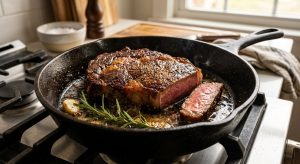
You need heavy, thick-bottomed cookware. An enameled cast iron skillet, a seasoned carbon steel pan, or a high-quality multi-clad stainless steel skillet are your only acceptable options here.
I know what you are thinking: “But Sassy Sous-Chef, everything sticks to your stainless steel!” No, it doesn’t. Food sticks to stainless steel when the pan is not preheated correctly or when you try to forcefully flip the meat before it is ready.
Preheat your stainless steel skillet over medium heat until a drop of water dances and glides across the surface like a mercury bead (the Leidenfrost effect). Add a high-smoke-point oil (like avocado or grapeseed oil). Gently place your meatballs into the pan, leaving at least an inch of space between them. Do not crowd the pan! If you crowd the pan, the moisture escaping from the meatballs will get trapped, creating steam.
Once the meatball hits the pan, leave it alone. The proteins will initially bond to the metal, but as the Maillard reaction occurs and the crust forms, the meat will naturally release itself from the pan. When it easily gives way to a spatula, it is time to flip. Investing in high-quality beginner kitchen tools like a flexible fish spatula will make turning these delicate, panade-softened meatballs an absolute breeze.
Cooking Methods: To Sear, Bake, or Braise?
Once you have mastered the panade, you have the flexibility to cook your meatballs however fits your schedule.
The Weekday Bake (Time is Money)
If it is a Wednesday night and you are exhausted, skip the stovetop sear entirely. Preheat your oven to 400°F (200°C). Line a heavy-duty baking sheet with parchment paper, arrange your meatballs, and bake them for 15 to 20 minutes until they reach an internal temperature of 160°F (71°C). The high heat of the oven will provide a decent browning on the outside, while the panade works its magic on the inside, keeping them incredibly juicy. It is hands-off, splatter-free, and highly efficient.
The Weekend Braise (The Perfectionist)
If it is Sunday and you are channeling your inner Italian grandmother, go for the braise. Sear the meatballs in a heavy skillet just until a brown crust forms on the outside (they will still be raw in the center). Remove them from the pan, deglaze all those beautiful browned bits (fond) with a splash of wine, and build your tomato sauce right in that same pot. Once the sauce is simmering, gently nestle the partially cooked meatballs back into the bubbling marinara. Turn the heat down to low, cover the pot, and let them gently poach in the sauce for 45 minutes to an hour. The panade will absorb the flavors of the tomato sauce, and the rendered fat from the meatballs will emulsify into the marinara, creating a rich, velvety masterpiece.
The Raw Drop (The Risky Traditionalist)
Some old-school recipes call for dropping completely raw meatballs directly into a pot of simmering sauce. I generally advise against this for beginners. Without the structural integrity provided by a seared crust, the gentle simmering action of the sauce can easily cause the meatballs to break apart, leaving you with a pot of meat sauce rather than distinct meatballs. If you insist on this method, your panade ratio must be absolutely perfect, and your sauce must be kept at a bare, gentle quiver—never a rolling boil.
Modern Meat Consumption: Why Making It Count Matters
We are living in an era where our relationship with meat is fundamentally shifting. Globally, the average meat consumption hovers around 45.3 kilograms per capita annually. In places like Germany, recent 2024 statistics show a slight stabilization at 53.2 kilograms per person, though the long-term trend strongly points toward flexitarian diets and a more mindful approach to animal proteins.
People are eating slightly less meat, but they are demanding higher quality when they do. We are paying more for ethically raised, grass-fed beef and heritage-breed pork. If you are going to spend your hard-earned money on high-quality ground meat, and if we are striving to be more conscious of our consumption, it is a culinary crime to ruin that ingredient by turning it into a dry, flavorless hockey puck.
Using a panade is not just about making a better dinner; it is about respecting the ingredients. It is about maximizing the yield, flavor, and texture of the meat you bring into your kitchen. It is a testament to the fact that brilliant cooking does not rely on truffles or caviar, but on understanding the humble, transformative power of a slice of bread and a splash of milk.
Conclusion: Your Culinary Emancipation
You now possess the definitive blueprint for the perfect meatball. You understand the treacherous nature of actin and myosin. You know why dry breadcrumbs are the enemy of moisture, and why a simple paste of crustless white bread and whole milk is the ultimate culinary equalizer. You know to respect the meat by mixing it gently, and you know to respect yourself by cooking it in safe, high-quality cookware.
The next time you are craving spaghetti and meatballs, a massive meatball sub, or a comforting weeknight meatloaf, you can approach the cutting board with absolute confidence. You do not need a professional kitchen, and you do not need to rely on luck. You just need a little bit of science, a splash of dairy, and the willingness to get your hands dirty.
Now get in the kitchen, mash up that bread, and go make something spectacular. You’ve got this.