Listen up, buttercup. We need to have a serious, sit-down conversation about that sad, separated puddle of oil currently drowning your lettuce. You know exactly what I am talking about. You spend twenty minutes meticulously chopping gorgeous, farmer’s market vegetables, only to douse them in a homemade vinaigrette that stubbornly splits into a greasy oil slick and an aggressively acidic, watery swamp the second it hits the serving bowl. It is a tragedy, it is an insult to your expensive organic produce, and frankly, we are going to fix it today.
I am a busy professional. During the week, my time is money, and I rely on ruthless efficiency to get dinner on the table. But on the weekends? I am an absolute culinary perfectionist. I have set off my smoke detector enough times to learn the hard way that cooking is not about possessing some innate, magical talent; it is about understanding the fundamental, unbending rules of the kitchen. You do not need an expensive culinary degree to make a mind-blowing salad. You just need a crash course in elementary school chemistry and the secret power of Dijon mustard.
Today, we are leaving no stone unturned. We are going to dive deep into the molecular food science of emulsions, demystify the natural chemical repulsion between oil and vinegar, and outline the exact techniques, surfactant ratios, and foolproof methods required to build a stable, creamy vinaigrette that never, ever splits in the fridge.
The Cold, Hard Science of Why Your Salad Dressing Hates You
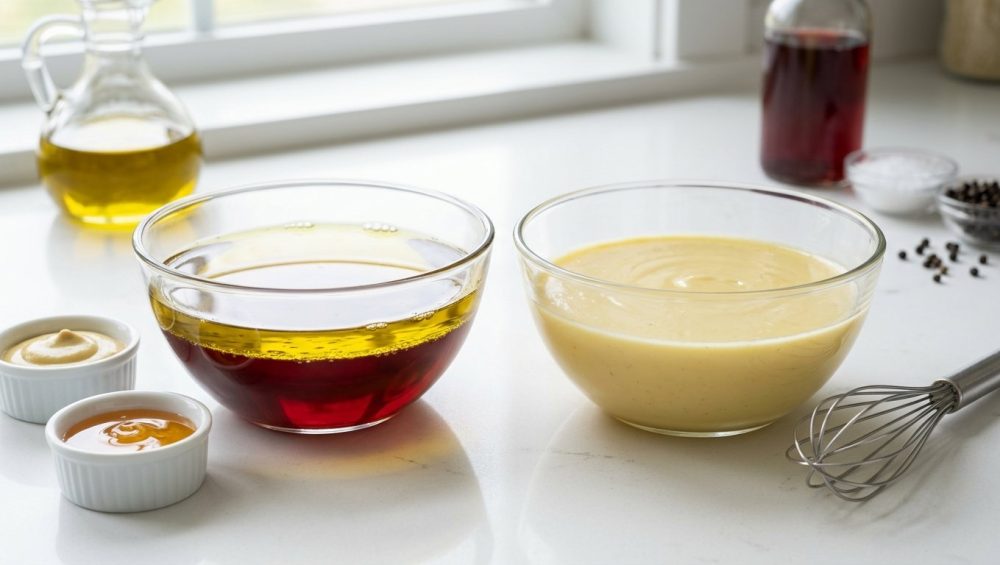
To understand why your salad dressing separates, you have to understand that oil and vinegar despise each other on a molecular level. It is a tale as old as time, governed by the strict laws of chemistry. Vinegar is composed primarily of water and acetic acid. Water is a polar molecule, meaning it has a slightly positive charge on one end and a slightly negative charge on the other. Oil, on the other hand, is made up of long chains of fatty acids that are entirely non-polar. They carry no electrical charge whatsoever.
In the microscopic world, the golden rule is that “like attracts like.” Polar molecules desperately want to bond with other polar molecules, and non-polar molecules want to cling exclusively to other non-polar molecules. Water molecules will literally push the oil out of the way so they can hold hands with each other.
When you aggressively shake or whisk oil and vinegar together in a bowl, you are using mechanical kinetic energy to physically smash the oil into microscopic droplets, forcefully dispersing them throughout the watery vinegar. In food science, this temporary mixture of two immiscible (unmixable) liquids is known as a colloidal dispersion, or an emulsion.
But here is the kicker: it is strictly temporary. According to the second law of thermodynamics, maintaining that forced, unnatural mixture requires a massive amount of energy. The universe inherently prefers a state of low energy and stability. The moment you stop whisking, the kinetic energy dissipates. The microscopic droplets of oil immediately seek each other out, coalesce into larger drops, and float right back up to the surface because oil is less dense than water. Within minutes, your beautiful dressing is completely broken.
The Peacemakers: Demystifying Nature’s Binding Agents
To bridge this massive chemical divide, you need a microscopic peacemaker. In the culinary world, we call this a surfactant or an emulsifier. Emulsifiers are miraculous, hardworking little molecules that are amphiphilic—meaning they are bipolar in the best way possible. One end of the molecule is hydrophilic (water-loving) and the other end is lipophilic (fat-loving).
When you introduce an emulsifying agent into your vinaigrette, it immediately rushes to the border between the oil and the water. It coats the microscopic oil droplets, grabbing the oil with its lipophilic hand and the water with its hydrophilic hand, effectively locking them together. This prevents the oil droplets from coalescing and separating.
Let us break down the most accessible, highly effective emulsifiers hiding right now in your pantry.
Mustard: The Mucilage Magic
Mustard is not just a condiment designed to make your mouth pucker; it is an incredibly powerful, natural emulsifying agent. The outer hull of the mustard seed contains a complex carbohydrate (a polysaccharide) called mucilage. Unrefined yellow mustard bran contains roughly 5.5% mucilage by weight. When mustard seeds are ground into a paste—like your trusty jar of Dijon—this mucilage is released. It acts as a thickener, a hydrocolloid stabilizer, and a surfactant. This is why a simple dollop of high-quality Dijon mustard can hold a standard vinaigrette together for days on end without breaking.
Egg Yolks: The Lecithin Lifesaver
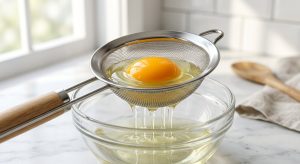
If you have ever made a traditional Caesar dressing, a velvety hollandaise, or a batch of homemade mayonnaise, you have witnessed the sheer, unadulterated magic of egg yolks. Egg yolks are absolutely packed with lecithin, a naturally occurring phospholipid. Lecithin was first isolated way back in 1846 by a French chemist, and it remains the undisputed heavyweight champion of the emulsification world. Its dual-affinity structure lowers the interfacial tension between oil and water so effectively that it creates a permanent, virtually unbreakable emulsion. If you are making a quick weeknight Caesar and want to skip the raw egg anxiety, a dollop of store-bought mayonnaise (which is already packed with emulsified lecithin) works as a brilliant, time-saving shortcut.
Garlic and Shallots: The Particulate Stabilizers
You might be surprised to learn that standard aromatics like raw garlic and shallots can also help bind your dressing. When you crush or finely grate garlic into a paste, you rupture its cell walls, releasing natural saponins and complex carbohydrates that act as mild emulsifiers. However, as any seasoned home cook knows, raw garlic is overpowering if left unchecked. The smart culinary hack is to macerate your minced garlic or shallots in your vinegar for ten to fifteen minutes before adding your oil. The acid naturally cooks and mellows the harsh allicin compounds, giving you a smooth flavor profile while still utilizing the plant’s natural stabilizing properties.
Honey and Maple Syrup: The Viscosity Builders
Let me be perfectly clear: honey, maple syrup, and agave nectar are not true chemical emulsifiers. They do not possess that necessary dual-action hydrophilic and lipophilic molecular structure. However, they are incredibly viscous. By thickening the water phase (the vinegar) of your dressing, they create physical roadblocks and friction that make it much harder for the suspended oil droplets to move around, find each other, and coalesce. They are the ultimate supporting actors in your vinaigrette production, adding both crucial flavor balance and structural stability.
The Golden Ratios: Throwing Out the Outdated Rulebook
If you open up any old-school, traditional French culinary textbook, it will aggressively demand that you follow a strict 3:1 ratio: exactly three parts oil to one part vinegar. I am here to tell you that for the modern, everyday home cook, that ratio is often absolute garbage.
Why? Because the classic 3:1 ratio was designed centuries ago for incredibly sharp, harsh, unrefined vinegars and a historical palate that favored heavy, oil-slicked greens. Today, we have access to a massive variety of softer, sweeter, and more nuanced acids like aged balsamic, seasoned rice vinegar, sherry vinegar, or fresh Meyer lemon juice. If you stubbornly apply a 3:1 ratio to a delicate, low-acidity champagne vinegar, all you will taste is a heavy, muted mouthful of liquid fat.
For weekday efficiency and a brighter, punchier flavor profile, I strongly advocate for the 2:1 or even the 1:1 ratio. Sometimes, a rich, heavy dinner actually needs acid to cut through the fat of the main course. A 1:1 ratio (one part high-quality olive oil, one part vibrant citrus or vinegar) held together by a generous, heaping spoonful of Dijon mustard and a touch of honey yields a bright, vibrant, highly stable dressing that will not leave you feeling like you just drank a bottle of canola oil.
The secret to mastering the ratio is to taste as you go. Dip a leaf of your actual salad green into the dressing to test it. Tasting a vinaigrette off a metal spoon will not give you an accurate representation of how it will taste when dispersed across bitter arugula or watery iceberg lettuce.
The Gear: Stop Sabotaging Yourself with Toxic Kitchenware
I have zero patience for pretentious, gatekeeping chef-speak, but I have even less patience for toxic, cheap kitchenware that actively ruins your food. The “No-Go” Rule in my kitchen is absolute: if a tool leaches chemicals, sheds plastic, or introduces mystery metals into my meals, it goes directly in the trash.
First of all, stop making your acidic dressings in cheap, heavily scratched plastic shaker bottles. Not only do plastic containers stay greasy forever because plastic is inherently lipophilic (it literally absorbs and holds onto oil), but highly acidic vinegars and citrus juices can degrade cheap plastics over time. This process leaches microplastics and known endocrine disruptors directly into your beautiful, expensive organic salad. Glass is non-reactive, non-porous, and perfectly safe.
Furthermore, if you are currently using a flimsy dollar-store whisk with a peeling, flaking non-stick silicone or Teflon coating, throw it away immediately. I will wait. You absolutely do not want microscopic flakes of mystery polymer floating in your vinaigrette. Invest in pure, food-grade stainless steel. A heavy-bottomed stainless steel mixing bowl, a thick glass mason jar, and a pure stainless steel balloon whisk are some of the very few beginner kitchen tools you actually need to build a flawless emulsion.
And please, periodically check the structural integrity of your equipment. If your whisk leaks dishwater from a poorly sealed handle after running it through the dishwasher, it is harboring dangerous mold and bacteria. Upgrade to a fully sealed, seamless stainless steel whisk. Your health and your vinaigrettes will thank you.
The Masterclass Technique: Three Foolproof Methods for a Bulletproof Emulsion
You now understand the molecular science, you have gathered the correct binding ingredients, and you have banished the toxic gear from your kitchen. Now, let us talk about flawless execution. The way you introduce the kinetic energy into your dressing dictates how stable the final emulsion will be.
Method 1: The Classic Bowl & Whisk (Weekend Perfection)
This method is for Saturday evenings when you have the time, the patience, and the desire to channel your inner Parisian bistro chef.
- The Base: In your heavy stainless steel mixing bowl, combine your acid (vinegar or citrus), your emulsifier (a hefty teaspoon of Dijon mustard or a pasteurized egg yolk), your stabilizers (a drizzle of honey or macerated minced shallot), and a generous pinch of kosher salt and freshly cracked black pepper.
- The Anchor: Secure your mixing bowl so it does not fly off the counter. A brilliant kitchen hack is to twist a damp kitchen towel into a tight ring and set the base of the bowl inside it. This creates a makeshift, non-slip base.
- The Homogenization: Whisk the base ingredients aggressively until they are completely smooth and homogenous. The salt must be fully dissolved in the water phase before the oil is introduced, as salt will not dissolve in oil.
- The Drip: This is the critical moment. While whisking constantly and vigorously, begin adding your oil drop by microscopic drop. I mean it. If you dump a quarter cup of oil into the bowl all at once, the emulsion will instantly fail, and you will have a greasy mess.
- The Stream: Once you have incorporated the first few tablespoons of oil drop-by-drop, you will notice the dressing begin to thicken, turn opaque, and lighten in color. This visual change is the absolute confirmation that the microscopic oil droplets are successfully suspending in the water phase. At this point, you can safely increase the oil flow to a slow, thin, continuous stream while maintaining your aggressive whisking until all the oil is incorporated.
Method 2: The Mason Jar Shake (Weekday Efficiency)
Time is money, and on a hectic Tuesday night after a long day at the office, absolutely nobody has the time or the wrist stamina to whisk oil drop-by-drop.
- The Dump: Add all of your ingredients—the acid, the mustard, the honey, the seasonings, and the entire measure of oil—directly into a clean, sturdy glass mason jar.
- The Seal: Ensure the lid is screwed on incredibly tight. A leaky mason jar will result in an olive oil disaster across your kitchen cabinets.
- The Violence: Shake the jar violently. Channel all of your workday frustrations, your traffic-jam rage, and your general existential dread into this jar for a solid 30 to 45 seconds. The immense kinetic energy bouncing off the hard glass walls will physically smash the oil into microscopic droplets, while the mustard and honey scramble to lock them into place. It is fast, it is efficient, and it creates a perfectly stable emulsion for a weeknight dinner.
Method 3: The Immersion Blender (The Industrial Strength Emulsion)
If you want a thick, creamy, almost mayonnaise-like vinaigrette that will absolutely never separate—even if it sits in the fridge for three weeks—the immersion blender (stick blender) is your best friend.
The mechanical shearing force generated by the rapidly spinning metal blades creates oil droplets that are exponentially smaller than anything you could ever achieve by hand. Place all of your ingredients into a tall, narrow, cylindrical container (the cup that came with the blender is perfect). Lower the immersion blender all the way to the bottom of the cup, turn it on high, and slowly pull it upward. The blades will create a powerful vortex, instantly emulsifying the oil and vinegar into a luxurious, velvety dressing that is practically bulletproof.
Temperature and Thermodynamics: Why Cold Ingredients Break Your Dressing
Food science is not just about what specific ingredients you mix together; it is heavily dependent on the temperature at which you mix them. If you try to build an emulsion with ice-cold olive oil and a jar of Dijon mustard pulled straight from the freezing back corner of your refrigerator, you are setting yourself up for miserable failure.
Cold temperatures make lipids (fats) incredibly sluggish, thick, and viscous. Cold emulsifiers are stiff and unyielding. When everything in your bowl is cold, the amount of mechanical kinetic energy required to smash the oil into those necessary microscopic droplets increases exponentially. The oil will stubbornly refuse to break apart, and the mustard will struggle to coat the droplets.
For the best, most foolproof results, always let your ingredients—especially your oil, mustard, and eggs if you are using them—come up to room temperature before you begin the emulsification process.
Troubleshooting: How to Rescue a Broken, Greasy Vinaigrette
So, you rushed the process. You got impatient, you dumped the oil into the bowl way too fast, and now you are staring down into a split, greasy, unappetizing mess. Take a deep breath. Do not throw it down the drain. You can fix this with science.
The Water Drop Trick: Sometimes, an emulsion breaks simply because there is too much oil and not enough water to suspend it in. The oil droplets become too crowded and crash into each other. This is called an inverted emulsion. To fix it, place exactly one tablespoon of boiling hot water into a clean, separate mixing bowl. Slowly whisk your broken, greasy dressing into the hot water, drop by drop. The heat from the water will loosen the stiff, coalesced oil, and the extra water volume will re-establish the continuous phase, giving the oil droplets room to suspend properly.
The Mustard Rescue: If the hot water trick fails, it means your chemical ratio of emulsifier to oil is fundamentally off. You need more peacemakers. Place a fresh, heaping teaspoon of Dijon mustard into a clean bowl. Slowly whisk your broken vinaigrette into the new mustard. The fresh influx of mucilage will forcefully bind the oil and vinegar back into a harmonious relationship.
Storage, Longevity, and the Refrigerator Conundrum
A properly emulsified, highly acidic homemade vinaigrette will easily last up to two weeks in the refrigerator. The high acid content creates an inhospitable environment for bacterial growth. However, you will inevitably encounter the great refrigerator conundrum: real, high-quality olive oil solidifies at cold temperatures.
When you pull your beautiful, handcrafted dressing out of the fridge on day three, it might look like a chunky, cloudy, unappetizing block of yellow wax. Do not panic, and definitely do not throw it away. This is just the natural thermodynamic crystallization of the lipid molecules in the oil.
To bring it back to life, simply leave the glass jar on the kitchen counter for twenty to thirty minutes, or run the base of the jar under warm (never boiling hot) tap water. Once the oil gently returns to room temperature and liquefies, give the jar a quick, vigorous shake. Your emulsion will be perfectly restored to its former glory.
And a quick reminder on salad prep: a perfect dressing is useless if it slides right off wet lettuce. The magic of a salad spinner ensures that residual tap water does not dilute your meticulously crafted emulsion. Furthermore, to prevent your greens from instantly wilting into a sad, soggy mess, stop adding salt too early to your leafy vegetables; you should only dress and salt your salad in the exact moments right before serving. And if you are tossing in beautiful extras like basil or cilantro, ensure your fresh herbs get slimy prevention by storing them properly dry in a paper towel before chopping them.
Ditching the Store-Bought Junk: A Final Plea
The global salad dressing market was valued at a staggering $82.67 billion in 2024. Do you know what that massive number actually means? It means that billions of dollars are being spent by well-meaning consumers on cheap, highly refined soybean oil, high-fructose corn syrup, and synthetic vegetable gums.
When you buy a standard bottle of ranch or Italian dressing off the ambient supermarket shelf, you are not paying for quality ingredients; you are paying for water that has been artificially thickened with xanthan gum, stabilized with polysorbates, and preserved with calcium disodium EDTA just so it can survive a nuclear apocalypse on a grocery store shelf. You are paying for artificial flavorings and the same industrial-grade additives found in aerosol cooking sprays. These highly processed, chemical-laden slurries have absolutely no place in a mindful home kitchen.
You are better than that. With a jar of good mustard, a bottle of quality vinegar, a splash of decent oil, and a fundamental understanding of basic emulsion chemistry, you can create a culinary masterpiece in under two minutes. You do not need a culinary degree, and you do not need to settle for separated, greasy salads ever again. You just need a sturdy stainless steel whisk, a little bit of science, and the confidence to show that oil and vinegar exactly who is boss.
Now, get back in the kitchen and start whisking.