It is a Tuesday night. You are exhausted from back-to-back meetings, your inbox is a disaster zone, and all you want to do is throw together a quick, comforting meal before collapsing on the couch. You pull out your favorite chef’s knife to dice a simple yellow onion. You line up the blade, press down, and instead of slicing cleanly through the papery skin, the knife skids sideways. The onion squishes, juice sprays across the counter, and you narrowly avoid adding a fingertip to your mirepoix.
You just sharpened that blade three weeks ago! You stand there, staring at the edge, wondering why your knives get dull so fast despite your best efforts. You probably blame the knife. You might even blame your own chopping technique. But pour yourself a generous glass of whatever gets you through a weekday evening, pull up a stool, and let me drop a massive culinary truth bomb on you: The problem isn’t you, and it isn’t your knife.
The culprit is that trendy, eco-friendly bamboo cutting board sitting on your counter. Yes, the one you bought because it looked chic, cost fifteen bucks at a big-box store, and promised to save the pandas.
As a home cook who learned everything through trial, error, and setting off the smoke detector, I am your biggest cheerleader. I firmly believe you can create mind-blowing food in a standard kitchen without a culinary degree. But I also have absolutely zero patience for bad equipment that actively sabotages your efforts. Today, we are going to dive deep into the material science, the metallurgy, and the hidden toxic traps of bamboo cutting boards. We are going to permanently fix this massive kitchen pain point so you can reclaim your prep time and cook with confidence.
The Big Lie: Why We All Bought Bamboo in the First Place
Let’s rewind a bit and look at how we got here. In the early 2010s, the culinary world was swept up in a massive greenwashing campaign. Bamboo was marketed as the ultimate sustainable, indestructible miracle material. It was pitched to us as an eco-friendly alternative to traditional hardwoods because it grows incredibly fast—up to three feet in a single day! It doesn’t require replanting after harvesting, and it matures in just three to five years, compared to the decades it takes for a maple or walnut tree to reach maturity.
From an environmental standpoint, it sounded like a no-brainer. From a manufacturing standpoint, it was incredibly cheap to mass-produce. Suddenly, bamboo was everywhere. It was shaped into spoons, spatulas, drawer organizers, and, most disastrously, cutting boards.
We all bought them. I bought them. It seemed like the responsible, modern thing to do. But falling for the bamboo cutting board marketing hype is one of those classic rookie kitchen mistakes that almost every home cook makes. Why? Because nobody bothered to consult the metallurgists, the professional knife makers, or the material scientists before crowning bamboo the king of the kitchen.
Manufacturers optimized for cost and sustainability, but they completely ignored the fundamental mechanical relationship between a sharp steel edge and the surface it strikes thousands of times per meal. As it turns out, the very biological traits that allow bamboo to grow so fast and strong are the exact same traits that make it a merciless assassin of sharp knives.
The Material Science of Bamboo: It’s a Grass, Not a Wood
To understand why your knife is suffering, we have to get a little bit nerdy. But don’t worry, I’ll keep the snark intact.
First and foremost, bamboo is not wood. It is a grass. Specifically, it belongs to the family Poaceae and the subfamily Bambusoideae. Because it is a giant, fast-growing grass, it does not have the same cellular structure as traditional hardwoods like maple, cherry, or walnut. Trees grow outward in concentric rings, creating a porous, relatively forgiving cellular matrix. Bamboo grows straight up, utilizing a dense, interlocking matrix of vascular bundles to support its massive height without a thick trunk.
To give these tall, slender stalks rigidity and defend against pests, the bamboo plant acts as a highly efficient silicon accumulator. It absorbs massive amounts of monosilicic acid from the soil and deposits it into its cellular walls as amorphous silica. In the botanical world, these microscopic silica deposits are called phytoliths (literally translating to “plant stones”).
Let me repeat that for emphasis: Bamboo is packed full of microscopic stones made of silica.
Silica is the exact same chemical compound (silicon dioxide) used to make quartz, glass, and sand. When you are forcefully chopping vegetables on a bamboo board, your knife is repeatedly striking a surface embedded with microscopic glass-like rocks.
Furthermore, let’s look at the Janka hardness scale, which measures the resistance of wood to denting and wear (specifically, the force required to embed an 11.28-millimeter steel ball halfway into the material). A standard piece of black walnut sits around 1,010 lbf (pounds-force). Hard maple, the gold standard for butcher blocks, sits at a respectable 1,450 lbf.
Standard edge-grain bamboo clocks in around 1,380 lbf. However, many modern bamboo boards are made from “strand-woven” bamboo, an engineered product where bamboo fibers are crushed and compressed with heavy resins under extreme pressure. Strand-woven bamboo can reach a staggering Janka hardness of 3,000 to 4,000 lbf!
You would never willingly chop your beautiful, expensive vegetables on a pane of window glass or a slab of granite, right? Well, chopping on a hyper-dense, high-silica grass isn’t much better for your super steel kitchen knives. It is an abrasive, unforgiving nightmare for a fine edge.
Microscopic Sandpaper: What Bamboo Does to Your Knife Edge
Let’s zoom in on the actual physics of slicing a vegetable. A high-quality chef’s knife has a microscopic apex, usually ground to a precise angle of 15 to 20 degrees per side. The very tip of that edge is incredibly thin, often measuring just a few microns across. This thinness is what allows the blade to effortlessly glide through the cellular walls of a ripe tomato or a tough sweet potato.
However, because that edge is so incredibly thin, it is highly susceptible to mechanical deformation. A cutting board’s primary job is to act as a shock absorber. It needs to be firm enough to provide a stable cutting surface, but yielding enough to absorb the kinetic energy of the descending blade without deflecting it.
When that delicate steel apex hits a bamboo board, it doesn’t sink into a forgiving, porous cellular structure. Instead, it violently crashes into a dense, unyielding wall of silica phytoliths and hardened glue. Over the course of just a few meals, this acts like a microscopic belt sander on your blade.
Depending on the type of knife you own, this catastrophic impact manifests in two different ways:
1. Edge Rolling (Plastic Deformation)
If you are using a standard Western-style knife (like a Wüsthof, Zwilling, or Victorinox), the blade is likely forged from a slightly softer stainless steel alloy (such as X50CrMoV15, which sits around 56-58 on the Rockwell Hardness scale). These softer steels are designed to be durable and resist snapping. When they hit the unyielding surface of a bamboo board, the microscopic edge literally bends and folds over on itself. This is called edge rolling. To the naked eye, the knife just feels dull, but under a microscope, the edge looks like a crumpled car fender.
2. Micro-Chipping
If you are using a high-end Japanese knife forged from harder, high-carbon steel (like VG-10, SG2, or Aogami/Blue Steel, which clock in at 60-64 on the Rockwell scale), the steel is much more brittle. It doesn’t roll; it shatters. When these ultra-hard, razor-thin blades strike the silica-laden bamboo, microscopic fragments of the steel actually break off. Your blade develops tiny, jagged teeth. Suddenly, your efficient vegetable prep turns into a frustrating, tearing, shredding mess.
In both cases, your knife’s performance falls off a cliff. A blade that should have stayed razor-sharp for four to six months of standard home use is suddenly struggling to cut a bell pepper after just two weeks.
The “Time is Money” Cost of Dull Knives
I am a busy professional, and I know you are too. When it comes to weekday meals, my absolute strictest philosophy is that time is money. We need efficiency, we need shortcuts, and we need our gear to work flawlessly so we can get dinner on the table and get back to our lives.
A dull knife is the ultimate kitchen time-thief. It turns joyful, relaxing cooking into a stressful, sweaty chore. When your knife is dull, you have to apply significantly more downward pressure to force the blade through the food. You end up sawing aggressively through tomato skins, turning the flesh into a watery pulp. You crush delicate fresh herbs instead of cleanly slicing them, leaving half their flavor as a green stain on your cutting board.
Furthermore, a dull knife is incredibly dangerous. Because you are applying excess force, the moment the blade encounters resistance (like the slippery skin of an onion or the hard curve of a butternut squash), it is highly likely to deflect sideways. This deflection is exactly how home cooks end up in the emergency room with sliced fingers.
If you want to stop weeping over onions, you need a blade that is sharp enough to cleanly sever the onion’s cell walls. A dull, bamboo-ruined knife crushes the cells, releasing a massive cloud of syn-propanethial-S-oxide (the volatile sulfur gas that triggers your tear ducts). Preserving your knife edge isn’t just about being a culinary perfectionist; it is about safety, speed, and keeping your sanity intact on a Tuesday night.
End-Grain vs. Edge-Grain vs. Face-Grain: The Anatomy of a Real Board
Okay, so I have thoroughly convinced you to chuck that bamboo board into the nearest recycling bin. But what do we replace it with? Before we talk about specific wood species, we need to talk about construction. Wood cutting boards are manufactured in three different ways, and the orientation of the wood fibers plays a massive role in edge preservation.
Face-Grain Boards
These boards are made by gluing together wide planks of wood, showing off the beautiful, natural oval patterns of the tree’s grain. They look stunning and are often the cheapest solid wood option. However, face-grain boards show knife scratches very easily and are highly susceptible to warping and splitting over time because the wood fibers are laid horizontally across the cutting surface.
Edge-Grain Boards
This is the middle ground. Strips of wood are turned on their side (the edge) and glued together. The grain runs in long, straight lines down the length of the board. Edge-grain boards are thicker, heavier, and much more stable than face-grain boards. They are a fantastic, durable choice for most home cooks, provided they are made from the right species of wood.
End-Grain Boards (The Holy Grail)
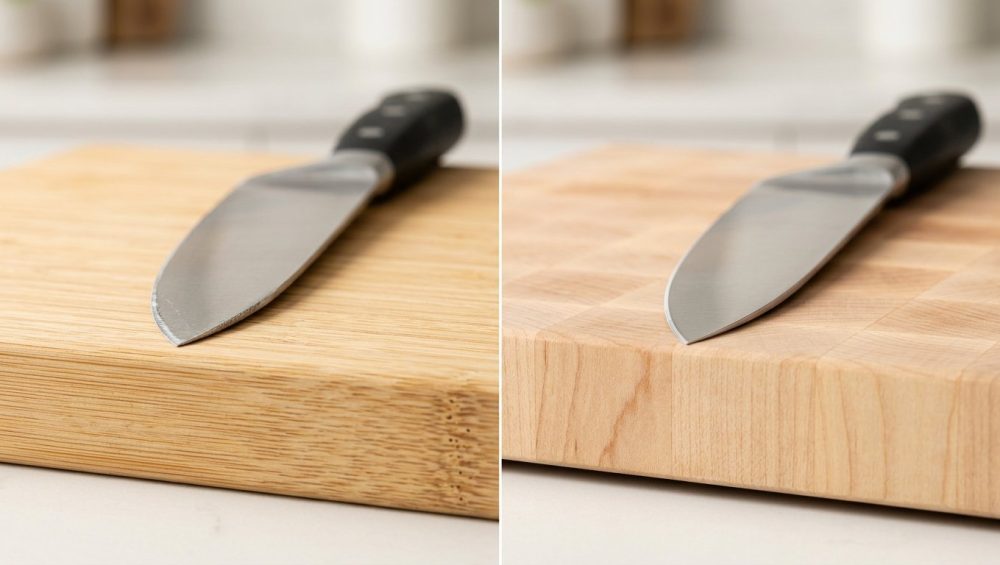
If you want to treat your knives like royalty, end-grain is the only way to go. To make an end-grain board, the wood is cut into blocks and arranged so that the ends of the wood fibers point straight up toward the ceiling (it often looks like a checkerboard pattern).
Imagine a bundle of dry spaghetti standing straight up. When your knife blade comes down onto an end-grain board, it slides between the vertical wood fibers rather than severing them. When you lift the knife away, the fibers naturally close back up. This “self-healing” property means the board absorbs the impact perfectly, preventing your knife edge from rolling. It also means the board rarely shows deep knife scratches.
However, to keep an end-grain board in top shape, you absolutely board keeps cracking if you ignore its maintenance. End-grain boards are thirsty. They require regular oiling with food-grade mineral oil to prevent the vertical fibers from drying out, shrinking, and splitting at the glue seams.
The Superior Alternatives: What You Should Buy Instead
As your sassy sous-chef, I only recommend gear that offers real, durable value. We want materials that are non-toxic, aesthetically pleasing, and scientifically proven to preserve your knife edges. Here are the essential tools every beginner needs when choosing a cutting surface:
1. Hard Maple (Acer saccharum)
This is the undisputed champion of the Western kitchen. Hard maple has a Janka hardness of 1,450 lbf, making it dense enough to resist deep gouges and bacterial infiltration, but its cellular structure is incredibly forgiving on knife edges. It has a tight, closed grain that prevents food liquids from soaking in. An end-grain maple butcher block is an investment that will outlive you if you oil it properly.
2. Black Walnut (Juglans nigra)
If you want a board that looks as good as it performs, go for black walnut. It is slightly softer than maple (around 1,010 lbf on the Janka scale), which makes it a dream to chop on. Your knife will glide beautifully, and the edge will last for months. The rich, dark chocolate color hides stains from beets and tomatoes perfectly. It is slightly more porous than maple, so it requires a bit more oiling, but the aesthetic tradeoff is well worth it.
3. Cherry (Prunus serotina)
Cherry is another phenomenal domestic hardwood. It sits right in the sweet spot of hardness (around 950 Janka) and has a beautiful, warm reddish hue that darkens gorgeously over time with exposure to light and oil. It is highly sustainable, relatively lightweight, and incredibly gentle on high-carbon steel blades.
4. Japanese Synthetic Rubber (Hasegawa or Asahi)
If you are dealing with ultra-hard, delicate Japanese knives (like a laser-thin Nakiri or Gyuto) and you absolutely hate oiling wooden boards, you need to look into high-end synthetic rubber boards. Brands like Hasegawa and Asahi manufacture boards with a wood core surrounded by a soft, food-safe synthetic elastomer. These boards offer an incredible, cushioned cutting feel that grips the food and entirely eliminates edge rolling. They are the secret weapon of sushi chefs worldwide.
Notice what is missing from this list? Glass, marble, granite, and hard plastic. Glass and stone will ruin a knife edge in a single stroke. Cheap plastic boards (polyethylene) score deeply, creating microscopic plastic canyons that harbor dangerous bacteria and cannot be sanitized, all while leaching microplastics into your food.
The Toxic Glue Trap of Cheap Bamboo Boards
Now we arrive at my absolute, non-negotiable “no-go” rule: I despise toxic kitchenware. I will actively hunt down and banish mystery metals, peeling non-stick coatings, and cheap plastics from your kitchen. And unfortunately, cheap bamboo cutting boards are some of the worst offenders on the market.
Because bamboo is a hollow grass, you cannot simply fell a bamboo stalk and cut a wide, solid slab out of it. To create a flat cutting board, manufacturers must harvest the bamboo, strip it, boil it, slice it into thin splints, and then heavily compress and glue those hundreds of tiny splints together.
A standard bamboo cutting board is essentially 20% to 30% adhesive by volume. And what kind of glue do you think overseas factories use to keep their costs low enough to sell you a board for $15?
They use cheap, industrial-grade synthetic resins—most commonly urea-formaldehyde or phenol-formaldehyde glues. Formaldehyde is a known human carcinogen and a volatile organic compound (VOC). While the off-gassing of a new board is bad enough for your indoor air quality, the mechanical action of chopping makes it much worse.
Every single time you forcefully drag a serrated bread knife or a heavy chef’s knife across a cheap bamboo board, you are micro-scoring the surface. You are actively shaving microscopic particles of formaldehyde-laden glue and silica directly into the food you are about to feed your family.
This is the hidden trap. You thought you were buying a natural, eco-friendly product, but you actually brought a heavily processed, toxic composite material into your food prep zone. This is why banishing toxic kitchen gear is step one in elevating your home cooking.
When you purchase a high-quality edge-grain or end-grain board made from maple or walnut by a reputable woodworker, they use food-safe, non-toxic, FDA-approved wood glues (like Titebond III) that contain zero formaldehyde. Yes, a real wood board costs more upfront, but you are paying for safety, longevity, and peace of mind.
How to Resurrect Your Ruined Knives
If you’ve been aggressively chopping on a bamboo board for the last year, I have bad news: your knives are currently blunter than a butter knife. But I also have good news: you do not need to throw them away. High-quality steel can always be brought back to life. You just need to understand the difference between honing and sharpening, and put in a little bit of elbow grease.
Step 1: Ditch the Bamboo and Get a Bench Scraper
Before you even attempt to fix your knife, you must promise me you will stop dragging the sharp edge of your blade sideways across the cutting board to scoop up your diced onions. This lateral friction instantly rolls the microscopic apex. You need a bench scraper. It costs five dollars. Use the knife to cut, and use the bench scraper to scoop. This one habit will double the lifespan of your edge.
Step 2: Understand Honing vs. Sharpening
Most home cooks confuse the long metal rod that came with their knife block (a honing steel) with a sharpener. A honing steel does not remove metal. It does not sharpen a dull knife. Its only job is to push a slightly rolled edge back into straight alignment. If you have been using bamboo, your edge isn’t just rolled; it is flattened, abraded, and micro-chipped. A honing rod will do absolutely nothing for you right now. You need to create a brand new edge.
Step 3: The Whetstone Revival
To fix the damage bamboo has done, you need to remove steel to reveal a fresh apex. Do not use those cheap, V-shaped pull-through carbide sharpeners; they aggressively tear chunks of metal out of your blade and ruin the geometry of the knife.
Invest in a dual-sided water stone (usually a 1000 and 3000 grit combination). Soak the stone in water for ten minutes. Hold your knife at a consistent 15- to 20-degree angle, and smoothly sweep the blade across the 1000-grit side until you feel a tiny metallic burr form on the opposite side of the edge. Flip the knife, repeat the process, and then move to the 3000-grit side to polish that edge until it can effortlessly slice through a piece of printer paper.
Learning to use a whetstone takes a Sunday afternoon of practice, but it is an incredibly meditative, satisfying skill. It empowers you to maintain your own tools forever. It is vastly cheaper and more rewarding than ruining your nonstick pans and dulling your knives year after year, only to throw them in the trash and buy replacements.
Conclusion: Reclaim Your Kitchen
Cooking should never feel like a battle against your own equipment. You do not need a Michelin star to make a perfect meal, but you absolutely cannot cook like an expert if you are fighting against dull blades and toxic, knife-destroying cutting surfaces.
Bamboo had a great marketing run, but the science doesn’t lie. Its high silica content, extreme density, and heavy reliance on toxic glues make it the absolute worst surface for your precious kitchen knives.
Do yourself, your sanity, and your weeknight schedule a massive favor: toss the bamboo. Invest in a gorgeous piece of end-grain maple or walnut. Maintain it with a little bit of mineral oil, learn to respect your newly sharpened blade, and watch how quickly your daily cooking transforms from a stressful chore into a fluid, effortless joy. Stay sassy, stay sharp, and I will see you in the kitchen.