The Sad, Soggy Epidemic Plaguing Weeknight Dinners
Look, I get it. You just worked an exhausting eight-hour shift, the dog threw up on the living room rug, your inbox is still overflowing, and the absolute last thing you want to do is perform complex culinary calculus just to get a healthy side dish on the dinner table. You want quick, you want easy, and you want it done ten minutes ago. So, you do what millions of tired home cooks do every single night: you hastily chop up a head of broccoli, dump the pieces onto a cold, room-temperature baking sheet, shove the whole thing into a 350°F oven, and hope for the best.
Thirty minutes later, the timer goes off. You pull the pan out, and what do you have? A limp, gray, watery, sulfurous pile of absolute sadness. The edges aren’t crispy; they are chewy. The stems aren’t tender; they are mush. It tastes like a punishment rather than a meal.
According to recent 2025 consumer economic data, a staggering 78% of people are cooking at home more frequently to combat inflation and wildly rising grocery costs. We are all trying to save a buck, but eating at home should never mean suffering through subpar, uninspiring food. If you find yourself dreading dinner time because you are constantly eating mushy veggies that lack any real texture or flavor, it is time for a brutal reality check.
The problem is not your oven. The problem is not the quality of the produce you bought at the supermarket. The problem, my friend, is your technique. You have been inadvertently sabotaging your own dinners by ignoring one of the most fundamental rules of kitchen physics. But do not panic. I am here to fix it, and it isn’t going to cost you a single dime or add a single minute to your prep time.
The Science of the Sizzle: Why Cold Pans Equal Steamed Mush
I have zero patience for pretentious, overly complicated chef-speak, but if you want to cook like a pro without going to culinary school, you need to understand a little bit of basic science. Let’s get one thing straight right now: cooking is not magic. It is applied thermodynamics. When you place a cold, water-dense vegetable onto a room-temperature sheet pan and slide it into a hot oven, you are setting yourself up for catastrophic failure. Why? Because of a concept called thermal mass.
Air is a notoriously terrible conductor of heat. When you turn your oven on and the air inside reaches 400°F, that air does not instantly transfer its energy to the cold metal pan you just put inside. It takes a solid ten to fifteen minutes for that thick piece of metal to actually absorb enough ambient heat to reach 400°F itself.
During that agonizing, slow warm-up period, your vegetables are just sitting there on the cold metal, slowly warming up alongside it. As the cellular walls of the vegetables begin to break down from the gently rising heat, they release their internal moisture. Because the pan underneath them isn’t hot enough to instantly evaporate that moisture, the water simply pools around the food.
Here is the undeniable, unbreakable law of kitchen physics: liquid water cannot exceed 212°F (100°C). As long as your vegetables are sitting in a puddle of their own juices, their surface temperature is strictly hard-capped at the boiling point of water. The exact reason why your roasted veggies turn mushy is because they are not actually roasting at all. They are boiling. They are steaming in a shallow, sad little sauna of their own making, breaking down into a pathetic puree before they ever have a chance to crisp up.
The Maillard Reaction Demystified
If you want those mind-blowing, restaurant-quality, deeply caramelized vegetables that taste like savory candy, you need to understand the Maillard reaction. I promise I will keep the nerd-talk brief, but this is the holy grail of flavor.
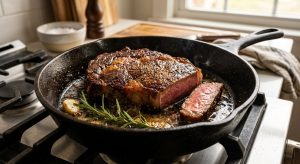
The Maillard reaction is a complex chemical process between amino acids and reducing sugars that occurs when food is subjected to high heat. It is the exact same chemical reaction that gives a beautifully seared steak its dark crust, freshly baked bread its golden-brown color, and roasted coffee its intoxicating depth. It creates hundreds of brand new, highly volatile flavor compounds that simply do not exist in raw food.
Here is the massive catch: the Maillard reaction does not even begin to occur until the surface temperature of the food reaches about 285°F (140°C), and it truly accelerates and works its magic at 310°F (154°C) and above.
Do you see the structural problem with the cold pan method now? If your vegetables are trapped in a 212°F puddle of their own leaked water, the Maillard reaction is physically impossible. You will never, ever get those crispy, charred, deeply savory edges. By the time the water finally evaporates and the pan gets hot enough to trigger browning, the internal structure of the vegetable has completely collapsed from overcooking. You are left with a burnt exterior and a hollow, mushy interior.
The Enemy of Caramelization: Water
Moisture is the absolute death of browning. Every single drop of water that sits on the surface of your food is an obstacle that heat must overcome before flavor can be built. This is why washing your produce and throwing it directly onto a pan without drying it is the ultimate rookie mistake. You are introducing outside water to a situation that is already fighting internal water. Once you understand that water is the enemy of the sear, you will stop throwing away sad veggies and start treating them with the high-heat respect they deserve.
The Zero-Effort Fix: Preheating Your Sheet Pan
The fix for this soggy epidemic is so incredibly simple, so profoundly effortless, that it infuriates me how rarely it is taught to home cooks. You do not need to buy a fancy new gadget. You do not need to spend hours hovering over a stove. You just need to put your empty sheet pan in the oven while the oven preheats.
That’s it. That is the master secret that separates the weekend hobbyist from the seasoned line cook.
When you turn your oven on to 425°F, slide your bare, empty sheet pan onto the middle or bottom rack. Let it sit there and absorb all of that thermal energy while the oven comes up to temperature. When the oven finally beeps to let you know it is ready, that piece of metal is now a screaming hot, 425°F heat battery, fully charged and ready to go to work.
What Actually Happens When Veggies Hit Hot Metal
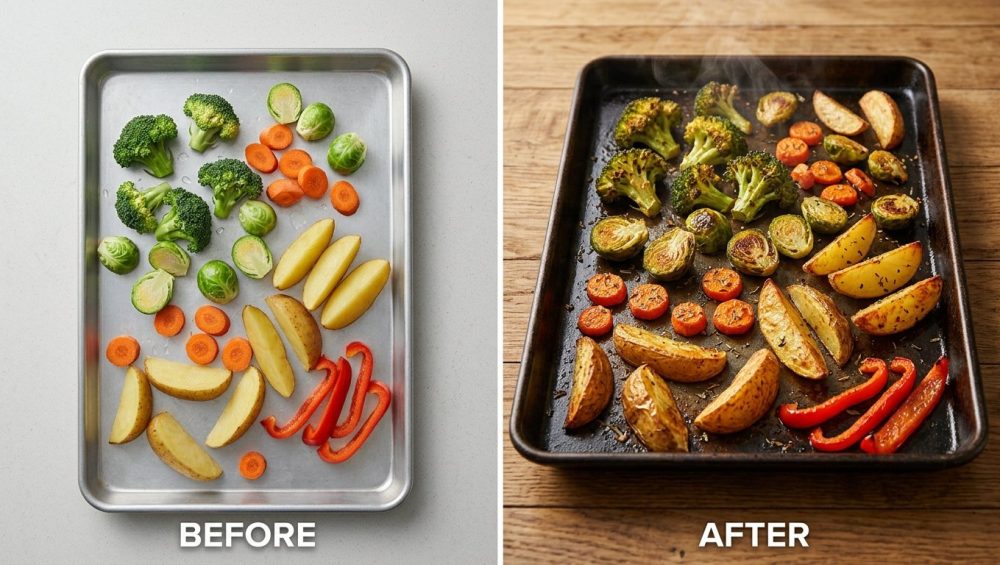
When you carefully pull that aggressively hot pan out of the oven and drop your oil-coated, seasoned vegetables onto it, you should immediately hear a loud, violent sizzle. That sizzle is the sound of absolute success.
That sound is the residual surface moisture on the vegetables flashing into steam and evaporating instantly upon contact with the hot metal. Because the water is obliterated on impact, the surface temperature of the vegetable immediately skyrockets past that crucial 285°F threshold. The Maillard reaction begins in seconds, not minutes. The bottom of the vegetable sears instantly, locking in a crispy, caramelized texture, while the ambient heat of the oven cooks the inside to a perfect, tender-crisp finish.
The “No-Go” Rule: Stop Baking on Toxic Trash
Now, before you go enthusiastically shoving your current sheet pans into a 450°F oven, we need to have a very serious, brutally honest conversation about your kitchen equipment. I absolutely despise cheap, toxic kitchenware. If you are currently using a flimsy, dark-coated, non-stick baking sheet that you bought for five dollars at a discount store, you need to throw it in the garbage today.
You cannot preheat a cheap non-stick pan empty. Traditional non-stick coatings are made of PTFE (polytetrafluoroethylene), famously known by the brand name Teflon. When PTFE is heated empty, especially at temperatures exceeding 400°F, the chemical coating begins to invisibly degrade, warp, and off-gas highly toxic fumes.
The Danger of Cheap Non-Stick
The modern data on this is terrifying and completely irrefutable. A comprehensive study conducted by the Ecology Center recently found that a shocking 79% of tested nonstick cooking pans and 20% of nonstick baking pans were coated with PTFE. This material is a polymer form of PFAS (per- and polyfluoroalkyl substances), which are the notorious “forever chemicals” that do not break down in the environment or the human body.
Prolonged exposure to PFAS has been clinically linked to kidney cancer, liver damage, thyroid disease, and severe immune system suppression. While recent 2025 and 2026 legislation in states like California has finally forced manufacturers to disclose the presence of these chemicals on their packaging, the market is still absolutely flooded with them. The cookware industry lobbied incredibly hard to prevent outright bans, meaning the burden of safety falls entirely on you, the consumer.
If you are ruining your nonstick pans by blasting them in a high-heat oven to get a good sear, you are not just ruining your dinner; you are actively releasing microscopic toxic nanoparticles into your food and the air you breathe. The minor convenience of a pan that is slightly easier to wash is absolutely not worth the devastating long-term health risks. It is time to draw a hard line in the sand. You must commit to banishing toxic kitchen gear from your home permanently. There are vastly superior, completely safe alternatives that perform infinitely better and will last you a lifetime.
What You Should Be Using Instead (Aluminum vs. Stainless Steel)
So, if toxic non-stick bakeware is out, what should you be using to roast your vegetables? Professional kitchens rely on two primary materials: heavy-gauge virgin aluminum and multi-clad stainless steel.
Let’s talk about virgin, heavy-duty aluminum first. Aluminum is an absolute superstar when it comes to thermal conductivity. It absorbs heat rapidly and distributes it flawlessly and evenly across the entire surface of the pan. A commercial-grade, 18-gauge half-sheet pan made of bare aluminum is practically indestructible, incredibly affordable, and completely safe at high oven temperatures. Because it conducts heat so efficiently, it is the perfect vessel for transferring that explosive thermal energy directly into your vegetables the second they hit the pan.
Then there is stainless steel. Stainless steel has a lower thermal conductivity than aluminum, meaning it takes a bit longer to heat up in the oven. However, it has a much higher specific heat capacity. This means that once a heavy stainless steel pan gets hot, it holds onto that heat with a terrifying vengeance. It will not drop in temperature when you add a massive, heavy batch of cold food to it. If you are using a high-quality stainless steel pan, you can even use the water drop test to verify that the metal has reached the optimal searing temperature before you add your food.
Whatever metal you choose, the key is thickness and physical weight. Thin, cheap pans lack the physical mass required to store thermal energy. If you have ever been startled by a loud, violent “BANG!” coming from your oven, and you realize your thin baking sheets keep warping and twisting into strange diagonal shapes, it is because the metal is too thin to handle the thermal expansion of high heat. Invest in heavy-duty, professional-grade sheet pans. They cost less than a single takeout meal and will never warp on you.
The Sassy Sous-Chef’s Rules for Flawless Roasting
Preheating your high-quality, non-toxic pan is the foundation of the masterclass, but if you want to graduate from amateur to expert, you must follow these strict rules of engagement. Roasting is a holistic process, and every step matters.
Dry Them Like Your Life Depends On It
We have already firmly established that water is the mortal enemy of browning. If you wash your vegetables in the sink and immediately toss them in oil while they are still dripping wet, you are actively sabotaging yourself. The oil will trap the water against the skin of the vegetable, guaranteeing a steamed, soggy mess regardless of how hot your pan is.
You must dry your vegetables ruthlessly. Treat moisture like a disease. Use a salad spinner for broccoli and cauliflower florets to whip the water out of the crevices. Use dry paper towels to aggressively pat down zucchini and bell peppers. If you have the time and foresight, chop your vegetables, lay them on a towel, and let them sit uncovered in the fridge for an hour. The cold, circulating air of the refrigerator will dehydrate the surface, practically guaranteeing a flawless, crispy sear.
Cut Them Uniformly (Geometry is Flavor)
The Maillard reaction only happens where the food physically touches the hot metal. If you chop your vegetables into jagged, uneven, spherical lumps, you are minimizing their contact with the pan. You want flat edges. You want maximum surface area.
Cut your Brussels sprouts perfectly in half so the entire inner face can sear. Slice your carrots on a sharp diagonal bias to create long, flat ovals rather than tiny little circles. Cut your potatoes into perfect cubes with distinct, flat sides. Do not be lazy with your knife work. Furthermore, if you are dealing with thick, fibrous, bitter skins on winter squashes or tough root vegetables, make sure you use a sharp carbon steel y-peeler to strip away the exterior so the tender, sweet flesh can make direct contact with the heat. Uniform cuts also ensure that everything finishes cooking at the exact same time, preventing the tragedy of burnt small pieces and raw large pieces.
Oil is Your Friend (But Choose Wisely)
You absolutely need fat to roast vegetables. Fat is a thermal conductor; it fills the microscopic gaps between the uneven surface of the vegetable and the flat surface of the pan, ensuring rapid and even heat transfer. But you must choose the right fat, and you must apply it correctly.
First, do not ever drizzle oil directly onto a screaming hot, preheated pan. It will immediately smoke, polymerize, and turn into a sticky, bitter aerosol that will set off your smoke detectors. Instead, place your perfectly dry vegetables into a large mixing bowl, drizzle the oil over them, and toss them aggressively with your hands or a spatula until every single piece is lightly and evenly coated.
Second, you must respect smoke points. Extra virgin olive oil is a beautiful, flavorful ingredient, but its smoke point hovers dangerously low around 375°F to 410°F depending on its filtration. If we are roasting at 425°F or 450°F, unrefined olive oil will burn, turning your food acrid and filling your kitchen with noxious smoke. For high-heat roasting, you must use high-smoke-point fats. Avocado oil (which has a massive smoke point of 520°F), refined “light” olive oil, or melted clarified butter (ghee) are your best friends here. Save the expensive extra virgin olive oil for drizzling over the vegetables after they come out of the oven.
Give Them Some Personal Space
I do not care if you have to wash an extra pan at the end of the night. Do not, under any circumstances, overcrowd your vegetables.
When vegetables cook, they release steam. If they are packed shoulder-to-shoulder on the sheet pan like commuters on a rush-hour subway train, that steam gets trapped between them. It creates a humid, wet micro-climate that completely prevents browning. Every single piece of food needs at least a half-inch of empty metal around it to allow the steam to vent up and away into the oven cavity. If they are touching, they are steaming. Period. Use two pans if you have to. Space them out. Let them breathe.
The Salt Timing Debate
Salt is a magical mineral, but it draws out water via osmosis. If you salt high-water vegetables too early and let them sit on the counter, they will begin to weep moisture, ruining your perfectly dry surfaces.
For high-water veggies like zucchini or eggplant, you can use salt to your advantage: salt them heavily 15 minutes prior to roasting, let them sweat out their excess water in a colander, and then pat them completely dry before oiling them. For dense roots like potatoes or carrots, salt them in the bowl right before they hit the pan so the salt sticks to the oil without having time to draw out internal moisture.
Troubleshooting Specific Veggies
Not all vegetables are created equal in the eyes of physics. They have vastly different water contents, different cellular structures, and different natural sugar levels. If you treat a delicate, watery zucchini the exact same way you treat a dense, starchy potato, one of them is going to be ruined.
The Cruciferous Crew (Broccoli, Cauliflower, Brussels Sprouts)
These vegetables are basically tightly packed, organic sponges. Their intricate florets and tightly wound leaves trap massive amounts of moisture. They require aggressive, high heat to roast properly without turning to mush.
Set your oven to 425°F. Toss them in avocado oil, and when you place them on the preheated pan, take the extra sixty seconds to manually flip every single piece so the flat, cut side is facing directly down against the hot metal. Do not skip this step. The intense bottom heat of the preheated pan will sear the flat side into a dark, caramelized crust, while the ambient heat of the oven will gently tenderize the stalks.
The Root Vegetables (Carrots, Potatoes, Beets, Parsnips)
Root vegetables are dense, starchy, and hard. They take significantly longer to cook through to the center. If you blast them at 450°F, the outside will burn to a bitter cinder before the inside is even remotely tender.
Drop the oven temperature to 400°F. They still absolutely need a preheated pan to kickstart the browning process, but they need a slower, more sustained ambient heat to break down their complex starches into sweet, simple sugars. If you have ever noticed that your favorite coated pan lost its non-stick properties prematurely, it is often because the prolonged, heavy contact of dense root vegetables baking onto cheap coatings at 400°F degrades the finish over time. This is why you stick to bare, heavy metal. Toss them halfway through the cooking time to ensure even browning on multiple sides.
The Water Bombs (Zucchini, Bell Peppers, Mushrooms)
These are the most notoriously difficult vegetables to roast because they are essentially just water held together by a fragile cellular matrix. Zucchini, for instance, is over 90% water by weight. If you want to roast these without them turning into a sloppy, unappetizing puree, you must use extreme heat to evaporate the water faster than the structure can collapse.
Crank your oven up to 450°F. The preheated pan is absolutely non-negotiable here; it is the only thing standing between you and a soggy disaster. For mushrooms, consider tossing them in a dry bowl with a heavy pinch of salt ten minutes before roasting. The salt will draw out the excess water into the bowl. Drain that dirty water away, pat the mushrooms dry, toss them in a high-heat oil, and then hit the hot pan. Because you removed the water beforehand, they will sear like tiny, perfect steaks.
The Final Flourish (Because We Aren’t Savages)
When you finally pull that glorious, sizzling pan out of the oven, your job is not quite done. The intense heat of roasting brings out the deep, heavy, earthy, and savory notes of the vegetables. To balance that heavy richness, you need the culinary magic of acid.
While the vegetables are still piping hot and resting on the pan, hit them with a squeeze of fresh lemon juice, a splash of high-quality aged balsamic vinegar, or a dash of apple cider vinegar. The acid will instantly brighten the flavor profile, cutting through the heavy roasting oil and elevating the dish from “good home cooking” to “restaurant-quality mastery.” Toss them with a handful of finely chopped fresh herbs—parsley, cilantro, or dill—and finish with a final sprinkle of crunchy, flaky sea salt for texture.
Stop Overcomplicating It: You Can Do This
Cooking does not have to be a stressful, chaotic chore that ends in disappointment. You do not need a culinary degree to make food that tastes incredible, and you certainly do not need to rely on expensive meal kits. You just need to understand the basic, underlying rules of heat, moisture, and metal. Furthermore, you need to respect yourself enough to refuse to settle for mediocre techniques and toxic equipment.
By simply taking an empty metal pan and putting it in the oven ten minutes earlier than you normally would, you are fundamentally changing the physics of your dinner. You are taking absolute control of the Maillard reaction. You are guaranteeing a perfect, crispy sear every single time. You can easily start breaking your takeout habit tonight, simply by letting your oven do the heavy lifting for you. Stop accepting soggy, steamed, sad side dishes as an inevitability. Preheat your pan, respect the sizzle, and start cooking like the absolute boss you are.