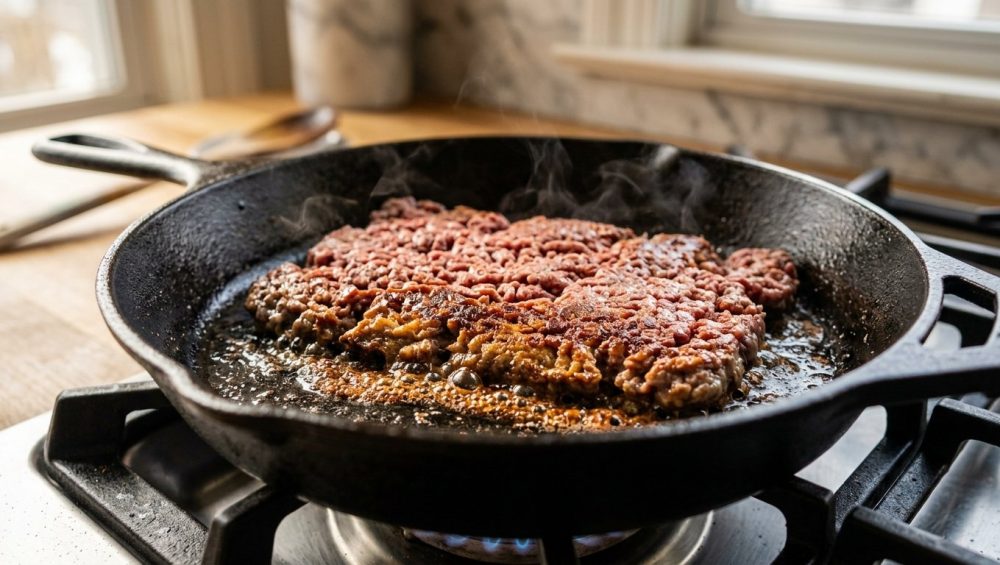
Put down the spatula, take a deep breath, and step away from the stove. If there is one hill I am absolutely willing to die on as a culinary professional and a passionate advocate for the home cook, it is this: you are overworking your ground beef. We all know the standard weeknight routine. You toss a cold brick of ground meat into a lukewarm frying pan and immediately start hacking at it with a wooden spoon like it owes you money. You stir, you chop, you push it around endlessly, hoping it will magically transform into the rich, deeply browned, restaurant-quality foundation for your chili or tacos.
Instead, you are left staring at a bubbling pool of grey, rubbery pebbles swimming in a murky bath of their own extracted juices. It is depressing, it lacks flavor, and it is entirely preventable.
You do not need a culinary degree from Le Cordon Bleu to make mind-blowing food at home. You do not need expensive, pretentious ingredients. What you do need is a basic understanding of kitchen thermodynamics, a heavy-duty pan, and the sheer willpower to do absolutely nothing for five minutes. If you are serious about conquering weeknight cooking anxiety, the very first lesson you must learn is how to let the stove do the heavy lifting. Today, we are going to break down the exact science of the sear, permanently banish mushy meat from your kitchen, and teach you the life-changing magic of leaving your food alone.
The Epidemic of Sad, Grey Meat
Walk into almost any home kitchen on a Tuesday night, and you will witness the exact same culinary crime being committed. The cook drops a pound of ground chuck into a skillet and immediately begins stirring it continuously. This obsessive need to keep the food moving is born out of a completely understandable fear of burning dinner. We have been conditioned to believe that active cooking means constantly touching the food.
However, this relentless stirring is the exact reason your ground beef steams instead of searing. When you constantly agitate ground meat, you are interrupting the complex chemical reactions required to build flavor. You are preventing the meat from maintaining sustained contact with the hot metal. Without that sustained, uninterrupted contact, you cannot build a crust. Without a crust, you have no texture. Without texture, you are essentially eating boiled hamburger. It is a tragedy, but fortunately, the fix is embarrassingly simple.
The Science of the Sear: Meet the Maillard Reaction
To truly understand why you need to stop stirring your meat, we have to talk about the sexiest scientific concept in the culinary world: the Maillard reaction. I promise to keep the pretentious chef-speak to a minimum, but understanding this chemical process is the key to unlocking professional-level flavor in a standard home kitchen.
What the Heck is the Maillard Reaction?
Discovered in 1912 by French chemist Louis-Camille Maillard, this reaction is a form of non-enzymatic browning. It is the complex chemical romance that occurs between amino acids (the building blocks of proteins) and reducing sugars when they are subjected to high heat. When these compounds collide under the right thermal conditions, they create melanoidins, which provide that gorgeous, deeply savory brown color. More importantly, the reaction rapidly produces hundreds of volatile flavor compounds that make roasted coffee taste like coffee, baked bread taste like bread, and seared steak taste like an absolute masterpiece.
Here is the critical data point you need to memorize: the Maillard reaction does not kick into high gear until the surface temperature of your food reaches approximately 285°F (140°C). Below that temperature, the reaction crawls at a microscopic pace, yielding zero noticeable flavor development.
The Enemy of Crust: Moisture and Steam
If 285°F is the magic number for flavor, we have a massive, watery problem to deal with. Raw beef is composed of roughly 70 to 75 percent water. When you throw meat into a pan, that water immediately begins to seep out.
Physics dictates that liquid water cannot exceed 212°F (100°C) at sea level. It will simply boil and turn into steam. Therefore, as long as there is liquid water sitting in the bottom of your skillet, the surface of your meat is physically trapped at 212°F. It cannot reach the 285°F threshold required for the Maillard reaction. If you want to stop steaming your meat, your primary goal must be to evaporate that surface moisture as violently and rapidly as possible so the temperature of the meat can finally climb into the browning zone.
Why Constant Stirring Ruins Your Dinner
Now that we know the science, let’s look at the mechanics of why your spatula is currently your own worst enemy.
The Cold Meat vs. Hot Pan Showdown
When you take a pound of 38°F ground beef out of the refrigerator and drop it into a hot skillet, you are introducing a massive thermal shock to the cooking surface. The cold mass of the meat immediately absorbs the heat energy from the metal, causing the pan’s temperature to plummet dramatically.
If you leave the meat in one solid block (like a giant hamburger patty), only the bottom surface of the meat is touching the pan. The pan can focus all of its remaining heat energy into that specific contact zone, quickly recovering its temperature and evaporating the localized moisture to begin the searing process.
However, if you immediately take your spatula and chop that block of cold meat into dozens of tiny pieces, spreading them across every single square inch of the skillet, you are exposing the entire cooking surface to freezing cold meat all at once. The pan loses all of its thermal momentum. It goes from screaming hot to lukewarm in seconds.
The “Sauna Effect” Explained
Because you have plummeted the pan’s temperature by spreading the cold meat everywhere, the pan is no longer hot enough to rapidly evaporate the water leaking out of the beef. The water pools in the bottom of the skillet. Because you continue to stir, you are constantly washing the meat in its own lukewarm juices.
You have essentially built a sad, grey sauna for your dinner. The meat gently boils in a murky liquid at 212°F, turning rubbery, tough, and entirely devoid of the rich, savory compounds produced by the Maillard reaction. By the time the water finally cooks off ten minutes later, the meat is completely overcooked and dried out on the inside, yet still grey on the outside.
The Sassy Sous-Chef’s Masterclass: How to Actually Sear Ground Beef
Enough with the culinary crimes. It is time to fix your technique. This is my definitive, no-nonsense method for achieving a deeply caramelized, violently flavorful crust on your weeknight ground beef.
Step 1: Dry Your Meat (Seriously)
Moisture is the enemy of browning. Before your ground beef even looks at the stove, take a paper towel and gently pat the outside of the brick of meat dry. You do not need to squeeze it like a sponge; just remove the excess surface condensation. Every drop of water you remove manually is a drop of water your pan doesn’t have to waste heat energy evaporating.
Step 2: Choose the Right Weapon (And Ditch the Toxic Pans)
Let’s have a brutally honest conversation about your kitchen cabinets. If you are attempting to sear meat in a flimsy, lightweight, scratched-up non-stick pan that you bought on clearance five years ago, you are setting yourself up for catastrophic failure. I have a strict, non-negotiable rule in my kitchen: absolutely zero toxic gear.
Most conventional non-stick skillets are coated with PTFE (commonly known by the brand name Teflon). While manufacturers claim these are safe at low temperatures, the reality is that PTFE begins to chemically break down and release highly toxic fumes when heated above 500°F (260°C). These toxic emissions are known to cause a violent respiratory condition literally called “polymer fume fever” or “Teflon flu” in humans, and they are lethal to pet birds.
Searing meat requires intense, high heat. High heat destroys cheap non-stick coatings. Have you ever wondered why your non-stick pans keep losing their slip after just a few months of use? It is because you are blasting them with searing temperatures and degrading the chemical surface. Throw the toxic garbage away.
We are cooking with grown-up metals now. You need a pan with immense thermal mass—meaning it is heavy enough to hold onto its heat when cold meat hits it. Your best options are a heavy cast iron skillet, a thick carbon steel pan, or a high-quality, multi-clad stainless steel skillet.
Step 3: Heat Management and the Drop
Place your heavy skillet on the stove over medium-high heat. Let it preheat thoroughly. Do not rush this step. If you are using a stainless steel skillet, you can utilize the magic of the water drop test to ensure the metal is perfectly preheated: flick a tiny drop of water into the pan. If it sizzles and evaporates instantly, the pan is too cold. If it shatters into a dozen tiny beads, it is too hot. If the water drop forms a single, cohesive bead that glides across the surface like a mercury marble (the Leidenfrost effect), your pan is ready.
Add a small splash of high-heat cooking oil (like avocado oil or clarified butter). Swirl it to coat the pan. Now, take your block of ground beef and place it directly into the center of the pan. Do not break it up. Leave it in the exact shape it came in from the grocery store packaging.
Take a heavy spatula and firmly press the block of meat down into the pan, smashing it flat like a giant diner-style smashburger. You want to maximize the physical contact between the bottom of the meat and the hot metal.
Step 4: The Hardest Part—Do Absolutely Nothing
Once you have smashed the meat flat, take your spatula, walk away from the stove, and do absolutely nothing. Do not poke it. Do not lift the edge to peek. Do not stir it.
You must leave the meat completely undisturbed for at least four to five minutes. I know every fiber of your being is screaming at you to touch the food, but you must resist. During this time, the heavy metal of the pan is pumping intense heat into the bottom layer of the beef. The moisture is rapidly boiling off, and the temperature of that bottom layer is climbing past 285°F. The Maillard reaction is working its magic, transforming the boring grey protein into a crispy, mahogany-brown crust of pure flavor.
If you are using traditional cookware, do not panic if the meat seems stuck. Once you understand the basic physics of seasoning cast iron and carbon steel, you know that meat naturally releases itself from the metal once a proper crust has formed. If you try to force it too early, you will tear the meat and leave the best parts stuck to the pan.
Step 5: The Flip and the Break-Up
After about five minutes, you should see the edges of your giant meat patty turning dark brown and crispy. Now, and only now, are you allowed to use your spatula.
Slide a thin, sturdy metal spatula under the meat and confidently flip the entire giant patty over. You should be staring at a deeply caramelized, gorgeous, dark brown crust. Once the meat is flipped, you can finally take your spatula and aggressively chop the beef into your desired crumble size. The raw side will quickly cook through in a matter of a minute or two.
You only need to develop a crust on one side of the ground beef. That single layer of intense, concentrated Maillard browning is more than enough to flavor the entire batch of meat perfectly.
Weeknight Efficiency: Why Ignoring Your Food Saves Time
My core philosophy is that time is money, especially on a chaotic Tuesday evening. The absolute best way to master simple weeknight dinners is to optimize your workflow by letting the stove do the work while you handle the prep.
When you adopt the “do nothing” searing method, you are instantly buying yourself five uninterrupted minutes of hands-free time. Instead of standing over the stove babysitting a pan of steaming grey meat, you can use those five minutes to finely dice your onions, mince your garlic, shred your cheese, or pour yourself a well-deserved glass of wine.
By the time your prep work is finished, your meat is perfectly crusted and ready to be flipped. You have essentially cut your active kitchen time in half simply by exercising a little bit of patience. Efficiency in the kitchen isn’t about moving faster; it is about moving smarter.
The Pan Deglaze: Liquid Gold You’re Probably Wasting
Once your ground beef is beautifully browned and cooked through, you might notice a layer of dark, sticky, caramelized bits clinging to the bottom of your skillet. Do not panic, and whatever you do, do not carry that pan to the sink to wash it.
That sticky brown residue is called the “fond,” and it is essentially concentrated flavor crystals. It is the culinary equivalent of liquid gold. The French built an entire culinary empire on this concept, and turning burnt bits into sauce is the ultimate hallmark of a resourceful home cook.
To harvest this flavor, you need to deglaze the pan. If you are making a ragu, pour in a splash of red wine or beef broth. If you are making tacos, toss in your diced onions—the natural moisture released by the sweating onions will act as a deglazing liquid. As the liquid bubbles up, use your wooden spoon to gently scrape the bottom of the pan. The fond will dissolve directly into your sauce or vegetables, coating your perfectly seared ground beef in an incredibly rich, savory glaze.
Troubleshooting Your Ground Beef Disasters
If you followed the steps above and still ended up with a lackluster result, do not throw in the towel just yet. Cooking is a science, and variables matter. Here are the three most common reasons your sear failed, and exactly how to fix them.
You Crowded the Pan
If you try to cook three pounds of ground beef in a tiny ten-inch skillet, you are going to fail. Overcrowding the pan is the cardinal sin of searing. When you pack too much cold meat into a confined space, the pan’s thermal mass is completely overwhelmed. Furthermore, the massive amount of moisture released by three pounds of beef has nowhere to evaporate. The steam gets trapped under the mountain of meat, and you are right back in the grey sauna.
If you need to cook a large volume of meat, you must do it in batches. Sear one pound, remove it to a bowl, let the pan reheat, and sear the next pound. It takes an extra five minutes, but the resulting flavor is exponentially better.
You Used Lean Beef
Fat is flavor, and fat is the conductive medium that helps fry the exterior of your meat. If you are buying 93/7 or 90/10 extra-lean ground beef, you are shooting yourself in the foot. Extremely lean beef lacks the necessary fat content to render out and fry the meat in the pan. It dries out instantly and turns to sawdust.
For the best possible texture and flavor, 80/20 ground chuck is the undisputed king of the weeknight kitchen. It has enough fat to keep the meat juicy and promote a gorgeous, crispy sear, but not so much that your tacos end up swimming in an oil slick.
You Salted Too Early
Salt is a magical ingredient, but it is also a powerful desiccant. When you salt raw ground beef in a mixing bowl before it hits the pan, the salt immediately goes to work dissolving the meat’s proteins and drawing internal moisture to the surface.
If you let salted ground beef sit for too long, it develops a bouncy, cured, sausage-like texture, and it dumps an excessive amount of water into your hot skillet, ruining your chances of a good sear. Always salt your ground beef either right as it hits the hot pan, or immediately after you flip it.
Elevating the Classics: Where This Technique Shines
You might be wondering if going through the trouble of building a massive crust on your ground beef is really worth it for a simple Tuesday night meal. The answer is an aggressive, uncompromising yes. This single technique will elevate your staple recipes from “edible” to “exceptional.”
Weeknight Tacos:
When you aggressively sear your ground beef before adding your cumin, chili powder, and oregano, the spices bind to the caramelized crust, creating a deep, smoky flavor profile that mimics the complex char of a high-end taqueria. The crispy texture of the beef provides a beautiful contrast to soft tortillas and creamy guacamole.
Hearty Chili:
Chili is meant to be a robust, deeply savory stew. If you start your chili with boiled, grey meat, the final product will taste flat and watery, no matter how much chili powder you dump into the pot. A hard sear on the beef provides a foundational layer of umami that permeates the entire pot as it simmers.
Pasta Sauces and Ragu:
A traditional Italian meat sauce relies heavily on the Maillard reaction. Searing the beef in a high-quality stainless steel pan allows you to build a massive fond. Deglazing that fond with red wine before adding your crushed tomatoes creates a rich, restaurant-quality depth. Furthermore, using safe, non-reactive stainless steel prevents that awful scenario where your tomato sauce tastes metallic after simmering for an hour.
Conclusion: Trust the Process, Respect the Crust
Becoming a fantastic home cook does not require you to learn complicated molecular gastronomy or buy a thousand dollars worth of specialized equipment. It simply requires you to understand the basic rules of heat, respect your ingredients, and occasionally get out of your own way.
The urge to poke, prod, and stir your food is a hard habit to break, but avoiding these instinctive pitfalls will help you dodge the common beginner cooking mistakes that ruin perfectly good groceries. By ensuring your pan is screaming hot, using safe and heavy cookware, and having the sheer willpower to leave the meat completely undisturbed, you are allowing the profound science of the Maillard reaction to work its magic.
So the next time you are staring down a package of ground beef on a busy weeknight, remember the golden rule of the Sassy Sous-Chef: smash it flat, step away, and let the stove do its job. Your tastebuds, your sanity, and your dinner guests will thank you.