The Culinary Betrayal: When Your Scrambled Eggs Taste Like a Bubble Bath
Picture this: You have just spent your precious Friday evening carefully curating a beautiful meal. You have done the prep work, you have managed your time perfectly, and you are finally sitting down to enjoy the fruits of your labor. You take that first, highly anticipated bite, and suddenly, your palate is assaulted by the unmistakable, aggressive flavor of Dawn dish detergent. You blink. You take another bite. Yes, it tastes exactly like a bubble bath. You aren’t crazy, your taste buds aren’t broken, and no, you didn’t accidentally squirt Palmolive directly into the skillet.
The culprit is sitting right there in your utensil crock, mocking you. It is your silicone spatula.
As a home cook who has learned the hard way, let me validate your frustration right now. This is a highly documented, incredibly annoying scientific phenomenon. One of the most common seven rookie kitchen mistakes is ignoring the quality of your utensils, assuming that a spatula is just a spatula. But the reality is that the vast majority of cheap, big-box-store silicone kitchenware is actively sabotaging your food. You do not need a culinary degree to make mind-blowing food, but you absolutely need equipment that doesn’t actively work against you.
We are going to dive deep into the molecular science of why your silicone tools are hoarding odors, how to expose the toxic, filler-heavy frauds hiding in your kitchen, and exactly what you need to buy to ensure you never eat a soapy meal again. Grab a glass of wine, and let’s get into it.
The Molecular Science of Soapy Spatulas
To understand why your kitchenware is betraying you, we have to look at the microscopic structure of silicone itself. Silicone is a synthetic polymer made up of silicon, oxygen, carbon, and hydrogen. It is celebrated in the culinary world because it is naturally non-stick, incredibly flexible, and highly heat-resistant. It was supposed to be the ultimate upgrade from the wooden spoons that splintered in your batter and the nylon flippers that melted onto your cast iron pans.
However, silicone has a dark side: it is porous.
When silicone is exposed to high heat, its molecules physically expand. As those molecules open up, the material becomes a microscopic sponge, ready to absorb whatever oils, odors, and flavors are present in its immediate environment. When the silicone eventually cools down, those expanded molecules contract and close, effectively trapping the absorbed oils deep within the material.
The Dishwasher Detergent Trap
This molecular expansion becomes a massive problem when you put your silicone spatulas in the dishwasher. Your dishwasher is essentially a high-heat, high-moisture sauna filled with incredibly aggressive chemical detergents. Many popular dishwashing pods and liquids contain heavy fragrances, essential oils, and antibacterial agents.
As the hot water cycle blasts your spatula, the silicone pores open wide. The heavy, perfumed oils from your dish detergent seep directly into the expanded material. When the cycle ends and the spatula cools, the pores snap shut, locking the soap oils inside.
The next time you pull that spatula out to cook, the heat from your frying pan causes the silicone molecules to expand once again. And what happens? The trapped dish soap oils are released directly into your food. You don’t want your beautiful pan-seared salmon and asparagus tasting like a bubble bath. The cycle of absorption and release is the exact mechanism causing your dinners to taste like a laundromat.
The Toxic Truth: Not All Silicone is Created Equal
If you are reading this and thinking, “Well, I guess I just can’t use silicone ever again,” take a deep breath. Silicone itself is not the enemy. The real enemy is the cheap, poorly manufactured garbage that masquerades as high-quality kitchenware. I am completely militant about banishing toxic kitchen gear from my home, and cheap silicone is at the very top of my hit list.
There is a massive, highly unregulated spectrum of quality when it comes to silicone kitchen tools. Manufacturers know that consumers want the non-stick, heat-resistant benefits of silicone, but pure silicone is expensive to produce. To cut costs and inflate their profit margins, shady manufacturers dilute their silicone with cheap chemical fillers.
The Danger of Cheap Fillers
These fillers—often precipitated silica, chalk, or various plasticizers—are blended into the raw silicone before it is molded. When you buy a cheap spatula from a discount bin, you are likely buying a tool that is only a fraction of actual silicone. The rest is mystery plastic.
Why does this matter? Because these fillers completely compromise the integrity of the tool. Fillers lower the overall heat resistance of the spatula, meaning it can easily melt, warp, or degrade when left leaning against a hot skillet. Worse, these plastic fillers are highly susceptible to chemical leaching. When exposed to the high heat of cooking, these unstable fillers can release volatile organic compounds (VOCs) and microplastics directly into your food.
Furthermore, filler-heavy silicone is significantly more porous and prone to degradation than pure silicone. This means it absorbs dish soap odors, garlic fumes, and rancid oils much faster, and holds onto them much tighter. You don’t need to decode pretentious recipe jargon to understand basic material science: cheap plastic fillers ruin your food and pose a legitimate risk to your health.
FDA “Food-Grade” vs. European LFGB Standards
This is where the marketing terminology gets incredibly deceptive. Many cheap spatulas proudly boast that they are made from “100% FDA-Approved Food-Grade Silicone.” That sounds safe, right? Wrong.
The FDA (Food and Drug Administration) standards for silicone are notoriously lenient. The FDA allows a surprisingly high percentage of chemical fillers to be present in the material, so long as the final product passes a basic extraction test. A manufacturer can legally label their product as “100% Silicone” under FDA guidelines even if it is heavily diluted with cheap plasticizers.
If you want truly safe, pure kitchenware, you need to look for the LFGB certification. LFGB is the European standard for food-contact materials, and it is exponentially stricter than the FDA standard. LFGB-certified silicone must undergo a rigorous secondary vulcanization process (often called platinum curing) that burns off any residual impurities and volatile compounds. LFGB silicone is structurally tighter, vastly more heat-resistant, and entirely free of the cheap plastic fillers that absorb soap and leach chemicals.
The “Pinch Test” Masterclass: Exposing the Frauds in Your Utensil Crock
When you are curating your beginner kitchen tools, silicone spatulas are usually the first thing you grab. But how do you know if the spatulas currently sitting on your counter are pure, or if they are packed with toxic fillers?
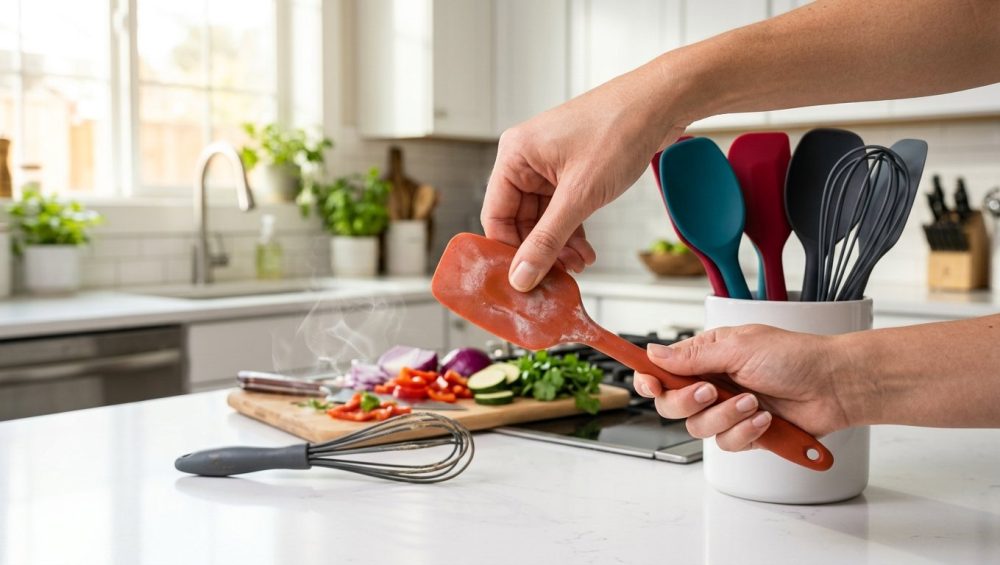
You perform the Pinch Test.
This is the ultimate, foolproof method for exposing cheap kitchenware, and I highly recommend you go to your kitchen right now and test every single piece of silicone you own.
How to Perform the Test
- Take your silicone spatula, baking mat, or ice cube tray in your hands.
- Grab a section of the flexible silicone between your thumb and index finger.
- Pinch it tightly, twist it, and stretch it aggressively.
- Observe the color of the silicone at the point of maximum tension.
The Physics of the White Streak
If the silicone retains its solid, uniform color while being stretched and twisted, congratulations! You have a piece of high-quality, pure silicone.
However, if the stretched area suddenly turns a cloudy, stark white color, you have a problem. That white streak is the undeniable proof of chemical fillers.
The science behind this is simple and fascinating. Pure silicone has a highly consistent molecular structure that absorbs and reflects light uniformly. Because it is a pure substance, stretching it does not alter how light passes through it. However, when cheap fillers (like precipitated silica or plasticizers) are mixed into the silicone, they disrupt that uniform molecular band structure. When the material is in a relaxed state, you can’t see them. But the moment you stretch the material, the silicone matrix pulls apart, exposing the dense, rigid filler particles. These impurities scatter the light, which presents to the human eye as a bright white discoloration.
If your spatula turns white when you pinch it, it belongs in the trash. Do not pass go, do not collect two hundred dollars. Even the most beautifully organized dream kitchen is useless if your tools ruin the food. Throw the filler-heavy plastics away, because they will never stop absorbing soap, and they will eventually melt into your meals.
How to Exorcise the Soap Demon: Rescuing Pure Silicone
Let’s say you performed the Pinch Test, and your spatula passed with flying colors. It is pure silicone, but it still tastes like a mouthful of dish soap. Do not throw it away! Because pure silicone is incredibly heat-resistant, you can actually force the trapped oils out of the material and rescue your tools. Consider this your ultimate kitchen survival guide for navigating the deceptive world of silicone odors.
The Oven Baking Method (The Ultimate Fix)
This is the most effective, scientifically sound method for removing embedded odors from pure silicone. By applying sustained, moderate heat, we can force the silicone molecules to expand and off-gas the trapped soapy oils.
Important Note: You can only do this with 100% pure, filler-free silicone. If you put cheap, filler-heavy silicone in the oven, it will melt, smoke, and ruin your day.
- Preheat your oven: Set your oven to 250°F (120°C) or up to 350°F (175°C).
- Surface Wash: While the oven is heating, wash your silicone items with a mild, unscented dish soap and hot water to remove any surface-level grease. Do not use abrasive sponges, as micro-scratches will damage the non-stick surface.
- Bake: Place your silicone spatulas, mats, or molds directly onto a metal baking sheet. Place the sheet in the oven.
- The Waiting Game: Let the silicone bake for 20 to 60 minutes. The heat will cause the pores to open, and the trapped volatile oils will literally evaporate out of the material.
- The Sniff Test: Carefully remove the baking sheet (it will be hot!). Let the silicone cool slightly and give it a sniff. If it still smells like soap, put it back in for another 20 minutes. Once the smell is completely gone, let it cool to room temperature, give it one final wash with unscented soap, and dry it completely.
The Baking Soda and Vinegar Paste
If you are dealing with a silicone item that has plastic handles attached to it (which cannot go in the oven), you have to rely on chemical neutralization rather than thermal expansion.
Baking soda is a natural, highly alkaline deodorizer that excels at absorbing acidic oils and odors.
- Create a thick paste using baking soda and a small amount of warm water. For extra odor-fighting power, you can use white vinegar or lemon juice instead of water.
- Slather the paste generously over the smelly silicone tool.
- Let the paste dry completely on the surface. This usually takes a few hours. As it dries, the baking soda actively pulls the embedded oils out of the porous surface.
- Scrub the dried paste off with a soft sponge, rinse thoroughly with hot water, and let it air dry.
Cooking should be a peaceful daily habit, not a game of chemical roulette. By maintaining your pure silicone properly and keeping it away from heavily fragranced dish detergents, you can ensure your tools last a lifetime without ever tainting your food.
The Anatomy of a Perfect Spatula: What You Should Be Buying Instead
Now that you have thrown away your toxic, filler-laden plastic spatulas, it is time to rebuild your arsenal. You deserve high-quality, professional-grade equipment. We rely on efficiency for simple weeknight dinners, so our gear needs to keep up with high heat, aggressive stirring, and daily dishwasher cycles.
When you are shopping for new silicone kitchenware, you must be ruthlessly uncompromising. Here are the non-negotiable features you need to look for:
1. 100% Platinum-Cured Silicone
Do not settle for generic “food-grade” labels. You want silicone that explicitly states it is “Platinum-Cured”. In the manufacturing world, silicone must be vulcanized (cured) to turn it from a liquid paste into a solid, flexible rubber. Cheap silicone is cured using peroxides, which leaves behind chemical byproducts and results in a weaker material. Platinum curing uses actual platinum as the catalyst. This process is more expensive, but it creates an incredibly strong, dense, and pure silicone matrix that is completely free of volatile organic compounds (VOCs). Platinum silicone will never leach chemicals, it boasts a significantly higher heat resistance, and it is far less porous, meaning it won’t absorb your dish soap.
2. LFGB Certification
As we discussed earlier, the European LFGB standard is the gold standard for food safety. If a brand has gone through the trouble and expense of acquiring LFGB certification, they will proudly display it on their packaging. This certification guarantees that the product has zero toxic fillers and will not transfer any chemicals to your food, even under extreme heat.
3. Seamless, Unibody Design
This is a massive pet peeve of mine. Do not buy spatulas that have a removable silicone head attached to a wooden or plastic handle. These two-piece designs are a horrific breeding ground for bacteria. Every time you wash a two-piece spatula, dirty dishwater, food particles, and raw egg seep into the microscopic gap where the handle meets the head. Over time, black mold and toxic bacteria flourish in that hidden crevice.
You must buy seamless, unibody spatulas. These tools are molded as one single, continuous piece of silicone wrapped around a rigid inner core (usually stainless steel or fiberglass). There are no seams, no cracks, and absolutely nowhere for bacteria to hide. They are infinitely more hygienic and significantly more durable.
4. Extreme Heat Resistance
A high-quality platinum silicone spatula should be rated to withstand temperatures of at least 425°F, with the best professional brands rated up to 600°F. This ensures that you can leave the spatula resting on the edge of a screaming hot cast-iron skillet without the handle melting into a puddle of toxic goo.
The Sassy Sous-Chef’s Top Utensil Upgrades
You don’t need to spend hours scouring the internet for the right tools. I have already done the vetting for you. If you are ready to upgrade your kitchen crock, these are the brands that consistently deliver uncompromising quality, safety, and performance. Knowing your equipment is safe will cure cooking anxiety faster than any glass of wine.
DI ORO Seamless Series
If you want the absolute pinnacle of professional-grade silicone, DI ORO is the undisputed champion. Their Seamless Series spatulas are made from LFGB-certified, platinum-cured silicone. They boast an astonishing heat resistance of 600°F, meaning you can use them for high-heat wok cooking or boiling caramel without a second thought. The unibody design is flawless, wrapped around a heavy-duty stainless steel core that provides incredible leverage for folding thick doughs. They are completely free of PFAS (forever chemicals) and will outlast any other tool in your kitchen.
GIR (Get It Right)
GIR is another phenomenal brand that completely revolutionized the silicone spatula market. Their tools are crafted from pharmaceutical-grade, platinum-cured silicone that is completely BPA and BPS-free. They feature a beautiful unibody design that is incredibly easy to clean, and their spatulas strike the perfect balance between flexibility (for scraping the last bit of batter out of a bowl) and rigidity (for chopping up ground meat in a pan). With a heat resistance of up to 550°F, GIR tools are an absolute joy to use and come in a stunning array of colors to match any kitchen aesthetic.
OXO Good Grips Everyday Silicone
If you are looking to replace your entire utensil crock in one fell swoop without breaking the bank, the OXO Good Grips silicone line is a fantastic, reliable choice. While they may not have the extreme 600°F heat rating of DI ORO, their high-quality silicone is durable, comfortable to hold, and perfectly safe for daily home cooking.
Final Thoughts: Protect Your Food, Protect Your Sanity
Cooking at home should be a joyful, creative, and deeply rewarding experience. You invest your time, your money, and your love into the meals you prepare. You absolutely do not deserve to have that effort ruined by a cheap, toxic piece of plastic that decided to garnish your dinner with the lingering essence of dishwasher detergent.
Take ten minutes today to audit your utensil crock. Perform the pinch test. Be ruthless. Throw away the stained, melting, filler-heavy frauds that are sabotaging your food. Invest in a few high-quality, platinum-cured, seamless spatulas. Wash them with mild, unscented soap, and treat them with the respect they deserve.
When you equip yourself with the right tools, you eliminate the hidden variables that cause kitchen disasters. You take back control of your food. So go ahead, upgrade your gear, and get back to cooking like the absolute expert you are. No soap required.