The Reality Check: Why Modern Recipes Are Terrifying (But Shouldn’t Be)
Let us get one thing straight right out of the gate: you are entirely capable of making mind-blowing, restaurant-quality food in your own kitchen without a culinary degree, a trust fund, or a personal dishwasher. If you are reading this, you are likely a busy professional who has survived on overpriced takeout and sheer willpower for far too long. You have probably set off the smoke detector a few times, stared blankly at a recipe that demanded you “chiffonade” something, and decided that ordering a lukewarm $35 pizza was the safer emotional choice.
I see you. I was you. I learned to cook through a grueling process of trial, error, and scraping burnt sacrifices out of cheap pans. But the culinary landscape has changed, and frankly, the modern food world does a terrible job of making beginners feel welcome. It is time to cut through the pretentious chef-speak and give you the raw, unfiltered truth about conquering your kitchen.
The Curse of Social Media “Aesthetics”
If you want to know why an entire generation of young professionals is terrified of their own stoves, look no further than your smartphone. Recent data analyzing home cooking trends among young adults highlights a massive shift: people have largely replaced traditional, detailed cookbooks with highly edited, one-minute social media videos.
These bite-sized clips are visually stunning, but they are an absolute disaster for a novice cook’s confidence. You watch a twenty-something “influencer” effortlessly chop an onion in 0.5 seconds, toss ingredients into a pristine pan without measuring, and pull a flawless, perfectly plated meal out of the oven. When your own attempt results in a chaotic kitchen and a lopsided, non-aesthetic dinner, the frustration sets in. It is no wonder that the consumption of ready-made meals has skyrocketed; people feel they cannot possibly measure up to these curated, unrealistic standards.
Let me let you in on a little secret: those videos skip the boring parts. They do not show the mountain of dirty dishes off-camera, the three failed test runs, or the fact that the food is probably ice-cold by the time they finish filming it. Cooking is not supposed to be a flawless aesthetic performance. It is a messy, beautiful, and deeply satisfying process.
Decoding the “30-Minute Meal” Lie
The greatest lie ever sold to the home cook is the “30-minute meal.” You find a recipe online, it promises dinner in half an hour, and 75 minutes later you are standing over the sink, covered in flour, quietly weeping.
Here is the brutal truth about recipe writing: the stated “prep time” almost never includes the time it actually takes a normal human being to wash, peel, chop, and measure the ingredients. Recipe authors assume you possess the knife skills of a seasoned line cook. If a recipe says “one onion, diced,” the clock in their head starts after the onion is already in pieces.
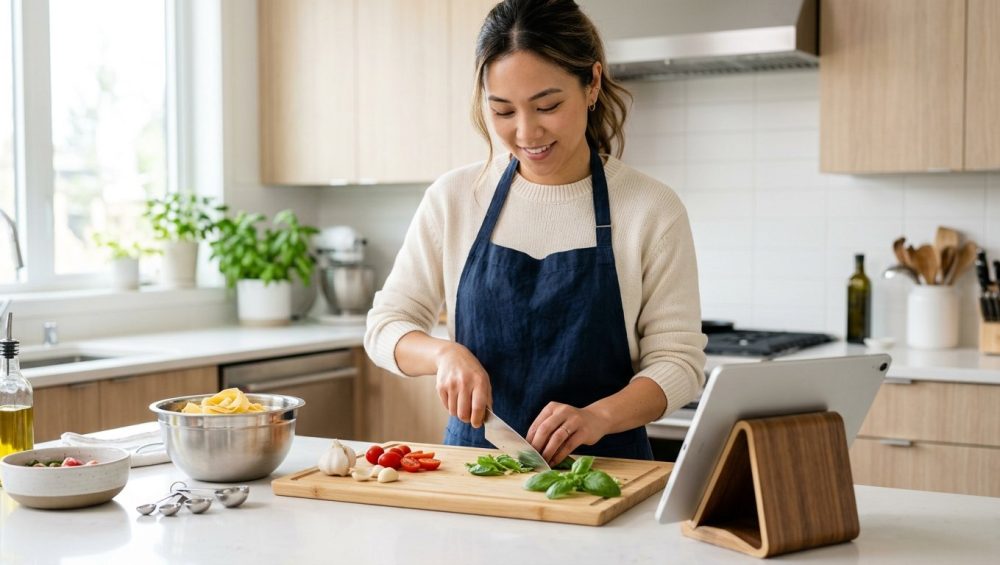
This brings us to the most crucial habit you must adopt: mise en place. It is a fancy French term that simply means “put in place,” and it is the ultimate antidote to kitchen chaos. Before you even think about turning on the stove, every single ingredient must be chopped, measured, and sitting in little bowls ready to go. If you are trying to frantically mince garlic while your chicken is actively burning in the skillet, you have already lost the battle. Preparing everything upfront transforms your cooking from a frantic race against time into a smooth, manageable process.
The Absolute Non-Negotiables: Your Beginner Kitchen Arsenal
You cannot build a house with a plastic hammer, and you cannot learn to cook properly with garbage equipment. The culinary industry loves to sell beginners massive, 15-piece cookware sets and hyper-specific gadgets (I am looking at you, avocado slicers). You do not need any of it. What you do need is a curated collection of high-quality basics.
The “No-Go” Rule on Toxic Cookware
We need to have a serious talk about the pans currently sitting in your cabinets. If you are cooking on cheap, lightweight non-stick pans with a coating that is scratched, flaking, or peeling, you need to throw them in the trash immediately. I have zero patience for mystery metals and toxic gear, and neither should you.
Most traditional non-stick pans are coated with polytetrafluoroethylene (PTFE), commonly known as Teflon, which is manufactured using a class of “forever chemicals” called PFAS. While newer pans claim to be PFOA-free, they often still rely on other potentially hazardous PFAS compounds. When these cheap pans are heated above 500°F (260°C)—which is incredibly easy to do if you leave an empty pan on a high burner for just a few minutes—the coating begins to break down and release toxic fumes. Inhaling these fumes can cause “polymer fume fever,” a condition that literally mimics the flu.
The regulatory world is finally waking up to this nightmare. As of January 2025, Minnesota became the first U.S. state to completely ban the sale of non-stick cookware coated with PFAS, with several other states slated to enforce similar bans between 2026 and 2028. Furthermore, the FDA recently finalized the total market phase-out of PFAS used in grease-proofing paper food packaging,. The writing is on the wall. Upgrading your skills starts with banishing toxic kitchen gear from your life forever. Invest in materials that will outlive you, not slowly poison you.
The Holy Trinity of Kitchen Tools
If you want to cook like a professional in a standard home kitchen, you only need three core items to get started. Do not let anyone convince you otherwise.
First, you need an 8-inch chef’s knife. Stop using that tiny, dull paring knife to hack apart a sweet potato. A sharp, well-balanced chef’s knife does 95% of the work in the kitchen. Second, you need a massive, heavy wooden cutting board. Those flimsy, thin plastic mats that slide all over your counter are a trip to the emergency room waiting to happen. Your cutting board should be large enough that your chopped vegetables do not immediately fall off the edge.
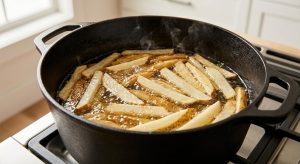
Third, you need a heavy-bottomed skillet. I highly recommend either a 12-inch cast-iron skillet or a high-quality stainless steel pan. These materials can withstand high heat, they hold their temperature beautifully, and they will last for generations. If you focus on acquiring just these only beginner kitchen tools, you will instantly elevate the quality of your meals.
The Unsung Heroes of Prep
While the knife and the pan get all the glory, there is one dirt-cheap tool that every professional cook relies on, yet most home cooks ignore: the bench scraper. It is essentially a flat, rectangular piece of metal with a handle.
Why do you need it? Because when you chop a massive pile of onions, you currently use the sharp edge of your expensive chef’s knife to scrape them off the board and into the pan. This destroys the blade’s alignment, making your knife dull and dangerous. A bench scraper effortlessly scoops up massive amounts of prepped ingredients, cleans gunk off your cutting board, and portions dough. Once you discover the various uses for a bench scraper, you will wonder how you ever functioned without one.
Decoding the Trends: Modern Cooking Techniques Demystified
Modern recipes love to throw around intimidating terminology. The secret to becoming a confident cook is realizing that these “advanced” techniques are just fancy words for very basic scientific reactions. Let’s decode the jargon so you can stop panicking.
“Caramelizing” vs. “Burning to a Crisp”
Recipes constantly tell you to “caramelize” onions or achieve a “golden-brown sear” on meat. What they are actually asking you to do is trigger the Maillard reaction. Without boring you with a chemistry lecture, the Maillard reaction is a complex chemical process where amino acids and reducing sugars react under heat to create hundreds of new, deeply savory flavor compounds. It is the reason a seared steak tastes infinitely better than a boiled steak.
Beginners consistently fail at this for two reasons: moisture and overcrowding. Water is the enemy of browning. If you take a dripping wet piece of chicken and throw it into a pan, the heat will spend all its energy evaporating the water, effectively steaming the meat instead of searing it. Always pat your proteins bone-dry with a paper towel before cooking. Furthermore, if you cram too much food into the pan at once, the trapped moisture cannot escape, and again, you end up boiling your food in its own juices. Give your ingredients room to breathe.
Conquering the Searing Anxiety
One of the most common fears among novice cooks is dealing with high heat. The moment a pan starts smoking, beginners tend to panic, crank the dial down to low, and ruin the dish. This hesitation is why your food lacks texture and depth.
Searing requires confidence. You must let your heavy skillet get genuinely hot before adding the oil, and the oil must be shimmering before you add the food. Yes, there will be a sizzle. Yes, there might be a wisp of smoke. That is the sound of flavor developing. Do not poke, prod, or aggressively flip the food every ten seconds. Let it sit undisturbed so the crust can form. Once you master this fear, you can easily execute dishes like a perfect pan-seared salmon with a crispy skin that rivals any high-end seafood restaurant.
The Art of Emulsification (Making Haters Mix)
“Emulsify” is a word that strikes fear into the hearts of many, but it simply means forcing two liquids that naturally hate each other—like oil and water—to blend together into a smooth, unified mixture.
If you just whisk oil and vinegar together in a bowl, they will separate the moment you stop stirring. To create a stable emulsion, you need an emulsifier: an ingredient that acts as a chemical bridge between the fat and the water. Common emulsifiers include egg yolks, mustard, honey, and mayonnaise. By adding a dollop of Dijon mustard to your vinaigrette and vigorously whisking while slowly drizzling in the olive oil, you create a creamy, luxurious dressing that clings perfectly to your salad greens instead of pooling sadly at the bottom of the bowl.
The Weekday Warrior: High-Efficiency, Low-Stress Modern Recipes
When it is 6:30 PM on a Tuesday, you have just logged off from a stressful workday, and you are starving, you do not need a culinary journey. You need efficiency.
Time is Money: The Philosophy of Weeknight Survival
Economic realities are forcing us back into our kitchens. Recent projections from the USDA indicate that while grocery prices are stabilizing with a modest 3.3% increase, the cost of dining out continues to surge at 3.7%. Relying on delivery apps is no longer a viable financial strategy for the average young professional.
However, cooking at home during the week requires a rigorous prioritization of time. You need recipes that deliver maximum flavor with minimal active labor. By relying on smart shortcuts and hands-off cooking methods, you can turn the chore of feeding yourself into a peaceful daily habit rather than a frantic scramble. Here are two foolproof modern formats you need to master.
The “Throw It In A Sheet Pan” Miracle
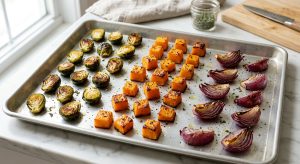
The sheet pan dinner is the undisputed king of weeknight survival. It involves tossing all your ingredients onto a single heavy-duty baking sheet and letting the high, dry heat of the oven do all the heavy lifting.
The Recipe: Crispy Sheet Pan Gnocchi with Blistered Tomatoes and Sausage
Boiling gnocchi on a weeknight is a rookie mistake. They often turn into dense, gummy little sinkers. Roasting them, however, is a revelation.
- The Prep: Take a package of store-bought, shelf-stable potato gnocchi (do not bother making them from scratch today). Toss them directly onto a large sheet pan. Add a pint of cherry tomatoes, a sliced pre-cooked chicken sausage, and a handful of roughly chopped garlic cloves.
- The Seasoning: Drizzle everything generously with good olive oil, kosher salt, black pepper, and a pinch of red pepper flakes. Toss it all together with your hands until every piece is coated.
- The Bake: Spread the ingredients out into a single, even layer. Roast in a preheated 400°F (200°C) oven for about 20 to 25 minutes.
- The Magic: As it bakes, the tomatoes will burst, releasing their sweet juices to create a natural sauce. The gnocchi will puff up, becoming crispy and golden on the outside while remaining pillowy on the inside. Top with fresh basil and a snowfall of grated Parmesan cheese. You just made a phenomenal dinner, and you only have one pan to wash.
The One-Pot Wonder That Actually Tastes Good
One-pot pastas are trendy, but they often result in a starchy, gluey mess if done incorrectly. The secret is to use a pasta shape that benefits from a starchy sauce, like orzo. Orzo looks like rice, but it is pasta, and it cooks remarkably fast.
The Recipe: Creamy Lemon-Herb Orzo with Spinach
This technique mimics the luxurious, creamy texture of a slow-stirred risotto, but it takes a fraction of the time and requires almost zero babysitting.
- The Base: In a large, deep skillet or Dutch oven, heat a splash of olive oil over medium heat. Sauté a finely diced onion until soft, then add minced garlic and toast for 30 seconds until fragrant.
- The Toast: Pour in one cup of dry orzo. Stir it constantly for about two minutes. Toasting the dry pasta in the oil enhances its nutty flavor and helps it maintain its shape during cooking.
- The Simmer: Pour in two and a half cups of high-quality chicken or vegetable broth. Bring the mixture to a gentle boil, then immediately drop the heat to low, cover the pot, and let it simmer for about 10 to 12 minutes. Stir it occasionally so it does not stick to the bottom.
- The Finish: Once the liquid is mostly absorbed and the orzo is tender, turn off the heat. The starch released by the pasta will have thickened the remaining broth into a creamy glaze. Stir in two massive handfuls of fresh spinach (it will wilt instantly in the residual heat), the zest and juice of one lemon, and a generous grating of Parmesan. It is bright, comforting, and ridiculously easy.
The Weekend Flex: Impressive (Yet Foolproof) Projects
Weekdays are about survival; weekends are about artistry. When you have the luxury of time, you can tackle projects that yield spectacular results. And thanks to the globalization of the modern pantry, weekend cooking has never been more exciting. A massive 2025 global consumer report analyzing nearly one billion home-cooked meals found that in 83% of markets, the most-cooked dish originated from another country. Fusion and global exploration are the new normal. We are actively demystifying modern recipes so you can confidently bring these global, restaurant-tier techniques into your own dining room.
Reverse-Seared Steak (Steakhouse Quality in Your Sweatpants)
Cooking a thick, expensive steak traditionally (searing it in a screaming hot pan and hoping the middle cooks perfectly) is a recipe for anxiety. You usually end up with a charred exterior and a raw center, or a gray, overcooked hockey puck. The modern, foolproof solution is the “reverse sear.”
The reverse sear flips the traditional method upside down. You start by baking the steak in a very low oven (around 250°F or 120°C) until the internal temperature reaches your desired doneness (for medium-rare, pull it out at 115°F). You absolutely must use a digital meat thermometer for this—do not guess. Because the oven temperature is so low, the meat cooks incredibly evenly from edge to edge, completely eliminating that dreaded gray band of overcooked meat.
Once the steak hits the target temperature, take it out of the oven and let it rest for ten minutes. Meanwhile, heat your cast-iron skillet until it is smoking hot. Add a high-smoke-point oil, drop the steak in, and sear it for exactly one minute per side. You will achieve a majestic, crusty exterior with a perfectly pink, uniformly cooked interior. It is scientific perfection.
The No-Knead Focaccia That Will Make You Cry Tears of Joy
Baking bread terrifies beginners. Professional culinary instructors note that recipes involving yeast are consistently ranked among the most intimidating because yeast is a living organism that requires patience and the right environment. People fear the ambiguous process of “kneading until smooth and elastic”.
Enter the no-knead focaccia. This recipe eliminates the physical labor of kneading and replaces it with the magic of time.
- The Mix: In a large bowl, whisk together 4 cups of bread flour, 2 teaspoons of kosher salt, and 2 teaspoons of instant yeast. Pour in 2 cups of warm water. Use a wooden spoon to mix it until you have a shaggy, sticky, incredibly ugly dough. Do not overthink it.
- The Fermentation: Cover the bowl tightly with plastic wrap and put it in the refrigerator for 18 to 24 hours. This cold, slow fermentation allows enzymes to break down the starches, developing a complex, bakery-level flavor that a quick rise simply cannot achieve. More importantly, the long resting time naturally aligns the gluten strands, doing the “kneading” for you.
- The Proof: The next day, pour a generous amount of olive oil into a 9×13 inch metal baking pan. Dump the bubbly, fermented dough into the pan, turn it over to coat it in oil, and gently stretch it out. Let it sit in a warm spot for 2 to 3 hours until it is puffy and reaches the edges of the pan.
- The Dimple and Bake: Drizzle more olive oil over the top. Coat your fingers in oil and press them firmly into the dough, creating deep dimples all over the surface. Sprinkle heavily with flaky sea salt and fresh rosemary. Bake at 425°F (220°C) for 25 minutes until the top is deeply golden brown and the bottom is fried and crispy from the oil. You will look like a master baker, and you barely lifted a finger.
Saving the Un-Savable: A Rookie’s Guide to Kitchen Disasters
Even the most experienced cooks mess up. I have burned pine nuts that cost more than my car insurance, and I have over-salted soups until they tasted like seawater. The difference between a rookie and a pro is knowing how to pivot when things go wrong.
Too Salty? The Potato Myth and What Actually Works
Let us kill a persistent kitchen myth right now: dropping a raw potato into an over-salted soup will not magically absorb the excess salt. It will just give you a slightly salty potato.
If you have over-salted a liquid dish like a soup or a stew, the only true scientific fix is dilution. You must add more unsalted broth, water, or a splash of cream to increase the volume of the dish, thereby lowering the concentration of the salt. If the dish is only slightly too salty, you can trick the palate by adding a pinch of sugar or a splash of acid (like vinegar or lemon juice) to balance the harshness. Learning how to properly save ruined meals is a rite of passage.
Too Spicy? Dairy to the Rescue
If you were too heavy-handed with the chili flakes, do not try to fix it by drinking a gallon of water. Capsaicin, the chemical compound that makes chilies hot, is an oil-based molecule. It repels water. Chugging a glass of water just spreads the spicy oil around your mouth, making the burning sensation worse.
To neutralize the heat, you need fat and dairy. Casein, a protein found in milk and yogurt, acts like a detergent, binding to the capsaicin molecules and washing them away from your pain receptors. Swirl a generous dollop of heavy cream, sour cream, or full-fat yogurt into your overly spicy curry or chili. A spoonful of peanut butter or tahini can also work wonders in Asian-inspired dishes.
Too Bland? The Acid Test
Beginners consistently under-season their food. If you taste your dish and think, “It’s missing something, but I don’t know what,” your first instinct is usually to reach for the salt shaker. While salt is crucial, the element you are most likely missing is acid.
Acid is the spark plug of flavor. It cuts through heaviness, brightens dull ingredients, and makes your mouth water. If your rich beef stew tastes flat, a splash of red wine vinegar stirred in right at the end will wake it up. If your roasted vegetables are boring, a squeeze of fresh lemon juice will transform them. Understanding how to balance fat, salt, and acid is the ultimate key to fixing rookie kitchen mistakes.
Setting Up for Success: Organization and Mindset
You can have the best ingredients and the sharpest knives, but if your physical environment is a disaster zone, cooking will always feel like a stressful chore.
The Workspace Flow
A cluttered kitchen creates a cluttered mind. You cannot expect to execute a seamless meal if you are constantly shoving mail, dirty coffee mugs, and random appliances out of the way to make room for your cutting board.
Before you start cooking, clear your counters entirely. Empty the dishwasher so you have a place to immediately load dirty prep bowls. Set up a “garbage bowl” on your counter to toss vegetable peels and wrappers into, saving you from making twenty trips to the trash can with dripping hands. By establishing a permanently organized kitchen system, you remove the physical friction that makes cooking feel exhausting.
Surviving the Clumsy Phase
When you are learning a new physical skill, you are going to be clumsy. You will chop vegetables unevenly, you will drop a spatula on the floor, and you will misjudge the timing of your side dishes. This is not a sign of failure; it is the necessary friction of learning. Accept that the first few months of your culinary journey will be imperfect. Give yourself grace, laugh at the burnt edges, and keep a survival guide for absolute beginners handy for when things inevitably go sideways.
The Final Verdict: You Belong in the Kitchen
Cooking is not a mystical talent bestowed upon a lucky few at birth. It is a mechanical skill, grounded in basic science, improved through repetition, and driven by a desire to eat well. You do not need to be a Michelin-starred chef to roast a chicken that makes your friends weak in the knees. You do not need a pristine, aesthetic kitchen to bake a loaf of bread that fills your home with the greatest scent on earth.
You simply need a sharp knife, a heavy pan, a refusal to accept mediocre takeout, and the courage to turn on the stove. The modern recipe world might seem intimidating, wrapped in jargon and filtered for social media, but underneath it all, it is just heat, salt, and time.
So pour yourself a glass of wine, turn on your favorite playlist, and step up to the cutting board. Your kitchen is waiting for you. Let’s get to work.