Listen, I know exactly why you’re here. You’re staring at a sad, wilted head of lettuce in your fridge, contemplating ordering $35 pad thai for the third time this week. You think cooking is an innate genetic trait that skipped your generation, and your smoke detector is basically your kitchen timer.
Stop. Take a breath. Put down the delivery app.
I’m here to tell you a hard truth, served with a side of tough love: anyone can cook. You don’t need a culinary degree from Le Cordon Bleu, and you certainly don’t need to be naturally gifted. What you need is a fundamental understanding of how heat works, a refusal to accept mediocre ingredients, and the willingness to make a few mistakes. According to recent 2025 data, Americans spend an average of 41 to 57 minutes a day cooking, yet a staggering number of people still feel entirely lost at the stove. Meanwhile, the financial toll of dining out is astronomical. A 2025 study from QuestionPro revealed that families who cook at home instead of dining out save upwards of $24,000 a year. In today’s economy, learning to cook isn’t just a fun hobby; it is a vital survival skill.
I learned to cook through sheer stubbornness, trial, error, and setting off the fire alarm more times than I care to admit. Now, I survive the chaotic weekdays using ruthless efficiency, which buys me the time to be an absolute perfectionist with my elaborate weekend culinary projects. I have zero patience for pretentious chef-speak, and I have even less patience for the toxic, cheap garbage that marketing companies try to sell to novice cooks.
This is your masterclass. We are going to strip away the fluff, purge the poison from your cabinets, and build your culinary foundation from the ground up.
The Mindset Shift: From Kitchen Terror to Culinary Confidence
The biggest hurdle between you and a restaurant-quality meal isn’t a lack of expensive ingredients; it’s your mindset. You are terrified of failing. You treat recipes like legally binding contracts rather than flexible roadmaps.
Here is the secret that professional chefs don’t want you to know: cooking is mostly just heat management and proper seasoning. That’s it. Baking is a science that requires precision, but cooking is an art form that thrives on intuition.
Interestingly, the desire to cook is there. A 2025 report from the Food Industry Association showed that 51% of Gen Z consumers actually love meal preparation—more than any other generation—but they are held back by a lack of basic cooking knowledge. You want the aesthetic, you want the delicious outcome, but you skip the foundational steps.
You need to embrace the learning curve. You will burn the garlic. You will overcook a chicken breast until it resembles a pencil eraser. It happens. But every failure is data. When you finally decide you are going to master your space, you begin transforming your daily cooking from a stressful chore into kitchen artistry. You stop viewing the kitchen as a place of obligation and start seeing it as a space of creation.
Purging the Poison: Why Your Cheap Pans Are Sabotaging You
Before we talk about what you should buy, we need to talk about what you must immediately throw in the trash. I have a strict, non-negotiable “No-Go” rule in my kitchen, and you need to adopt it right now: absolutely no toxic, peeling, mystery-metal, cheap non-stick cookware.
I despise cheap non-stick pans with the fire of a thousand commercial gas burners. Not only do they produce a terrible sear, but they are actively detrimental to your health. Let’s look at the cold, hard facts. A 2025 Ecology Center study found that a staggering 79% of non-stick cooking pans tested were coated with PTFE (polytetrafluoroethylene), commonly known as Teflon. These coatings are manufactured using PFAS—per- and polyfluoroalkyl substances, ominously dubbed “forever chemicals” because they refuse to break down in the environment or your body.
When you heat a cheap non-stick pan over 500°F (260°C)—which happens much faster than you think when preheating an empty skillet—the coating begins to degrade, releasing toxic fumes. If your pan has a single scratch on it, those chemicals are leaching directly into your scrambled eggs. A comprehensive 2025 study highlighted that PFAS exposure is linked to kidney cancer, testicular cancer, liver toxicity, and severe reproductive harm, estimating that PFAS in drinking water and cookware could be responsible for thousands of additional cancer cases annually in the U.S. alone. In 2024 and 2025, the EPA finally began setting legally enforceable limits on these chemicals in drinking water, yet they are still sitting right there in your kitchen cabinet.
Throw them out. Today. I don’t care if you paid $19.99 for a set of three at a big-box store. They are garbage. You cannot achieve professional-level results on a surface that is chemically designed to repel everything, including heat and flavor. You need cookware that can handle high heat, build a proper fond (the caramelized brown bits at the bottom of the pan), and last a lifetime.
The Holy Trinity of Kitchen Gear (What You Actually Need)
Now that your cabinets are free of toxic waste, it’s time to rebuild. The kitchen industry makes billions of dollars convincing novices that they need single-use gadgets. You do not need a strawberry huller. You do not need a specialized avocado slicer. You need a curated selection of beginner kitchen tools you actually need to execute fundamental techniques.
If you are just starting out, there are only a few must-have tools for the culinary curious that you should invest your money in. Quality over quantity, always.
1. A High-Quality Chef’s Knife
Do not buy a 15-piece knife block set. You will use exactly two of them, and the rest will gather dust. You need one excellent 8-inch chef’s knife. Whether you prefer the heavy, sturdy rock-chop of a German blade (like Wüsthof) or the lightweight, razor-sharp precision of a Japanese blade (like Mac or Shun), this is an extension of your arm. A sharp knife is a safe knife; a dull knife requires you to apply excessive force, which is how the blade slips and you end up in the emergency room.
2. A Heavy-Bottomed Skillet (Carbon Steel or Cast Iron)
Since we threw away your toxic non-stick, you need a daily driver. A 10-inch or 12-inch cast iron or carbon steel skillet is your best friend. Yes, they require a tiny bit of maintenance (seasoning), but they are virtually indestructible, naturally non-stick once properly seasoned, and they hold heat like a dream. They will give your steaks a crust that will make you weep with joy. For acidic foods (like tomato sauces), invest in a fully clad stainless steel skillet.
3. The Bench Scraper
If there is one tool that separates the chaotic amateur from the organized pro, it’s the bench scraper. This flat piece of steel with a handle is the kitchen’s unsung hero. You use it to scoop up massive piles of chopped onions, clean off your cutting board, portion out dough, and smash garlic cloves. Once you start using one, you will wonder how you ever functioned without it.
4. A Massive, Heavy Cutting Board
Stop chopping on those flimsy, plastic, paper-thin cutting boards that slide all over the counter. You need a large, heavy wooden cutting board (edge-grain or end-grain teak, maple, or walnut). It protects your knife’s edge, provides a stable work surface, and looks beautiful sitting on your counter.
Knife Skills 101: Stop Mutilating Your Vegetables
Having a great knife means nothing if you hold it like a serial killer in a horror movie. Proper knife skills are the foundation of kitchen efficiency. If it takes you twenty minutes to chop an onion, of course you’re going to hate cooking.
The Pinch Grip
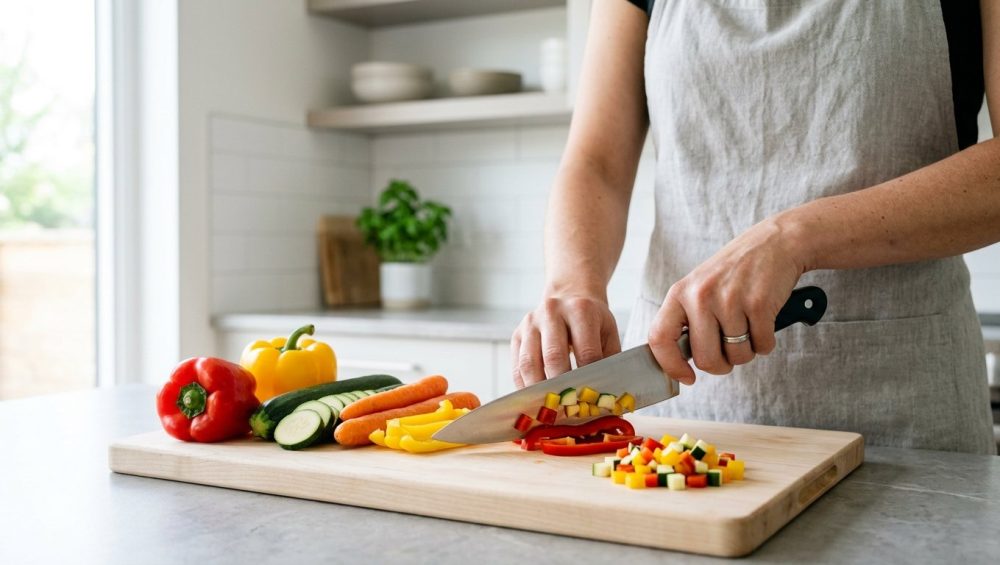
Do not wrap your entire fist around the handle of the knife with your index finger pointing down the spine. This gives you zero control. Instead, use the “pinch grip.” Pinch the actual base of the blade (the heel) between your thumb and your index finger, and wrap your remaining three fingers loosely around the handle. It will feel weird for the first two days, and then it will feel like you have a superpower.
The Claw Hand
The hand that holds the food (your non-dominant hand) needs to be protected. Form your hand into a “claw,” tucking your fingertips inward and resting your knuckles against the flat side of the knife blade. As you chop, you slowly walk your claw hand backward. The knife blade glides against your knuckles, and your fingertips remain safely out of the strike zone.
The Onion Rule
Why do onions make you cry? Because when you crush their cell walls with a dull knife, they release a volatile sulfur compound that irritates your eyes. A razor-sharp knife slices cleanly through the cells, minimizing the chemical release. Leave the root end intact while you dice; it holds the entire onion together and prevents it from slipping around the board.
The Science of Flavor: Salt, Fat, Acid, Heat (and a Little Snark)
Why does restaurant food taste so much better than yours? I promise you, it’s not magic. It’s because professional chefs are not afraid of salt, they utilize copious amounts of fat, they understand the brightening power of acid, and they know how to manipulate heat.
Salt is Not Your Enemy
Unless your doctor has explicitly put you on a low-sodium diet, you are under-seasoning your food. Salt does not just make food salty; it makes food taste more like itself. It suppresses bitterness and enhances sweetness. You should be using Kosher salt (Diamond Crystal is the industry standard) because the large, hollow flakes allow you to season evenly by hand without over-salting. Season your food at every step of the cooking process, not just at the end.
Fat is Flavor
Fat carries flavor compounds across your palate. It provides mouthfeel and richness. Whether it’s a high-quality extra virgin olive oil finished over a plate of pasta, or a knob of cold butter swirled into a pan sauce right before serving (a technique called monter au beurre), fat is essential. Stop buying fat-free products. They compensate for the lack of fat by adding sugar and chemical thickeners.
Acid: The Missing Link
If you taste a soup, a sauce, or a stew and think, “This needs something, but I don’t know what,” 90% of the time, it needs acid. Acid cuts through richness and wakes up a dull dish. A squeeze of fresh lemon juice, a splash of apple cider vinegar, or a dash of sherry vinegar right at the end of cooking will elevate your dish from muddy to vibrant.
The Maillard Reaction: Color Equals Flavor
The Maillard reaction is a chemical reaction between amino acids and reducing sugars that gives browned food its distinctive flavor. It’s what makes the crust of a steak taste incredible, what makes roasted coffee complex, and what makes toast taste better than plain bread. To achieve this, your pan must be hot, and your ingredients must be dry. If you drop a wet piece of meat into a lukewarm pan, it will steam, turn grey, and taste like sadness. Pat your proteins dry with a paper towel before they hit the heat.
Weekday Survival: Time-Saving Hacks That Don’t Sacrifice Soul
Weekdays are a battleground. You’ve worked all day, you’re exhausted, and the siren song of the drive-thru is loud. My philosophy for Monday through Thursday is simple: Time is money. We rigorously prioritize efficiency and shortcuts, but we never sacrifice the soul of the food.
The Power of Mise en Place
Mise en place is a French culinary phrase meaning “putting in place.” It means gathering, chopping, and measuring all of your ingredients before you even turn on the stove. If you are frantically chopping garlic while your onions are burning in the pan, you have already lost the war. Prep everything first. Put it in little bowls. Cooking becomes a calm assembly process rather than a chaotic scramble.
Component Prep, Not Meal Prep
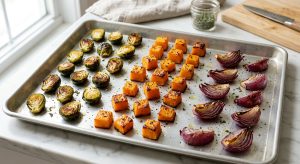
I despise traditional “meal prep” where you cook five identical, depressing portions of chicken and broccoli on Sunday and eat them until Thursday when they taste like damp cardboard. Instead, prep components. Make a large batch of a versatile grain like quinoa or farro. Roast a huge tray of mixed vegetables. Whip up a killer vinaigrette. During the week, you can mix and match these components with a quick-cooking protein.
The 30-Minute Masterpiece
You need a repertoire of meals that can be executed in under half an hour. Fish is your best friend here. If you want a masterclass in efficiency, follow a step-by-step guide to pan-seared salmon. You get a screaming hot pan, sear the salmon skin-side down until it’s crispy, flip it, throw in some asparagus, and you have a luxurious, healthy, restaurant-quality meal on the table in 15 minutes flat.
The Weekend Warrior: Elevating Your Culinary Projects
If weekdays are for survival, weekends are for artistry. This is when you pour a glass of wine, turn on a great playlist, and dive into the meticulous, perfectionist projects that remind you why cooking is a joy.
This is the time to tackle a slow-braised beef short rib that cooks low and slow for four hours until it melts in your mouth. It’s the time to learn how to make fresh pasta from scratch, feeling the dough transform from a shaggy mess into a smooth, elastic sheet under your hands. It’s the time to bake a loaf of sourdough bread, nurturing a starter and mastering the complex folds and proofing times.
Weekend cooking is about the process, not just the product. It’s about building layers of flavor. When you make a proper homemade chicken stock on a Sunday afternoon, simmering roasted bones and aromatics for hours, your kitchen smells like heaven, and you have liquid gold to use in your quick weekday meals.
Fixing Rookie Mistakes Before They Ruin Your Dinner
I see novice cooks make the same catastrophic errors time and time again. Let’s address the rookie kitchen mistakes that are ruining your dinners so you can stop sabotaging your own efforts.
1. Overcrowding the Pan
If you put too much food in a skillet at once, the temperature of the pan drops rapidly. The moisture released from the food has nowhere to evaporate, so instead of searing, your food boils in its own juices. If you are browning mushrooms or searing meat, leave space between the pieces. Cook in batches if you have to. Patience yields a crust; impatience yields mush.
2. Cooking Meat Straight from the Fridge
If you throw a freezing cold steak into a hot pan, the outside will burn before the inside even comes up to room temperature. Let your proteins rest on the counter for 20 to 30 minutes before cooking to take the chill off.
3. Fiddling and Flipping
Stop touching the food! When you put a piece of chicken in a hot pan, leave it alone. If you try to flip it and it sticks, it’s not ready. The meat will naturally release from the pan when it has developed a proper sear. Put your tongs down and step back.
4. Not Resting Your Meat
When you cook meat, the muscle fibers contract and push all the juices toward the center. If you slice into a steak the second it comes off the heat, all those juices will bleed out onto your cutting board, leaving you with a dry, chewy piece of leather. Let your meat rest for at least 5 to 10 minutes (longer for large roasts) so the fibers relax and the juices redistribute.
Kitchen Aesthetics and Workflow: Creating a Space You Don’t Hate
You will never want to cook if your kitchen is a disaster zone. The physical environment directly impacts your mental state and your culinary output. You don’t need a massive, expensive remodel to create a functional space; you just need logic and organization.
The Triangle and the Zones
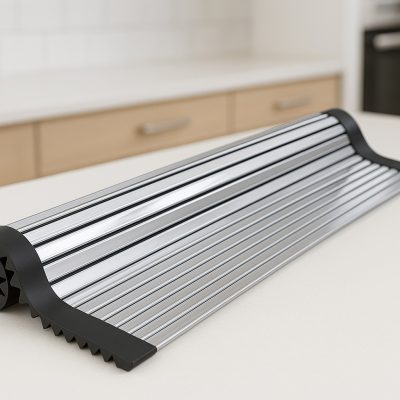
Professional kitchens are broken down into stations. Your home kitchen should be no different. You need to establish a permanently organized kitchen by thinking in zones: a prep zone (cutting board, knives, trash can nearby), a cooking zone (stove, spatulas, oils, spices), and a wash zone (sink, dishwasher, drying rack). Stop storing your heavy pots on the top shelf across the room from the stove. Store things exactly where you use them.
Light and Space
A dark, cramped kitchen feels like a dungeon. If you are stuck in a small apartment, there are brilliant ways to make your kitchen feel brighter and more spacious. Utilize under-cabinet lighting to illuminate your prep space. Clear the clutter off your counters—appliances you use once a month belong in a closet, not taking up prime real estate. Keep your workspace pristine. Clean as you go. Waiting until the end of the meal to tackle a mountain of dishes is a guaranteed way to ruin your post-dinner relaxation.
The Art of Feeding Others: Dinner Parties Without the Panic
Eventually, you are going to want to show off your new skills. But hosting friends for dinner often induces a level of anxiety that entirely defeats the purpose of gathering.
If you want to host a relaxed dinner party, you have to leave your ego at the door. The biggest mistake novice hosts make is attempting to cook a highly complex, multi-component dish they have never made before. Do not try to make a soufflé for the first time when you have six people sitting in your dining room. You will panic, the soufflé will fall, and you will spend the entire evening sweating in the kitchen while your guests drink all your wine without you.
To master the art of effortless hosting, you must rely on dishes that can be prepared mostly in advance. Braises, stews, and roasted meats are perfect because they sit happily in the oven and actually taste better as they sit. Prepare a cold appetizer that is ready when guests arrive. Make a dessert that sets in the fridge overnight. Your job as a host is to curate a vibe, pour the drinks, and be present with your friends—not to be a frantic line cook trapped behind a stove.
The Final Bite
Mastering the art of the kitchen is not about achieving Michelin-star perfection every time you turn on the burner. It is about taking control of your health, your budget, and your time. It’s about knowing that you can walk into a grocery store, pick up a few humble ingredients, and transform them into something that brings you genuine joy.
Throw away the toxic pans. Buy a good knife. Salt your food like you mean it. Embrace the mistakes, because every burnt piece of toast and overcooked piece of fish is just a stepping stone to culinary confidence. The kitchen is your domain now. Act like it. Now, go make yourself something spectacular for dinner. You’ve earned it.