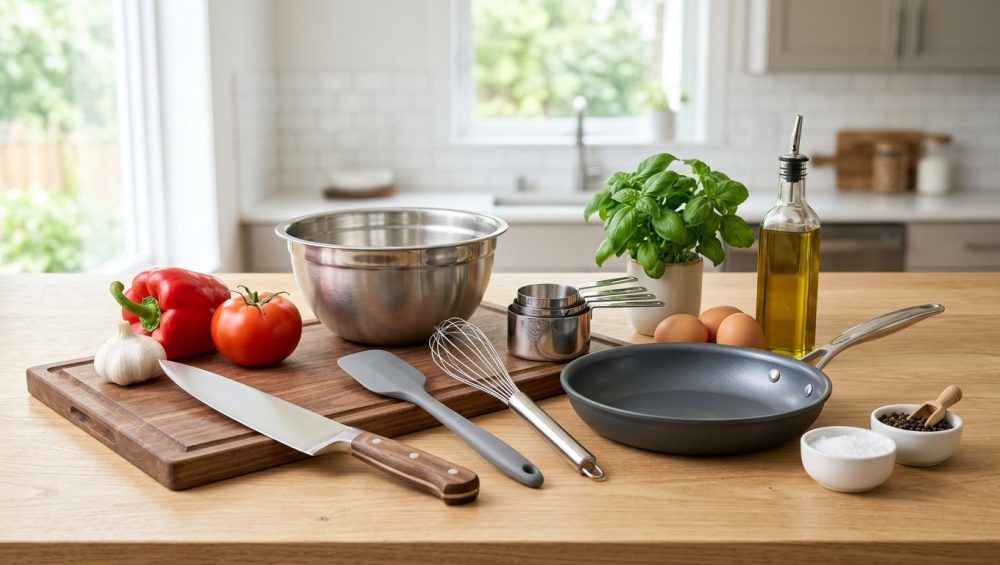
Pour yourself a glass of something strong. We need to talk about your kitchen. If you’re reading this, you’re likely staring at a confusing abyss of targeted ads pushing 15-piece cookware sets for $49.99 and gadgets that promise to core an apple while doing your taxes. Stop. Put the credit card down.
As someone who learned to cook by setting off the smoke alarm so many times my neighbors thought it was a metronome, I am here to tell you that you do not need a culinary degree to make mind-blowing food. You also don’t need a kitchen packed with useless, single-purpose clutter. Weekdays are a battlefield; time is money, and we survive by using clever, efficient tools. Weekends? That’s when we pour the wine, turn on the jazz, and get meticulous. But neither scenario requires a 12-speed avocado slicer.
This masterclass is your definitive, no-nonsense guide to the beginner cooking essentials that will actually transform your culinary life. No fluff, no 2,000-word stories about my grandmother’s farm. Just straight-shooting, battle-tested advice to get you cooking like a pro.
The Holy Trinity of Cutlery: Stop Mutilating Your Vegetables
Let’s get one thing straight: a dull knife is the most dangerous object in your kitchen. It requires more force, slips easily off that onion, and sends you straight to the urgent care clinic. You do not need a massive wooden block of 24 knives. You need three. That’s it. Three high-quality blades will handle 99.9% of the tasks you will ever face.
The 8-Inch Chef’s Knife (The Undisputed Workhorse)
If you only buy one knife, this is it. The 8-inch chef’s knife is the extension of your dominant hand. It chops, slices, dices, minces, and smashes garlic cloves with the flat of the blade.
When shopping, look for high-carbon stainless steel. It holds an edge beautifully and doesn’t rust the second you look at it funny. You don’t have to drop $200 on a hand-forged Japanese blade right out of the gate. Brands like Victorinox (their Fibrox line is legendary in commercial kitchens and constantly tops independent testing charts) or a sturdy entry-level Wüsthof will cost you between $40 and $80 and last a lifetime if you treat them right.
Weekday Hack: Learn the “claw grip” for your non-knife hand. Tucking your fingertips behind your knuckles while you chop will save you a trip to the ER and drastically speed up your prep time. Time is money, people. We don’t have time to bleed.
The Paring Knife (The Detailer)
For the tiny, off-board tasks that the 8-inch chef’s knife is too clumsy for, you need a 3-to-4-inch paring knife. This is your precision instrument. You’ll use it for peeling apples, hulling strawberries, deveining shrimp, and scoring the fat on a duck breast when you’re feeling fancy on a Saturday night.
Again, don’t overspend here. A $10 Victorinox paring knife is sharper than the devil’s tongue and completely indestructible.
The Serrated Bread Knife (The Hacker)
Ever tried to slice a crusty sourdough boule or a delicate, ripe tomato with a dull chef’s knife? It looks like a crime scene. A serrated knife, with its saw-like teeth, grips and tears through tough exteriors without crushing the soft interior.
Get one that is at least 10 inches long. A short bread knife is an exercise in utter frustration. You want long, smooth sawing motions. And a little secret? You can’t really sharpen a serrated knife easily. So buy a relatively inexpensive one (Mercer Culinary makes a fantastic one for under $25) and replace it every five to ten years when it goes dull.
Cutting Boards (Wood vs. Plastic vs. Shudders Glass)
Let me be perfectly clear: if you own a glass cutting board, throw it in the recycling bin immediately. Glass, marble, and ceramic boards will destroy the edge of your knife in seconds. They are a crime against cutlery.
You need two cutting boards. First, a large, heavy wooden or bamboo board (at least 15×20 inches). This is your main stage for chopping vegetables and slicing cooked meats. Wood is naturally antimicrobial and gentle on your knives.
Second, you need a plastic, dishwasher-safe board specifically dedicated to raw meat. We do not mess around with cross-contamination. After you cube raw chicken, that plastic board goes straight into the dishwasher on the sanitize cycle.
Cookware That Won’t Poison You (The “No-Go” Rule on Toxic Gear)
Alright, pull up a chair. It’s time for my absolute biggest pet peeve. We need to talk about cheap, toxic cookware.
I categorically refuse to recommend those flimsy, $15 aluminum pans coated in mystery “non-stick” black magic. You know the ones. You use them for three months, someone uses a metal fork on them, the coating starts peeling off in flakes, and suddenly you’re garnishing your scrambled eggs with Polytetrafluoroethylene (PTFE) and forever chemicals (PFAS).
Absolutely not. Health agencies and environmental groups have been sounding the alarm on forever chemicals for years. When heated past 500°F (which happens incredibly fast on a gas stove), cheap Teflon can release toxic fumes that literally kill pet birds and cause “Teflon flu” in humans. We are building a kitchen of quality, durability, and safety. Here is what you actually need.
The Stainless Steel Skillet (The Sear Master)
A fully clad, 10-inch or 12-inch stainless steel skillet is the beating heart of your stovetop. “Fully clad” means it has an aluminum or copper core sandwiched between layers of stainless steel, running all the way up the sides. This guarantees even heating and prevents the pan from warping when you drop a cold steak into it.
Stainless steel is virtually indestructible. It won’t peel, it won’t leach chemicals, and it is the absolute best tool for getting a hard, crusty sear on a piece of meat. It is also essential for creating a “fond”—those glorious, caramelized brown bits stuck to the bottom of the pan after searing. You deglaze that with a splash of wine, and boom: you have a pan sauce that tastes like you spent four years at Le Cordon Bleu.
Yes, food will stick to it if you don’t use it right. The trick? Heat the pan before adding the oil. When the oil shimmers, add your food, and don’t touch it. The food will naturally release from the pan when a proper crust has formed.
The Cast Iron Skillet (The Heirloom)
Cast iron is the original non-stick, and it has been around for centuries for a reason. A 10.25-inch Lodge cast iron skillet will cost you about $25, and your great-grandchildren will fight over it in your will.
Cast iron is heavy, holds heat like a thermal blanket, and is oven-safe up to the temperature of a dying star. It is perfect for searing thick steaks, baking cornbread, roasting whole chickens, or making deep-dish pizza.
Don’t let the “seasoning” process intimidate you. Just wash it with a little mild soap (yes, modern dish soap is fine, it doesn’t contain the lye that ruined seasoning in the 1800s), dry it completely on the stove, and rub it with a microscopic layer of neutral oil before putting it away.
The Enameled Dutch Oven (The Weekend Warrior)
When the weekend rolls around and you have time to let something simmer for four hours, the enameled cast iron Dutch oven is your best friend. Think of it as a heavy pot with a tight-fitting lid, coated in a smooth, non-reactive glass enamel.
You use this for braising short ribs, simmering Sunday tomato sauce, making hearty stews, and baking artisan sourdough bread. The heavy lid traps moisture, creating an oven-within-an-oven effect. Le Creuset and Staub are the gold standards, but they cost a small fortune. For a beginner, the Lodge Enameled Dutch Oven (around 6-quart capacity) performs almost identically for a fraction of the price.
A Word on Non-Stick (And How to Buy It Responsibly)
I know what you’re thinking: “But how do I cook eggs without non-stick?”
Fair point. Eggs and delicate fish are the only reasons to own a non-stick pan. If you must buy one, buy a high-quality ceramic-coated pan or a hard-anodized aluminum pan strictly verified to be free of PFOA and PFAS. Treat it like a fragile newborn. Never use metal utensils on it. Never put it in the dishwasher. Never heat it empty, and never use aerosol cooking sprays (the propellants degrade the coating).
And accept this harsh reality: even the best non-stick pan is a consumable item. It will lose its slickness in 2 to 4 years. When it starts sticking or scratching, throw it out immediately. Do not ingest the coating.
The Trusty Saucepan and Stockpot (Liquid Assets)
You need a 3-quart stainless steel saucepan for boiling pasta water for two, making oatmeal, or reducing sauces. You also need an 8-to-12-quart stockpot. You don’t need to spend a fortune on the stockpot—its only job is to hold large volumes of boiling water for big batches of pasta, blanching vegetables, or making homemade chicken broth. A cheap, heavy-bottomed stainless steel pot will do the trick perfectly.
Prep and Measure: The Unsung Heroes of Consistency
Cooking is an art, but baking is a science. And even in cooking, consistency is what separates the amateur from the confident home chef. If your cookies are flat one day and puffy the next, or your vinaigrette is too acidic, it’s because you are guessing. Stop guessing.
The Digital Kitchen Scale (Stop Measuring by Volume)
If you take only one piece of advice from this entire manifesto, let it be this: buy a digital kitchen scale.
Measuring dry ingredients (especially flour) by volume using cups is a wildly inaccurate fool’s errand. Depending on how tightly you pack a cup, the amount of flour can vary by up to 30%. That is the difference between a light, flaky biscuit and a dense, chalky hockey puck.
A digital scale costs $15. It allows you to measure in grams, which guarantees perfect accuracy every single time.
Weekday Hack: Using a scale saves you from washing a dozen measuring cups. Just put your bowl on the scale, hit “Tare” (zero), pour in your flour, hit Tare, pour in your sugar, hit Tare. It is a massive time-saver.
Mixing Bowls (Stainless Steel or Glass)
You need a set of nesting mixing bowls. Buy stainless steel or tempered glass. Never buy plastic. Plastic absorbs odors, stains from tomato sauce, and retains a microscopic film of grease that will permanently prevent you from whipping egg whites into stiff peaks.
Stainless steel is lightweight, indestructible, and can be placed over a simmering pot of water to create a double-boiler for melting chocolate. Glass is heavy but microwave-safe. Pick your fighter, but banish the plastic.
Measuring Spoons and Liquid Jugs
For tiny amounts of spices and leavening agents, you need a set of stainless steel measuring spoons. Look for ones that are narrow and rectangular rather than round, so they can actually fit inside the mouths of standard spice jars.
For liquid volumes (water, milk, broth), you need a spouted Pyrex glass measuring jug. The surface tension of liquids makes them difficult to measure accurately in dry measuring cups. Read the liquid level at eye level, right at the bottom of the meniscus (that little curve the liquid forms).
Gadgets That Actually Earn Their Keep (No Unitaskers Allowed)
Alton Brown famously coined the term “unitasker” for kitchen gadgets that only do one highly specific job (looking at you, strawberry huller and garlic press). Unitaskers steal your money and clutter your drawers. We only allow multi-tasking heavy hitters in this kitchen.
The Instant-Read Thermometer (Your Shield Against Food Poisoning and Dry Chicken)
Let’s have a moment of silence for all the boneless, skinless chicken breasts that have been cooked to the texture of a Goodyear tire because someone was “just making sure it was done.”
You cannot tell if meat is cooked by poking it, looking at the color of the juices, or cutting it open and letting all the moisture bleed out. You need a fast, accurate digital instant-read thermometer. The ThermoWorks Thermapen is the industry standard, but the ThermoPop or a basic Lavatools Javelin will do the job for under $30.
Chicken is safe and juicy at 165°F (or even 155°F if held there for a minute, but let’s stick to basics). Pork is beautiful and slightly pink at 145°F. Stop guessing. Stop poisoning your dinner guests. Stop eating dry meat.
The Microplane (The Zest of Life)
A Microplane rasp grater is a long, skinny grater originally designed as a woodworking tool. In the kitchen, it is a flavor-maximizing powerhouse.
You will use it to zest lemons and limes (extracting the fragrant oils without the bitter white pith). You will use it to shower mountains of fluffy parmesan cheese over pasta.
Weekday Hack: Throw away your annoying-to-clean garlic press. Use the Microplane to instantly grate garlic cloves and fresh ginger directly into your pan or salad dressing. It takes five seconds and rinses clean under the tap.
Silicone Spatulas and Metal Tongs (Extensions of Your Hands)
You need a seamless, one-piece silicone spatula. It won’t melt in a hot pan (silicone is heat resistant to 600°F), and because it’s one solid piece, the head won’t fall off, and gross bacteria won’t grow in the crevices. You’ll use it for scrambling eggs, folding cake batter, and scraping every last drop of expensive sauce out of a blender.
Next, get a pair of 9-inch or 12-inch locking metal tongs with scalloped edges. Tongs are the heat-proof extensions of your fingers. You use them to flip steaks, toss salads, twirl pasta, and retrieve hot ramekins from the oven. Avoid tongs with silicone tips unless you are exclusively using them on your fragile non-stick pan; bare metal grips food much better.
The Y-Peeler (Speed and Precision)
Throw away that straight, swivel-blade peeler that takes ten minutes to peel a potato and hurts your wrist. You want a carbon-steel “Y-peeler” (Kuhn Rikon makes a set of three for about $15).
This is what professional prep cooks use. The horizontal blade allows you to use long, ergonomic, pulling motions. It peels carrots and potatoes in seconds, shaves hard cheeses into beautiful ribbons, and peels wide strips of citrus zest for your Friday night Old Fashioned. When the blade eventually gets dull, you toss it and grab a new one—they are cheap enough to be replaceable.
The Pantry Essentials: Flavor Without the Fuss
Having the right tools is only half the battle. If your pantry consists of a bottle of crusty ketchup and a canister of iodized table salt from 2018, your food is going to taste sad. Building a beginner pantry doesn’t mean buying fifty exotic spices. It means buying high-quality foundational ingredients.
The Salt Situation (Ditch the Iodized Dust)
Salt is the single most important ingredient in your kitchen. It does not make food taste “salty”; it makes food taste more like itself. It suppresses bitterness and enhances sweetness and umami.
Take your cylinder of fine, iodized table salt and throw it in the trash. It tastes metallic and its microscopic grains make it incredibly easy to over-salt your food.
You need Kosher salt. Specifically, Diamond Crystal or Morton’s. Kosher salt has large, coarse, irregular flakes. You can pinch it between your fingers, feel exactly how much you are holding, and sprinkle it evenly over a chicken breast from high above. (Note: Diamond Crystal is much less dense than Morton’s. If a recipe calls for 1 tablespoon of Morton’s, you need nearly 2 tablespoons of Diamond Crystal. Pick one brand and stick with it for life to learn its salinity).
Fats and Oils (Cooking vs. Finishing)
You need two types of oil: one for high-heat cooking, and one for low-heat flavor.
For cooking (searing, roasting, sautéing), you need a neutral oil with a high smoke point. Avocado oil, canola oil, or grapeseed oil are perfect. They won’t burn and turn acrid when you crank the heat to sear a steak.
For flavor, you need Extra Virgin Olive Oil (EVOO). Do not cook with expensive EVOO over high heat; you will destroy its delicate, peppery, grassy flavors. Use EVOO for making salad dressings, drizzling over roasted vegetables right before serving, or dipping bread.
Buyer Beware: The olive oil market is rife with fraud. Always look for a harvest date on the bottle, or look for certification seals like the California Olive Oil Council (COOC) to ensure you aren’t buying rancid oil cut with cheap soybean oil.
Acid Trip (Vinegars and Citrus)
If you taste a dish and think, “This is missing something,” but it already has enough salt, it is almost certainly missing acid. Acid brightens flavors and cuts through heavy, rich fats.
Always keep fresh lemons and limes on hand. The bottled juice tastes like battery acid and preservatives—avoid it entirely. For your pantry, stock a good Apple Cider Vinegar (great for pork and cabbage dishes), a White Wine or Red Wine Vinegar (essential for simple vinaigrettes), and a Balsamic Vinegar (for drizzling over tomatoes or strawberries).
The Spice Rack (Quality Over Quantity)
Do not buy a pre-filled wooden spice rack containing 30 dusty jars of herbs you will never use. Pre-ground spices lose their volatile aromatic oils within six months.
Start with the absolute basics:
- Whole Black Peppercorns: Buy a cheap pepper grinder. Pre-ground pepper tastes like sawdust. Freshly cracked black pepper is a revelation.
- Garlic Powder & Onion Powder: Essential for dry rubs and quick weekday marinades when you don’t have time to peel fresh aromatics.
- Smoked Paprika: Adds an instant, deep, smoky, wood-fired flavor to chili, roasted potatoes, and meats.
- Crushed Red Pepper Flakes: For when you need a quick hit of heat.
- Cumin: The earthy backbone of Mexican, Indian, and Middle Eastern flavor profiles.
Buy your spices in small quantities. If you can smell the spice through the jar, it’s fresh. If it smells like nothing, it will taste like nothing.
Conclusion: Your Kitchen, Your Rules
Outfitting your first kitchen shouldn’t feel like a hostage negotiation with a high-end department store. You don’t need a massive budget, and you certainly don’t need a culinary degree to create incredible meals.
By focusing on a few high-quality, non-toxic, multi-tasking essentials—a sharp chef’s knife, a heavy stainless steel skillet, an instant-read thermometer, and a digital scale—you are setting yourself up for a lifetime of culinary success. You are eliminating the friction, the guesswork, and the ruined dinners.
Cooking is a lifelong journey of trial and error. You will burn things. You will over-salt things. You will definitely set off the smoke detector at least a dozen more times. But with these trusted tools in your arsenal, those failures will become fewer and farther between. Now, pour yourself another glass of wine, preheat that stainless steel skillet, and go cook something amazing. You’ve got this.