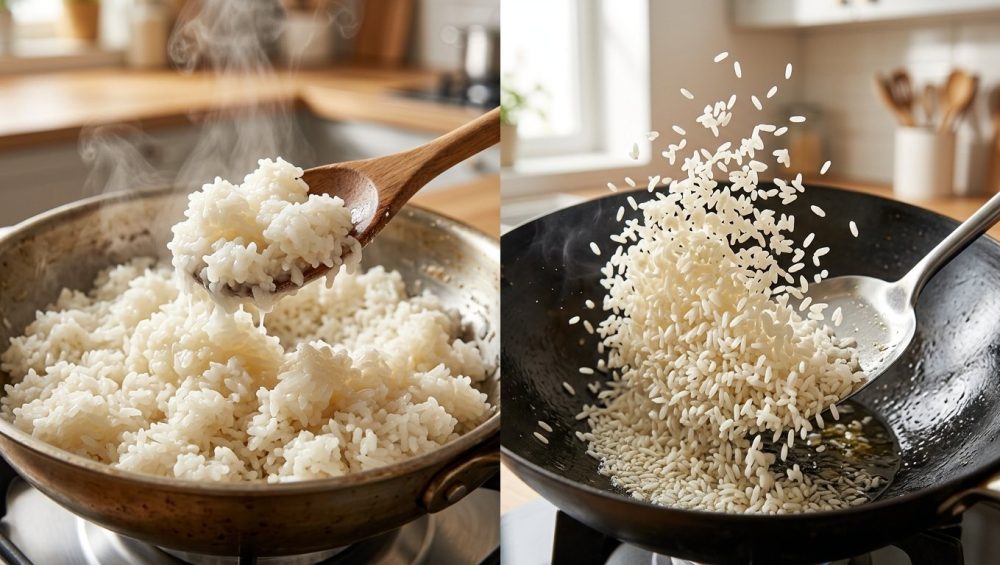
The Tragedy of the Gummy Stir-Fry
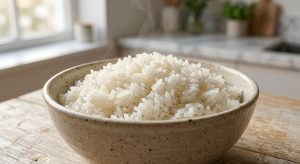
I see you. You have just walked through the door after a grueling workday, your stomach is aggressively demanding carbohydrates, and you have decided to be responsible. Instead of opening a delivery app and spending thirty dollars on lukewarm takeout, you are going to whip up a quick, inexpensive batch of homemade fried rice. You toss a cup of raw jasmine rice into your cooker, wait impatiently for it to finish, and the moment it beeps, you scoop that steaming, fragrant mound directly into a hot pan with some oil, soy sauce, and a scrambled egg.
Five minutes later, you are staring into your pan in absolute despair. You haven’t made fried rice. You have made a tragic, greasy, soy-sauce-flavored risotto. The grains are clumped together in a sticky, impenetrable mass. The vegetables are weeping. The egg is hopelessly spackled into the starchy glue. You eat it standing over the sink out of sheer stubbornness, but let’s be honest: if your homemade fried rice is always mushy, you are missing out on one of the greatest, fastest, and cheapest culinary joys known to humanity.
Here is the brutally honest truth: you cannot make proper, restaurant-quality fried rice with freshly cooked, warm rice. It is molecularly impossible. You do not need a culinary degree to cook like an expert, but you do need to understand a tiny bit of basic food chemistry. We are going to break down exactly why warm rice turns into a gummy nightmare, the absolute magic of letting your grains chill out overnight, and how you can transform this stressful weeknight failure into a foolproof, mind-blowing dinner. And if you are serious about breaking your takeout habit once and for all, mastering this single technique is your golden ticket.
The Microscopic Battlefield: Inside a Grain of Rice
To understand why your dinner looks like wallpaper paste, we have to zoom in and look at the anatomy of a rice grain. Rice is essentially a tiny, highly organized package of starch, and that starch comes in two primary molecular forms: amylose and amylopectin.
Amylose is a straight, linear molecule. It behaves itself. It stacks neatly, and rice varieties that are high in amylose (like long-grain Basmati) tend to cook up light, fluffy, and perfectly separated. Amylopectin, on the other hand, is a highly branched, chaotic molecule. It is the culinary equivalent of a clingy ex. Rice varieties high in amylopectin (like short-grain sushi rice or glutinous sweet rice) cook up incredibly sticky, chewy, and clumped together.
When you boil raw rice, you are subjecting these starches to a process called gelatinization. As the water heats up, it forces its way into the tightly packed starch granules. The granules swell, absorb the water, and eventually burst open, spilling their starchy contents—especially that sticky amylopectin—all over the surface of the grain.
When rice is freshly cooked and still warm, this gelatinized starch is in a highly unstable, amorphous, and sticky state. The surface of every single grain is coated in a microscopic layer of wet glue. If you take this hot, wet, glue-covered rice and throw it into a frying pan, the residual moisture instantly turns to steam, dropping the temperature of your pan. Worse, the mechanical action of your spatula smashing the grains together forces that sticky amylopectin to bind the rice into a singular, gummy mass. You are essentially creating a starch-based mortar. No amount of oil or high heat can save you at this point.
The Miracle of the Fridge: The Science of Starch Retrogradation
So, how do we disarm this starchy glue? We use the simplest, most passive cooking technique in the world: we put it in the refrigerator and walk away.
When gelatinized starch is allowed to cool down—specifically to temperatures around 4°C (39°F), which is exactly the temperature of your standard home fridge—a magical chemical process occurs called starch retrogradation. Because I promised you no pretentious chef-speak, let’s keep it simple. Retrogradation is simply the starch molecules reorganizing themselves.
As the rice cools, those wild, sticky strands of amylose and amylopectin begin to calm down and form tight, ordered, crystalline structures. The glue hardens. Simultaneously, the intensely dry environment of your refrigerator acts as a passive dehydrator. It pulls the excess surface moisture out of the rice grains.
After twelve to twenty-four hours in the fridge, the rice has completely transformed. The surface of each grain is now dry, firm, and slightly rigid. The sticky glue has crystallized. When you toss this day-old rice into a screaming hot pan, the grains remain distinct and separate. They bounce off each other rather than sticking together, allowing the oil to coat each individual grain perfectly. This is the secret to that delightfully chewy, distinct texture you get from your favorite Chinese takeout spot. Simply put, understanding why day-old rice changes everything is the first step to becoming a wok master in your own kitchen.
The Hidden Health Bonus: Resistant Starch
As a sassy sous-chef, my primary concern is flavor and texture, but I would be remiss if I didn’t mention the incredible biological side effect of starch retrogradation. When those starch molecules crystallize in the fridge, a significant portion of them convert into something called “resistant starch.”
Recent clinical studies and nutritional data from 2026 have heavily highlighted the benefits of resistant starch. Unlike the easily digestible starches in warm, fresh rice that rapidly spike your blood sugar, resistant starch literally resists digestion in your small intestine. It passes intact into your large intestine, where it functions almost exactly like dietary fiber. It feeds your beneficial gut microbiome, which in turn produces short-chain fatty acids that reduce inflammation.
Studies have shown that cooling white rice for 24 hours increases its resistant starch content by up to 180% (jumping from about 0.6g per 100g to roughly 1.7g). This significantly lowers the glycemic response of the meal. And the best part? Reheating the rice in your wok does not destroy the resistant starch. The crystalline structure is heat-stable. So, by making your fried rice the correct, traditional way, you are accidentally making it vastly better for your metabolic health. You are welcome.
Choosing Your Weapon: Not All Grains Are Created Equal
If you want to set yourself up for success, you have to start with the right foundation. You cannot grab a bag of Arborio risotto rice, throw it in the fridge, and expect perfect Chinese takeout the next day. The ratio of amylose to amylopectin dictates your success.
Jasmine Rice (The Undisputed Champion)
For classic, restaurant-style fried rice, long-grain Jasmine rice is the undisputed king. It originates from Thailand and possesses the perfect, delicate floral aroma. More importantly, it has a brilliant golden ratio of amylose to amylopectin. When subjected to starch retrogradation, Jasmine rice becomes perfectly firm on the outside while retaining a slight, satisfying chewiness on the inside.
Basmati Rice (The Overachiever)
Basmati is a long-grain rice from the Indian subcontinent that is exceptionally high in amylose. Because of this, it naturally cooks up incredibly dry and separated, even when fresh. While you can absolutely make a phenomenal fried rice with leftover Basmati, it tends to lack that signature plump, slightly chewy texture that makes traditional East Asian fried rice so comforting. It can sometimes feel a bit too dry and brittle.
Short-Grain and Sushi Rice (Hard Mode)
Short-grain rice is packed with sticky amylopectin. This is what you use for sushi, poke bowls, and sticky rice. Can you make fried rice with it? Yes. In Japan, chahan (Japanese fried rice) is traditionally made with short-grain rice. However, because it is inherently so sticky, it requires pristine, flawless wok technique, aggressive heat, and a perfectly seasoned pan to prevent it from turning to mush. If you are a beginner, stay away from short-grain rice for your stir-fries until you have mastered the basics.
The Master Protocol: Prepping Your Rice Like a Professional
We firmly believe that professional-level results are achievable in a standard home kitchen, but you have to respect the process. You cannot just dump raw rice into boiling water and hope for the best. Here is the rigorous, foolproof protocol for preparing the ultimate day-old rice.
Step 1: Wash Your Damn Rice
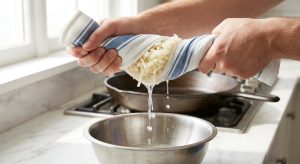
I cannot stress this enough. When rice is milled, the grains rub against each other, creating a fine powder of pure surface starch. If you do not wash this off, that powder will instantly turn to glue the second it hits hot water. Place your rice in a bowl, cover it with cold water, and aggressively swish it around with your hands. The water will turn milky white. Drain and repeat this three to five times until the water runs mostly clear. Investing in a dedicated Japanese wash bowl can make this process incredibly fast and efficient, preventing you from accidentally dumping half your rice down the sink drain.
Step 2: The Golden Cooking Ratio
When cooking rice specifically with the intention of making fried rice the next day, you want to slightly reduce your water content. If you normally cook Jasmine rice with a 1:1.25 ratio of rice to water, drop it down to a strict 1:1 ratio. We want the rice to be fully cooked, but leaning toward the al dente side. A rice cooker is your best friend here, but a heavy-bottomed pot on the stove works just fine.
Step 3: The Fluff and Spread
When the rice is done cooking, do not just turn off the machine and leave it in the pot. And absolutely do not pack it tightly into a deep plastic Tupperware container. If you do that, the rice in the center will stay warm and trap steam, completely preventing retrogradation. Instead, immediately fluff the hot rice with a paddle to release the initial burst of steam. Then, spread the rice out in a thin, even layer on a large, rimmed baking sheet.
Step 4: The 24-Hour Chill
Place the baking sheet of rice, completely uncovered, into your refrigerator. Leave it alone for at least 12 hours, but preferably 24 hours. The cold air will force the starch to crystallize, and the circulating dry air of the fridge will wick away the surface moisture.
Step 5: The Pre-Cook Crumble
Before you even think about turning on your stove, take the baking sheet out of the fridge. The rice will likely have formed a few hard clumps. Wet your hands slightly with cold water and gently rub the rice between your fingers to break apart any clusters. You want every single grain to be separated before it hits the pan. High-heat wok cooking moves in seconds; you will not have time to smash clumps apart with a spatula while your garlic is burning.
The Emergency Room: Hacks for Same-Day Cravings
I hear you. It is a random Tuesday, you did not plan ahead, and you want fried rice right now. Time is money, and sometimes we do not have 24 hours to wait for the miracle of starch retrogradation. Can you make fried rice with freshly cooked rice? Yes, but you have to force the moisture out artificially.
The Freezer Flash-Chill
Cook your rice using the reduced-water method (1:1 ratio). Spread it out as thinly as humanly possible on a large metal baking sheet. Place the baking sheet directly into your freezer for 20 to 30 minutes. The extreme cold of the freezer will rapidly halt the cooking process and shock the starch, while the harsh freezer environment will quickly evaporate surface moisture. It will not develop the perfect crystalline structure of true day-old rice, but it will save you from a gummy disaster.
The Fan Method
If your freezer is completely packed with frozen peas and old soup, you can use ambient air. Spread the hot rice on a baking sheet and set up a small desk fan pointing directly at it. Leave it for an hour, occasionally tossing the rice with a spatula to expose the underside. The constant airflow will aggressively dry out the surface of the grains.
The “No-Go” Rule: Banish Toxic Gear from Your Kitchen
You can have the most perfectly retrograded, beautifully chilled day-old rice in the world, and you will still ruin it if you are cooking on garbage equipment. I have zero patience for cheap, toxic kitchenware. If you are trying to achieve high-heat, restaurant-quality stir-fries, we need to talk about your pans.
The Teflon Tragedy
If you are currently attempting to make fried rice in a lightweight, scratched, peeling non-stick Teflon skillet, I am begging you to stop. Traditional non-stick coatings cannot handle the extreme temperatures required for stir-frying. When heated above 500°F (which happens very quickly on a gas burner), these coatings begin to break down, releasing toxic fumes and slowly flaking forever-chemicals directly into your food. Furthermore, that aerosol garbage absolutely ruins nonstick pans over time, baking a sticky layer of polymerized soy lecithin onto the surface that destroys whatever non-stick properties the pan originally had. Throw the scratched pan away.
The Holy Grail: Carbon Steel
If you want to cook like an expert, you absolutely need a carbon steel wok to achieve true greatness. Carbon steel is the undisputed champion of the Asian kitchen. It is relatively lightweight, heats up incredibly fast, and responds to temperature changes instantly. Most importantly, when properly cared for, it develops a natural, completely non-toxic, non-stick patina. Mastering the art of carbon steel wok seasoning will give you a slick, glass-like surface that eggs and rice will gracefully glide across without sticking.
If you do not have a wok, a heavy-bottomed cast iron skillet or a high-quality, multi-clad stainless steel frying pan is your next best option. They possess the thermal mass required to retain heat when you drop a mountain of cold rice into them. If you are using stainless steel, always use the simple water drop test to ensure your pan is properly preheated before adding oil, which prevents the proteins from molecularly bonding to the metal.
Spatulas: Metal or Wood Only
When cooking over intense heat, plastic is your enemy. If your cheap silicone spatulas taste like soap, throw them in the trash immediately. They are absorbing dishwasher detergents and leaching off-flavors into your food. Use a traditional metal wok spatula (chuan) if you are cooking on carbon steel, or a sturdy wooden spoon if you are using cast iron.
Chasing the Dragon: The Thermodynamics of Wok Hei
You have your day-old rice. You have your carbon steel wok. Now, we must talk about the elusive, magical element of Chinese cooking: Wok Hei. Translated literally as the “breath of the wok,” Wok Hei is that distinct, smoky, slightly charred, complex flavor that elevates restaurant takeout to a level of transcendence.
Wok Hei is not an ingredient; it is a thermodynamic reaction. It is the result of three specific scientific phenomena happening simultaneously at temperatures exceeding 400°F.
- The Maillard Reaction: The extreme heat causes the amino acids and reducing sugars in the rice, soy sauce, and proteins to rapidly brown, creating hundreds of complex, savory flavor compounds.
- Caramelization: The natural sugars in your vegetables and the added sauces caramelize instantly upon hitting the scorching metal.
- Oil Aerosolization: When you toss the rice violently in the air (the classic wok toss), microscopic droplets of oil and moisture catch the thermal radiation from the burner. If you are cooking over an open gas flame, these droplets briefly ignite, kissing the food with a fleeting, smoky char.
You absolutely cannot achieve Wok Hei if your rice is wet. If you dump a cup of soggy, warm rice into your wok, the temperature plummets. The water turns to steam, and instead of searing, frying, and aerosolizing, your food simply boils in its own juices. This is why day-old, dehydrated rice is non-negotiable.
The Choreography of the Stir-Fry: Weeknight Efficiency
When dealing with high heat, time is money. A proper stir-fry takes exactly four minutes to cook, which means you do not have time to chop an onion while the oil is smoking. You must practice mise en place—having every single ingredient prepped, chopped, and sitting in little bowls next to your stove before you even touch the burner dial.
The Aromatics
The foundation of flavor in any fried rice relies on aromatics: usually a holy trinity of minced garlic, fresh ginger, and the white parts of scallions. However, please stop adding garlic first when you heat up your wok. Minced garlic burns in exactly fifteen seconds in a screaming hot pan, turning bitter and acrid. Add your aromatics only after your proteins are cooked, or push your rice to the side and let the aromatics sizzle in a tiny pool of oil for ten seconds before tossing everything together.
The Egg Conundrum
There are two schools of thought for the egg.
- The Scramble: Heat the wok, add oil, pour in beaten eggs, and scramble them quickly until just set. Remove them to a plate, cook your rice, and add the eggs back at the very end. This yields distinct, fluffy curds of egg throughout the dish.
- The Golden Fleece: Add the cold rice to the pan first, toss it until heated through, and then pour the raw beaten egg directly over the rice. Toss violently. The egg coats every individual grain of rice, cooking onto the starch and turning the entire dish a beautiful, uniform golden yellow. Both methods are spectacular, provided your rice is perfectly chilled and dry.
The Sauce Strategy: Less is More
One of the biggest rookie mistakes is drowning the rice in half a cup of soy sauce to give it flavor. Liquid is the enemy of a good stir-fry. If you add too much sauce, you rehydrate the rice and turn it back into mush.
You only need a tablespoon or two of liquid seasoning—usually a mix of light soy sauce for saltiness, a dash of dark soy sauce for that rich mahogany color, and perhaps a drop of toasted sesame oil off the heat.
The Technique: Never pour the soy sauce directly onto the mound of rice. Instead, pour the sauce in a circle around the bare, screaming-hot upper edges of the wok. As the soy sauce slides down the scorching metal, it sears, reducing instantly and burning off excess water content before it even touches the rice. This concentrates the flavor and imparts a deeply savory, almost charred aroma.
Troubleshooting Your Culinary Disasters
Even with day-old rice, things can occasionally go sideways. Let’s troubleshoot the most common weeknight pitfalls.
“My rice is still sticking to the pan!”
Your pan was not hot enough before you added the oil, or your pan is completely stripped of its seasoning. Always follow the rule of “Hot Pan, Cold Oil.” Heat the dry wok until it is literally smoking, add your high-smoke-point oil (like peanut, avocado, or canola—never extra virgin olive oil), swirl it to coat the pores of the metal, and immediately add your ingredients.
“My fried rice is incredibly greasy and heavy.”
You either used way too much oil, or your heat was too low. If the heat is too low, the rice acts like a sponge, simply absorbing the oil rather than frying in it. High heat instantly sears the exterior of the grain, preventing the oil from penetrating the interior.
“The rice grains are too hard and crunchy.”
You either left the rice in the fridge for four days, completely dehydrating it into little pebbles, or you undercooked the rice initially. If you find your day-old rice is unpleasantly hard while stir-frying, add one single tablespoon of chicken broth or water to the wok and immediately cover it with a lid for exactly ten seconds. The flash of trapped steam will gently rehydrate the exterior of the grains without turning them to mush, softening them to the perfect chewy texture.
The Final Word
Cooking beautiful, restaurant-quality food at home does not require expensive gadgets, pretentious culinary degrees, or magical ingredients. It simply requires a basic respect for technique and an understanding of how your ingredients behave.
By taking five minutes on a Sunday night to wash, cook, and spread out a batch of rice, you are setting yourself up for a week of effortless, spectacular, lightning-fast dinners. You are utilizing the brilliant science of starch retrogradation to transform sticky glue into distinct, chewy, perfect grains that can withstand the fiery breath of the wok.
So, banish those toxic peeling pans, throw away the takeout menus, and embrace the simple, transformative magic of day-old rice. Your weeknight dinners will never be the same. Now, pour yourself a glass of wine, get your wok smoking hot, and go make some magic.