The heartbreak is universal.
Picture this: It’s a Tuesday night, or maybe a lazy Sunday afternoon. The house smells like a Parisian chocolaterie, and you’ve just pulled a bubbling, crackling tray of brownies out of the oven. You’ve done everything right. You splurged on the good cocoa powder. You patiently melted the butter. You even achieved that elusive, tissue-paper-thin glossy crust on top.
But then, impatience strikes. You want a brownie, and you want it now. You grab your trusty metal chef’s knife, press it into the warm, fudgy center, and pull.
Disaster.
The crust shatters into a million jagged shards. The fudgy interior smears across the blade like spackling paste. When you finally wrestle a square out of the pan, it looks less like a bakery masterpiece and more like a mudslide. You’re left standing over the sink, eating the mangled, gummy scraps off the knife, wondering where it all went wrong.
Spoiler alert: It’s not your recipe. It’s not your oven. It’s your knife.
Welcome back to the kitchen, my fellow weekend culinary warriors. As your resident Sassy Sous-Chef, I am here to tell you that you do not need a pastry degree from Le Cordon Bleu to achieve those razor-sharp, bakery-worthy brownie squares. You just need to understand a little bit of food science, and you need to spend about three dollars on a tool you probably thought was a useless infomercial gimmick: the plastic lettuce knife.
Yes, you heard me correctly. That neon-green, ridiculously blunt piece of plastic is the ultimate secret weapon for home bakers. Today, we are diving deep into the thermodynamics of baked goods, the heartbreak of metal conductivity, and why repurposing a simple plastic lettuce knife offers the perfect, zero-fuss, non-stick solution for slicing sticky desserts. Let’s get to work.
The Food Science of Sticky Brownies: Why Metal Knives Fail
To understand why the plastic lettuce knife is a stroke of genius, we first have to understand why your expensive, high-carbon steel chef’s knife is failing you so miserably. Cooking is just chemistry and physics for hungry people, and cutting a warm brownie is a masterclass in thermal dynamics and friction.
The Anatomy of a Fudgy Brownie
Let’s look at what actually makes a brownie fudgy. Unlike a cake, which relies on a robust network of gluten and a high ratio of flour to provide structure, a fudgy brownie is essentially a baked emulsion of fat and sugar. Recent 2024 baking industry statistics show that brownie mixes account for nearly 27% of all dessert mix consumption, and the overwhelming consumer preference is for dense, ultra-rich, fudgy textures.
When you pull these beauties out of the oven, that internal matrix is incredibly fragile. The chocolate and butter are still in a semi-liquid state, and the sugar is behaving like a molten syrup. The internal temperature of a freshly baked brownie can easily hover around 160°F to 180°F. At this stage, the brownie hasn’t fully set; it is merely holding its shape through the sheer willpower of a few gelatinized starches and coagulated egg proteins.
Thermal Conductivity: The Heat Transfer Problem
Here is where the metal knife ruins everything. Metals—especially the stainless steel or carbon steel used in high-quality kitchen knives—are exceptional conductors of heat. Thermal conductivity is measured in Watts per meter-Kelvin (W/m·K). Stainless steel has a thermal conductivity of around 15 to 20 W/m·K.
When you plunge a room-temperature (roughly 70°F) metal blade into a 160°F brownie, a rapid transfer of thermal energy occurs. The cold metal immediately absorbs the heat from the surrounding brownie crumb. As the metal blade heats up, it melts the fats and sugars that come into direct contact with it. The cocoa butter and sugar syrup turn into a literal glue, adhering aggressively to the smooth surface of the steel.
The Sugar Matrix and Friction
Once that molten sugar and fat bond to your metal knife, friction takes over. A standard chef’s knife has a wide, flat blade (the bevel). As you push the knife down and pull it back up, that wide surface area acts like a squeegee dragging against the fragile crumb. Because the brownie is glued to the metal, the upward motion of the knife tears the brownie apart from the inside out. The delicate, glossy crust on top—which is formed by dissolved sugar and egg whites migrating to the surface during baking—is collateral damage, shattering as the dense fudge below is violently displaced.
Professional kitchens often try to circumvent this by using the “hot knife” trick, where a metal blade is repeatedly dipped in boiling water and wiped dry between every single cut. But let’s be brutally honest: you are a busy home cook. You do not have the time or the counter space to set up a boiling water bath just to cut a pan of brownies on a Tuesday night. Time is money, and we need a faster, smarter shortcut.
Enter the Plastic Lettuce Knife: Your New Baking Best Friend
If metal is the enemy of the warm brownie, what is the hero? A cheap, lightweight, entirely unpretentious plastic lettuce knife.
What Actually Is a Lettuce Knife?
If you’ve never seen one, a lettuce knife looks like a child’s toy. It is a long, serrated knife made entirely out of plastic—usually polypropylene or polystyrene. It was originally invented to solve a highly specific salad problem: when you cut delicate greens like iceberg or romaine lettuce with a metal knife, the iron and copper in the steel trigger an enzymatic reaction that causes the edges of the lettuce to rapidly oxidize and turn brown. The plastic lettuce knife was designed to slice through greens without causing that unappetizing rust color.
But while it’s great for salads, its true calling is in the baking aisle.
Why Plastic Triumphs Over Metal for Baked Goods
The magic of the plastic lettuce knife lies in its material properties. Polypropylene is a thermal insulator. Its thermal conductivity is incredibly low—usually around 0.1 to 0.2 W/m·K. That is roughly 100 times less conductive than a stainless steel knife.
When you slice into a warm brownie with a plastic lettuce knife, the plastic does not absorb the heat from the baked good. Because there is no rapid temperature exchange, the fats and sugars in the brownie do not melt and seize against the blade. The plastic remains a neutral, non-reactive interloper.
Furthermore, plastic is naturally non-porous and boasts inherent non-stick properties. Molten chocolate and sticky sugar syrup simply cannot get a grip on the smooth plastic surface.
The Geometry of the Serration
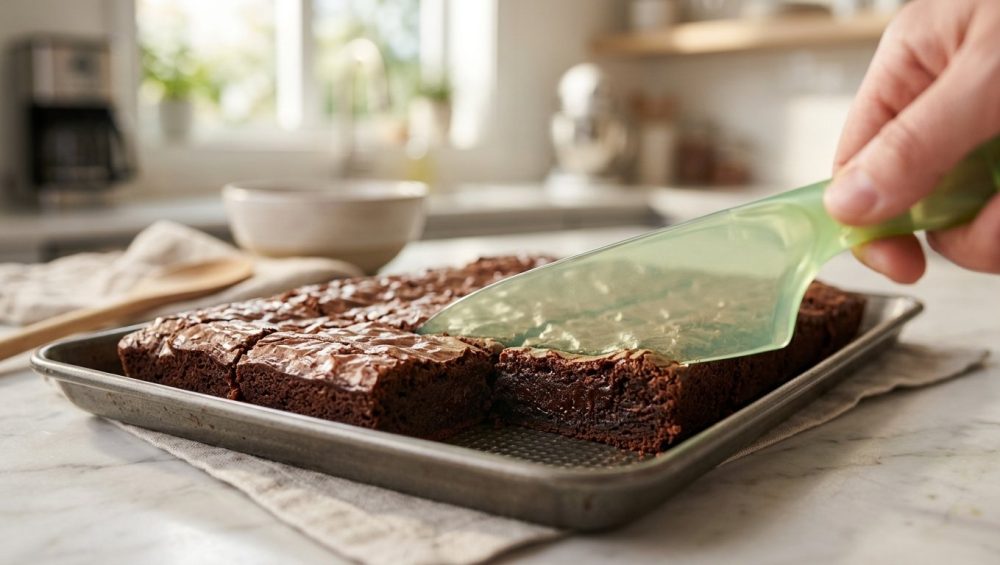
It isn’t just the material; it’s the shape. Lettuce knives feature wide, blunt, scalloped serrations. When you apply this to a brownie, those blunt serrations act like a gentle saw. They easily break through the fragile, glossy top crust without crushing it downward. As the blade descends into the fudgy center, the non-stick plastic glides through the dense crumb without creating the massive drag and friction that a flat-edged metal chef’s knife causes. The result? Razor-sharp, bakery-perfect squares, even when the brownies are still delightfully warm.
The “No-Go” Rule: Why We Aren’t Using Toxic Non-Stick Gear to Solve This
At this point, you might be thinking, “Well, if sticking is the problem, why don’t I just buy a Teflon-coated metal knife, or bake my brownies in a non-stick pan so I don’t have to worry about it?”
Absolutely not. If you’ve been following my kitchen rants, you know I have a strict “No-Go” rule when it comes to cheap, toxic kitchenware. I despise peeling non-stick coatings, mystery metals, and gimmick pans that leach chemicals into your food.
The Dangers of Cheap Coated Pans and Knives
Many cheap “non-stick” knives are just standard steel blades sprayed with a thin layer of polytetrafluoroethylene (PTFE) or similar chemical coatings. The moment you use these knives on a hard surface, or accidentally scrape them against the bottom of a pan, that coating begins to flake off. You do not want microplastics and forever chemicals (PFAS) adding a little extra crunch to your dessert.
The same goes for your bakeware. Baking in cheap, dark non-stick pans is a rookie mistake that ruins perfectly good recipes. In fact, the fatal flaw in dark nonstick pans is that their dark surface absorbs radiant heat far too aggressively. They heat up incredibly fast, causing the edges of your brownies to overbake, dry out, and burn before the center has even had a chance to set.
Safe, High-Quality Alternatives for Baking
Instead of relying on toxic crutches, we rely on smart materials. For baking, you should always use light-colored, heavy-gauge aluminum pans. Aluminum conducts heat evenly and gently, giving you a perfectly uniform bake from edge to center. And please, I am begging you, stop baking brownies in glass pans. Glass is a thermal insulator. It takes forever to heat up, which means by the time the center of your brownie is cooked, the edges are rock hard. Even worse, if you subject glass to rapid temperature changes, you might end up with a glass baking dish shattered all over your oven floor.
Line your high-quality aluminum pan with a simple parchment paper sling, bake your recipe to perfection, and use your $3, food-safe, solid plastic lettuce knife to do the cutting. It’s cheap, it’s durable, it’s completely safe, and it won’t flake toxic chemicals into your chocolate.
The Masterclass: Step-by-Step Guide to Slicing Bakery-Worthy Brownies
Alright, enough theory. It’s time to put this into practice. Let’s walk through the definitive, foolproof method for achieving those flawless, Instagram-worthy brownie squares.
Step 1: The Bake and The Prep
Before you even think about cutting, you have to bake them correctly. Ensure you are measuring your ingredients accurately—no blindly scooping your flour straight from the bag, which packs it down and results in dry, cakey brownies. Use a kitchen scale.
Line your light-colored aluminum pan with a parchment paper sling. This means cutting a sheet of parchment long enough to cover the bottom and extend up over two opposite sides of the pan. This creates “handles” that you will use later.
Bake your brownies until they are just set. Do not overbake them! A common reason brownies are always dry is because home bakers keep waiting for a clean toothpick. If the toothpick comes out completely clean, your brownies are already overcooked. You want it to come out with a few moist, fudgy crumbs attached.
Step 2: The Crucial Cooling Window (Yes, You Still Have to Wait a Little)
I know the plastic lettuce knife is magic, but it cannot defy the laws of physics entirely. You cannot cut a brownie the exact second it comes out of a 350°F oven. The internal structure is essentially boiling lava. If you cut it now, the brownie will collapse into a puddle.
You must let the pan sit on a wire cooling rack for at least 45 minutes to an hour. This allows the residual heat to finish cooking the center gently, and it gives the starches and fats time to stabilize. You want the brownies to be warm to the touch, but not hot.
Step 3: The Lift
Once the cooling window has passed, do not cut the brownies inside the pan. Cutting inside the pan restricts your movement, damages your bakeware, and makes it impossible to get the first square out cleanly.
Instead, grab the parchment paper “handles” of your sling and gently lift the entire slab of brownies out of the pan. Transfer the slab, parchment and all, onto a large, flat cutting board. (Side note: if you notice your baking sheets keep warping or your pans are buckling under the heat, it’s time to upgrade your gear, but that’s a lecture for another day).
Step 4: The Lettuce Knife Technique
Now, take your plastic lettuce knife.
- The Grip: Hold the knife firmly but don’t white-knuckle it. You want a relaxed grip so you can control the sawing motion.
- The Cut: Position the knife over the brownie slab. Do not press straight down like a guillotine. Instead, use a gentle, back-and-forth sawing motion to break through the glossy top crust. Once you are through the crust, gently press downward while continuing the sawing motion until you hit the cutting board.
- The Wipe: After every single cut, take a damp paper towel and wipe the plastic blade clean. Even though plastic is non-stick, a few crumbs might hitch a ride. Starting with a perfectly clean blade for each cut ensures razor-sharp edges.
- The Grid: Cut the slab down the middle first, then divide those halves into quarters. This ensures perfectly even squares.
Beyond Brownies: Other Brilliant Uses for Your Plastic Knife
Once you buy a plastic lettuce knife, you will quickly realize it is one of the most versatile, unsung heroes of the kitchen. It doesn’t just stop at brownies. Here are a few other culinary nightmares this little tool will effortlessly conquer.
Conquering Fudge, Blondies, and Rice Krispies Treats
If you think warm brownies are sticky, try cutting a fresh batch of Rice Krispies treats. The melted marshmallow matrix is a literal adhesive. It will grip a metal knife so tightly you’ll think you’ve hit a brick wall. The plastic lettuce knife, however, glides through marshmallow treats like butter. The same principle applies to rich, dense fudges and sticky blondies. The thermal insulation and non-stick surface of the plastic make portioning these sticky sweets an absolute breeze.
The Ultimate Tool for Layer Cakes
Have you ever tried to slice a beautifully frosted layer cake, only to have your knife drag the dark chocolate frosting right through the pristine white vanilla crumb, ruining the visual appeal of the slice? Because plastic is non-porous and naturally non-stick, a lettuce knife is fantastic for slicing delicate cakes. It won’t smear the frosting, and the wide serrations won’t compress the airy sponge.
Protecting Your Good Equipment
We all know how fast kitchen knives get dull when they are abused. Dragging your expensive Japanese steel chef’s knife across the bottom of a metal baking pan or a hard ceramic dish is a surefire way to roll the edge and ruin the blade. A plastic lettuce knife will never scratch your bakeware, and you never have to worry about dulling it. It is the perfect beater tool for rough jobs.
And unlike cheap silicone tools that absorb dish soap and ruin your food (we all know the horror when our silicone spatulas taste like soap), hard polypropylene lettuce knives do not absorb odors or flavors. They wash clean in seconds.
Saving Your Sanity During the Holidays
When the holiday baking rush hits, you will be making multiple batches of bar cookies, shortbreads, and sticky pecan bars. You don’t have time to wait hours for every single pan to cool completely before portioning. The lettuce knife allows you to safely cut baked goods while they are still slightly warm, speeding up your production line and saving your sanity. If you ever wonder why your cookies always spread flat or your bar cookies crumble, having the right tools to portion and move them while they set is half the battle. Use a stainless steel bench scraper to lift the cooled squares off the board, and you will look like a professional pastry chef.
Stop Stressing and Start Slicing
Cooking and baking should be a joy, not a source of stress. You don’t need to suffer through mangled, crumbly brownie squares just because you wanted to enjoy your dessert while it was still warm and gooey.
By understanding the simple food science behind thermal conductivity and friction, you can outsmart your sticky baked goods. A cheap, non-toxic, plastic lettuce knife is the ultimate proof that you don’t need expensive, pretentious culinary gear to get professional results. Sometimes, the best solution is just a clever hack that respects the chemistry of the food.
So, do yourself a favor. Next time you are at the store, skip the toxic non-stick pans and the overpriced gadgets. Grab a $3 plastic lettuce knife, whip up a batch of your favorite fudgy brownies, and slice with confidence. You’ve earned it. Now go pour yourself a glass of milk, grab a perfectly square corner piece, and enjoy the fruits of your labor. You’re a home-baking rockstar, and don’t let anyone tell you otherwise.