We need to have a serious, brutally honest conversation about one of the most pervasive, infuriating lies in the modern culinary world. If you have ever flipped open a glossy cookbook, scrolled through a pristine food blog, or watched a hyper-edited cooking video on social media, you have undoubtedly encountered it. It is a lie so widespread that it has gaslit an entire generation of weekend culinary hobbyists into believing they are fundamentally incompetent in the kitchen.
The lie is this: “Sauté the onions over medium-high heat until deeply caramelized, about 5 to 10 minutes.”
I am here to tell you, with absolute scientific certainty, that you cannot achieve true, jammy, deeply sweet caramelized onions in ten minutes. You cannot do it in fifteen minutes. Unless you have somehow managed to bend the laws of thermodynamics and alter the fabric of space-time within your kitchen, true caramelization is a stubborn, low-and-slow process that demands a minimum of forty-five minutes to a full hour of your undivided attention.
As a busy professional who has set off the smoke detector more times than I care to admit, I understand the frustration. When you are conquering weeknight cooking anxiety, every single minute counts. You do not have the luxury of standing over a hot stove on a random Tuesday evening, stirring a pan of alliums for an hour while the rest of your dinner gets cold. You need a shortcut. But you do not need a shortcut that sacrifices flavor, and you certainly do not need a shortcut that results in burnt, bitter, crispy onion strings.
Enter the magic of baking soda.
By leveraging a fundamental understanding of food science, we can manipulate the pH level of our onions, drastically accelerating the chemical reactions responsible for that coveted, rich, sweet flavor. We are going to cut a grueling 45-minute slog down to a highly manageable 15 to 20 minutes. No chef-speak, no pretentious culinary school jargon—just practical, actionable kitchen chemistry that will change the way you cook forever.
The Great Culinary Gaslighting: Why Recipe Writers Lie to You
Before we dive into the chemistry of baking soda, we have to unpack why you have been struggling with caramelized onions in the first place. The frustration you feel when your onions are still pale and crunchy after fifteen minutes is not your fault.
The “10-minute caramelized onion” is a well-documented myth in modern food writing. The legendary food writer Tom Scocca famously exposed this industry-wide deception in a viral 2012 article for Slate, where he tested the claims of various high-profile recipe authors. Scocca found that following the standard “five to ten minutes” instruction either resulted in raw, slightly sweaty onions, or, if the heat was cranked up to compensate, scorched and bitter onions. He noted that this exposé might have been the most valuable journalistic work he had ever done, as it validated the frustrations of thousands of home cooks.
Why do recipe developers lie about this? It all comes down to marketing. In the highly competitive world of food media, recipes are aggressively optimized for speed. A cookbook titled 15-Minute Weeknight Meals cannot suddenly feature a recipe that requires 45 minutes of mandatory onion-stirring. Therefore, publishers and writers began blurring the lines between a “golden sear” (which takes 10 minutes) and true “caramelization” (which takes an hour).
A golden sear is fine for a quick burger topping, but it lacks the profound, jammy, complex sweetness that true caramelization provides. If you want that deep, rich, steakhouse-quality flavor, you have to break down the cellular structure of the onion and force its sugars to transform. And to do that quickly, we need to hack the Maillard reaction.
The Food Science of the Slog: What is Actually Happening in Your Skillet?
To understand why baking soda works, we first have to strip away the pretentious chef-speak and look at the actual physics and chemistry happening inside your skillet. When you drop a mound of sliced onions into a hot pan, you are initiating a complex cascade of thermal reactions.
Interestingly, the term “caramelized onions” is scientifically incomplete. When you cook onions down until they are dark brown and sweet, you are actually witnessing two entirely different chemical processes happening simultaneously: true caramelization and the Maillard reaction.
True Caramelization
Caramelization is a strictly non-enzymatic browning process that involves the oxidation of sugars. It is what happens when you melt plain white sugar in a pan to make caramel sauce. Heat causes the complex sugar molecules (poly- and disaccharides) inside the onion’s starch to break down into simpler monosaccharides, like glucose and fructose. As the heat persists, these simple sugars literally melt, oxidize, and turn brown, creating that signature sweet, nutty flavor.
The catch? Different sugars require different temperatures to caramelize. Fructose, which is abundant in onions, begins to caramelize at approximately 230°F (110°C). However, onions are composed of roughly 89% water. As long as there is significant water evaporating in your pan, the temperature of the onions will struggle to rise above the boiling point of water (212°F or 100°C). This means true caramelization cannot fully begin until a massive amount of the onion’s internal moisture has been cooked off. This evaporation phase is exactly why the process takes so long.
The Maillard Reaction
The second, arguably more important process is the Maillard reaction. Named after French chemist Louis-Camille Maillard, this is a chemical reaction between amino acids (proteins) and reducing sugars in the presence of heat. The Maillard reaction is the undisputed king of savory cooking. It is the exact same chemical process that gives a seared steak its brown crust, turns pale dough into a golden loaf of bread, and transforms roasted coffee beans into a complex morning brew.
In onions, the Maillard reaction works alongside caramelization to generate hundreds of new, highly complex flavor compounds that taste savory, meaty, and deeply umami. But just like caramelization, the Maillard reaction is highly dependent on temperature, moisture, and—crucially—pH levels.
Enter the Hero: The Magic of Baking Soda
This is where our brilliant, time-saving kitchen hack comes into play. If we want to speed up the browning process without cranking the heat to a level that will burn the onions to a crisp, we have to alter the chemical environment of the skillet.
Baking soda, scientifically known as sodium bicarbonate, is an alkaline compound. When you add a tiny pinch of baking soda to your cooking onions, you instantly raise the pH level of the food, shifting it from slightly acidic/neutral to alkaline.
Why does this matter? Because the Maillard reaction is incredibly sensitive to pH levels. In an acidic environment, the amino groups in the food are protonated, which significantly reduces their reactivity and slows down the browning process. However, in an alkaline environment (a pH above 7), those amino acids are deprotonated. They become highly reactive nucleophiles, meaning they will aggressively seek out and bond with the reducing sugars in the pan.
The result? The Maillard reaction goes into absolute overdrive. By simply raising the pH with a pinch of baking soda, you can increase the rate of browning by over 50%. You achieve that deep, mahogany-brown color and rich, savory flavor in a fraction of the time. This alkaline manipulation is a staple trick in food science; it is the exact same reason why dipping pretzel dough in an alkaline lye solution gives baked pretzels their iconic, dark brown, glossy crust. It is also highly similar to the trick for achieving extra crispy chicken by altering the pH of the poultry skin.
The Pectin Breakdown
But the baking soda is not just accelerating the color and flavor; it is also physically altering the structure of the onion. Onions hold their shape thanks to pectin, a structural carbohydrate found in their cell walls. Pectin acts like the biological glue holding the vegetable together.
When the pH of the cooking environment shifts to alkaline, pectin dissolves and breaks down much more rapidly. This means the cell walls of the onion collapse faster, releasing their internal moisture and trapped sugars into the pan at an accelerated rate. Because the water is driven out faster, the overall temperature of the pan can rise to that crucial 230°F caramelization threshold much sooner.
You are essentially attacking the 45-minute slog from two different scientific angles: chemically accelerating the browning, and physically accelerating the softening.
The Danger Zone: Why You Must Respect the Pinch
Now, before you go dumping a spoonful of baking soda into your skillet, we need to establish some rigorous ground rules. Baking soda is a powerful chemical agent, and with great power comes the very real risk of ruining your dinner.
I firmly advocate for the home cook, which means I must warn you about the two massive pitfalls of this technique: the texture trap and the flavor trap.
The Texture Trap
Because an alkaline environment aggressively dissolves pectin, using too much baking soda will completely obliterate the structural integrity of your onions. If you are looking for distinct, beautiful, intact ribbons of caramelized onion to lay across a gourmet burger, you must use a very light hand. If you use too much baking soda, the onions will rapidly disintegrate into an absolute mush.
Now, if you are making a French onion dip, an onion jam, or a blended soup, this jammy, mushy texture is actually highly desirable. But if you want the onions to hold their shape, you cannot overdo the alkaline powder.
The Flavor Trap
The second, far more offensive danger is the taste. Baking soda has a distinct, bitter, soapy, and highly metallic flavor profile. If you add an excess amount to your food, it will leave a lingering chemical aftertaste that will completely overpower the delicate sweetness of the onions.
The Golden Ratio: The scientifically backed, strictly enforced rule for this hack is to use no more than 1/4 teaspoon of baking soda per pound of raw onions. In fact, if you are a beginner, I strongly suggest erring on the side of caution and starting with just 1/8 of a teaspoon per pound of onions. It is a microscopic amount, but chemistry does not require volume to be effective. A tiny pinch is all it takes to shift the pH and ignite the Maillard reaction.
Cookware Matters: Ditch the Toxic Pans
You cannot execute a perfect, scientifically optimized cooking technique if you are using garbage equipment. As your sassy culinary guide, I have zero patience for cheap, toxic kitchenware. If you are still cooking your meals on flimsy aluminum skillets coated in mystery chemicals, we need to have an intervention.
You must actively ditch those toxic, peeling non-stick coatings immediately. Not only are scratched Teflon pans a health hazard, but they are also fundamentally incapable of producing good caramelized onions. Non-stick surfaces are designed to repel food, which means they prevent the formation of “fond.”
Fond is the culinary term for those sticky, deeply browned, caramelized bits of sugar and protein that adhere to the bottom of the pan during the cooking process. Fond is pure, concentrated flavor. As you cook your onions, you want them to stick slightly so that these browned bits can develop. You then use a splash of liquid to scrape them up and reincorporate them into the onions. Non-stick pans completely rob you of this flavor-building mechanism.
To caramelize onions properly, you need cookware with excellent thermal mass and heat retention. A heavy-bottomed skillet is one of those beginner kitchen tools you absolutely cannot compromise on.
- Stainless Steel: The gold standard for building fond. Yes, onions will stick to it, but that is the entire point. If you are struggling with food sticking to stainless steel excessively, you just need to learn proper temperature control and deglazing techniques.
- Carbon Steel: My personal favorite for high-heat searing and rapid caramelization. If you’ve spent time seasoning carbon steel pans, this is where they shine. They offer the heat retention of cast iron but respond to temperature changes much faster.
- Enameled Cast Iron: Fantastic for slow, even heat distribution. It holds a steady, low temperature perfectly, preventing the sugars from scorching.
The Masterclass: How to Caramelize Onions in 20 Minutes
We have covered the history, the chemistry, the ratios, and the gear. Now it is time to put it all together. Here is the definitive, step-by-step masterclass on how to execute the baking soda shortcut flawlessly.
Step 1: The Prep and the Cut
Start with two pounds of standard yellow onions. Why yellow? Because they have the perfect balance of sugar and astringency. White onions lack the depth, and sweet onions (like Vidalias) actually contain too much moisture and can turn to mush too quickly. Never use red onions for this baking soda hack. Red onions contain anthocyanins, which are pH-sensitive pigments. When exposed to an alkaline environment like baking soda, red onions will undergo a horrifying chemical color change and turn a sickly, unappetizing bluish-green.
Cut the ends off the onions, slice them in half, and peel them. If you are weeping over the cutting board, a dull knife is to blame, not the onion. A sharp blade cleanly slices through the cell walls, whereas a dull blade crushes them, releasing the volatile sulfur compounds that irritate your eyes. Slice the onions “pole to pole” (from the root to the stem) rather than across the equator. Pole-to-pole slices hold their structural integrity much better during the intense cooking process.
Step 2: The Fat and the Heat
Place your stainless steel or carbon steel skillet over medium heat. Add two tablespoons of unsalted butter and one tablespoon of a neutral, high-smoke-point oil (like avocado oil or grapeseed oil). The butter provides milk solids that assist in the browning process, while the oil prevents the butter from burning too quickly.
Step 3: The Sweat
Once the butter is melted and foaming, add your mountain of sliced onions. It will look like too much, but remember that they are almost 90% water; they will shrink drastically. Toss the onions to coat them in the fat.
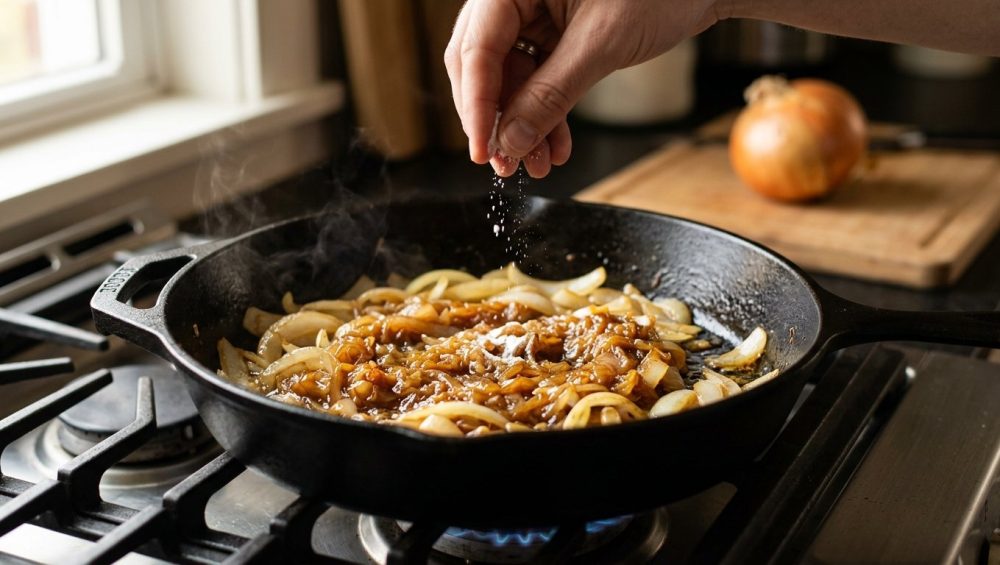
At this stage, you want to add a generous pinch of kosher salt. Salt is a desiccant; it draws moisture out of the onion cells through osmosis. This helps the onions “sweat” and collapse faster. Cook the onions for about 5 minutes, stirring occasionally, until they become translucent and begin to soften.
Step 4: The Chemical Catalyst
Once the onions have released their initial wave of moisture and are soft, it is time for the magic. Sprinkle exactly 1/4 teaspoon of baking soda (for your two pounds of onions) evenly over the skillet.
Stir vigorously to distribute the alkaline powder. Almost immediately, you will notice a difference. The onions will suddenly turn a vibrant shade of yellow, and within minutes, they will begin to rapidly transition into a deep, golden brown. The cellular walls will soften aggressively, and the volume in the pan will reduce before your eyes.
Step 5: Temperature Management and Deglazing
Because the Maillard reaction is now in overdrive, you must actively manage the heat. Do not walk away from the stove. Stir the onions frequently. As the sugars oxidize and the proteins brown, a dark, sticky fond will begin to build up on the bottom of your skillet.
Do not let this fond burn. When the bottom of the pan gets too dark, it is time to deglaze. Pour in a small splash (about two tablespoons) of water, chicken broth, or dry white wine. The liquid will aggressively boil and lift the browned bits off the metal. Use a wooden spoon or a flat-edged spatula to scrape the fond up and stir it back into the onions. You will repeat this deglazing process two or three times over the next 10 minutes.
Much like fixing a broken pan sauce, deglazing is a crucial step that regulates the temperature of the pan and ensures all that concentrated flavor ends up in the food, not stuck to your cookware.
Step 6: The Finish Line
After about 15 to 20 minutes of active cooking, your onions will be a glorious, deep mahogany color. They will be incredibly soft, jammy, and profoundly sweet. Turn off the heat. If you want to balance the intense sweetness, stir in a tiny splash of balsamic vinegar or apple cider vinegar. The acidity will cut through the richness and elevate the final flavor profile.
Troubleshooting the Slog: What Went Wrong?
Even with the baking soda hack, cooking requires intuition. If your onions did not turn out perfectly, you likely fell victim to one of these common rookie mistakes.
The Onions Turned into Complete Mush: You used too much baking soda, or you sliced the onions too thin. Remember the golden ratio: 1/8 to 1/4 teaspoon per pound. Furthermore, slice your onions at least 1/4-inch thick. Paper-thin slices cannot survive the alkaline pectin breakdown. Just like when you finally stop eating mushy vegetables by using proper heat, you have to respect the structural limits of the produce.
The Onions Taste Bitter or Metallic: Again, this is the flavor trap of using too much baking soda. If you accidentally over-poured, you can attempt to neutralize the alkaline taste by adding an acid, such as a squeeze of lemon juice or a dash of vinegar. However, if they taste like a bar of soap, they are beyond saving. Throw them out and start over.
The Onions Burned: You walked away from the pan, or your heat was too high. The baking soda accelerates browning, which means the window between “perfectly caramelized” and “scorched carbon” is much narrower. You already know how to stop burning your minced garlic by controlling the heat; apply that same vigilance here. Use your deglazing liquid to cool the pan down if things are moving too fast.
The Payoff: Elevating Your Everyday Meals
You have just successfully hacked the Maillard reaction, bypassing a 45-minute culinary chore in under 20 minutes. Time is money, and you just bought back half an hour of your evening.
So, what do you do with this jammy, savory-sweet culinary gold? The applications are endless.
- The Ultimate Burger: Pile a generous heap onto a freshly seared smash burger with a slice of sharp gruyere cheese. The sweetness of the onions will perfectly cut through the rich, fatty beef.
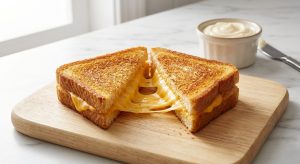
- Gourmet Grilled Cheese: Elevate a standard weeknight sandwich by layering caramelized onions between slices of sharp cheddar and sourdough bread.
- Instant French Onion Dip: Fold the cooled onions into a mixture of sour cream, mayonnaise, a dash of Worcestershire sauce, and fresh chives for a party dip that will embarrass anything you can buy in a plastic tub.
- Pizza and Flatbreads: Spread a thin layer of ricotta cheese on a pizza crust, top with caramelized onions, fresh thyme, and prosciutto for a stunning, effortless dinner.
Cooking does not have to be an exhausting, hours-long endeavor, and you do not need a culinary degree to produce restaurant-quality flavors. You just need a basic understanding of kitchen chemistry, a refusal to tolerate toxic cookware, and the confidence to bend the rules. Keep your knives sharp, respect the baking soda ratio, and never let a recipe writer gaslight you into believing true caramelization takes five minutes ever again.