Let us get one thing straight right out of the gate: if you are still pushing dry cocoa powder through a fine-mesh sieve, dusting your countertops, your apron, and your soul in a stubborn layer of brown dust, you are wasting your precious time. We have all been there. You find a recipe for a decadent weekend chocolate cake, and the instructions strictly demand that you sift the dry ingredients together before gently folding them into the wet ingredients. It is a tale as old as time, passed down by pretentious culinary school instructors and outdated cookbooks. But if you want to truly master the art of the kitchen, you have to stop blindly following rules that no longer serve you.
As a busy professional who relies on clever, time-saving hacks to survive the weekday grind, I have zero patience for fussy, messy steps that do not actually improve the final dish. I’ve said it before, and I’ll say it again: you need to stop scooping your flour with a measuring cup, and you absolutely need to stop sifting your cocoa powder. Mixing dry cocoa directly into your flour mixture is a fundamental misunderstanding of food science. It mutes the flavor of your chocolate, leads to a duller crumb, and leaves your baked goods tasting like a shadow of what they could be.
Instead, we are going to talk about a zero-cost, thirty-second technique that will instantly elevate everything from an elaborate, multi-tiered weekend baking project to a cheap box of Tuesday-night brownie mix. It is called “blooming,” and it involves hitting your cocoa powder with a hot liquid before it ever touches a single speck of flour.
The Science of the Cocoa Bean: Why Your Powder is Holding Back
To understand why blooming works, we have to take a brief, snarky field trip to the chocolate factory. Chocolate does not start out tasting like the rich, complex treat we all know and love. It begins as a rather dull, bitter seed packed inside a cacao pod. Developing that characteristic flavor profile requires intense processing, specifically fermentation and roasting.
During the roasting process, the beans are subjected to precisely controlled high heat, which triggers the Maillard reaction. This chemical reaction between amino acids and reducing sugars caramelizes the internal structures of the bean, developing hundreds of deeply complex, volatile flavor compounds. Once roasted, the beans are ground into a thick, fatty paste known as cocoa liquor.
Here is where the magic (and the tragedy) of cocoa powder happens. That cocoa liquor is fed into massive hydraulic presses that squeeze it under immense pressure. This extracts the luxurious, highly prized cocoa butter—the fat that makes chocolate bars melt so beautifully on your tongue. What is left behind is a dry, dense puck called “cocoa cake,” which is then pulverized into the fine cocoa powder you buy in the baking aisle.
Because the vast majority of the fat has been stripped away, cocoa powder is essentially a concentrated matrix of cellular debris, starches, and dormant flavor compounds. It is notoriously hydrophobic, meaning it actively repels water at room temperature. If you have ever tried to stir a spoonful of dry cocoa powder into a glass of cold milk, you have witnessed this firsthand; the powder just sits on the surface in stubborn, dry clumps, refusing to integrate.
When you follow a traditional recipe and sift your dry cocoa powder into your dry flour, you are trapping those dormant, tightly coiled flavor compounds inside a starchy prison. During the baking process, the ambient moisture from your eggs and butter will eventually hydrate the cocoa, but the batter is thick, and the hydration happens slowly and inefficiently. You are leaving an incredible amount of flavor locked inside the powder.
What is Blooming? The Sassy Sous-Chef’s Secret Weapon
Blooming is the culinary equivalent of kicking the door down. Instead of waiting for the cocoa to slowly hydrate in a thick, cold batter, you forcefully extract its flavor by mixing the dry cocoa powder directly with a hot liquid—usually boiling water, hot brewed coffee, or bubbling melted butter.
When you introduce a liquid that is significantly hotter than the melting point of cocoa butter (which sits around 93°F), several brilliant chemical reactions happen simultaneously. First, any residual fat left in the cocoa powder instantly melts, breaking down the hydrophobic barrier. Second, the heat causes the tightly coiled starches in the cocoa to gelatinize and swell, opening up their cellular structures. Finally, and most importantly, the high heat acts as a solvent, forcefully dissolving and releasing those trapped, volatile Maillard compounds into the liquid.
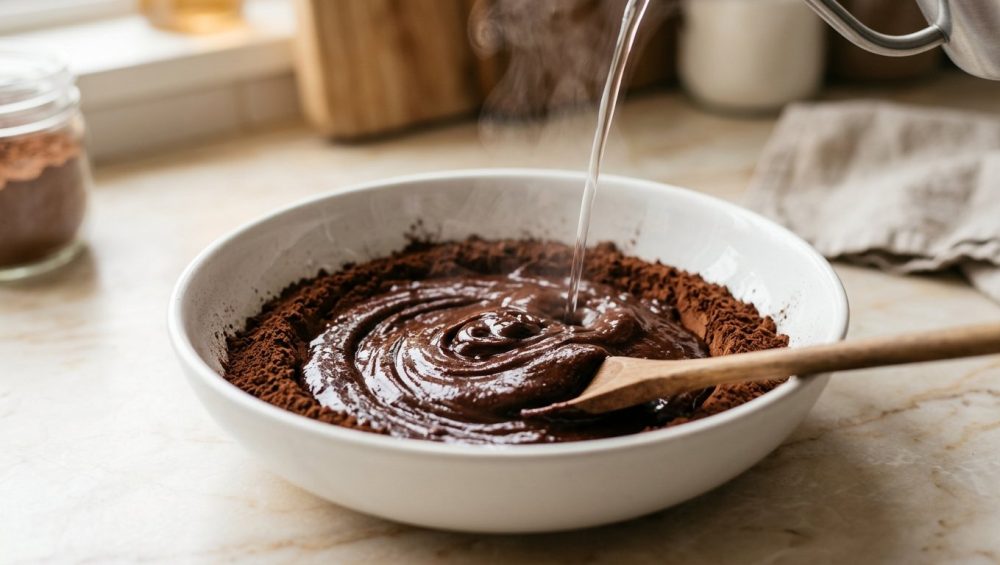
The result is immediate. The moment the hot liquid hits the powder, your kitchen will fill with an intoxicating, intensely dark chocolate aroma. The mixture transforms from a dusty, pale powder into a thick, glossy, jet-black paste. You have essentially created a hyper-concentrated flavor bomb that will disperse effortlessly and evenly throughout your cake or brownie batter.
Why Hot Water is Actually Better Than Milk
I know what you are thinking. “If I want a richer chocolate cake, shouldn’t I bloom my cocoa in hot milk or heavy cream instead of plain, boring water?”
It sounds logical, but food science is rarely intuitive. While milk adds fat and moisture, it also brings a lot of baggage to the party. Milk contains lactose (milk sugar), lactic acid, and animal proteins. According to food scientists and professional pastry chefs, those dairy proteins can actually bind to the volatile flavor compounds in the chocolate, effectively coating your palate and masking the pure, intense cocoa flavor. Milk introduces competing notes of sweetness and sourness that actively work against the dark, roasted profile of the chocolate.
Hot water, on the other hand, is a completely neutral solvent. It provides the pure hydration and high heat necessary to dissolve the cocoa solids without introducing any competing flavors or heavy proteins. This allows the bloomed cocoa to shine with absolute clarity. If you want to take it a step further, hot brewed coffee is the ultimate cheat code. The natural acidity and roasted bitterness of the coffee perfectly mirror the flavor profile of the cacao, amplifying its depth without making your cake taste like a mocha.
The Weekday Boxed Brownie Hack: Maximum Flavor, Zero Effort
I firmly believe that anyone can cook like an expert, and part of being an expert is knowing when to take a shortcut. There is absolutely no shame in reaching for a boxed brownie mix on a chaotic Tuesday evening. Time is money, and sometimes we just need a chocolate fix without dirtying every bowl in the kitchen. But just because we are using a box does not mean we have to settle for a mediocre, flat-tasting dessert.
If your baking sheets pop in the oven because they are cheap and warped, your perfectly bloomed brownies will bake unevenly, but assuming you have decent gear, this blooming hack will make a $2 box mix taste like it came from a boutique French bakery.
Here is the secret: throw the instructions on the back of the box directly into the trash.
Most boxed brownie mixes ask you to combine the dry mix with room-temperature tap water, a neutral vegetable oil, and a couple of cold eggs. This is a recipe for a chronically underwhelming, poorly hydrated batter. Instead, we are going to force that cheap, factory-grade cocoa powder to bloom.
- Ditch the Oil for Butter: Vegetable oil is flavorless garbage. Swap the requested amount of oil for an equal amount of high-quality, unsalted European butter. Melt the butter in the microwave or on the stove until it is bubbling hot.
- Upgrade the Water: Swap the requested room-temperature water for an equal amount of boiling water or piping hot espresso.
- The Bloom: Pour the dry brownie mix into a large mixing bowl. Pour the violently hot butter and the boiling water directly over the dry mix. Do not add the eggs yet!
- The Whisk: Whisk the hot liquids into the dry mix vigorously. Because the mix contains sugar, flour, and cocoa, it will immediately seize up into a thick, incredibly dark, glossy fudge. The heat from the butter and water is instantly dissolving the cocoa solids and releasing the trapped flavor compounds.
- The Cool Down: Let this thick paste sit for about three to five minutes. This allows the starches to fully hydrate and, more importantly, drops the temperature of the batter so you do not accidentally scramble your eggs.
- The Finish: Once the batter is warm but no longer scalding, whisk in your cold eggs one at a time until the batter is smooth and velvety. Bake as directed.
This process takes exactly the same amount of time as the standard instructions, but the resulting brownies will be exponentially darker, fudgier, and richer.
Natural vs. Dutch-Processed Cocoa: Know Your Chemistry
If you are going to start blooming your cocoa from scratch, you need to understand the tools in your pantry. Not all cocoa powders are created equal, and treating them interchangeably is a rookie mistake. Precision matters here, which is why a digital kitchen scale is your best friend when measuring alkalized or natural cocoa for delicate baking projects.
Natural Cocoa Powder:
This is the standard, ubiquitous powder you find in the baking aisle (think classic Hershey’s). It is simply roasted cocoa beans that have been ground and pressed. Natural cocoa retains the natural acidity of the cacao bean, typically sitting at a pH level of around 5. It has a sharp, fruity, and slightly astringent flavor profile. Because it is acidic, recipes that use natural cocoa almost always call for baking soda (a base) as the primary leavening agent. The acid in the cocoa reacts with the alkaline baking soda to create carbon dioxide bubbles, giving your cake its lift.
Dutch-Processed (Alkalized) Cocoa Powder:
Dutching is a chemical process where the cocoa nibs or powder are washed in an alkaline solution—usually potassium carbonate or sodium carbonate. This process neutralizes the natural acidity of the cacao, raising its pH to a neutral 7. Alkalization profoundly changes the powder. It darkens the color to a rich, deep mahogany, drastically improves its solubility in liquids, and smooths out the flavor, removing the sharp, fruity notes in favor of a mellow, earthy, undeniably “fudgy” profile. Because it is no longer acidic, Dutch-processed cocoa will not react with baking soda. Recipes utilizing it must rely on baking powder, which contains its own built-in acid to create lift.
How Blooming Affects Both:
Both types of cocoa benefit immensely from the blooming process. However, you must pay attention to your liquids. If you are making a recipe that calls for natural cocoa and baking soda, and you decide to bloom the cocoa in hot, highly acidic black coffee, you are introducing a massive amount of acid into the batter. This will create a violent reaction with the baking soda, resulting in a great rise, but it can also leave the final cake tasting overly tangy if there is not enough sugar and fat to balance it out. Always taste your batter and understand the chemical reactions you are triggering.
The “No-Go” Rule: Stop Baking in Toxic Gear
Now, let us have a brutally honest conversation about your equipment. You have just spent your evening carefully blooming high-quality cocoa powder, executing the chemistry perfectly, and mixing a flawless, bakery-level batter. What good is all of that effort if you are going to pour that pristine batter into a cheap, scratched, peeling non-stick baking pan?
I have a strict, uncompromising rule in my kitchen: I do not cook with toxic mystery metals, and I absolutely despise cheap non-stick bakeware.
If your brownies keep burning around the edges, it is likely because you are using a cheap, dark-coated non-stick pan that absorbs heat far too aggressively. But burnt edges are the least of your worries. Recent data from the Ecology Center and consumer watchdog groups have exposed a grim reality about the baking aisle. The vast majority of non-stick pans—including an estimated 20% of non-stick baking pans and 79% of cooking pans—are coated with PTFE (polytetrafluoroethylene).
PTFE, commonly known by the brand name Teflon, belongs to a massive class of synthetic chemicals called PFAS (per- and polyfluoroalkyl substances). These are widely referred to as “forever chemicals” because they simply do not break down in the environment, and they accumulate in the human body over time. Exposure to PFAS has been linked to a horrifying laundry list of health issues, including suppressed immune systems, hormone disruption, liver toxicity, and an increased risk of certain cancers.
For years, manufacturers proudly slapped “PFOA-Free” labels on their pans, tricking consumers into thinking the gear was safe. In reality, PFOA was just one specific type of PFAS that was globally banned. The industry simply replaced it with other highly toxic “regrettable substitutions” like GenX, which carry the exact same persistent health risks.
When you bake brownies in a non-stick pan, what is the very first thing you do when they come out of the oven? You grab a metal butter knife and slice them directly in the pan. Every single time you do that, you are scoring deep scratches into that PTFE coating. When that damaged, flaking pan is subjected to the high heat of an oven, those forever chemicals can leach directly into the fats and oils of your beautifully bloomed brownie batter.
It is officially time to stop ruining your nonstick pans with metal spatulas, but more importantly, it is time to stop buying toxic cookware altogether. You do not need a slick chemical coating to bake a cake.
The Safe Alternatives:
Instead of poisoning your weekend baking projects, invest in gear that will last a lifetime.
- Aluminized Steel: This is what commercial bakeries use. It conducts heat beautifully, bakes evenly, and contains zero synthetic chemical coatings. Line it with unbleached parchment paper, and your brownies will lift out effortlessly.
- Anodized Aluminum: Excellent for cake pans, offering rapid, even heat distribution without leaching reactive metals into acidic batters.
- High-Quality Glass or Ceramic: We’ve all heard horror stories where a glass baking dish shattered into a thousand pieces due to thermal shock, so stick to high-quality, temperature-safe borosilicate glass or heavy, uncoated stoneware. Keep in mind that glass acts as an insulator, so you will often need to drop your oven temperature by 25 degrees and bake slightly longer.
The Step-by-Step Masterclass: Blooming from Scratch
If you are abandoning the boxed mixes and making a scratch chocolate cake or brownie recipe that does not explicitly call for blooming, you can easily adapt the recipe yourself. Here is the foolproof method to integrate this technique into any standard recipe.
Step 1: Isolate the Cocoa and the Liquid
Read through your recipe and identify the total amount of cocoa powder and the primary liquid (water, coffee, or milk). If the recipe calls for cold milk, I highly recommend swapping it for hot water or hot coffee for the reasons we discussed earlier.
Step 2: Heat the Liquid
Bring your chosen liquid to a near-boil. You want the temperature to be well over 200°F. If your recipe relies heavily on melted butter rather than water, you can bloom the cocoa directly in the hot butter. Simply melt the butter in a saucepan until it is bubbling and slightly toasty.
Step 3: The Whisk
Place your dry cocoa powder in a large, heat-proof mixing bowl. Pour the scalding hot liquid directly over the powder. Using a wire whisk, beat the mixture vigorously for about thirty to forty-five seconds. You are looking for a complete textural transformation. The powder will absorb the liquid, thickening into a dark, luxurious, glossy paste that smells like a high-end chocolatier’s kitchen.
Step 4: The Crucial Resting Phase
Do not immediately dump your eggs or sugar into this molten hot paste. If you are constantly wondering why your cookies spread into thin, greasy puddles, improper temperature control during this cooling phase is often the culprit. Let the bloomed cocoa sit at room temperature for five to ten minutes. You want it to be warm to the touch, but not hot enough to melt your granulated sugar into a syrup or cook your raw eggs into scrambled chocolate omelets.
Step 5: Proceed as Normal
Once the bloomed paste has cooled slightly, whisk in your sugars, followed by your eggs and vanilla extract. Finally, gently fold in your remaining dry ingredients (flour, salt, baking soda/powder) until just combined. Pour the batter into your non-toxic, parchment-lined pan and bake.
Expanding the Repertoire: Cookies, Frostings, and Beyond
The beauty of understanding the foundational science of blooming is that you can apply it to almost any chocolate application in your kitchen.
The Ultimate Chewy Chocolate Cookie
If you are making double chocolate chip cookies, the standard method asks you to cream cold butter and sugar, then add eggs, and finally fold in a sifted mixture of flour and cocoa. Throw that method out.
Instead, brown your butter in a skillet. Browning butter evaporates its water content and toasts the milk solids, creating an incredibly nutty, complex flavor profile. While the brown butter is still screaming hot, pull it off the heat and immediately whisk your dry cocoa powder directly into the skillet. The hot fat will bloom the cocoa aggressively. Let this chocolate-butter paste cool to room temperature before mixing it with your sugars and eggs. This technique, combined with resting your dough in the refrigerator for at least twenty-four hours, will yield bakery-level results. The hot fat breaks down the cocoa, which is exactly why melted butter makes cookies chewier and more intensely flavored than creaming cold butter and sugar.
Next-Level Buttercream Frosting
Making a chocolate American buttercream usually involves beating powdered sugar, softened butter, and dry cocoa powder together. The result is often grainy, and the chocolate flavor feels muted and dusty.
To fix this, take a small portion of the heavy cream or milk called for in the frosting recipe and heat it in the microwave until steaming. Whisk your cocoa powder into this hot liquid to create a thick, bloomed chocolate slurry. Let the slurry cool completely to room temperature (if it is even slightly warm, it will melt your butter and ruin the frosting). Once cooled, beat this intensely flavored paste into your butter and powdered sugar. The frosting will be exponentially smoother, darker, and richer because the cocoa solids have already been fully dissolved and hydrated.
The Perfect Cup of Hot Cocoa
This principle is exactly why homemade hot chocolate tastes vastly superior to the powdered packets you buy at the store. If you dump a packet of dry cocoa mix into a mug and pour warm milk over it, you end up with a clumpy, powdery mess floating at the top of your mug.
To make a scientifically perfect cup of hot cocoa, place your high-quality Dutch-processed cocoa powder and a pinch of salt in the bottom of your mug. Add just two tablespoons of boiling water. Whisk this vigorously until it forms a thick, glossy syrup. Only then should you pour in your steamed milk. By blooming the cocoa in a tiny amount of boiling water first, you ensure total solubility and maximum flavor extraction before the dairy proteins can interfere.
The Final Bite
Cooking and baking do not have to be intimidating, and you certainly do not need a degree from Le Cordon Bleu to make mind-blowing food in a standard home kitchen. What you do need is a basic understanding of how your ingredients interact, a willingness to challenge outdated recipe instructions, and the common sense to throw your peeling, toxic bakeware into the recycling bin.
Sifting cocoa powder is a relic of the past. By taking thirty seconds to introduce a hot liquid to your dry cocoa, you are manipulating the chemical structure of the cacao bean, dissolving hydrophobic fats, and unlocking a world of trapped, roasted flavor compounds that would otherwise remain dormant in your dessert. Whether you are spending a lazy Sunday afternoon crafting a three-tiered devil’s food cake, or you are frantically doctoring a $2 box of brownie mix on a Tuesday night, this simple food science hack guarantees a richer, darker, and vastly superior chocolate experience. Now put away the fine-mesh sieve, boil the kettle, and get to baking.