Listen, I know exactly why you’re here. You decided to be ambitious this weekend. You invited a few friends over, popped a bottle of reasonably priced Pinot Grigio, and announced that you were going to make homemade potato gnocchi. You envisioned a rustic, flour-dusted evening filled with laughter, ending with delicate, cloud-like pillows of potato melting in your mouth.
Instead, you ended up sweating over a sticky, unmanageable paste that glued itself to your countertop, your hands, and your soul. When you finally managed to scrape those misshapen lumps into boiling water, they didn’t magically transform into fluffy clouds. They turned into dense, chewy, waterlogged sinkers that sat in your stomach like lead weights. You essentially boiled potato-flavored chewing gum.
I’ve been there. We’ve all been there. Making gnocchi is the ultimate culinary paradox. It requires exactly three ingredients—potatoes, flour, and maybe an egg—yet it is notoriously one of the most unforgiving, temperamental dishes you can attempt in a home kitchen. But here is the good news: you don’t need a culinary degree, a nonna from Naples, or a magic wand to fix this. You just need to understand a little bit of basic potato physics and respect the limits of gluten.
Weeknights are for surviving, cutting corners, and getting dinner on the table before you pass out. But weekends? Weekends are for slowing down, getting your hands dirty, and mastering a craft. Gnocchi is the perfect tactile, mindful cooking project to share with friends, provided you know the rules of engagement. Today, we are going to tear down the pretentious chef-speak and look at the brutal, honest truth about why your gnocchi gets dense, and exactly how you can guarantee perfectly pillowy results every single time.
The Potato Science: Why Your Spud Choice Dictates Your Destiny
Let’s start with the foundation. The absolute biggest mistake rookies make when attempting gnocchi is walking into the grocery store and grabbing whatever bag of potatoes happens to be on sale. You cannot treat all potatoes equally. They are chemically distinct, and choosing the wrong one is a one-way ticket to a ruined dinner.
The Starch-to-Moisture Ratio Explained
Potatoes generally fall into two categories: starchy and waxy. Starchy potatoes, like the classic Russet (or Idaho), have a high starch content and very low moisture. When they cook, their cells swell and separate, creating a fluffy, dry, and mealy texture. Waxy potatoes, like Red potatoes or New potatoes, have low starch and high moisture. They hold their shape beautifully when cooked, which makes them fantastic for a potato salad, but absolutely devastating for gnocchi.
Why? Because in the world of gnocchi, moisture is your mortal enemy. The more water your potatoes hold onto, the more flour you will be forced to add to turn that wet mush into a workable dough. And as we will discuss shortly, adding excess flour is the exact mechanism that creates dense, tough, rubbery dumplings.
The Only Acceptable Choice: The Russet
If you want light, ethereal gnocchi that practically float off the plate, you must use aged, starchy Russet potatoes. I don’t care if the Yukon Golds look prettier at the farmer’s market. Yukon Golds are medium-starch potatoes. They have a buttery flavor, yes, but they still retain too much water for a beginner to handle without overcompensating with flour. Stick to the ugly, dirt-covered Russets. Their dry, powdery interior is exactly the canvas you need to absorb just a whisper of flour and egg, keeping the final product delicately soft.
Hydration is the Enemy: The Great Baking vs. Boiling Debate
If you take away nothing else from this masterclass, let it be this: stop boiling your potatoes for gnocchi. I know that traditional recipes often tell you to boil them whole in their jackets. I know your grandmother might have boiled them. But unless you have decades of intuitive muscle memory to know exactly how to dry them out post-boil, boiling is a massive, unnecessary risk.
Why Boiling Sabotages Your Dough
When you submerge potatoes in boiling water, even with their skins on, they act like sponges. They absorb water. Remember our golden rule? Water requires more flour, and more flour creates dense gnocchi. When you boil potatoes, you are actively working against your own success. You are injecting the very thing you are trying to eliminate.
The Salt Bed Baking Technique
To achieve the ultimate dry thermal extraction, you need to bake your potatoes. But we aren’t just going to toss them on a warped baking sheet and hope for the best. We are going to bake them on a bed of coarse kosher salt.
Preheat your oven to 400°F (200°C). Pour a generous layer of coarse salt onto a sturdy baking pan. Prick your Russet potatoes a few times with a fork to allow steam to escape, and nestle them into the salt. The salt acts as a desiccant, drawing out excess moisture from the potato skins as they bake, while the dry heat of the oven turns the interior into a fluffy, arid powder. Bake them until they are completely tender and yield zero resistance when pierced with a knife—usually about 45 to 60 minutes depending on their size.
This method guarantees the absolute lowest moisture content possible, setting you up for a dough that requires a shockingly small amount of flour.
The Essential Gear for Gnocchi Greatness (And What to Toss)
I have zero patience for kitchen gadgets that only serve one hyper-specific purpose, but when it comes to gnocchi, there are a few tools you absolutely cannot compromise on. Furthermore, this is a tactile, delicate process, and using cheap, peeling, toxic equipment is not only going to ruin your food, but it’s also a hazard to your health.
The Non-Negotiable Potato Ricer
Do not even think about mashing your baked potatoes with a standard wire masher. Do not look at your food processor. If you put potatoes in a food processor, the high-speed blades will instantly shear the starches, turning your fluffy potatoes into a sticky, gelatinous, gluey nightmare.
You must use a trusty potato ricer. A ricer gently forces the potato through small holes, aerating the flesh and creating tiny, uniform crumbles without overworking the starches. It is the only way to achieve the perfectly smooth, lump-free, airy base required for cloud-like gnocchi.
The Unsung Hero of Pasta Night
Your hands are warm. Warm hands melt the starches and make the dough sticky. To handle the dough efficiently without overworking it, you need a metal bench scraper. This simple, flat piece of steel is your best friend. You will use it to chop the flour into the potato, fold the dough over itself, and effortlessly scrape your work surface clean. It minimizes skin-to-dough contact, preventing the mixture from turning into a tacky mess.
Ditching the Toxic Cookware
We will talk about cooking the gnocchi later, but let me make this abundantly clear right now: if you plan on pan-searing your gnocchi after boiling them (which you absolutely should), you need to throw away your scratched, peeling, toxic non-stick pans immediately. I despise mystery-metal cookware coated in forever chemicals. They cannot hold a proper sear, they leach toxins into your food when heated to high temperatures, and they belong in the garbage. Invest in a heavy-bottomed stainless steel or carbon steel skillet. Your health, and your gnocchi’s crust, will thank you.
The Flour Equation: Why “Just Enough” is a Mathematical Trap
Most old-school Italian recipes measure flour by “feel.” They tell you to add flour “until the dough feels right.” For a beginner, this is the most infuriating, useless piece of advice imaginable. How are you supposed to know what “right” feels like when you’ve never successfully made it?
Type 00 vs. All-Purpose Flour
The type of flour you use drastically impacts the texture of your gnocchi. Wheat flour contains two proteins: gliadin and glutenin. When hydrated and agitated, these proteins bond together to form gluten—the stretchy, elastic network that gives bread its chew. In bread, gluten is glorious. In gnocchi, gluten is the enemy.
You want a flour with the lowest possible protein content to minimize gluten development. This is why Italian “Type 00” (doppio zero) flour is the gold standard. It is milled incredibly fine from soft wheat and typically sits around 10% to 11% protein. The fine particle size allows it to hydrate rapidly and evenly without needing to be kneaded aggressively.
If you cannot find 00 flour, a standard unbleached All-Purpose flour will work, but you must be even more delicate, as AP flour usually has a slightly higher protein content (around 11.5% to 12%). Never, ever use bread flour.
Weighing Your Ingredients
Stop using measuring cups. Baking and pasta-making are sciences, and volume measurements are wildly inaccurate. A cup of densely packed flour weighs significantly more than a cup of sifted flour. If you want consistent results, you must use a digital kitchen scale.
A reliable starting ratio for perfect gnocchi is roughly 100 grams of 00 flour for every 400 grams of riced, baked potato. This is a 1:4 ratio. Notice how low that flour amount is? Because we baked our potatoes and eliminated the water, we can get away with using very little flour. Less flour equals less gluten, which equals softer gnocchi.
The Art of the Mix: Avoiding the Gluten Monster
This is the make-or-break moment. You have your dry, fluffy riced potatoes. You have your precisely weighed 00 flour. How you combine them will determine whether you end up with clouds or rubber bullets.
The Hot Peel and Rice
Timing is everything. You must peel and rice your potatoes while they are still scalding hot. Yes, it will burn your fingers a little bit. Wear a clean kitchen towel like a glove if you have to. Ricing the potatoes while hot allows the steam to continue escaping, further drying out the potato flesh. If you let the potatoes cool before ricing them, the starches will undergo retrogradation, turning gummy and impossible to work with.
Once riced, spread the fluffy potato crumbles out into an even layer on your work surface and let them cool just until they stop steaming (about 5 to 10 minutes). You don’t want them ice cold, but if they are too hot, they will instantly cook the egg we are about to add.
The Chop-and-Fold Method
Make a well in the center of your cooled potato crumbles. Crack one beaten egg yolk into the well (the yolk adds richness and acts as a binder without the tough proteins found in the egg white). Sprinkle your sifted flour evenly over the top.
Now, put your hands away. Grab your bench scraper.
You are not going to knead this dough like bread. You are going to use the scraper to literally chop the flour into the potatoes, cutting down vertically in a rapid motion. Once the flour is somewhat incorporated, use the scraper to fold the pile over onto itself, press down gently, and chop again.
You are looking for the exact moment the mixture comes together into a shaggy, cohesive ball. The dough should feel incredibly soft, slightly warm, and slightly tacky, but it should not stick to your fingers like glue. The absolute second it holds its shape, stop touching it. Every additional fold you make is developing gluten and making your gnocchi tougher.
Shaping and Rolling: Turning Dough into Edible Art
You have successfully navigated the minefield of gluten development. Now comes the fun, relaxing part. This is the stage where you pour another glass of wine, turn on some music, and turn your kitchen into an artisanal pasta workshop.
The Gentle Roll
Cut your dough ball into four manageable quadrants. Keep the pieces you aren’t actively using covered with a clean, dry kitchen towel so they don’t dry out.
Dust your work surface with a very light scattering of flour. Take one piece of dough and, using the flat palms of your hands, gently roll it out into a long rope, about the thickness of your thumb (roughly 3/4 of an inch in diameter). Do not press down hard; let the weight of your hands do the work. If you push too aggressively, the dough will compress and become dense.
Once you have your rope, use your bench scraper to cut it into 1-inch little pillows.
The Gnocchi Board (Rigagnocchi) vs. The Fork
You could technically leave your gnocchi as little smooth pillows, but we are not amateurs. Traditional gnocchi feature distinctive ridges on one side and a gentle dimple on the other. This is not just for aesthetics; it is a highly engineered sauce-delivery system. The ridges hold onto the sauce, and the dimple ensures the dumpling cooks evenly all the way through.
To achieve this, you can use a wooden gnocchi board (a rigagnocchi) or the back of a standard dinner fork. Hold the fork at a 45-degree angle to your work surface. Take a piece of cut dough, place it against the tines of the fork, and gently press your thumb into the center of the dough while simultaneously rolling it down and off the fork.
It takes a few tries to get the muscle memory down, but once you do, it becomes a mesmerizing, rhythmic process.
Hosting a Mindful Gnocchi Gathering: Pasta Night, Unplugged
Let’s pause and talk about why we are doing this. Cooking shouldn’t always be a frantic race against the clock. When you invite people over, the goal shouldn’t be to banish them to the living room while you sweat profusely over a hot stove, stressing about timing.
A gnocchi night is the ultimate stress-free dinner party because the cooking is the actual entertainment.
Setting Up Stations
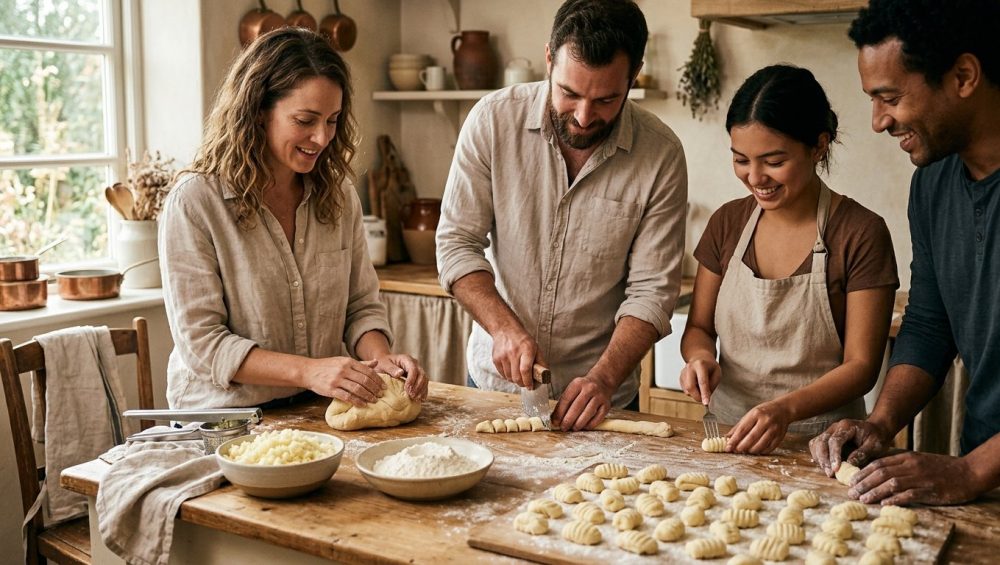
Once you have the dough mixed (which you can do right before your guests arrive, or even have them watch the chop-and-fold process), clear off your kitchen island or dining table. Set up individual stations. Give each person a small dusting of flour, a fork or gnocchi board, and a portion of the dough ropes.
Show them the rolling technique, and then let them go at it. Some of the gnocchi will be beautiful. Some will look like mangled little gremlins. It doesn’t matter. The act of working with your hands, focusing on a simple, repetitive physical task, is incredibly grounding. It forces everyone to put their phones away. It creates natural lulls in conversation, allowing for more meaningful, relaxed interactions.
Pacing the Evening
Do not rush. Have a simple charcuterie board or a crisp, acidic salad ready for people to pick at while they roll the pasta. Keep the drinks flowing. The beauty of gnocchi dough is that it is forgiving once cut. As the little dumplings pile up, simply toss them lightly in flour and arrange them in a single layer on a parchment-lined baking sheet so they don’t stick together.
By turning the meal preparation into a communal activity, you eliminate the pressure of hosting. You aren’t a frantic caterer; you are a guide leading a shared culinary experience.
The Final Frontier: Boiling, Searing, and Saucing
Your beautiful, hand-rolled gnocchi are resting on their tray. Now, we must cook them without destroying all the hard work we just put in.
The Boiling Water Drop Test
Bring a large, wide pot of water to a rolling boil. You must salt the water aggressively. It should taste like the sea. Gnocchi dough contains very little salt, so this is your only opportunity to season the interior of the dumpling.
Do not dump all the gnocchi in at once. If you overcrowd the pot, the water temperature will plummet, the starch on the outside of the gnocchi will turn to glue, and they will stick together in a massive, tragic clump. Work in batches.
Gently drop a batch of gnocchi into the water. Give them one very gentle stir with a stainless steel spider skimmer to ensure they don’t stick to the bottom. Now, watch them closely.
Gnocchi have a built-in timer. When they are cooked, they float to the surface. The second they bob to the top, give them exactly 15 to 20 seconds more, then immediately scoop them out with your skimmer. Do not let them sit in the boiling water, or they will turn to mush.
The Pan-Sear Finish (Because Texture is Everything)
You can absolutely serve your boiled gnocchi immediately, tossed in a sauce. They will be soft, delicate, and lovely. But if you want to elevate this dish to restaurant-quality perfection, you need to introduce textural contrast. You need a pan-sear.
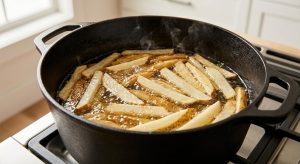
Take that heavy-bottomed stainless steel pan we talked about earlier. Place it over medium-high heat. Add a knob of good quality butter and a splash of olive oil (to prevent the butter from burning instantly).
Once the butter is foaming and starting to smell nutty, take your freshly boiled, well-drained gnocchi and drop them straight into the pan. Let them sit undisturbed for about 90 seconds. Do not shake the pan. Do not stir them. Let the Maillard reaction do its magic. When the undersides develop a deeply golden, crispy crust, toss them gently.
You now have a dumpling that is shatteringly crisp on the outside and unbelievably fluffy on the inside. It is a revelation.
Pairing the Perfect Sauce
Gnocchi are rich, filling, and heavy, even when made perfectly light. They demand a sauce that complements them without overwhelming them. Please, put down the jar of heavy, cloying, store-bought Alfredo sauce.
The classic pairing is a simple Brown Butter and Sage sauce (Burro e Salvia). As you are searing your gnocchi, drop a handful of fresh sage leaves into the bubbling butter. The leaves will crisp up, infusing the fat with an earthy, aromatic flavor. Squeeze a tiny bit of fresh lemon juice in at the very end to cut the richness, and finish with a shower of freshly grated Parmigiano-Reggiano.
If you prefer a tomato base, opt for a vibrant, acidic marinara. Use a sturdy wooden spoon to gently fold the gnocchi into the simmering sauce. Remember to save a splash of that starchy pasta water to help emulsify the sauce, allowing it to cling perfectly to the ridges you so carefully rolled into your dough.
Troubleshooting Your Gnocchi Nightmares (So You Don’t Have To)
Even with the best techniques, environmental factors like high humidity can throw a curveball into your pasta night. Here is how to diagnose and fix the most common issues without panicking.
The Dough is Too Sticky to Roll
If your dough is clinging to your hands and the board like wet cement, your potatoes likely retained too much moisture, or your kitchen is incredibly humid. Do not panic, and whatever you do, do not dump a whole cup of flour onto the board.
Dust the board very lightly. Use your bench scraper to fold the dough over the dusting. Let the dough rest for 5 minutes. Flour takes time to hydrate. Sometimes, simply walking away for a few minutes allows the flour to absorb the ambient moisture, transforming a sticky mess into a workable dough. If it is still unmanageable, add flour one tablespoon at a time, folding gently. Accept that these gnocchi might be slightly denser than ideal, but they will still be delicious.
The Gnocchi Disintegrate in the Boiling Water
This is the most heartbreaking failure. You drop your beautiful dumplings into the water, and they instantly dissolve into a cloudy potato soup.
This happens for two reasons: either you didn’t add enough flour to bind the potatoes, or you didn’t include an egg yolk, and your technique wasn’t flawless enough to pull off an eggless dough.
If your first test batch disintegrates, do not boil the rest! Take the remaining raw dough, place it back in your bowl, and gently fold in another tablespoon or two of flour, and perhaps half of a beaten egg yolk. Re-roll a test piece and boil it. It is better to have slightly chewy gnocchi than no gnocchi at all.
The Gnocchi Look Gray and Unappetizing
If your raw gnocchi dough starts taking on a sickly, grayish hue as it sits on the counter, it means the potatoes are oxidizing. This usually happens if you let the riced potatoes sit out for far too long before mixing the dough, or if you used an iron-reactive knife to cut them. It won’t hurt you, and the color will usually improve slightly when cooked, but it’s aesthetically displeasing. To prevent this, work efficiently once the potatoes are baked, and keep your finished, raw gnocchi covered lightly or freeze them if you aren’t cooking them within the hour.
The Final Word on Your Pasta Night
Cooking is not about perfection. It is about understanding the materials in front of you and manipulating them with care and respect. Yes, making gnocchi requires attention to detail. You have to respect the starch, fear the water, and handle the gluten with kid gloves.
But when you pull a tray of baked Russets from the oven, rice them into fluffy snow, and gently fold them into a dough alongside your friends, you are doing more than just making dinner. You are engaging in a centuries-old tradition. You are slowing down the clock. You are transforming a few humble, inexpensive ingredients into a masterpiece.
So throw out the cheap pans, buy a scale, and invite some friends over this weekend. Embrace the flour on your countertops. Your mind-blowing, pillowy-soft gnocchi await. Now get cooking.